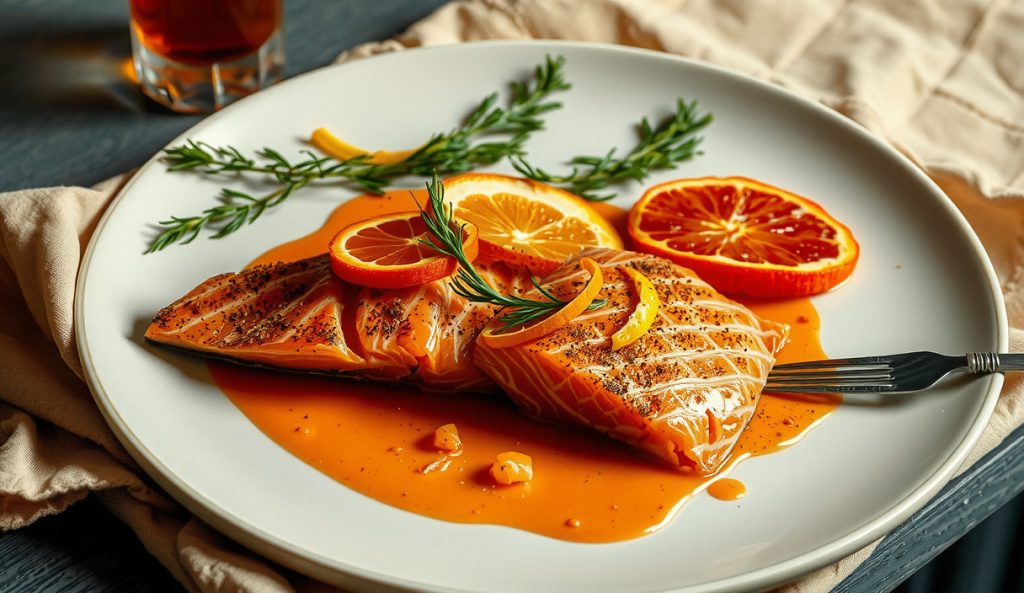
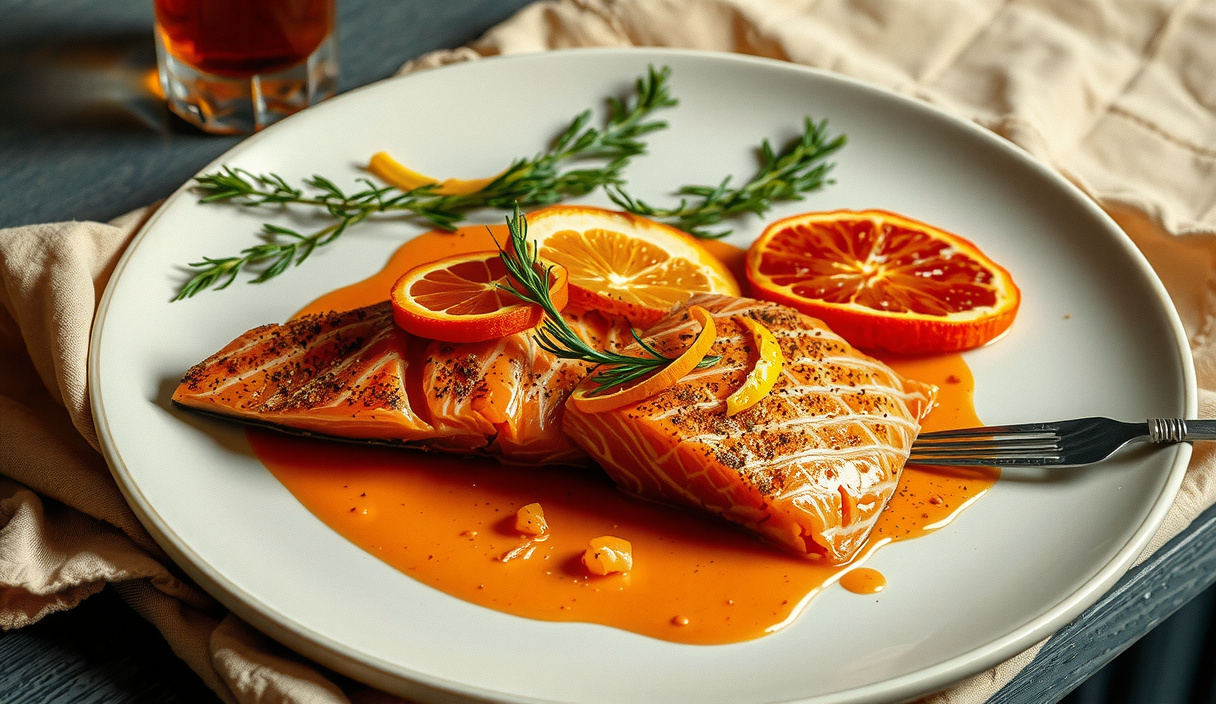
Low-Sodium Smoked Salmon with Dill-Citrus Cure

Equipment
- 1 Offset smoker, kettle grill with indirect setup, or pellet smoker Must hold a stable 160–180°F (71–82°C) chamber temperature
- 1 Digital kitchen scale Gram precision required for the 1.5% cure calculation
- 1 Probe thermometer with continuous readout Pull at exactly 140°F (60°C) internal
- 1 Wire rack set inside a rimmed baking sheet For pellicle formation in the refrigerator
- 1 Microplane zester For zesting — pith-free zest only
- 2 to 3 cups Alder wood chunks or chips Apple wood is a solid alternative; avoid hickory and mesquite
Ingredients
Salmon
- 1.5 to 2 lbs center-cut skin-on salmon fillet Pin bones removed; weigh in grams before proceeding
Half-Salt Dill-Citrus Cure
- kosher salt (Diamond Crystal), measured by weight Calculate as 0.015 x fillet weight in grams — this is your exact NaCl dose
- 2 tsp granulated sugar Accelerates Maillard surface browning and offsets any perceptible bitterness at reduced salt levels
- 1 large lemon, zested Microplane only; avoid the white pith
- 1 medium navel orange, zested Adds limonene and linalool volatiles that read as brightness
- 3 tbsp fresh dill, finely chopped Carvone and myristicin compounds; add just before applying to the fish
- 0.5 tsp white pepper, finely ground Piperine activates TRPV1 receptors and extends palate finish without sodium
Finish (optional, at service)
- 1 tbsp fresh dill fronds Garnish
- 1 tsp lemon zest Bright aromatic finish just before serving

Instructions
Cure Preparation
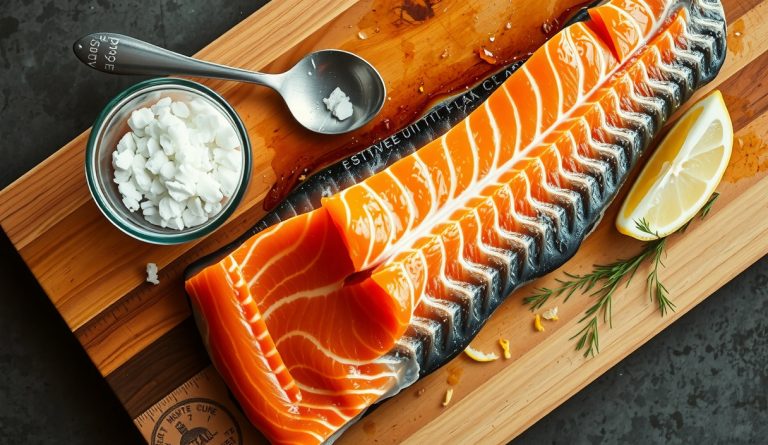
- Weigh your salmon fillet in grams on a digital kitchen scale. Multiply that weight by 0.015 to get your exact kosher salt dose in grams. Write this number down. Measure out the salt precisely by weight — do not estimate by volume.
- In a small bowl, combine the weighed kosher salt, sugar, lemon zest, and orange zest. Using your fingertips, work the zest into the salt for about 30 seconds until the mixture is fragrant and slightly damp. Let it sit for 5 minutes — this blooming step releases essential oils from the flavedo cells directly into the salt crystals, improving aromatic transfer to the fish surface.2 tsp granulated sugar, 1 large lemon, zested, 1 medium navel orange, zested
- Add the finely chopped fresh dill and white pepper to the cure blend and stir to combine.3 tbsp fresh dill, finely chopped, 0.5 tsp white pepper, finely ground
Curing the Salmon
- Place the salmon fillet skin-side down on a large sheet of plastic wrap set inside a rimmed baking dish. Apply the entire cure blend evenly over the flesh side of the fillet, pressing gently to ensure full contact across the surface. Pay extra attention to the thicker end of the fillet — the thicker sections need full coverage to cure evenly.2 tsp granulated sugar, 1 large lemon, zested, 1 medium navel orange, zested, 3 tbsp fresh dill, finely chopped, 0.5 tsp white pepper, finely ground
- Wrap the fillet tightly in the plastic wrap and refrigerate for exactly 6 hours. Do not shorten this window — the reduced salt concentration requires the full time to drive equivalent osmotic dewatering and surface protein denaturation. Flip the wrapped fillet once at the 3-hour mark.
Pellicle Formation
- Unwrap the cured salmon and rinse it thoroughly under cold running water for 60 seconds, removing all surface cure. Pat completely dry with paper towels — every bit of surface moisture you remove now is moisture the pellicle does not have to expel.
- Place the rinsed, dried fillet skin-side down on a wire rack set over a rimmed baking sheet. Refrigerate uncovered for a minimum of 1 hour, ideally 2. The pellicle is ready when the surface of the fish is tacky and slightly shiny to the touch. This dried protein film is essential for smoke adhesion — do not skip this step.
Smoking
- Set up your smoker for indirect heat and preheat to a stable 160–180°F (71–82°C) chamber temperature. Add alder wood chunks or soaked chips to produce a thin, clean blue smoke. Avoid thick white billowing smoke, which deposits harsh creosote compounds on the pellicle.
- Place the salmon fillet skin-side down directly on the smoker grate. Insert a probe thermometer into the thickest part of the fillet, center-cut, keeping the probe tip away from the skin. Close the lid and smoke without opening for the first 45 minutes.
- Continue smoking until the internal temperature reads exactly 140°F (60°C). Total time will be approximately 90–120 minutes depending on fillet thickness and smoker consistency. Do not exceed 140°F — every degree above this threshold increases the risk of actin network collapse and permanent moisture loss. Remove the fillet from the smoker the moment the target temperature is reached.
Rest and Serve
- Rest the smoked salmon on its rack at room temperature for 15 minutes, then transfer to the refrigerator uncovered for at least 1 hour before slicing. This rest period allows internal moisture to redistribute and dramatically improves slice integrity.
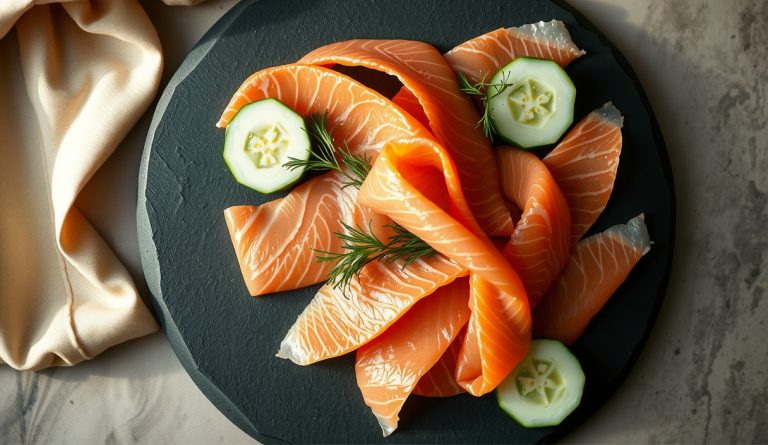
- To serve, slice thin on a bias against the grain of the myomere layers using a long, sharp slicing knife. Garnish with fresh dill fronds and a light dusting of fresh lemon zest if desired. Store leftovers refrigerated at or below 38°F (3°C) and consume within 5 days.1 tbsp fresh dill fronds, 1 tsp lemon zest
Notes
Nutrition
Most home-smoked salmon recipes call for a 3% sodium chloride cure by weight — the traditional ratio that denatures surface proteins fast, yanks free water out of the flesh via osmosis, and deposits enough salt to carry the flavor all the way through a smoke session. The result is beautiful. It is also, depending on portion size, a meaningful sodium delivery vehicle. A single 3-ounce serving of standard smoked salmon can clock in above 600 mg of sodium before you have touched a cracker or a schmear of anything. For anyone managing hypertension, post-cardiac-event dietary guidelines, or simply tracking intake with intention, that math becomes inconvenient fast.
This recipe solves the problem at the physics level, not the flavor level. The cure drops to 1.5% w/w — exactly half the standard dose — and the cure window extends from the typical 2-to-3-hour express cure out to a full 6 hours. Osmosis does not care how impatient you are; it operates on concentration gradient and contact time. Given enough time at a lower salt concentration, the driving force for water migration out of the muscle and into the brine is sustained, the pellicle forms correctly, and the surface proteins cross-link adequately to accept smoke. The result is comparable moisture removal at roughly half the sodium input. The flavor gap left by the missing salt is closed by a precision aromatic system: fresh dill, lemon and orange zest, and a small amount of white pepper that activates TRPV1 at the back of the palate rather than requiring salt to carry heat. The finished fillet reads bright, complex, and deeply savory — not flat, not diet-food, not a compromise.
Why does low-sodium smoked salmon work? The science
Low-sodium smoked salmon works because osmotic dewatering is governed by contact time as much as by concentration. Salt curing salmon is fundamentally an osmotic dewatering operation. When NaCl dissolves into the water surrounding or coating the fish, it creates a concentration gradient across the semi-permeable cell membranes of the myofibrillar tissue. Water migrates outward down that gradient — a process governed by the van ‘t Hoff relationship, where osmotic pressure scales linearly with molar solute concentration. At a standard 3% w/w cure, this gradient is steep and fast; moisture loss and surface protein denaturation (specifically myosin, which begins unfolding around 104°F / 40°C even under salt-only conditions) occur quickly, forming the tacky, shiny pellicle essential for smoke adhesion. At 1.5% w/w, the gradient is shallower and slower, but given 6 hours of contact time at refrigerator temperature (34–38°F / 1–3°C), the cumulative osmotic work is equivalent. The extended time also allows volatile aroma compounds from the dill and citrus zest — primarily carvone, limonene, and linalool — to partition into the surface lipid layer of the salmon, embedding aromatics that will survive the low-temperature smoke phase and remain perceptible on the palate even without the amplifying effect of a high-sodium matrix.
The smoking phase operates at 160–180°F (71–82°C) chamber temperature, targeting a final internal temperature of 140°F (60°C). At this temperature, the salmon operates in the sarcoplasmic denaturation zone (51–67°C / 124–153°F) while deliberately staying below the actin collapse threshold of 74.4°C (166°F). Actin denaturation causes violent longitudinal and transverse contraction of the actomyosin complex, catastrophically degrading the water-holding capacity of the muscle. Every degree above 140°F internal is an irreversible step toward a dry, chalky result. The extended low-sodium cure actually makes thermal management more critical, not less — because less salt means slightly less protein cross-linking at the surface, so the structural buffer against moisture expulsion is thinner. Stay disciplined on internal temp. The smoke itself contributes phenolic compounds (primarily guaiacol and syringol) that deposit on the pellicle and continue the protein cross-linking already initiated by the salt, adding both color and an additional antimicrobial surface layer.
From a flavor-physics standpoint, reducing sodium from 3% to 1.5% w/w removes sodium’s primary role as a taste-receptor modulator. Sodium ions suppress bitterness receptors on the tongue (specifically the TAS2R family) while simultaneously enhancing the signal of other tastants — a function no herb or acid can directly replicate. The compensation strategy in this recipe is triangulation: citrus zest introduces limonene and linalool volatiles that stimulate retronasal olfaction and create perceived brightness; fresh dill delivers carvone and myristicin, which combine with the fish’s own DHA-derived lipid oxidation products to produce a complex, integrated savory note; and white pepper’s piperine activates TRPV1 channels on the back palate, extending the finish duration without adding sodium. These three inputs operate on different receptor systems, and together they create a multi-dimensional flavor persistence that compensates for the sodium reduction at the sensory level without replicating its biochemistry.
What equipment and ingredients do you need?
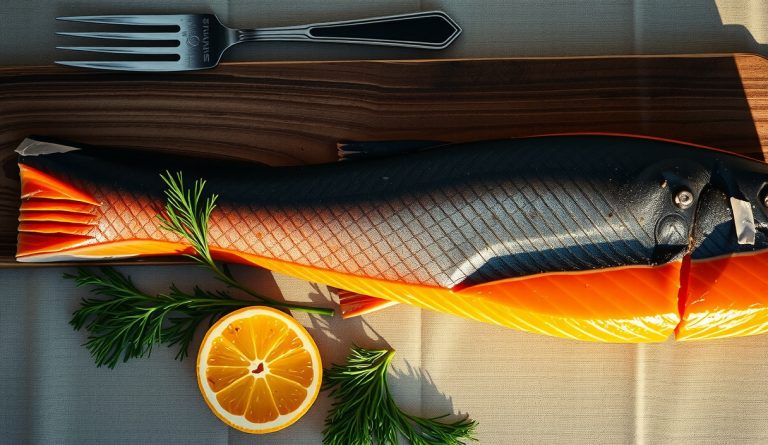
Salmon fillet: Center-cut skin-on Atlantic or king salmon, 1.5 to 2 pounds, pin bones removed. The fat content of center-cut salmon is critical here — intramuscular lipid provides the hydrophobic phase that anchors the citrus and dill aromatics during the cure and prevents the flesh from drying under the extended low-sodium contact time.
The 1.5% cure math: Weigh the fillet in grams on a kitchen scale. Multiply by 0.015. That number is the total NaCl in grams. Do not estimate this. At half-salt, precision is everything. Use Diamond Crystal kosher salt (1g per 0.3 tsp, accounting for its lower bulk density vs. Morton’s) or measure by weight regardless of brand.
Citrus zest: Microplane only. The goal is zest — the colored flavedo layer containing the essential oil sacs — not the bitter white pith beneath. Use one large lemon and one medium navel orange. Zest directly onto the cure blend so the volatile oils land on the salt crystals rather than oxidizing on the cutting board.
Smoker setup: Any offset smoker, kettle grill with indirect setup, or dedicated pellet smoker capable of holding a stable 160–180°F (71–82°C) chamber temperature. Alder wood is the canonical choice for salmon — its phenolic profile is lighter and less tannic than hickory or mesquite, which can overwhelm the delicate fat of the fish. Apple wood is a good second choice. Use chunks or chips, not logs; clean, thin blue smoke is the target, not thick white billowing output that will deposit creosote and acrid compounds on the pellicle.
Thermometer: A probe thermometer with a continuous read-out is non-negotiable. Pull the fillet at exactly 140°F (60°C) internal. This is the actin-preservation boundary.
Low-Sodium Smoked Salmon with Dill-Citrus Cure
Equipment
- 1 Offset smoker, kettle grill with indirect setup, or pellet smoker Must hold a stable 160–180°F (71–82°C) chamber temperature
- 1 Digital kitchen scale Gram precision required for the 1.5% cure calculation
- 1 Probe thermometer with continuous readout Pull at exactly 140°F (60°C) internal
- 1 Wire rack set inside a rimmed baking sheet For pellicle formation in the refrigerator
- 1 Microplane zester For zesting — pith-free zest only
- 2 to 3 cups Alder wood chunks or chips Apple wood is a solid alternative; avoid hickory and mesquite
Ingredients
Salmon
- 1.5 to 2 lbs center-cut skin-on salmon fillet Pin bones removed; weigh in grams before proceeding
Half-Salt Dill-Citrus Cure
- kosher salt (Diamond Crystal), measured by weight Calculate as 0.015 x fillet weight in grams — this is your exact NaCl dose
- 2 tsp granulated sugar Accelerates Maillard surface browning and offsets any perceptible bitterness at reduced salt levels
- 1 large lemon, zested Microplane only; avoid the white pith
- 1 medium navel orange, zested Adds limonene and linalool volatiles that read as brightness
- 3 tbsp fresh dill, finely chopped Carvone and myristicin compounds; add just before applying to the fish
- 0.5 tsp white pepper, finely ground Piperine activates TRPV1 receptors and extends palate finish without sodium
Finish (optional, at service)
- 1 tbsp fresh dill fronds Garnish
- 1 tsp lemon zest Bright aromatic finish just before serving
Instructions
Cure Preparation
- Weigh your salmon fillet in grams on a digital kitchen scale. Multiply that weight by 0.015 to get your exact kosher salt dose in grams. Write this number down. Measure out the salt precisely by weight — do not estimate by volume.
- In a small bowl, combine the weighed kosher salt, sugar, lemon zest, and orange zest. Using your fingertips, work the zest into the salt for about 30 seconds until the mixture is fragrant and slightly damp. Let it sit for 5 minutes — this blooming step releases essential oils from the flavedo cells directly into the salt crystals, improving aromatic transfer to the fish surface.2 tsp granulated sugar, 1 large lemon, zested, 1 medium navel orange, zested
- Add the finely chopped fresh dill and white pepper to the cure blend and stir to combine.3 tbsp fresh dill, finely chopped, 0.5 tsp white pepper, finely ground
Curing the Salmon
- Place the salmon fillet skin-side down on a large sheet of plastic wrap set inside a rimmed baking dish. Apply the entire cure blend evenly over the flesh side of the fillet, pressing gently to ensure full contact across the surface. Pay extra attention to the thicker end of the fillet — the thicker sections need full coverage to cure evenly.2 tsp granulated sugar, 1 large lemon, zested, 1 medium navel orange, zested, 3 tbsp fresh dill, finely chopped, 0.5 tsp white pepper, finely ground
- Wrap the fillet tightly in the plastic wrap and refrigerate for exactly 6 hours. Do not shorten this window — the reduced salt concentration requires the full time to drive equivalent osmotic dewatering and surface protein denaturation. Flip the wrapped fillet once at the 3-hour mark.
Pellicle Formation
- Unwrap the cured salmon and rinse it thoroughly under cold running water for 60 seconds, removing all surface cure. Pat completely dry with paper towels — every bit of surface moisture you remove now is moisture the pellicle does not have to expel.
- Place the rinsed, dried fillet skin-side down on a wire rack set over a rimmed baking sheet. Refrigerate uncovered for a minimum of 1 hour, ideally 2. The pellicle is ready when the surface of the fish is tacky and slightly shiny to the touch. This dried protein film is essential for smoke adhesion — do not skip this step.
Smoking
- Set up your smoker for indirect heat and preheat to a stable 160–180°F (71–82°C) chamber temperature. Add alder wood chunks or soaked chips to produce a thin, clean blue smoke. Avoid thick white billowing smoke, which deposits harsh creosote compounds on the pellicle.
- Place the salmon fillet skin-side down directly on the smoker grate. Insert a probe thermometer into the thickest part of the fillet, center-cut, keeping the probe tip away from the skin. Close the lid and smoke without opening for the first 45 minutes.
- Continue smoking until the internal temperature reads exactly 140°F (60°C). Total time will be approximately 90–120 minutes depending on fillet thickness and smoker consistency. Do not exceed 140°F — every degree above this threshold increases the risk of actin network collapse and permanent moisture loss. Remove the fillet from the smoker the moment the target temperature is reached.
Rest and Serve
- Rest the smoked salmon on its rack at room temperature for 15 minutes, then transfer to the refrigerator uncovered for at least 1 hour before slicing. This rest period allows internal moisture to redistribute and dramatically improves slice integrity.
- To serve, slice thin on a bias against the grain of the myomere layers using a long, sharp slicing knife. Garnish with fresh dill fronds and a light dusting of fresh lemon zest if desired. Store leftovers refrigerated at or below 38°F (3°C) and consume within 5 days.1 tbsp fresh dill fronds, 1 tsp lemon zest
Notes
Nutrition
How do you nail low-sodium smoked salmon every time?
- Weigh, never measure by volume. The entire sodium reduction system depends on hitting 1.5% w/w NaCl exactly. A gram scale removes all guesswork. Off by even 0.5% and you either under-cure (pellicle fails, smoke won’t adhere properly) or over-cure (you’ve drifted back toward the sodium levels you were trying to avoid).
- The pellicle is not optional. After the 6-hour cure, rinse the fillet thoroughly under cold running water — all surface cure must come off — then pat completely dry and rest uncovered on a wire rack in the refrigerator for a minimum of 1 hour, ideally 2. The pellicle is a dried, tacky protein film. Without it, smoke droplets bead off rather than bonding, you get uneven color, and phenolic deposition is poor. If you see a glossy, slightly sticky surface sheen before the salmon goes on the smoker, it is ready.
- Keep chamber temperature below 185°F (85°C). Above this threshold, you risk pushing the internal temperature through the 74.4°C / 166°F actin-collapse ceiling before the smoke has time to deposit. Low and slow is a physical mandate here, not a stylistic preference.
- Do not skip the citrus-oil blooming step. Combining the zest with the kosher salt and allowing the mixture to sit for 5 minutes before applying to the fish releases the essential oils from the flavedo cells and distributes them into the salt crystals, creating a contact surface that transfers aromatics directly into the surface protein layer rather than sitting on top.
- Rest before slicing. After the salmon comes off the smoker, rest it uncovered at room temperature for 15 minutes, then refrigerate for at least 1 hour before slicing. The internal moisture redistribution during this window dramatically improves slice integrity and prevents the fish from tearing along the myomere separations.
- Check for doneness visually as backup. Properly smoked salmon at 140°F internal will show a firm but yielding texture, a fully opaque cross-section, and an amber-mahogany exterior. If the center looks translucent, the salmon needs more time regardless of what the probe says — probe placement in thin fillets can be deceptive.
What variations can you make on this recipe?
Potassium chloride partial swap: For aggressive sodium reduction beyond the half-salt cure, up to 25% of the NaCl can be replaced with food-grade potassium chloride (KCl). KCl activates the same ionic conductance pathways in the taste system as NaCl and provides a nearly identical osmotic driving force for dewatering. Above 25–30% substitution, bitterness from K+ ions becomes perceptible on the back palate for most tasters. When using a KCl partial swap, reduce the total cure contact time by 30 minutes, as KCl diffuses slightly faster through muscle tissue than NaCl. Note that some individuals on ACE inhibitors or ARBs should consult a physician before increasing dietary potassium significantly.
Cold-smoked variant: True cold-smoking operates below 90°F (32°C) chamber temperature, meaning the fish is never thermally cooked — it is salt-cured and smoke-cured simultaneously. This yields the silky, translucent texture of classic lox-style smoked salmon. At 1.5% w/w, cold-smoking requires extending the cure to 10–12 hours minimum to achieve adequate surface denaturation and antimicrobial activity. FDA guidelines for cold-smoked fish specify validated process parameters; for home production intended for immediate consumption, ensure the source salmon is sushi-grade or has been commercially frozen to FDA parasite-destruction standards (−4°F / −20°C for 7 days) before cold-smoking without a cooking step.
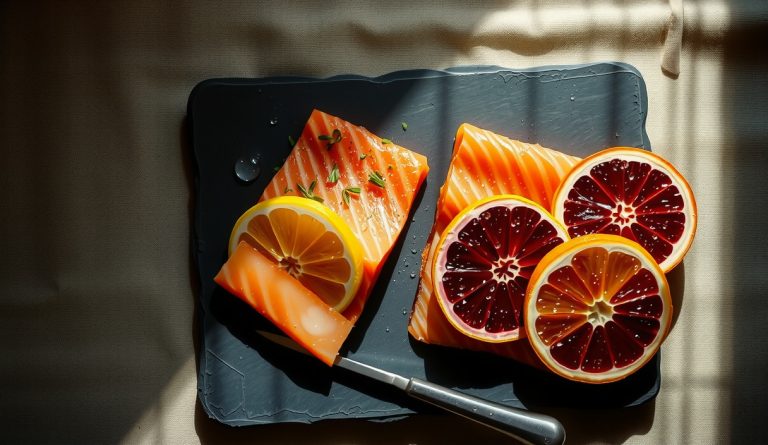
Herb substitutions: The dill-citrus aromatic framework can be rotated seasonally. Tarragon (estragole + ocimene) and Meyer lemon zest works beautifully in winter. Fresh fennel frond (anethole) with blood orange zest is a strong Sicilian-inspired variant. In each case, the aromatic compounds should be paired with the salt in the cure blend and allowed to bloom for 5 minutes before application so the essential oils transfer efficiently rather than sitting as an inert surface layer.
Scaling for larger fillets: The 1.5% w/w cure scales linearly by weight with no adjustment required to cure time for fillets up to 3 pounds. Above 3 pounds on a whole side, consider scoring the skin every 2 inches at a shallow angle to improve osmotic penetration from the skin side and ensure even pellicle formation across the full surface.
Frequently asked questions
Why does my smoked salmon come out dry and flaky instead of moist and yielding? The cause is almost certainly an internal temperature overshoot. Once internal temp crosses 74.4°C (166°F), the actin network in the myofibrillar tissue undergoes irreversible collapse, destroying water-holding capacity. At the half-salt cure level, there is slightly less protective protein cross-linking at the surface, so the salmon is marginally more sensitive to thermal abuse than a standard-salt cure. Pull at exactly 140°F (60°C) and rest before slicing. If the probe reads 140°F but the fish is still dry, verify probe calibration in an ice bath (32°F / 0°C) and recheck placement — center of the thickest part of the fillet, not near the thin tail end.
Can I use table salt instead of kosher salt? Yes, but adjust by weight, not volume. Table salt has a much higher bulk density than Diamond Crystal kosher salt — the same volume of table salt contains nearly twice the sodium. Because this recipe is calibrated in grams (1.5% of fillet weight), using a scale makes the distinction in crystal structure irrelevant. The only meaningful functional difference is that finer table salt dissolves faster and may produce slightly more aggressive initial surface denaturation — not a problem at the cure ratios used here.
How long does low-sodium smoked salmon keep, and is it safe? The half-salt cure reduces the antimicrobial activity of the finished product compared to standard smoked salmon. Refrigerate at or below 38°F (3°C) and consume within 5 days of smoking. Do not vacuum-seal and hold at ambient temperature — without the full-salt cure, the Clostridium botulinum risk in reduced-oxygen packaging increases meaningfully. For longer storage, freeze immediately after the rest period and consume within 3 months. Defrost in the refrigerator, never at room temperature.