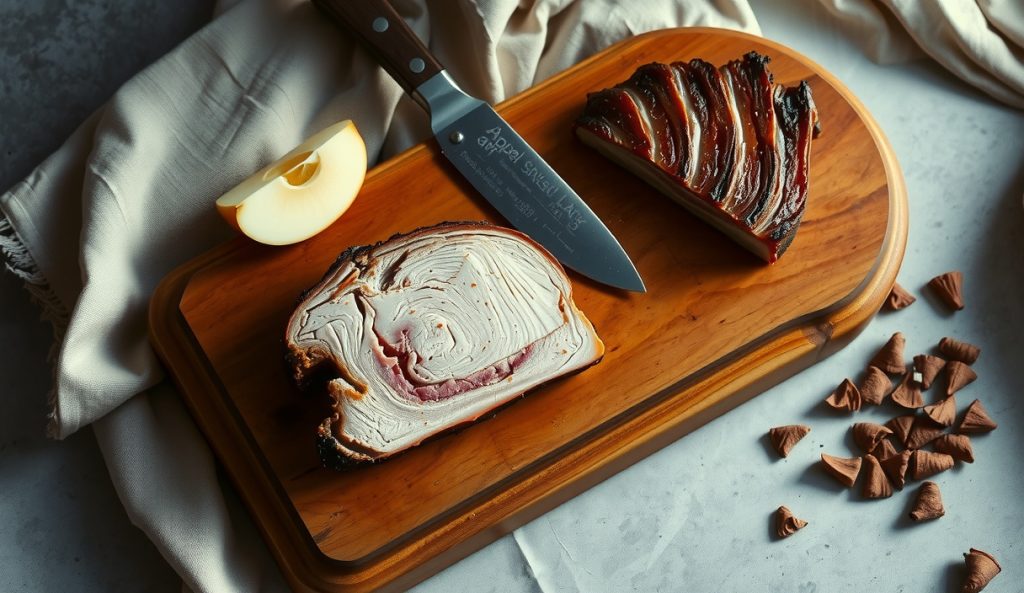
Buckboard bacon — also called cottage bacon in parts of Canada and Britain — uses pork shoulder rather than belly. The result is a fundamentally different product: less fat, tighter grain, and a chew that is closer to a cured ham steak than a traditional rasher. For cooks who want the cure and smoke experience of home-cured bacon without the richness of a belly, or who find belly cost-prohibitive, the shoulder is a compelling and historically validated substitute.
What changes when you switch from belly to shoulder?
Substitute a bone-in or boneless Boston butt or pork shoulder for the pork belly. Because pork shoulder is composed of denser, tighter muscle bundles with significantly less intramuscular fat channels than belly, the cure brine migrates more slowly through the tissue. At a 3-inch cross-section, a belly achieves equilibrium cure in 5–7 days; the same geometry in shoulder requires a minimum of 10 days to ensure nitrite penetration reaches the geometric center.
Under-cured shoulder at the core presents both a safety and a quality failure — the center will be gray and bland rather than pink and cured. Use a consistent 1.75–2% total salt w/w of the meat weight and do not shorten the cure duration regardless of visual cues on the surface.
For smoke, applewood is the preferred choice for buckboard bacon. The leaner shoulder profile means smoke compounds are absorbed onto a higher ratio of protein surface relative to fat. Heavier woods — hickory, mesquite, or oak at extended durations — can overwhelm the meat-forward character of buckboard. Applewood’s fruity, mild phenolic output complements without masking the clean pork flavor that makes this cut distinctive.
What stays exactly the same from the belly bacon method?
The Prague Powder No. 1 percentage-by-weight calculation, the pellicle formation step, the cold-smoke temperature ceiling, and all refrigeration and slicing protocols carry over without modification. The fundamental two-stage model — cure, then cold smoke, then hot cook at the point of service — remains identical for buckboard bacon.
When is buckboard bacon the better choice over belly?
Buckboard bacon is the better choice when cooking for guests who find traditional belly bacon too rich, when pork belly is unavailable or priced high at your butcher, or when you want thick-cut slabs that hold their shape on a plate or in a sandwich without curling. Buckboard bacon is also the traditional preparation for anyone replicating Canadian back-bacon style textures using more accessible shoulder cuts.
Use the full method, equipment, and cure ratio calculations from the original Cold-Smoked Cured Bacon — Home-Cured, extending cure duration to 10 days minimum for shoulder cuts at 3-inch depth.