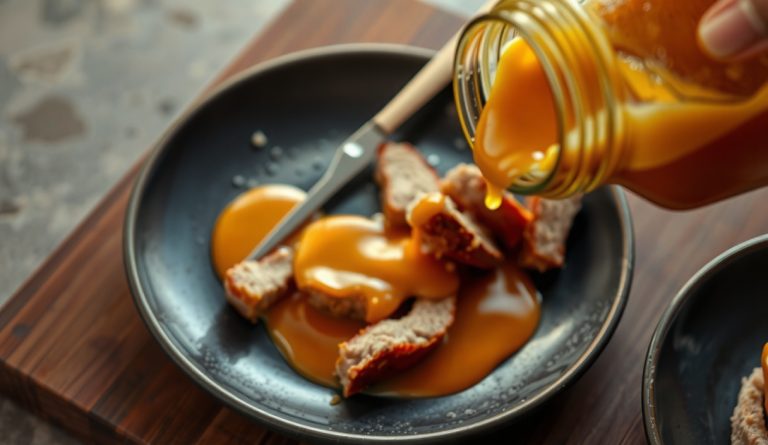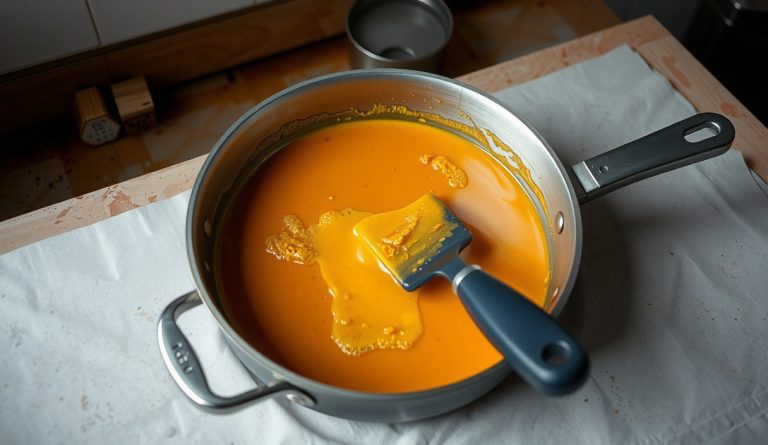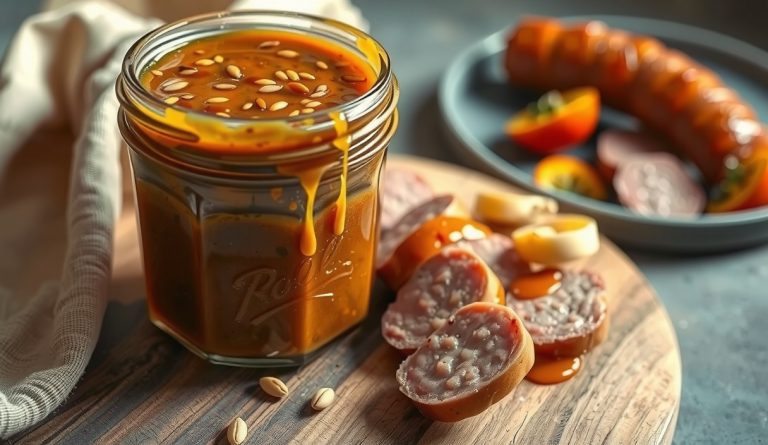
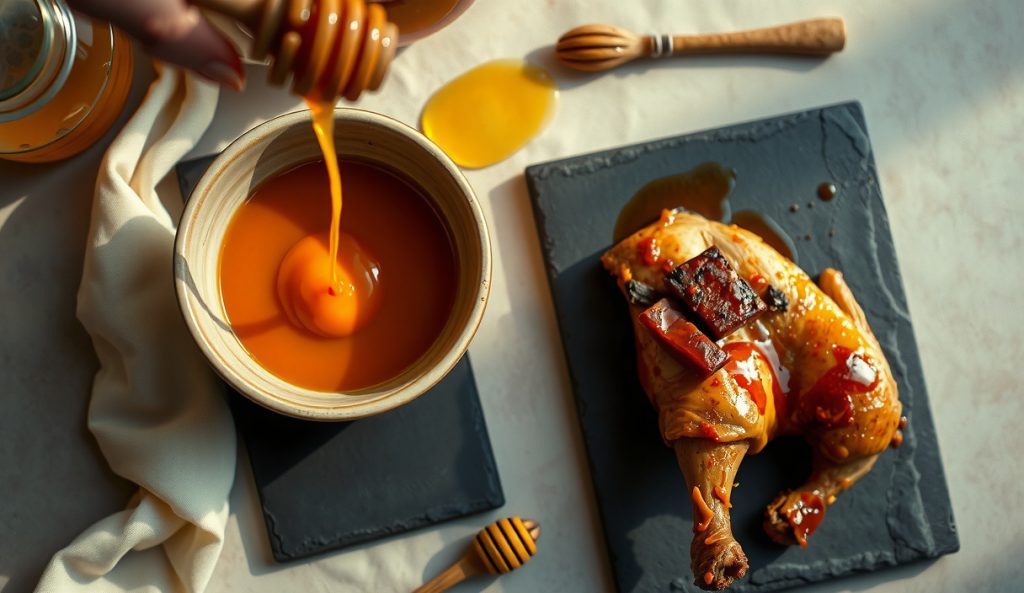
The Honey-Gold variant of Carolina Mustard BBQ Sauce replaces up to half the brown sugar with raw wildflower honey, stirred in off-heat after the reduction is complete. The result is a sauce with deeper aromatic complexity — floral, slightly perfumed, and noticeably more nuanced than the straight-sugar original. The Honey-Gold build is the right choice when the protein is delicate enough to let the sauce lead: smoked chicken thighs, grilled pork tenderloin, and glazed pork chops all benefit from the shift.
What changes when you swap in honey — and why does it matter?
Honey must be added off-heat, not during the simmer, because heat above roughly 55 °C (130 °F) denatures glucose oxidase — an enzyme naturally present in honey that, once the sauce cools and contacts moisture on a food surface, catalyzes the oxidation of glucose to gluconic acid and hydrogen peroxide. That enzymatic activity contributes a subtle antimicrobial character and a faint back-tartness that disappears entirely if the honey enters the active reduction.
The fructose-to-glucose ratio in wildflower honey runs approximately 1:1, which delivers a slightly higher perceived sweetness at equivalent gram weight compared to sucrose-dominant brown sugar. Start at one-quarter substitution and increase to half only if a more pronounced honey character is the goal — going straight to 50% on the first batch can tip the sauce sweeter than intended.
The floral monoterpene aromatics in raw wildflower honey — linalool and geraniol chief among them — are volatile and fragile. Stirring honey into the sauce off-heat locks in that perfumed finish rather than boiling it off during the reduction. This is the single most important technique difference between the Honey-Gold variant and the standard build.
What stays exactly the same in the Honey-Gold variant?
The mustard base, apple cider vinegar ratio, Worcestershire, and all dry spice quantities remain identical to the canonical recipe. The reduction process, timing, and target consistency do not change. Honey’s water content — roughly 17–20% by weight — is close enough to brown sugar’s moisture contribution that the final body of the sauce is unaffected at a half-substitution level, so no compensatory adjustments to simmer time are needed.
When is the Honey-Gold variant the better choice?
Choose the Honey-Gold build when serving proteins with subtle, clean smoke — spatchcocked chicken, pork tenderloin, or smoked turkey breast — where the standard version’s molasses-forward brown sugar can overpower the meat. The floral character of wildflower honey complements mild smoke without competing with it, keeping the sauce in a supporting role rather than dominating the plate.
The Honey-Gold variant also excels as a finishing glaze applied in the last five minutes of cook time. Applied late, the sugars caramelize quickly over direct or radiant heat while the floral top-notes remain perceptible — a window that closes if the glaze is applied early and exposed to prolonged smoke and heat.
Use the full method, equipment, and base measurements from the original Carolina Mustard BBQ Sauce.