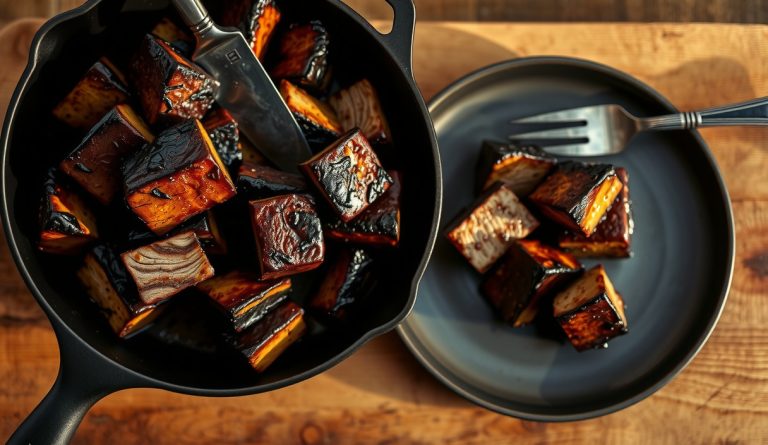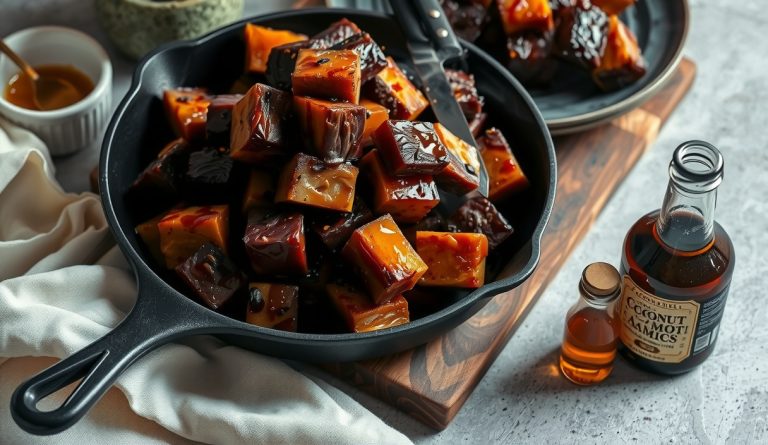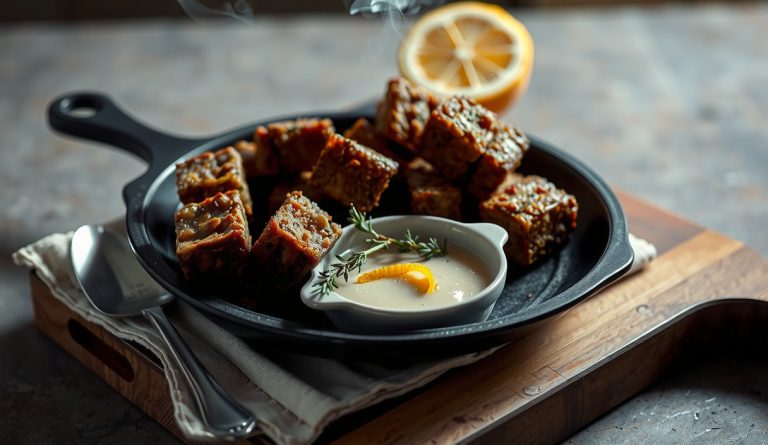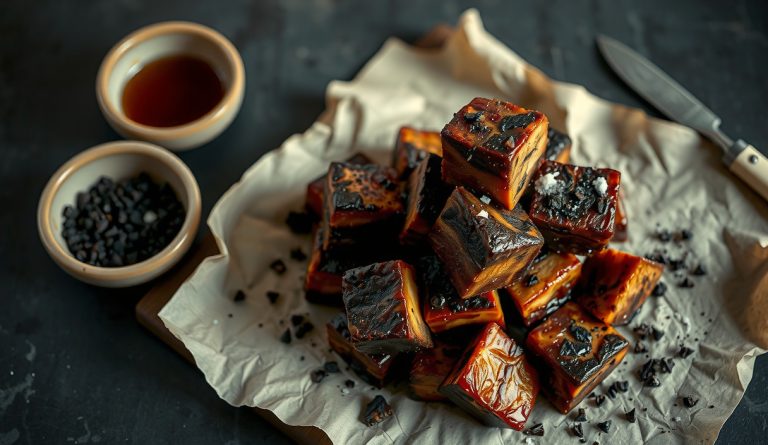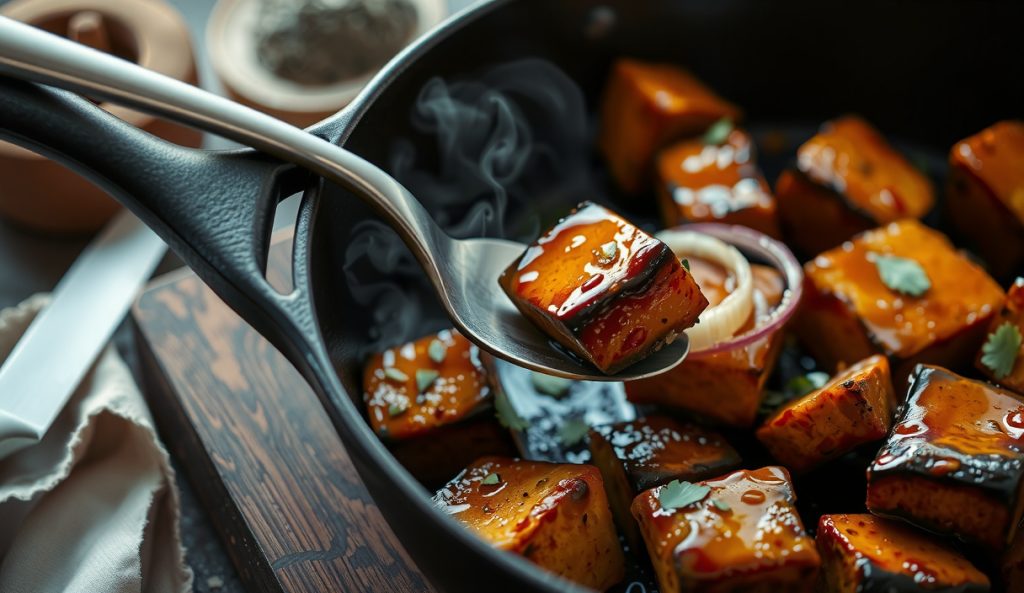
This is not a replacement for brisket point — no vegetable analog honestly is. The Kansas City Burnt Ends Vegetarian Companion is a companion plate designed for the same table, built around the same double-bark process, the same rub, and the same post-oak smoke that defines Kansas City burnt ends. The vehicle is king trumpet (Pleurotus eryngii) mushrooms — the best available proxy for this specific application.
What changes from the brisket version?
Why king trumpets are the right analog: King trumpet mushrooms have the densest, most fibrous cell-wall matrix of any widely available cultivated mushroom. Their stipe (stem) tissue is composed of tightly packed hyphae with a low initial moisture content relative to portobello or oyster mushrooms, which means king trumpets shed water slowly under heat rather than collapsing into a soggy mass. Cut the thick stems into 1.5-inch cubes — matching the canonical cube size — and king trumpets hold structural integrity through a two-phase smoke cook in a way that cremini or button mushrooms cannot. The caps can be used as well, though they are more prone to dehydration; prioritize the stems.
The pre-treatment: King trumpet mushrooms contain no collagen and no intramuscular fat, so the long initial cook that drives hydrolysis in brisket would simply desiccate them. Instead, salt-brine the cubed trumpets for 30 minutes in a 2% brine by weight, then pat completely dry. The brine draws out excess free water via osmosis, pre-conditioning the surface for Maillard chemistry rather than steaming. Toss the dried cubes with the canonical rub at full concentration — mushroom cell walls have a large surface-area-to-volume ratio and absorb dry spice readily.
Phase one — initial smoke: Run the mushroom cubes in a cast-iron skillet or on a wire rack at 225°F for 60–75 minutes with post-oak smoke. This is the primary smoke-deposition window: the moist surface accepts phenols, guaiacol, and syringol just as brisket surface does, and the lower initial temperature keeps evaporation slow enough to allow genuine smoke absorption rather than surface flash-drying. The first rind — a drier, spiced, lightly browned exterior — begins to form during this phase.
Phase two — sauce and return: Toss the smoked cubes in the canonical KC glaze sauce, nestle them in a cast-iron pan with two tablespoons of unsalted butter (or good olive oil for a fully vegan preparation), cover, and return to the smoker at 275°F for 20 minutes covered, then uncover for 20–30 minutes. The covered phase re-hydrates the surface with sauce; the butter provides the fat-soluble flavor vehicle that tallow provides for brisket. The uncovered phase drives the second Maillard bark on the sugar-and-spice-coated surface. Because king trumpets have no collagen to gelatinize, the sauce itself supplies the lacquered, tacky coating — reduce it aggressively in the pan.
What the mushroom companion honestly delivers: Deep smoke penetration, a genuine double-bark exterior, the KC sweet-spice flavor profile, and a dense, meaty-textured bite. What the mushroom companion does not deliver: the collagen-gelatin unctuous interior, the rendered beef-fat richness, or the smoke ring. That is an honest accounting — and the result is still a compelling plate.
What stays exactly the same as the original burnt ends?
The canonical rub formula, the KC glaze sauce, post-oak as the wood choice, the 1.5-inch cube size, the two-phase (smoke then sauce-and-return) structure, and the 275°F second-bark temperature are all carried over directly from the brisket recipe. The Maillard chemistry on a sugar-and-spice-coated surface operates identically regardless of substrate — beef point or king trumpet mushroom.
When is the vegetarian companion the better choice?
The vegetarian companion plate belongs at any table that includes vegetarians or flexitarians. Served alongside the brisket burnt ends — not instead of them — it lets every guest participate in the same smoke-and-sauce ritual. The mushroom version is also the right call when you want a fast companion dish: king trumpet burnt ends come off the smoker in under two hours while the brisket runs its full timeline.
The full sauce formula, rub ratios, and wood guidance are at the original Kansas City Burnt Ends recipe — use them unchanged for both the brisket and the mushroom companion.