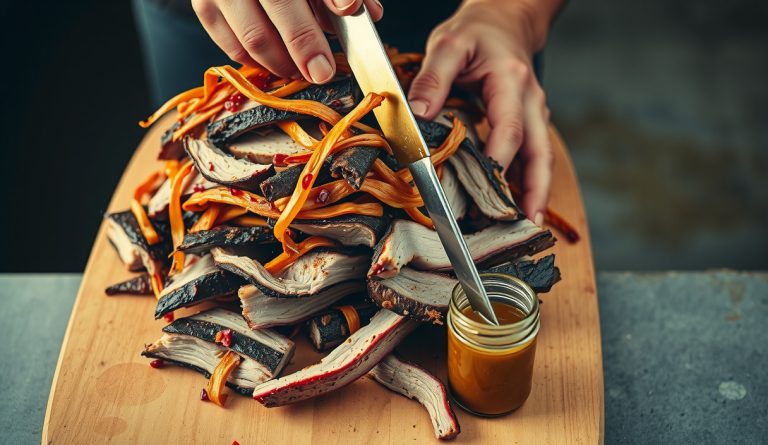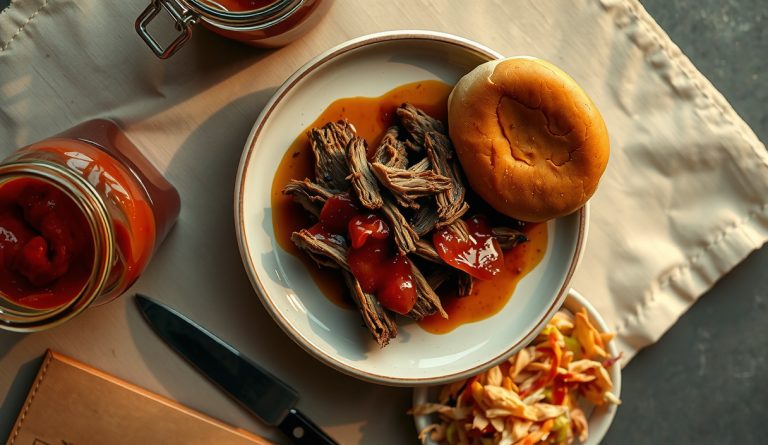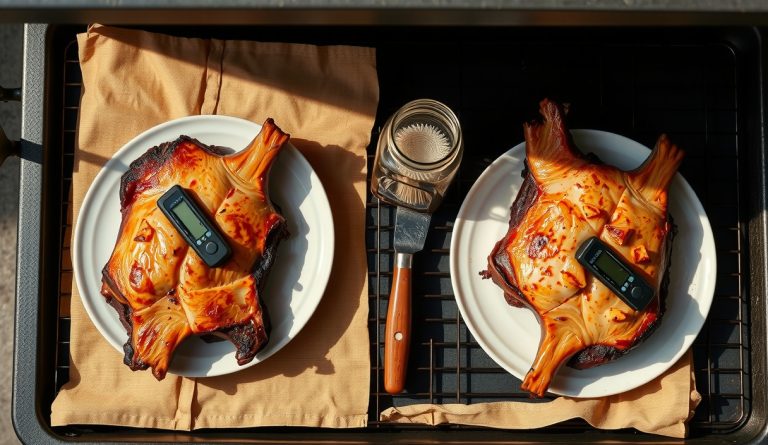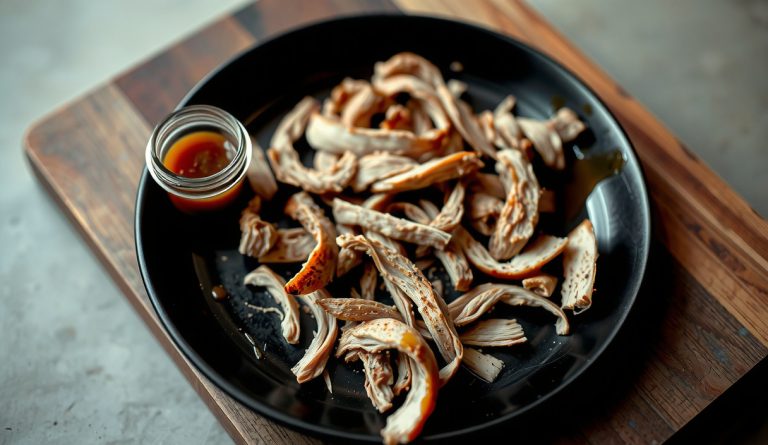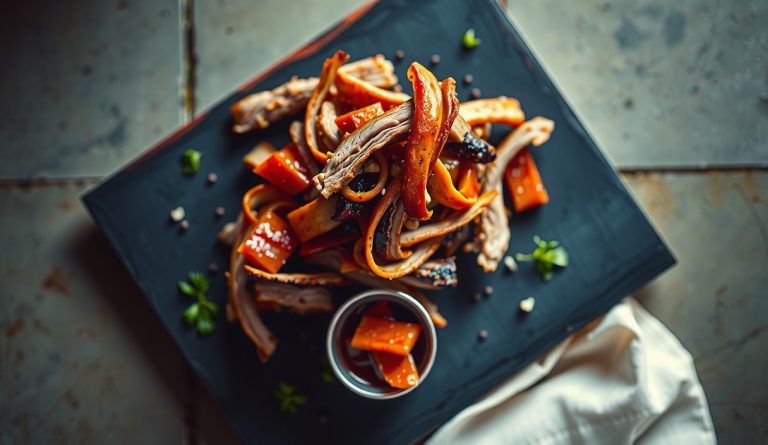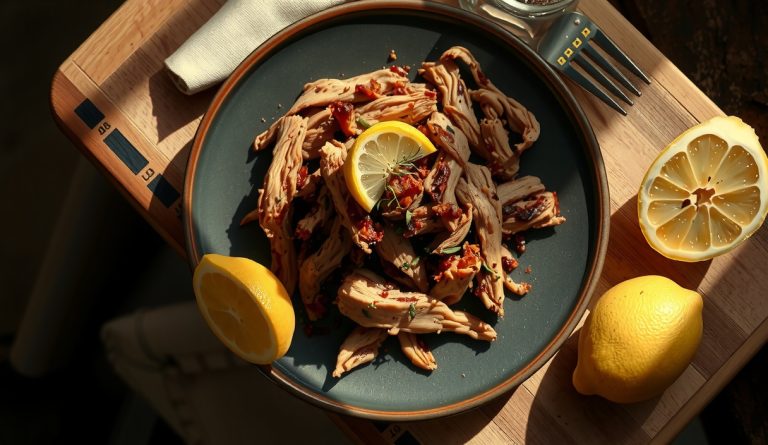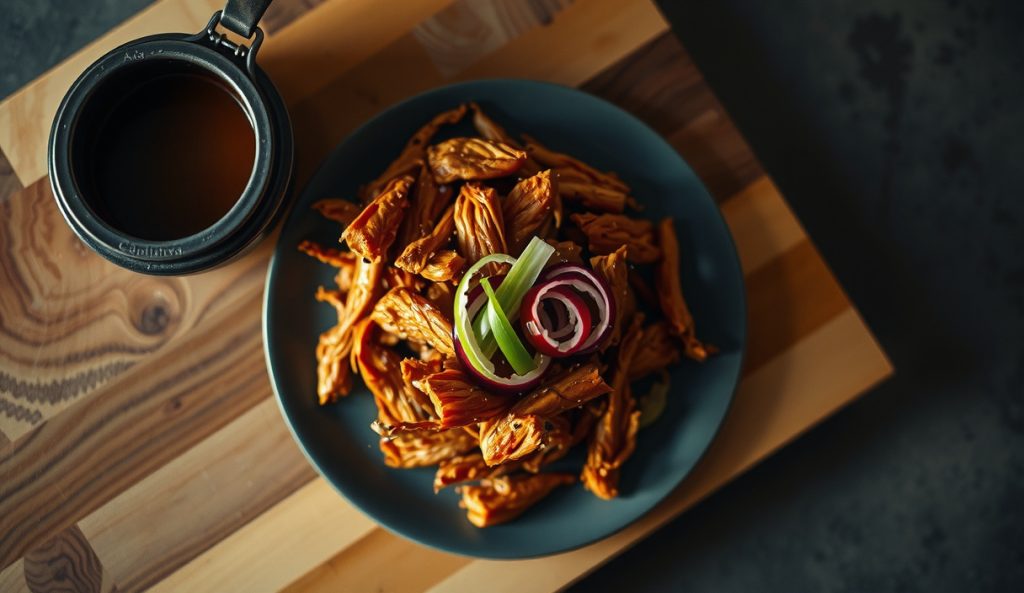
This dish is not a replacement for pulled pork. It is a companion for the same table — built for guests who do not eat meat but deserve something more considered than a hastily dressed salad beside a platter of Carolina pork. Smoked young green jackfruit, pulled and mopped with the canonical Eastern NC vinegar sauce, occupies the same serving position: it goes in the same roll, takes the same slaw, and drinks from the same bottle of ACV mop. What jackfruit does not do is replicate the collagen-gelatin mouthfeel or the intramuscular fat render of a Boston butt. Honesty about that gap is what makes this companion genuinely good rather than perpetually apologetic.
What changes when you swap pork for jackfruit?
The analog — young green jackfruit: Canned young green jackfruit in brine (not syrup) is the correct choice. Jackfruit’s cell wall structure is predominantly pectin and hemicellulose arranged in fibrous bundles that, when pulled along the grain after smoking, produce strands visually and texturally close to coarse-pulled pork. Jackfruit contains no myofibrillar proteins or collagen, so the shredding mechanism is purely mechanical rather than biochemical. Drain and rinse the canned jackfruit thoroughly to remove the brine’s sodium and the vegetal tin note, then pat completely dry — surface moisture is the enemy of both bark formation and smoke uptake.
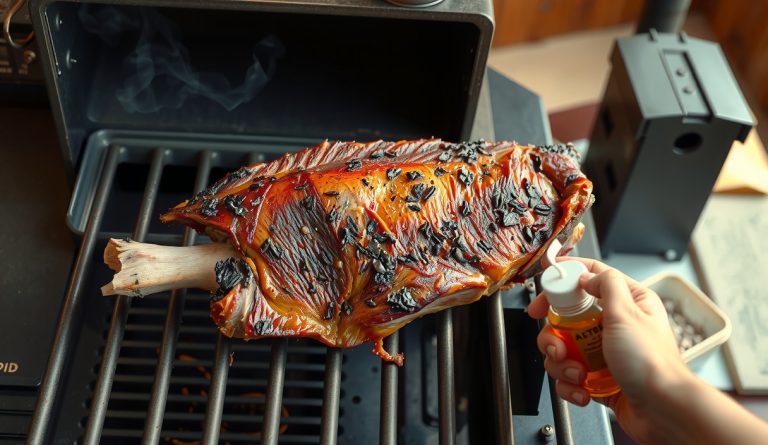
Smoke uptake mechanics: Jackfruit’s water activity is higher than raw pork surface, and its pectin matrix is more hydrophilic than myofibrillar protein. Smoke compounds — guaiacol, syringol, and phenolic volatiles from oak and hickory — partition more aggressively into jackfruit’s surface moisture and can turn bitter faster than on pork. Hold chamber temperature at 225°F and limit total active smoke time to 2.5–3 hours by transitioning to a foil-wrapped phase after that window. The foil replaces the Texas crutch role here, not butcher paper, because jackfruit never builds a true Maillard crust at the depth pork does and carries no bark-softening risk. Before foiling, apply the canonical vinegar mop twice to establish surface acidity, which shifts smoke compound partitioning toward the vapor phase and moderates bitterness by the same pH mechanism the original recipe exploits on pork.
Pre-smoke preparation and fat compensation: Toss the drained jackfruit pieces in 2 tablespoons of neutral oil — avocado or refined coconut — before applying the dry rub. Use the same salt and red pepper base from the canonical recipe. This oil coating serves the function intramuscular fat serves on the shoulder: it carries fat-soluble smoke volatile compounds and prevents the jackfruit pieces from desiccating over the cook. Spread the coated pieces on a wire rack over a foil-lined sheet pan, not directly on grates, to prevent small pieces from falling through.
Pull and mop finish: After the foil phase, open the foil and apply one final mop application, then return the jackfruit uncovered to a 300°F chamber for 15 minutes to tighten the surface. Pull the jackfruit into strands by hand or with two forks — it separates readily. Toss the pulled jackfruit in additional vinegar mop at serving; unlike pork, jackfruit carries no rendered juice of its own, so the mop is the primary source of moisture at the plate.
What stays exactly the same as the pork recipe?
The canonical rub — salt and red pepper — the 2:1 oak-to-hickory wood ratio, the ACV mop formula, and the serving context are completely unchanged. Fire management and chamber temperature hold at 225°F throughout the smoke phase. The only variable that compresses is total cook time: jackfruit finishes in approximately 3–3.5 hours total versus 12–14 hours for a Boston butt.
When is the jackfruit companion the better choice?
Any time you want one fire, one set of flavors, and one table that includes vegetarians without running a separate kitchen, this companion earns its place. The jackfruit cooks alongside the pork shoulder for the first three hours, comes off while the butt enters the stall, and hits the table at the same moment the pork finishes resting — zero additional logistical overhead.
The canonical mop formula and full fire protocol are detailed at the original recipe — use that page as your mop and smoke reference even when jackfruit is in the smoker.