Central Texas Brisket — Salt-and-Pepper Bark

Equipment
- 1 Offset smoker or ceramic kamado Capable of holding a steady 225°F for 12–16 hours. Charcoal kettle with a slow-and-sear setup also works.
- 8–12 lbs Post-oak splits or chunks Splits for stick burners, chunks for charcoal rigs. Aim for thin blue smoke throughout.
- 1 Leave-in digital probe thermometer A dual-probe unit that monitors both cook chamber temperature and brisket internal temperature simultaneously is strongly recommended.
- 1 Instant-read thermometer For confirming probe tenderness across the flat at the end of the cook.
- 1 roll Uncoated pink butcher paper Peach or pink, unwaxed, uncoated. Not parchment. Not foil.
- 1 Large insulated cooler (60 qt or larger) Preheated with boiling water for 30 minutes before the brisket goes in. This is the faux Cambro for the rest phase.
- 1 Kitchen scale Required for accurate 50/50 rub ratio by weight.
- 1 Large cutting board Minimum 24 by 18 inches to accommodate a whole packer.
- 1 Slicing knife (12-inch) Long, thin, flexible blade. A Granton edge reduces sticking on the slices.
Ingredients
The Brisket
- 1 whole packer beef brisket 12–16 lbs, USDA Choice or Prime, fat cap trimmed to a uniform 1/4 inch on the flat side
The Rub
- 85 g Diamond Crystal kosher salt Approximately 1/2 cup by volume; weigh it. If using Morton kosher salt, use 60 g — Morton is denser.
- 85 g coarsely cracked black pepper 16-mesh grind. Crack whole peppercorns in a spice grinder pulsed briefly, or use a coarse burr grinder setting. Fine-ground pepper will paste instead of bark.

Instructions
Day Before: Trim and Season
- Place the brisket fat-cap-down on a large cutting board. Remove any hard deposits of fat on the meat side (these will never render) and trim silver skin. Flip fat-cap-up and trim to a uniform 1/4 inch across the entire flat — use your fingers as a depth gauge. Thicker fat insulates against smoke; thinner fat leaves the flat exposed.
- Combine kosher salt and cracked black pepper in a bowl and mix thoroughly by weight — you are targeting exactly 50/50. Apply the rub to every exposed surface of the brisket: meat sides, fat cap, and the exposed muscle of the point. Do not be timid. You are seasoning 12 to 16 pounds of beef. Place on a wire rack set over a sheet pan, uncovered, in the refrigerator overnight (8–24 hours). The surface will dry out slightly — that is correct. A dry surface forms bark faster.85 g coarsely cracked black pepper
Fire Setup and Smoker Prep
- Two hours before you plan to put the brisket on, build your fire and stabilize your smoker at 225°F measured at grate level, not at the lid thermometer (lid thermometers run 25–40°F hot on most smokers). Add post-oak splits or chunks to maintain the fire. Adjust airflow until you see thin, pale blue or nearly invisible smoke from the stack — not white, billowing smoke, which indicates incomplete combustion and delivers bitter creosote to the bark surface.
- Pull the brisket from the refrigerator 30–45 minutes before it goes on the smoker. A cold surface is not a liability here — the longer the brisket sits in the smoke zone before the exterior heats past the evaporative threshold, the more smoke compounds can deposit on the surface — but letting it approach room temperature allows more even heating through the flat.
The Smoke (0°F–170°F Internal)
- Place the brisket fat-cap-up on the smoker grate, with the point end (the thicker, fattier end) oriented toward the heat source if your smoker has a firebox on one side. Insert your leave-in probe into the thickest part of the flat — avoiding the seam of fat between flat and point — and close the smoker. Do not open it for the first 3 hours.
- Maintain 225°F at grate level by managing airflow and adding fuel as needed. Feed post-oak to sustain thin blue smoke. Do not spray or mop the brisket during the first half of the cook — every time you open the smoker lid, you drop the cook-chamber temperature and extend the cook by 15–20 minutes, and surface moisture applied too early prevents bark from setting.
- The brisket will enter the stall between 155°F and 170°F internal — likely between hours 5 and 8. The internal temperature will plateau and may hold there for 2–6 hours. This is evaporative cooling, not stalled collagen hydrolysis. Do not panic. Do not increase the smoker temperature. Do not wrap yet. Let the smoke continue to build bark. The stall ends when surface moisture is depleted enough for the internal temperature to resume climbing.
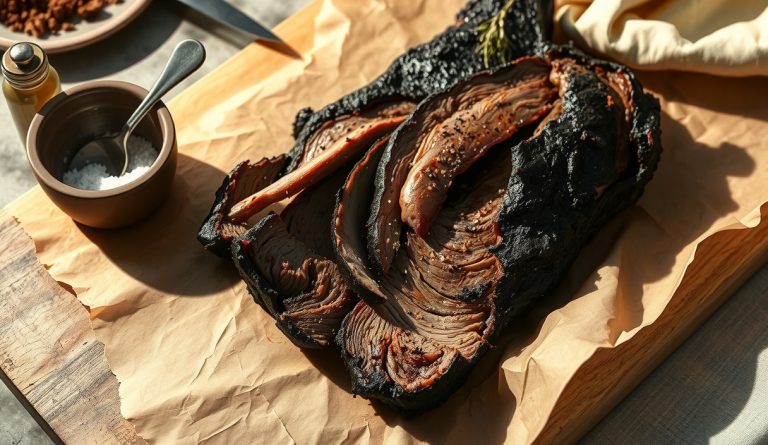
- When the internal temperature of the flat reaches 170°F, pull the brisket from the smoker for the wrap. Total elapsed time to reach this point is typically 7–10 hours at 225°F, but cook by temperature and bark color — not by the clock. The bark should be deeply mahogany, dry to the touch, and not smear when you press it. If it smears, it has not set; give it another 30 minutes and check again.
The Butcher Paper Wrap (170°F–200°F+ Internal)
- Tear off two large sheets of pink butcher paper — each sheet roughly 2.5 times the length of the brisket — and overlap them slightly in the center to create a double-width sheet. Place the brisket fat-cap-down on the paper. Fold the long sides of the paper up over the brisket, then fold the short ends under and over to create a tight, steam-resistant packet. The goal is full enclosure with no major gaps; tuck aggressively. Return the wrapped brisket to the smoker, seam-side-down to prevent the folds from opening under the weight.
- Continue cooking at 225°F. Reinsert your probe through the paper into the flat. The temperature will resume climbing noticeably faster now that evaporative cooling is arrested. Begin monitoring closely when the internal temperature reaches 195°F. At 195°F, start probe-testing the flat every 15 minutes using a skewer or instant-read probe — push it through the paper into the thickest part of the flat and assess the resistance. You are looking for zero resistance, like pushing into room-temperature butter. For most whole packers, this occurs between 200°F and 205°F internal, but texture is the real target. Total time from wrap to pull is typically 2–4 hours.
The Rest (The Faux Cambro)
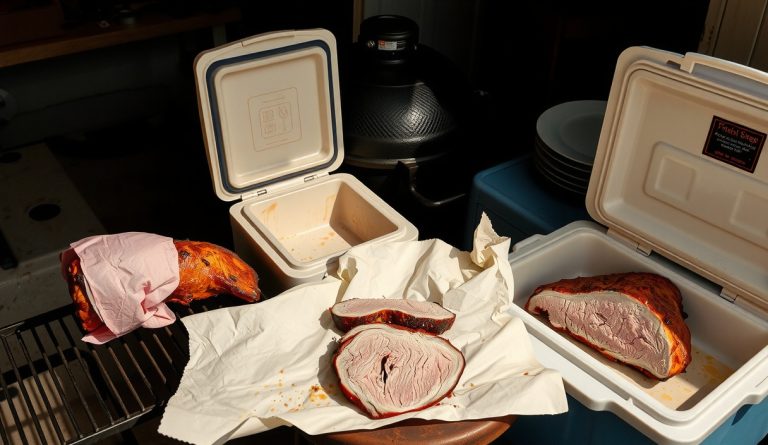
- Thirty minutes before you expect the brisket to be done, fill a large insulated cooler with boiling water and close the lid. Let it preheat for at least 30 minutes. Drain the water and dry the interior with towels. Line the bottom and sides with old towels or a folded blanket.
- When the brisket passes the probe-tenderness test, pull it from the smoker. Do not unwrap it. Place the fully wrapped brisket into the preheated cooler, fat-cap-up. Pack additional towels around and on top of the brisket to fill any air gaps. Close the lid tightly. Let the brisket rest for a minimum of 2 hours — 3 to 4 hours is better. During this rest, the internal temperature gradient between the thick point and the thinner flat equalizes, and the denatured protein matrix partially reabsorbs expelled moisture as the thermal energy redistributes. A properly rested brisket will still be above 140°F internal when you open the cooler, which is food-safe for service.
Slicing and Serving
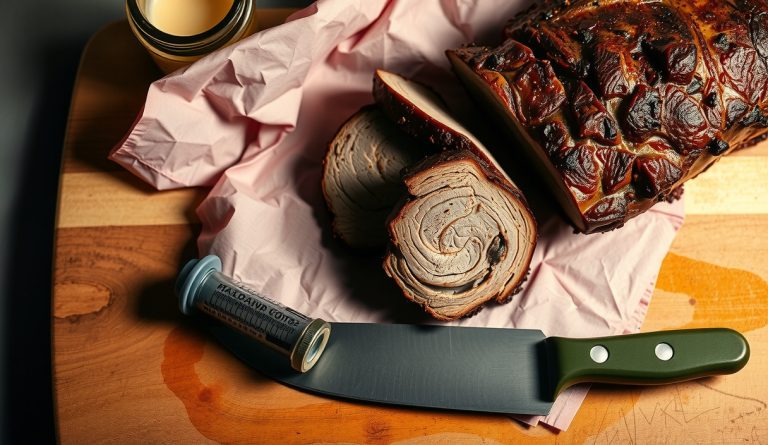
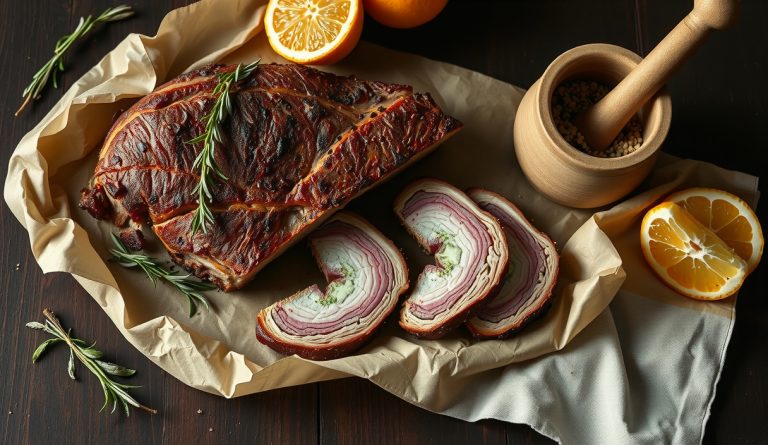
- Transfer the brisket to your large cutting board and unwrap it over the board — save any accumulated juices in the paper and pour them over the sliced meat. The bark will have re-firmed during the rest. Locate the seam of fat running between the flat and the point; separate the two muscles by cutting along this seam with your slicing knife. Set the point aside.
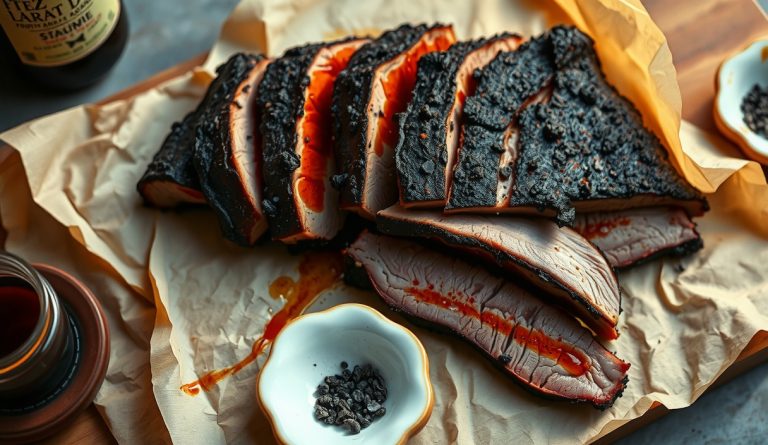
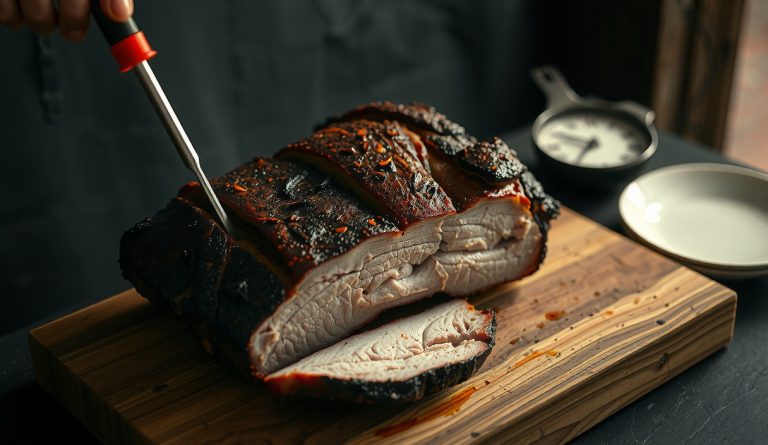
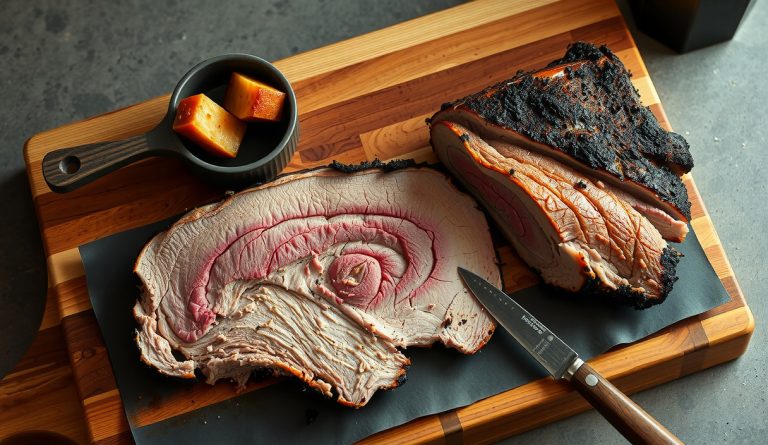
- Identify the grain direction of the flat — the muscle fibers run lengthwise. Slice across the grain (perpendicular to the fibers) at approximately 3/8 inch thickness. If slices are longer than eight inches, they will bend and break; this is correct texture for a properly cooked flat. If they crumble, you either overcooked or underrested. Now address the point: its grain runs in a slightly different direction than the flat — rotate the point so you are cutting perpendicular to its grain as well. Slice the point at the same 3/8 inch thickness, or cube it for burnt ends (see Variations). Serve immediately. Brisket does not wait well on a cutting board — cover lightly with butcher paper if service is staggered.
Notes
Nutrition
There is no recipe on this site I take more seriously than Central Texas brisket. Not because it is complicated — the ingredient list is two items — but because every variable matters and failure is not recoverable. You cannot un-dry a brisket. You cannot rebuild bark that steamed off inside a foil wrap. Twelve to sixteen hours of post-oak smoke deserves twelve to sixteen hours of intellectual honesty about what is actually happening inside that packer.
This recipe is built around a whole packer — flat and point together, untrimmed fat cap intact — smoked at 225°F over post-oak with nothing but kosher salt and coarsely cracked black pepper at a 50/50 ratio by weight. The wrap happens at 170°F internal, not by the clock. The rest runs two hours minimum in a preheated cooler. Every one of those decisions is load-bearing. Here is why.
Why does Central Texas brisket work? The science
Central Texas brisket achieves its butter-soft texture through collagen hydrolysis kinetics run to completion — not mystique, not magic. Brisket is a composite biomaterial composed of myofibrillar proteins (myosin and actin), a dense connective tissue lattice of collagen, and a substantial intramuscular fat fraction. At 225°F, the brisket progresses through a sequential series of irreversible phase transitions. Myosin begins denaturing around 130°F and is substantially complete by 145°F — the window where the brisket first loses its raw character and takes on a slightly firm bite.
Sarcoplasmic proteins and early collagen shrinkage follow between 140°F and 165°F. During this phase, the connective matrix physically contracts, beginning to expel intramuscular fluid and generating the mechanical chewiness that makes an under-cooked brisket unpleasantly tough rather than pleasantly gelatinous. This is a predictable, physics-driven sequence — not a variable you can negotiate with by adjusting the clock.
The stall — the plateau that parks the brisket’s internal temperature between 155°F and 170°F for two to six hours — is a pure evaporative cooling event, not a collagen-conversion event. Surface moisture evaporates at exactly the rate the smoker delivers thermal energy, anchoring the surface temperature near 212°F and preventing any net rise in core temperature. The smoker is working; physics is working against you. The correct response is patience or the butcher paper wrap, not foil. Foil traps all evaporated moisture and steam-cooks the surface, destroying bark formation. Butcher paper is semi-permeable: it arrests the evaporative drain while still allowing some vapor exchange, preserving the crust integrity built over the first seven to nine hours of smoke exposure.
Collagen hydrolysis — the actual conversion of tough cross-linked collagen into soluble, unctuous gelatin — is governed by first-order kinetics. The reaction rate accelerates exponentially above 160°F and operates meaningfully anywhere from 160°F to 205°F, but it requires sustained time at temperature. A brisket that probes tender at 200°F to 205°F internal has accumulated enough thermal time for the collagen in both the flat and the collagen-rich point to hydrolyze substantially, yielding a matrix where rendered intramuscular fat and dissolved gelatin coat every fiber. The two-hour rest in a preheated cooler is not optional: the brisket’s core drops from 203°F–205°F to the 140°F–150°F range, the internal temperature equalizes across the flat and point, and the denatured protein network reabsorbs some expelled juices as the thermal gradient relaxes — producing a clean slice rather than a shredding mess.
What equipment and ingredients do I need?
The brisket: Buy a whole packer — USDA Choice minimum, Prime if you can find it at a rational price. The flat alone will dry out before the point converts; you need both muscles together. Trim the fat cap to a uniform 1/4 inch. Anything thicker insulates against smoke penetration; anything thinner gives the flat no thermal buffer during the long cook.
The rub: 50/50 kosher salt and coarsely cracked black pepper by weight, full stop. Diamond Crystal kosher salt is the standard in Central Texas; its larger crystal size and lower sodium density per volume mean you are less likely to over-salt by feel. The pepper must be 16-mesh or cracked to a similar coarseness — fine-ground pepper will cake into a paste rather than forming a true bark crust. Mix by weight, not volume, for a repeatable result. Apply aggressively: the salt will pull surface moisture within 30 minutes and begin a dry-brine cycle that improves bark adhesion. Season at least one hour before the cook, or the night before under refrigeration.
Post-oak: Post-oak (Quercus stellata) is the defining wood of Central Texas barbecue. It burns cleanly, produces a medium-intensity smoke with a mild tannin character, and does not overpower beef the way mesquite does. Use chunks or splits depending on your smoker type — chunks for offset drum or charcoal kettles, splits for a stick burner. Aim for thin blue smoke, not billowing white. White smoke is incomplete combustion and will deposit bitter creosote on the bark surface.
Butcher paper: Uncoated, unwaxed pink (peach) butcher paper only. Standard parchment has a silicone coating that traps steam. The pink paper is the correct permeability for the wrap phase — semi-porous, heat-tolerant to 400°F, and available from any restaurant supply house.
The faux Cambro: A large insulated cooler preheated with boiling water for 30 minutes, emptied and dried, then lined with several layers of old towels. Place the wrapped brisket inside, pack towels around it, and close the lid. A properly preheated 60-quart cooler will hold a brisket at or above 140°F for three to four hours — well within food-safe parameters for service, and long enough for full equalization of the internal temperature gradient.
Central Texas Brisket — Salt-and-Pepper Bark
Equipment
- 1 Offset smoker or ceramic kamado Capable of holding a steady 225°F for 12–16 hours. Charcoal kettle with a slow-and-sear setup also works.
- 8–12 lbs Post-oak splits or chunks Splits for stick burners, chunks for charcoal rigs. Aim for thin blue smoke throughout.
- 1 Leave-in digital probe thermometer A dual-probe unit that monitors both cook chamber temperature and brisket internal temperature simultaneously is strongly recommended.
- 1 Instant-read thermometer For confirming probe tenderness across the flat at the end of the cook.
- 1 roll Uncoated pink butcher paper Peach or pink, unwaxed, uncoated. Not parchment. Not foil.
- 1 Large insulated cooler (60 qt or larger) Preheated with boiling water for 30 minutes before the brisket goes in. This is the faux Cambro for the rest phase.
- 1 Kitchen scale Required for accurate 50/50 rub ratio by weight.
- 1 Large cutting board Minimum 24 by 18 inches to accommodate a whole packer.
- 1 Slicing knife (12-inch) Long, thin, flexible blade. A Granton edge reduces sticking on the slices.
Ingredients
The Brisket
- 1 whole packer beef brisket 12–16 lbs, USDA Choice or Prime, fat cap trimmed to a uniform 1/4 inch on the flat side
The Rub
- 85 g Diamond Crystal kosher salt Approximately 1/2 cup by volume; weigh it. If using Morton kosher salt, use 60 g — Morton is denser.
- 85 g coarsely cracked black pepper 16-mesh grind. Crack whole peppercorns in a spice grinder pulsed briefly, or use a coarse burr grinder setting. Fine-ground pepper will paste instead of bark.
Instructions
Day Before: Trim and Season
- Place the brisket fat-cap-down on a large cutting board. Remove any hard deposits of fat on the meat side (these will never render) and trim silver skin. Flip fat-cap-up and trim to a uniform 1/4 inch across the entire flat — use your fingers as a depth gauge. Thicker fat insulates against smoke; thinner fat leaves the flat exposed.
- Combine kosher salt and cracked black pepper in a bowl and mix thoroughly by weight — you are targeting exactly 50/50. Apply the rub to every exposed surface of the brisket: meat sides, fat cap, and the exposed muscle of the point. Do not be timid. You are seasoning 12 to 16 pounds of beef. Place on a wire rack set over a sheet pan, uncovered, in the refrigerator overnight (8–24 hours). The surface will dry out slightly — that is correct. A dry surface forms bark faster.85 g coarsely cracked black pepper
Fire Setup and Smoker Prep
- Two hours before you plan to put the brisket on, build your fire and stabilize your smoker at 225°F measured at grate level, not at the lid thermometer (lid thermometers run 25–40°F hot on most smokers). Add post-oak splits or chunks to maintain the fire. Adjust airflow until you see thin, pale blue or nearly invisible smoke from the stack — not white, billowing smoke, which indicates incomplete combustion and delivers bitter creosote to the bark surface.
- Pull the brisket from the refrigerator 30–45 minutes before it goes on the smoker. A cold surface is not a liability here — the longer the brisket sits in the smoke zone before the exterior heats past the evaporative threshold, the more smoke compounds can deposit on the surface — but letting it approach room temperature allows more even heating through the flat.
The Smoke (0°F–170°F Internal)
- Place the brisket fat-cap-up on the smoker grate, with the point end (the thicker, fattier end) oriented toward the heat source if your smoker has a firebox on one side. Insert your leave-in probe into the thickest part of the flat — avoiding the seam of fat between flat and point — and close the smoker. Do not open it for the first 3 hours.
- Maintain 225°F at grate level by managing airflow and adding fuel as needed. Feed post-oak to sustain thin blue smoke. Do not spray or mop the brisket during the first half of the cook — every time you open the smoker lid, you drop the cook-chamber temperature and extend the cook by 15–20 minutes, and surface moisture applied too early prevents bark from setting.
- The brisket will enter the stall between 155°F and 170°F internal — likely between hours 5 and 8. The internal temperature will plateau and may hold there for 2–6 hours. This is evaporative cooling, not stalled collagen hydrolysis. Do not panic. Do not increase the smoker temperature. Do not wrap yet. Let the smoke continue to build bark. The stall ends when surface moisture is depleted enough for the internal temperature to resume climbing.
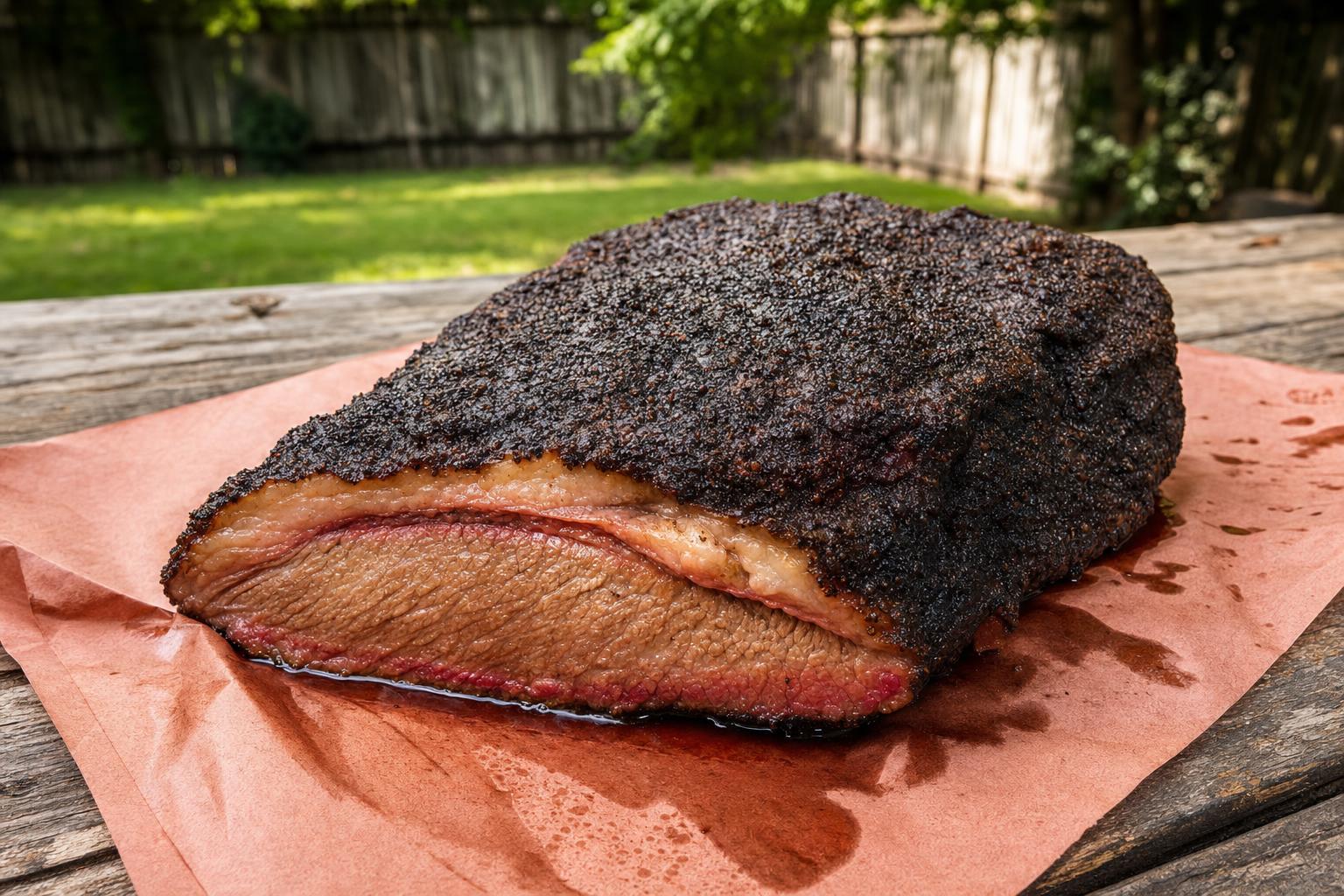
- When the internal temperature of the flat reaches 170°F, pull the brisket from the smoker for the wrap. Total elapsed time to reach this point is typically 7–10 hours at 225°F, but cook by temperature and bark color — not by the clock. The bark should be deeply mahogany, dry to the touch, and not smear when you press it. If it smears, it has not set; give it another 30 minutes and check again.
The Butcher Paper Wrap (170°F–200°F+ Internal)
- Tear off two large sheets of pink butcher paper — each sheet roughly 2.5 times the length of the brisket — and overlap them slightly in the center to create a double-width sheet. Place the brisket fat-cap-down on the paper. Fold the long sides of the paper up over the brisket, then fold the short ends under and over to create a tight, steam-resistant packet. The goal is full enclosure with no major gaps; tuck aggressively. Return the wrapped brisket to the smoker, seam-side-down to prevent the folds from opening under the weight.
- Continue cooking at 225°F. Reinsert your probe through the paper into the flat. The temperature will resume climbing noticeably faster now that evaporative cooling is arrested. Begin monitoring closely when the internal temperature reaches 195°F. At 195°F, start probe-testing the flat every 15 minutes using a skewer or instant-read probe — push it through the paper into the thickest part of the flat and assess the resistance. You are looking for zero resistance, like pushing into room-temperature butter. For most whole packers, this occurs between 200°F and 205°F internal, but texture is the real target. Total time from wrap to pull is typically 2–4 hours.
The Rest (The Faux Cambro)
- Thirty minutes before you expect the brisket to be done, fill a large insulated cooler with boiling water and close the lid. Let it preheat for at least 30 minutes. Drain the water and dry the interior with towels. Line the bottom and sides with old towels or a folded blanket.
- When the brisket passes the probe-tenderness test, pull it from the smoker. Do not unwrap it. Place the fully wrapped brisket into the preheated cooler, fat-cap-up. Pack additional towels around and on top of the brisket to fill any air gaps. Close the lid tightly. Let the brisket rest for a minimum of 2 hours — 3 to 4 hours is better. During this rest, the internal temperature gradient between the thick point and the thinner flat equalizes, and the denatured protein matrix partially reabsorbs expelled moisture as the thermal energy redistributes. A properly rested brisket will still be above 140°F internal when you open the cooler, which is food-safe for service.
Slicing and Serving
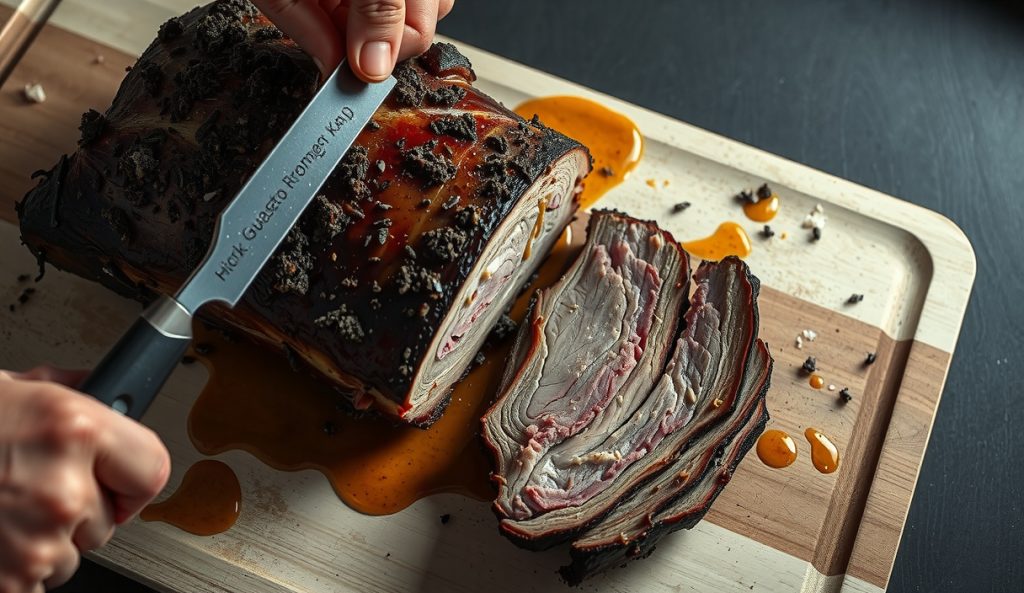
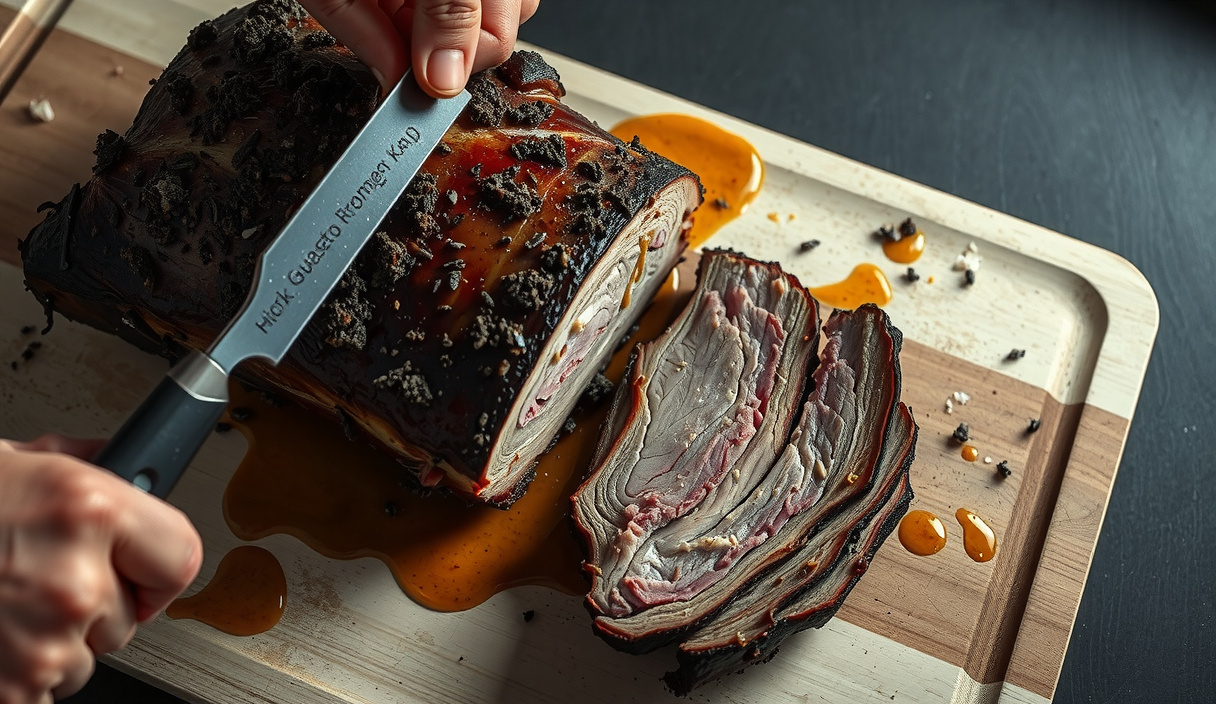
- Transfer the brisket to your large cutting board and unwrap it over the board — save any accumulated juices in the paper and pour them over the sliced meat. The bark will have re-firmed during the rest. Locate the seam of fat running between the flat and the point; separate the two muscles by cutting along this seam with your slicing knife. Set the point aside.
- Identify the grain direction of the flat — the muscle fibers run lengthwise. Slice across the grain (perpendicular to the fibers) at approximately 3/8 inch thickness. If slices are longer than eight inches, they will bend and break; this is correct texture for a properly cooked flat. If they crumble, you either overcooked or underrested. Now address the point: its grain runs in a slightly different direction than the flat — rotate the point so you are cutting perpendicular to its grain as well. Slice the point at the same 3/8 inch thickness, or cube it for burnt ends (see Variations). Serve immediately. Brisket does not wait well on a cutting board — cover lightly with butcher paper if service is staggered.
Notes
Nutrition
How do I nail it every time? Tips
- Do not wrap by the clock. Wrap by internal temperature — 170°F in the thickest part of the flat, confirmed with a leave-in probe. Wrapping too early traps steam before bark has set; wrapping too late extends the stall unnecessarily.
- Probe for tenderness, not temperature. Pull the brisket when a probe or skewer slides into the thickest part of the flat with zero resistance — like pushing into softened butter. For most whole packers this happens between 200°F and 205°F, but the tactile test is the real target. Temperature is a proxy.
- Keep the fat cap up. Smoke and radiant heat hit the top of the brisket hardest. The fat cap acts as a thermal shield for the flat beneath it, moderating the temperature differential between the fast-cooking point and the slower flat. Flipping mid-cook introduces unnecessary temperature swings.
- Manage your fire for thin blue smoke. More wood does not mean more smoke flavor — it means more creosote and a bitter, acrid crust. Use smaller splits more frequently rather than large logs less frequently to maintain combustion temperature and smoke quality.
- Let the cooler rest run the full two hours. Cutting into a brisket at 190°F internal means the juices are still mobile and will pour out onto the cutting board. At 150°F they have partially re-gelled and will stay in the slice. Patience at the end is as important as patience at the smoker.
- Slice against the grain, and know the grain changes direction. The flat and the point have different muscle fiber orientations. If you slice straight through the whole packer without adjusting your angle, half your slices will be with the grain and will be chewy. Separate the flat from the point at the seam of fat between them, then slice each muscle perpendicularly to its own grain at approximately 3/8 inch thickness.
What variations can I run on this recipe?
Higher cook temperature (275°F–300°F hot-and-fast): The hot-and-fast method compresses the cook to eight to ten hours by running the smoker hotter. The physics are identical — collagen hydrolysis must still complete and the stall must still be pushed through — but the shorter cook reduces total smoke exposure time, which some pitmasters compensate for with denser splits. Bark development is slightly less pronounced because the Maillard cascade has less time to deepen on the surface. Wrap timing shifts to roughly 165°F internal because the faster thermal ramp compresses the stall window.
Brisket flat only: If you can only source a flat, trim it to a 1/4 inch fat cap and be prepared to wrap earlier — around 160°F internal — and pull at a slightly lower temperature of 195°F to 198°F, because the flat has less intramuscular fat and collagen to buffer against drying. Inject with a simple beef tallow and beef broth solution to compensate for the missing point fat. This is a concession, not a preference.
Dalmatian rub with additions: The purist 50/50 salt-and-pepper bark is the Central Texas canon, but adding a small fraction of garlic powder — no more than 10% of the rub weight — lowers the Maillard activation energy slightly, promoting slightly faster browning at 225°F and adding a savory depth note. Beyond garlic, you are leaving Texas and entering a different regional tradition, which is not wrong — it is just a different recipe.
Scaling for competition or large service: Multiple briskets on the same smoker significantly increase thermal mass in the cook chamber and alter airflow dynamics. Space briskets with at least four inches of clearance on all sides for even smoke circulation. Stagger wrap timing to avoid opening and closing the smoker lid repeatedly during the stall phase, which bleeds thermal energy. Plan faux Cambro capacity before you cook — you need enough insulated volume to hold all briskets simultaneously without stacking them in ways that trap steam.
Frequently asked questions
Why does my brisket stall for so long — six hours or more? The duration of the stall is directly proportional to the surface area of the brisket relative to its mass, the ambient humidity inside your smoker, and the efficiency of your airflow. A water pan in the firebox, high ambient humidity, or restricted airflow all increase the evaporative cooling effect and extend the stall. Switching to a drier fire environment — more airflow, no water pan — shortens the stall at the cost of a slightly drier bark surface. The butcher paper wrap is the most controllable intervention: it arrests the evaporative drain without steaming the surface, letting the internal temperature resume its climb within 30 to 60 minutes of wrapping.
Can I use a different wood if I cannot find post-oak? Yes. White oak is the closest substitute and is widely available across the United States — it shares the mild tannin profile and clean burn characteristics of post-oak. Red oak is acceptable but burns slightly hotter and produces a more assertive smoke. Hickory is a valid choice for a more intensely flavored bark but will shift the flavor profile toward a Southern rather than Central Texas character. Avoid fruitwoods for a full brisket cook — they are too mild to register meaningfully over twelve-plus hours of smoke exposure and the sweetness can conflict with the salt-and-pepper rub.
My flat is dry but my point is perfect — what went wrong? The flat and the point cook at different rates because they differ in thickness, fat content, and collagen density. The point, with its heavy interlaced fat and abundant collagen, buffers thermal energy far more effectively than the lean, thin flat. If the flat is dry, you either cooked past the tactile probe-tender window, you did not wrap until the flat had already lost too much moisture through the stall, or you trimmed the fat cap too aggressively on the flat side. Going forward: wrap at 170°F, probe the flat specifically — not the point — for tenderness, and keep a minimum 1/4 inch fat cap on the flat side of the packer throughout the cook.