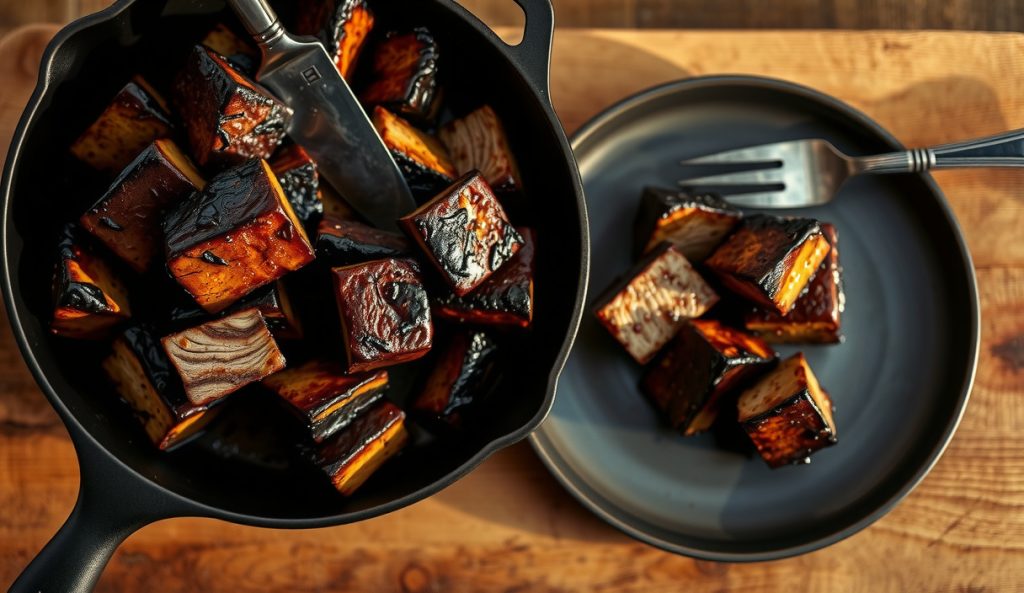
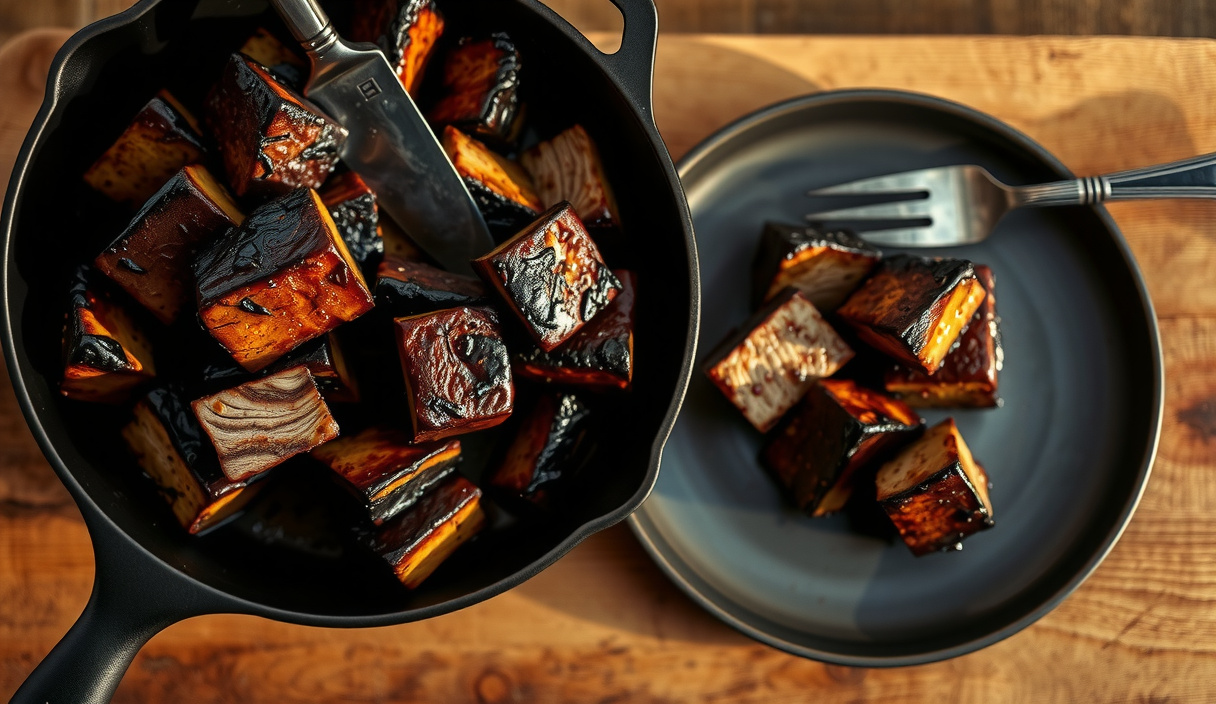
Kansas City Burnt Ends
Equipment
- 1 Offset smoker, kettle, drum, or pellet smoker Must hold 250°F for 10-12 hours and 275°F for the finish phase
- 1 Instant-read thermometer A leave-in probe thermometer for the initial cook is strongly recommended
- 2 large sheets Uncoated butcher paper Not foil — butcher paper is vapor-permeable and preserves bark integrity through the stall
- 2 Disposable aluminum half-pan One for the braise phase, one as backup; cubes must sit in a single layer
- 1 Large cutting board
- 1 Sharp boning or chef’s knife For separating the point from the flat and cubing
- 1 Cooler or insulated Cambro container For the mandatory post-cook rest
- 1 Chimney starter For lighting wood or charcoal
Ingredients
Brisket
- 1 whole packer brisket, USDA Prime or high-Choice 14-18 lb; you will use the point only (~5-7 lb trimmed) — cook the full packer and separate after the flat is done
- 2 tbsp kosher salt Diamond Crystal; if using Morton, reduce to 1.5 tbsp
- 2 tbsp coarse black pepper 16-mesh or coarsely cracked; not fine-ground
- 1 tbsp garlic powder
- 1 tbsp smoked paprika
- 1 tsp cayenne pepper Optional; adjust to heat preference
KC-Style Glaze Sauce
- 1.5 cups ketchup
- 0.5 cup apple cider vinegar
- 0.5 cup dark brown sugar Packed; provides reducing sugars and molasses bitter-complexity for Maillard depth
- 0.25 cup unsulfured molasses
- 2 tbsp Worcestershire sauce Verify gluten-free if needed
- 1 tbsp yellow mustard
- 1 tbsp onion powder
- 1 tsp garlic powder
- 1 tsp smoked paprika
- 0.5 tsp ground black pepper
- 0.5 tsp kosher salt
- 0.25 tsp cayenne pepper
Braise Liquid
- 4 tbsp rendered beef tallow or brisket drippings Collect from the initial cook drip pan; substitute with unsalted butter if not available
- 0.25 cup beef stock or bone broth Low sodium; used to thin the sauce for the braise phase if needed
Wood Fuel
- 4-6 chunks post oak wood chunks Or substitute: 2 chunks cherry + 2 chunks post oak for a slightly sweeter bark

Instructions
Make the KC Sauce
- Combine all KC-Style Glaze Sauce ingredients in a medium saucepan over medium heat. Whisk to dissolve the brown sugar and molasses. Bring to a gentle simmer and cook for 15-20 minutes, stirring occasionally, until the sauce has thickened slightly and the raw vinegar edge has mellowed. Taste and adjust salt. Remove from heat and set aside. Make-ahead note: Sauce keeps refrigerated for up to 2 weeks.1.5 cups ketchup, 0.5 cup apple cider vinegar, 0.5 cup dark brown sugar, 0.25 cup unsulfured molasses, 2 tbsp Worcestershire sauce, 1 tbsp yellow mustard, 1 tbsp onion powder, 1 tsp garlic powder, 1 tsp smoked paprika, 0.5 tsp ground black pepper, 0.5 tsp kosher salt, 0.25 tsp cayenne pepper
Season the Brisket
- Mix salt, black pepper, garlic powder, smoked paprika, and cayenne in a small bowl. Trim the fat cap of the whole packer brisket to approximately 1/4 inch — do not trim to zero. Apply the rub generously across all surfaces, pressing it firmly into the meat. For maximum bark development, season 12-24 hours ahead and refrigerate uncovered on a wire rack. This dry-brining step draws surface moisture out and then back in, hydrating the rub into the protein matrix.2 tbsp kosher salt, 2 tbsp coarse black pepper, 1 tbsp garlic powder, 1 tbsp smoked paprika, 1 tsp cayenne pepper
Initial Smoke (250°F, ~10-12 hours)
- Fire your smoker to a stable 250°F. Add 2-3 chunks of post oak. Place the brisket fat-side up on the grate. Insert a leave-in probe into the thickest part of the flat, away from fat seams. Add the remaining wood chunks in the first 3-4 hours of the cook — smoke deposition is most effective when the surface is moist.
- Smoke the brisket undisturbed until the flat reaches an internal temperature of 165°F — this typically takes 5-7 hours. You will hit the stall in this range: the internal temperature will plateau for 1-3 hours as surface evaporation absorbs heat energy as fast as the smoker delivers it. Do not panic. Do not raise the pit temperature. The stall is driving bark formation.
- Wrap the brisket tightly in 2 sheets of uncoated butcher paper at 165°F internal. Return to the smoker. Continue cooking until the flat reaches 195-200°F internal and a probe inserted into the flat meets no resistance — it should slide in like warm butter. This is the sign that collagen hydrolysis is complete in the flat. Total cook time is typically 10-12 hours depending on brisket size and pit consistency.
- At this point, remove the whole brisket from the smoker and rest it, still wrapped, inside a cooler lined with towels for a minimum of 60 minutes. The flat is done. The point needs more time — but it will hold perfectly in the cooler rest while you prepare the cube phase.
Separate, Cube, and Set Up the Braise
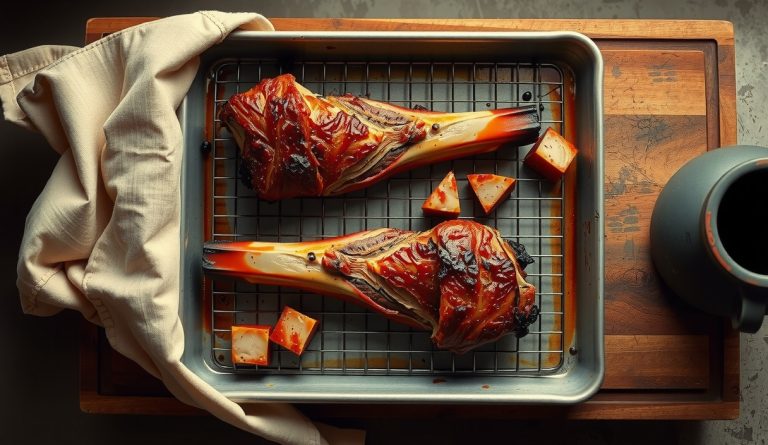
- After the rest, unwrap the brisket on a large cutting board over a rimmed sheet pan — you want to catch all accumulated juices and drippings for the braise. Locate the fat seam running diagonally between the flat and the point. Using a boning knife or sharp chef’s knife, separate the point from the flat along that seam. Set the flat aside to slice and serve separately.
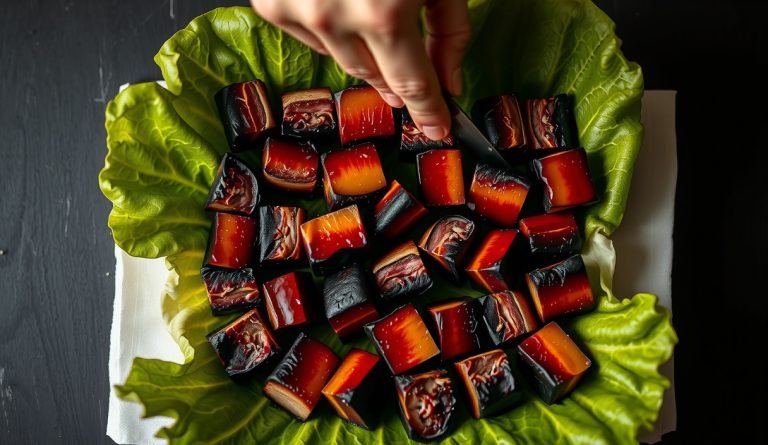
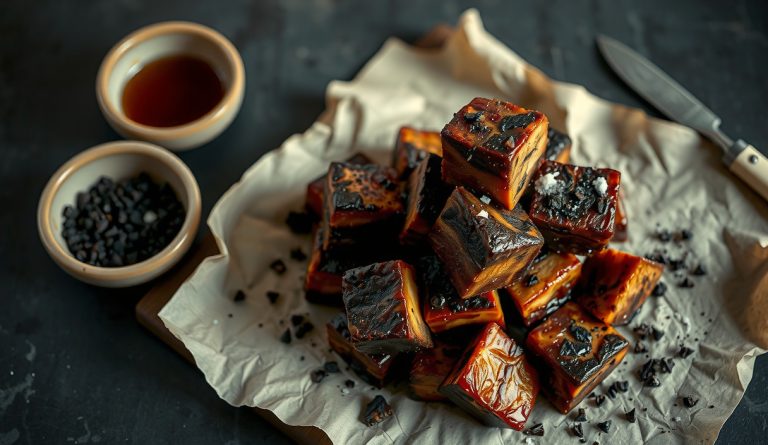
- Cut the brisket point into 1.5-inch cubes. Irregular cuts are fine — the goal is uniform size for even cooking, not geometric perfection. Discard any hard fat pockets that did not render during the initial cook. Place the cubes in a single layer in one or two disposable aluminum half-pans. Do not pile or stack.
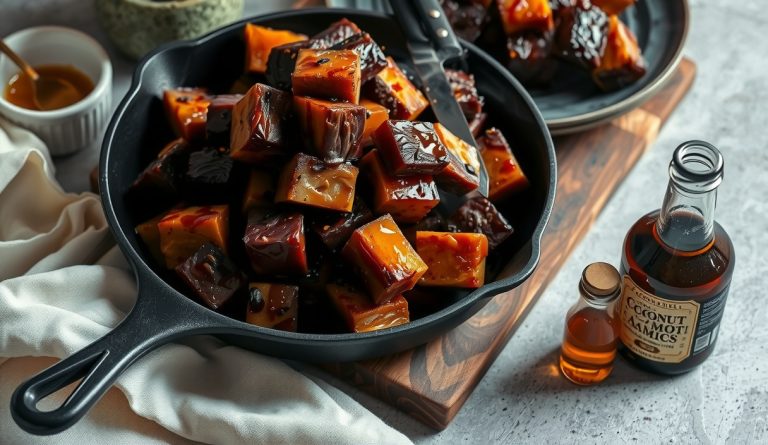
- Add the rendered beef tallow or drippings to the pan. Pour approximately 2/3 of the KC sauce over the cubes and toss gently to coat all sides. If the sauce is very thick, thin with 1/4 cup of beef stock to achieve a pourable consistency — you want the cubes coated, not submerged.4 tbsp rendered beef tallow or brisket drippings, 0.25 cup beef stock or bone broth
Braise Phase (275°F, ~60 minutes covered)
- Bring the smoker up to 275°F. Cover the half-pan tightly with aluminum foil. Place the covered pan on the smoker grate. Cook covered for 45-60 minutes. The sauce will bubble and reduce; the cubes will re-absorb moisture and the interior gelatin structure will tighten into a rich, sticky matrix. Do not rush this phase — covered braising is what transforms the interior from sliced-brisket texture to true burnt-end richness.
Uncover and Return to Smoke (275°F, ~60-90 minutes)
- Remove the foil cover. Pour the remaining 1/3 of the KC sauce over the cubes — this fresh application provides new reducing sugars for the final Maillard sprint. Toss gently if possible without breaking the cubes apart. Return the uncovered pan to the 275°F smoker. Do not add a water pan — you need dry convective airflow for bark re-formation.1.5 cups ketchup, 0.5 cup apple cider vinegar, 0.5 cup dark brown sugar, 0.25 cup unsulfured molasses, 2 tbsp Worcestershire sauce, 1 tbsp yellow mustard, 1 tbsp onion powder, 1 tsp garlic powder, 1 tsp smoked paprika, 0.5 tsp ground black pepper, 0.5 tsp kosher salt, 0.25 tsp cayenne pepper
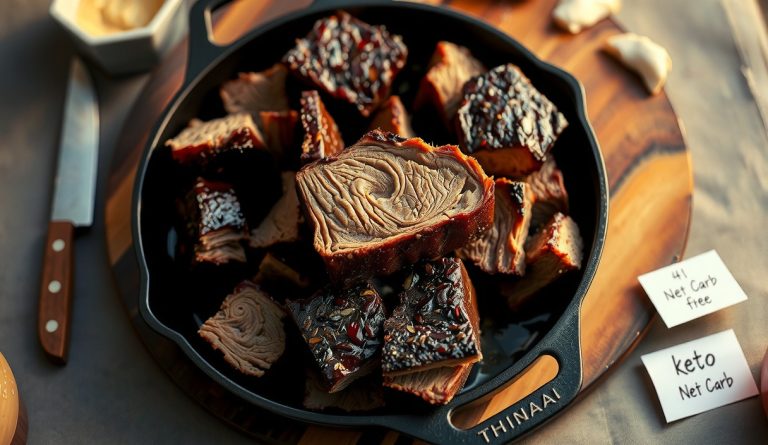
- Cook uncovered for 60-90 minutes, checking every 20 minutes. The burnt ends are done when the glaze has shifted from wet and reflective to matte-tacky, and the surface of each cube shows a tight, dark, lacquered bark on all exposed faces. An instant-read probe into the center of a cube should read 195-205°F. The cubes should hold their shape when lifted with tongs but yield to slight pressure.
Rest and Serve
- Remove the pan from the smoker. Let the burnt ends rest uncovered for 10 minutes — this allows the glaze to set from tacky to firm and allows steam from the interior to escape without condensing back onto the bark. Serve directly from the pan or pile onto a butcher paper-lined tray. Serve with additional KC sauce on the side if desired. Burnt ends are best eaten immediately but hold well covered in a 150°F oven for up to 2 hours.
Notes
Nutrition
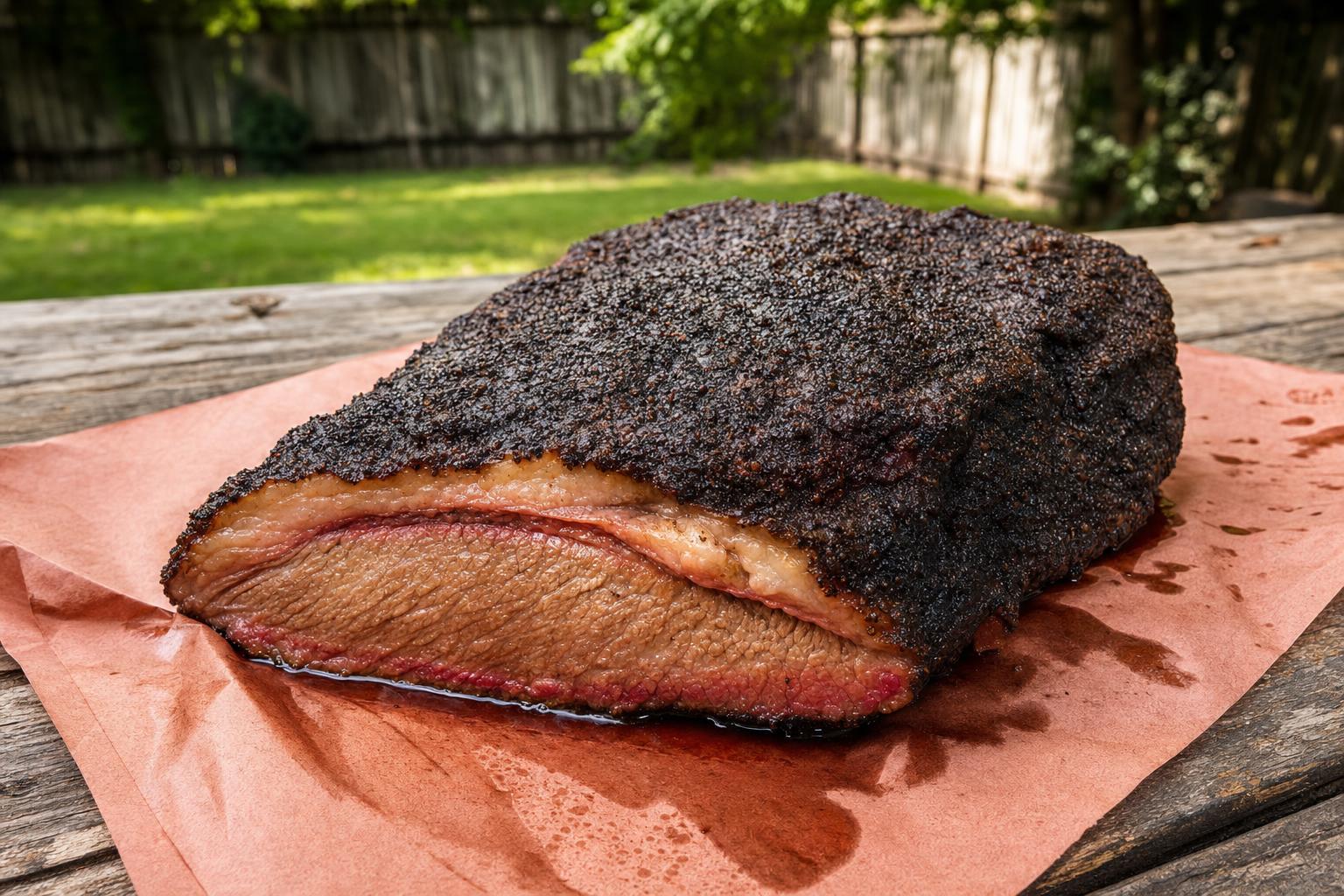
There is a moment — maybe 14 hours in, maybe 16 — when the brisket point stops being a piece of beef and becomes something else entirely. The collagen has hydrolyzed into gelatin. The intramuscular fat has rendered through the dense, marbled seam meat of the deckle. The exterior has gone almost black, a crust built from Maillard polymers and polymerized smoke phenols. That is the moment you cube the brisket point, sauce it, and put it back in the fire. That is how Kansas City burnt ends are made, and it is one of the most mechanistically interesting things you can do with a piece of meat.
The burnt ends tradition traces to the working-class lunch counters of Kansas City’s West Side, where pitmaster scraps from the point were handed out while customers waited in line. What began as a trim byproduct became the most sought-after item on the board. American Meathead builds burnt ends from scratch, with full control over every phase transition along the way.
Why do Kansas City burnt ends work? The science of double-bark brisket
Burnt ends work because the brisket point contains the exact collagen density and intramuscular fat content required to survive — and improve through — two full cook cycles. The brisket point, anatomically the pectoralis superficialis, is a hyperactive locomotive muscle with a collagen density significantly higher than the flat, and intramuscular fat threaded through in a coarse, irregular marbling pattern. Two things must happen sequentially: first, a prolonged collagen hydrolysis event converts the tough connective-tissue network into soluble, lubricating gelatin; second, a Maillard re-crust forms on all six faces of each cube during the glaze-and-return phase.
The initial smoke cook targets 203°F internal, which holds the muscle matrix just past the actin denaturation threshold (74–78°F) long enough to drive collagen hydrolysis — a first-order kinetic process that runs optimally between 160–180°F internal over extended time. Holding the brisket point at a pit temperature of 250°F for 10–12 hours after the stall satisfies both collagen hydrolysis kinetics and the render of the intermuscular fat seam.
The stall — that plateau at 155–165°F internal — is an evaporative cooling event: surface water vaporizes faster than the smoker delivers heat, anchoring surface temperature and delaying Maillard onset. Wrapping in butcher paper during the stall traps a boundary layer of humid air, reducing evaporative flux and allowing the thermal wave to advance into the interior without sacrificing bark integrity the way foil does.
The cube-and-return phase is where the physics become genuinely exciting. Cutting the cooked brisket point into 1.5-inch cubes multiplies total surface area by roughly 6x compared to the whole point. Every new cut face is an exposed, collagen-rich, fat-saturated surface primed for Maillard chemistry. The KC-style sauce — a sucrose-and-tomato-based glaze with a pH of approximately 3.8–4.2 — introduces free reducing sugars that dramatically lower the Maillard activation threshold. Sucrose is a non-reducing disaccharide, but the acid environment of the sauce hydrolyzes it to glucose and fructose during the cook, and those monosaccharides participate eagerly in the amino-carbonyl condensation cascade at surface temperatures as low as 280°F.
The pan braise step — cubes nestled together with sauce and rendered tallow, covered — creates a closed convection environment where steam-assisted conduction brings the interior of each cube back to serving temperature (195–200°F) while gelatin dissolved in the sauce reinforces into a tacky, lacquered coating as the liquid reduces. The final uncovered return to the smoker at 275°F drives surface water activity below 0.7, allowing the Maillard cascade to accelerate and build the second bark — darker, stickier, and more structurally complex than the first.
Smoke functions on two levels in this cook. Primary smoke deposition — phenols, guaiacol, syringol — occurs during the first cook when the surface is moist and receptive. These compounds bond covalently to the protein matrix, contributing the smoke ring (a myoglobin-carbon-monoxide complex formed below 140°F internal) and the base-note phenolic aroma. During the return phase, secondary smoke exposure layers additional volatile aldehydes onto the sugar-laden glaze surface, creating the characteristic sweet-smoke aromatic signature of KC burnt ends. Pit temperature of 275°F is not arbitrary: it is the point at which surface Maillard kinetics run fast enough to build bark within 60–90 minutes without the interior of each cube overshooting 205°F, which would drive further moisture expulsion and produce a drier, stringier product.
What equipment and ingredients do you need for burnt ends?
Smoker: An offset stick-burner, kettle, drum, or pellet smoker capable of holding 250°F for 10–12 hours and 275°F for the finish will work for burnt ends. A water pan during the long cook stabilizes temperature and maintains pit humidity, reducing evaporative moisture loss from the brisket point during the pre-stall phase. If using a kamado, crack the lid during the cube-return phase — convective airflow is required to re-form bark, not trapped steam.
Brisket Point: Buy a full packer brisket (USDA Prime or high-Choice, 14–18 lb) and separate the point from the flat yourself after the flat reaches 195°F during the initial cook — this lets you pull the flat at its optimal window while the point continues. Alternatively, source a whole untrimmed point from a butcher. Do not trim the fat cap to zero: a 1/4-inch fat cap insulates the meat during the long initial cook and renders into basting fat during the braise phase.
Wood: Post oak is the Kansas City standard — medium phenolic intensity, clean combustion, compatible with the sweet sauce profile. Cherry adds a reddish bark pigment and a mild fruity top-note. Hickory is assertive; use it sparingly in a blend. Avoid mesquite for this application — its high guaiacol density overwhelms the sauce glaze.
KC-Style Sauce: The recipe below builds a sauce from scratch. The key functional parameters are sucrose-forward sweetness (for Maillard substrate delivery), tomato paste acidity (pH driver), molasses (additional reducing sugars plus bitter complexity), and a moderate vinegar load that stays below the threshold where acidity would denature surface proteins before the glaze can set. If using a commercial sauce, choose one with a pourable rather than paste-like viscosity — thick commercial sauces scorch before bark reforms.
Disposable Aluminum Half-Pan: A disposable aluminum half-pan is non-negotiable for the braise phase. Depth matters — cubes should sit in a single layer with sauce coming 1/3 of the way up their sides, not submerged. Submerging produces braised beef; the goal is glazed, smoke-kissed bark cubes.
Kansas City Burnt Ends
Equipment
- 1 Offset smoker, kettle, drum, or pellet smoker Must hold 250°F for 10-12 hours and 275°F for the finish phase
- 1 Instant-read thermometer A leave-in probe thermometer for the initial cook is strongly recommended
- 2 large sheets Uncoated butcher paper Not foil — butcher paper is vapor-permeable and preserves bark integrity through the stall
- 2 Disposable aluminum half-pan One for the braise phase, one as backup; cubes must sit in a single layer
- 1 Large cutting board
- 1 Sharp boning or chef’s knife For separating the point from the flat and cubing
- 1 Cooler or insulated Cambro container For the mandatory post-cook rest
- 1 Chimney starter For lighting wood or charcoal
Ingredients
Brisket
- 1 whole packer brisket, USDA Prime or high-Choice 14-18 lb; you will use the point only (~5-7 lb trimmed) — cook the full packer and separate after the flat is done
- 2 tbsp kosher salt Diamond Crystal; if using Morton, reduce to 1.5 tbsp
- 2 tbsp coarse black pepper 16-mesh or coarsely cracked; not fine-ground
- 1 tbsp garlic powder
- 1 tbsp smoked paprika
- 1 tsp cayenne pepper Optional; adjust to heat preference
KC-Style Glaze Sauce
- 1.5 cups ketchup
- 0.5 cup apple cider vinegar
- 0.5 cup dark brown sugar Packed; provides reducing sugars and molasses bitter-complexity for Maillard depth
- 0.25 cup unsulfured molasses
- 2 tbsp Worcestershire sauce Verify gluten-free if needed
- 1 tbsp yellow mustard
- 1 tbsp onion powder
- 1 tsp garlic powder
- 1 tsp smoked paprika
- 0.5 tsp ground black pepper
- 0.5 tsp kosher salt
- 0.25 tsp cayenne pepper
Braise Liquid
- 4 tbsp rendered beef tallow or brisket drippings Collect from the initial cook drip pan; substitute with unsalted butter if not available
- 0.25 cup beef stock or bone broth Low sodium; used to thin the sauce for the braise phase if needed
Wood Fuel
- 4-6 chunks post oak wood chunks Or substitute: 2 chunks cherry + 2 chunks post oak for a slightly sweeter bark
Instructions
Make the KC Sauce
- Combine all KC-Style Glaze Sauce ingredients in a medium saucepan over medium heat. Whisk to dissolve the brown sugar and molasses. Bring to a gentle simmer and cook for 15-20 minutes, stirring occasionally, until the sauce has thickened slightly and the raw vinegar edge has mellowed. Taste and adjust salt. Remove from heat and set aside. Make-ahead note: Sauce keeps refrigerated for up to 2 weeks.1.5 cups ketchup, 0.5 cup apple cider vinegar, 0.5 cup dark brown sugar, 0.25 cup unsulfured molasses, 2 tbsp Worcestershire sauce, 1 tbsp yellow mustard, 1 tbsp onion powder, 1 tsp garlic powder, 1 tsp smoked paprika, 0.5 tsp ground black pepper, 0.5 tsp kosher salt, 0.25 tsp cayenne pepper
Season the Brisket
- Mix salt, black pepper, garlic powder, smoked paprika, and cayenne in a small bowl. Trim the fat cap of the whole packer brisket to approximately 1/4 inch — do not trim to zero. Apply the rub generously across all surfaces, pressing it firmly into the meat. For maximum bark development, season 12-24 hours ahead and refrigerate uncovered on a wire rack. This dry-brining step draws surface moisture out and then back in, hydrating the rub into the protein matrix.2 tbsp kosher salt, 2 tbsp coarse black pepper, 1 tbsp garlic powder, 1 tbsp smoked paprika, 1 tsp cayenne pepper
Initial Smoke (250°F, ~10-12 hours)
- Fire your smoker to a stable 250°F. Add 2-3 chunks of post oak. Place the brisket fat-side up on the grate. Insert a leave-in probe into the thickest part of the flat, away from fat seams. Add the remaining wood chunks in the first 3-4 hours of the cook — smoke deposition is most effective when the surface is moist.
- Smoke the brisket undisturbed until the flat reaches an internal temperature of 165°F — this typically takes 5-7 hours. You will hit the stall in this range: the internal temperature will plateau for 1-3 hours as surface evaporation absorbs heat energy as fast as the smoker delivers it. Do not panic. Do not raise the pit temperature. The stall is driving bark formation.
- Wrap the brisket tightly in 2 sheets of uncoated butcher paper at 165°F internal. Return to the smoker. Continue cooking until the flat reaches 195-200°F internal and a probe inserted into the flat meets no resistance — it should slide in like warm butter. This is the sign that collagen hydrolysis is complete in the flat. Total cook time is typically 10-12 hours depending on brisket size and pit consistency.
- At this point, remove the whole brisket from the smoker and rest it, still wrapped, inside a cooler lined with towels for a minimum of 60 minutes. The flat is done. The point needs more time — but it will hold perfectly in the cooler rest while you prepare the cube phase.
Separate, Cube, and Set Up the Braise
- After the rest, unwrap the brisket on a large cutting board over a rimmed sheet pan — you want to catch all accumulated juices and drippings for the braise. Locate the fat seam running diagonally between the flat and the point. Using a boning knife or sharp chef’s knife, separate the point from the flat along that seam. Set the flat aside to slice and serve separately.
- Cut the brisket point into 1.5-inch cubes. Irregular cuts are fine — the goal is uniform size for even cooking, not geometric perfection. Discard any hard fat pockets that did not render during the initial cook. Place the cubes in a single layer in one or two disposable aluminum half-pans. Do not pile or stack.
- Add the rendered beef tallow or drippings to the pan. Pour approximately 2/3 of the KC sauce over the cubes and toss gently to coat all sides. If the sauce is very thick, thin with 1/4 cup of beef stock to achieve a pourable consistency — you want the cubes coated, not submerged.4 tbsp rendered beef tallow or brisket drippings, 0.25 cup beef stock or bone broth
Braise Phase (275°F, ~60 minutes covered)
- Bring the smoker up to 275°F. Cover the half-pan tightly with aluminum foil. Place the covered pan on the smoker grate. Cook covered for 45-60 minutes. The sauce will bubble and reduce; the cubes will re-absorb moisture and the interior gelatin structure will tighten into a rich, sticky matrix. Do not rush this phase — covered braising is what transforms the interior from sliced-brisket texture to true burnt-end richness.
Uncover and Return to Smoke (275°F, ~60-90 minutes)
- Remove the foil cover. Pour the remaining 1/3 of the KC sauce over the cubes — this fresh application provides new reducing sugars for the final Maillard sprint. Toss gently if possible without breaking the cubes apart. Return the uncovered pan to the 275°F smoker. Do not add a water pan — you need dry convective airflow for bark re-formation.1.5 cups ketchup, 0.5 cup apple cider vinegar, 0.5 cup dark brown sugar, 0.25 cup unsulfured molasses, 2 tbsp Worcestershire sauce, 1 tbsp yellow mustard, 1 tbsp onion powder, 1 tsp garlic powder, 1 tsp smoked paprika, 0.5 tsp ground black pepper, 0.5 tsp kosher salt, 0.25 tsp cayenne pepper
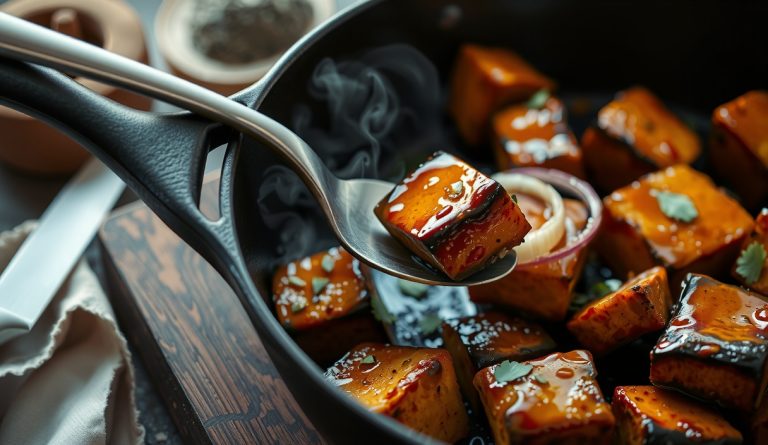
- Cook uncovered for 60-90 minutes, checking every 20 minutes. The burnt ends are done when the glaze has shifted from wet and reflective to matte-tacky, and the surface of each cube shows a tight, dark, lacquered bark on all exposed faces. An instant-read probe into the center of a cube should read 195-205°F. The cubes should hold their shape when lifted with tongs but yield to slight pressure.
Rest and Serve
- Remove the pan from the smoker. Let the burnt ends rest uncovered for 10 minutes — this allows the glaze to set from tacky to firm and allows steam from the interior to escape without condensing back onto the bark. Serve directly from the pan or pile onto a butcher paper-lined tray. Serve with additional KC sauce on the side if desired. Burnt ends are best eaten immediately but hold well covered in a 150°F oven for up to 2 hours.
Notes
Nutrition
How do you nail burnt ends every time? Tips for perfect results
- Do not skip the rest. After the initial cook, the brisket point must rest wrapped in butcher paper inside a cooler for a minimum of 60 minutes — ideally 90. During rest, carryover conduction continues to drive collagen hydrolysis while juice redistribution re-equilibrates moisture across the muscle fiber bundles. Cutting into a hot-off-the-smoker point sends all that accumulated juice straight to the cutting board.
- Cube size is a bark-to-interior ratio problem. 1.5-inch cubes deliver the maximum surface area for bark formation while keeping the interior moist. Go smaller than 1.25 inches and the cube risks desiccating during the return phase. Go larger than 2 inches and the interior stalls at serving temperature while the surface over-chars.
- The stall is not a problem to fix — it is a phase to manage. Wrap the brisket point in uncoated butcher paper (not foil) at 165°F internal. Foil traps so much moisture that it steams the bark off. Butcher paper is vapor-permeable — it reduces evaporative loss without fully collapsing the bark.
- Sauce in two hits, not one. Apply 2/3 of the sauce before covering the pan for the braise, and the remaining 1/3 after uncovering for the return to the smoker. The first application reduces and caramelizes into a tacky base coat; the second application provides fresh reducing sugars and moisture for the final Maillard sprint.
- Watch surface sheen, not the clock, during the return phase. The burnt ends are done when the glaze has gone from wet and reflective to matte-tacky. At 275°F this typically takes 60–90 minutes, but pit-to-pit variation is real. An over-sauced pan will steam rather than glaze — if you see aggressive bubbling without crust formation, remove the foil and give the cubes 5 minutes of direct, uncovered convection.
- Rendered tallow or beef dripping in the braise is not optional. Fat-based heat transfer is 30–40% more efficient than water-based in a braise at this temperature. The fat also acts as a lipophilic aromatic carrier, extracting and concentrating phenolic smoke compounds from the bark surface back into the sauce, creating a self-basting loop that deepens flavor through every minute of the covered phase.
How can you vary this recipe? Burnt ends for every style and scale
Competition Style: For competition presentation, push the sugar load in the glaze higher by adding 2 tablespoons of honey or brown sugar to the sauce for the return phase. The additional monosaccharides push the glaze toward lacquer territory — high gloss, very sweet, with a thin, shattering bark rather than a thick, chewy one. Finish with a light dusting of rub to add visual texture and a pop of color contrast on the presentation box.
Texas-Style Burnt Ends: Skip the KC sauce entirely. After cubing the brisket point, toss the cubes in rendered brisket tallow, dust with coarse black pepper and kosher salt, and return to the smoker at 275°F uncovered. The result is a cleaner, beef-forward product with intense smoke phenolics and no sweetness — closer to the beef rib tradition of central Texas. The Maillard bark will be thinner but intensely savory.
Scaling Up: This recipe is written for a single brisket point (approximately 5–7 lb trimmed). For competition or catering runs, the physics scale linearly — two points cook identically to one as long as they are not stacked or crowded on the smoker grate. Air circulation between pieces is critical for even bark formation. The braise phase does not fully scale: using a single large pan for more than 4 lb of cubes risks creating a steaming environment rather than a glazing one. Use multiple half-pans and keep cube depth to a single layer.
Gluten-Free Friendly: All components as written are naturally gluten-free. Verify your Worcestershire sauce — some brands use malt vinegar (barley-derived). Substitute a certified GF Worcestershire or replace with coconut aminos plus a splash of tamarind concentrate for equivalent depth.
Frequently asked questions about Kansas City burnt ends
Can I use the brisket flat for burnt ends? Technically yes, but the flat is a poor choice. The flat’s collagen density is lower, its fat marbling is minimal, and its muscle fiber alignment is more uniform — which means the flat dries out aggressively during the cube-and-return phase. The brisket point’s high collagen and intramuscular fat content are not incidental; they are the load-bearing structural elements that keep each cube moist and rich through two full cook cycles. If only flat is available, reduce the return-phase time to 45 minutes maximum and add an extra 2 tablespoons of tallow to the braise pan.
My bark turned out soft, not crunchy. What went wrong? Soft bark is a water activity problem: the surface of the cube never got dry enough for the Maillard cascade to accelerate. The three most common causes are (1) too much sauce in the braise pan, creating a steam environment rather than a glaze environment; (2) covering the pan for too long during the return phase — the lid should come off for the final 60–90 minutes minimum; (3) smoker temperature too low or too much water-pan humidity during the return phase. The fix for next time is to run the smoker dry (no water pan) during the return phase and pull the foil cover off 30 minutes earlier than seems necessary.
How long can I hold burnt ends before serving? Burnt ends hold extremely well because the high gelatin and fat content buffer temperature loss. Wrapped tightly in foil and held in a 150°F oven or a Cambro-style insulated container, burnt ends maintain quality for 2–3 hours. The bark will soften slightly as steam from the interior migrates outward — acceptable for service. For a crispier finish after holding, spread the cubes on a wire rack and run them under a broiler or back into a 300°F oven for 10 minutes before plating. Do not hold burnt ends uncovered in a warming pan longer than 30 minutes; direct heat without moisture will desiccate the exterior aggressively.