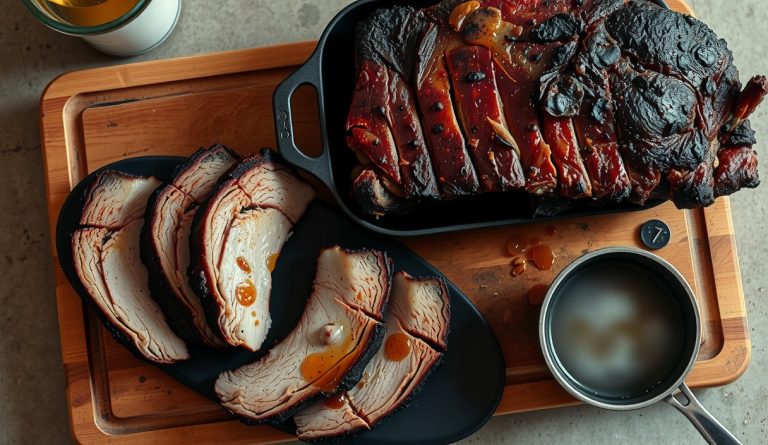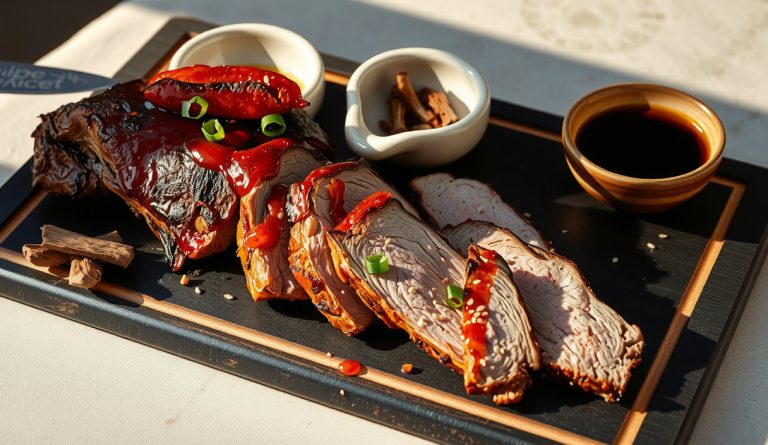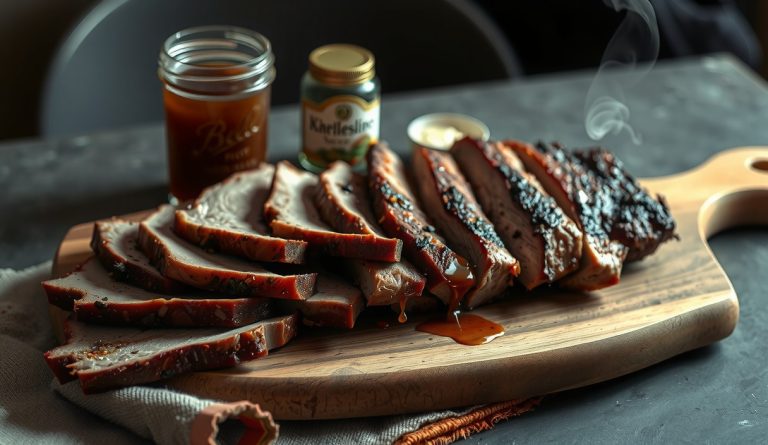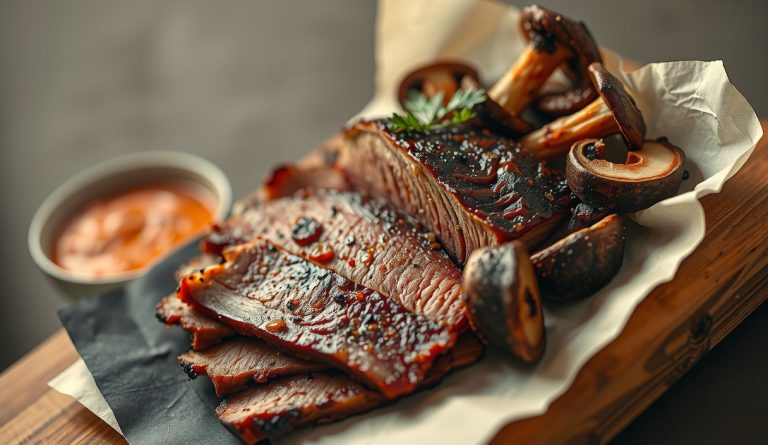
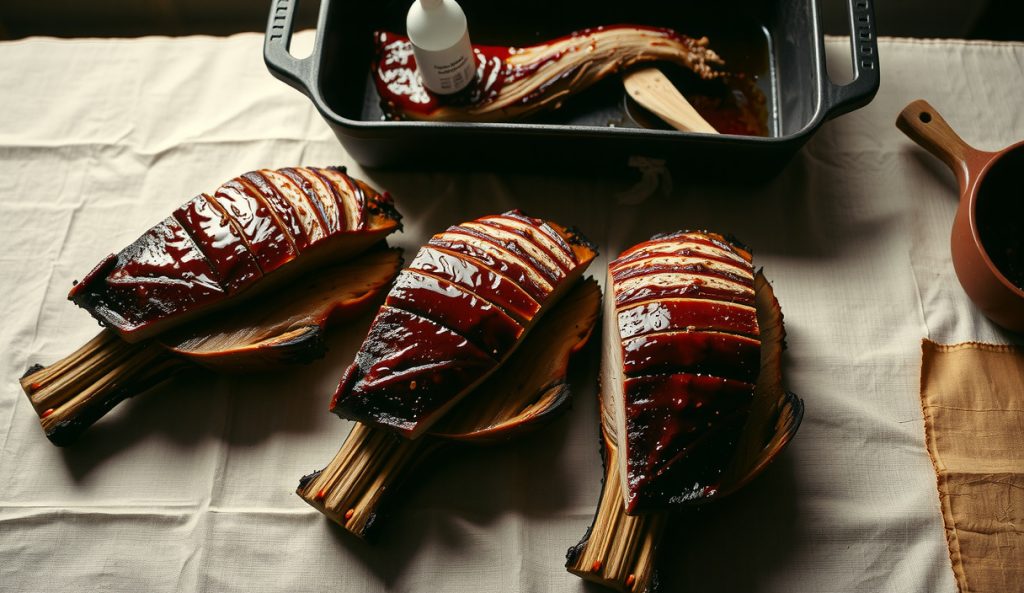
Cooking one brisket and cooking six briskets are not the same operation scaled up — they are logistically different cooks with specific failure points. For the bone-broth glaze in this recipe, the most consequential difference is that liquid reductions do not scale linearly with volume. Evaporation is a surface-area-driven phenomenon, not a volume-driven one. A wider pot with more surface area exposed to heat will reduce a larger batch of broth in the same or shorter time as a narrower pot reduces a smaller batch — but the cook who expects to simply triple the broth and wait proportionally longer will either undershoot the reduction or scorch it trying to catch up.
This variation exists for competition teams, catering cooks, and anyone feeding a large event who needs consistent glaze quality across a multi-brisket cook.
What changes when you scale up? The glaze reduction and airflow rules
The brisket cook itself scales linearly — each brisket receives the same rub quantity per pound, occupies its own rack space with adequate airflow clearance, and follows the same internal temperature targets and rest protocol as a single brisket. Do not stack briskets or reduce pit airflow to accommodate volume; smoke penetration and bark development require unobstructed circulation around each piece.
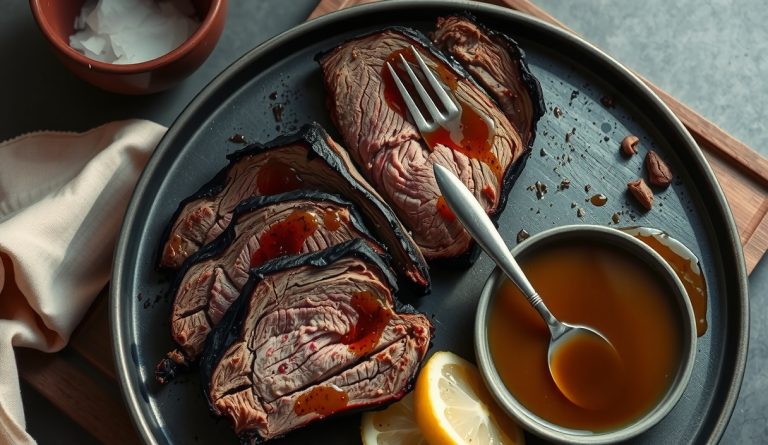
The glaze reduction requires separate planning. When reducing 8 quarts of bone broth, use the largest, widest pot available — a rondeau or wide stockpot rather than a tall, narrow stockpot — to maximize evaporation surface area. Expect the same six-hour reduction window to yield approximately 1.5–2 cups of finished glaze rather than the 1-cup yield from a single-brisket batch, due to the increased surface area accelerating evaporation. Monitor viscosity by the spoon-coating test rather than by clock alone. Critically, hold the reduction at a bare simmer — surface temperature should not exceed 220°F. Above that threshold, the Maillard-active compounds concentrated in the broth will caramelize into bitter, acrid notes that cannot be corrected in the finished glaze.
What stays the same at any scale? The per-brisket quality standard
Every per-brisket parameter remains unchanged — rub ratios per pound, target internal temperatures, rest duration, and glaze application timing relative to pull. The quality standard for each individual brisket is identical to the canonical single-brisket cook.
When is the large-scale method the right choice?
This is the operative method any time you are cooking more than two briskets simultaneously — competition turn-in boxes, catering events, large family gatherings, or restaurant prep. The explicit guidance on reduction vessel geometry and heat ceiling prevents the two most common failure modes at scale: under-reduced glaze with poor viscosity and over-heated glaze with bitter finish notes.
Use the full method, equipment, and rub measurements from the original Smoked Brisket with Bone-Broth Glaze, applying the reduction vessel and heat-ceiling adjustments described above when scaling the broth volume.