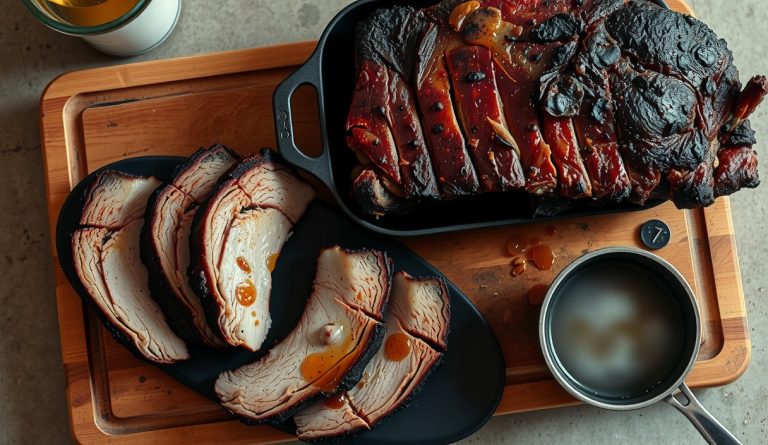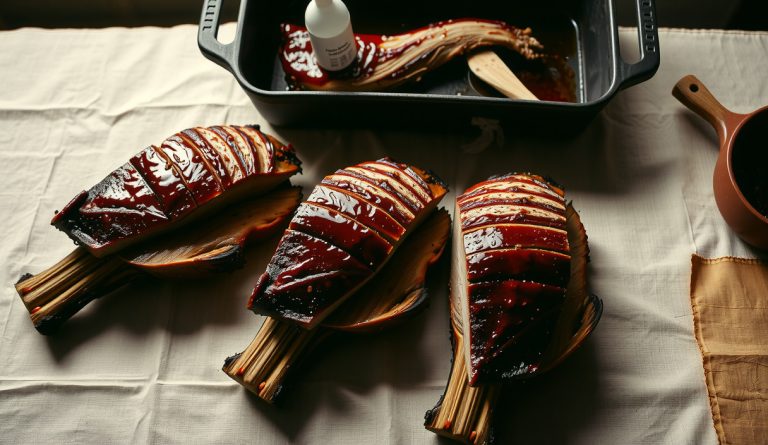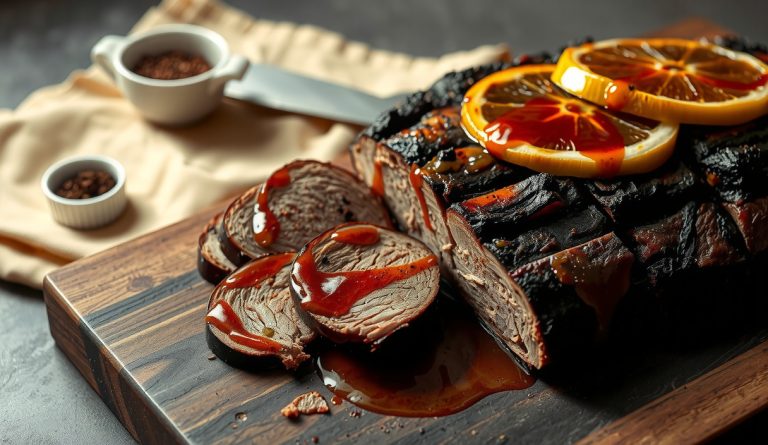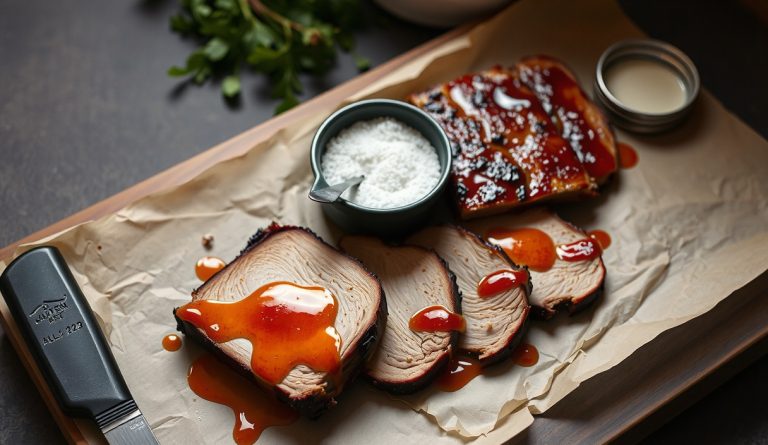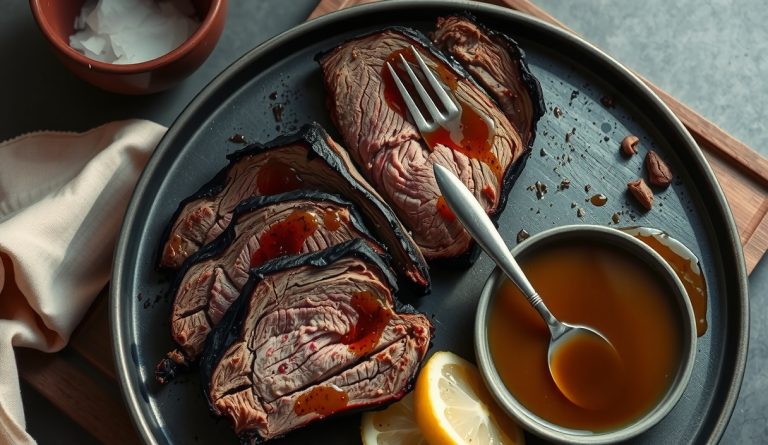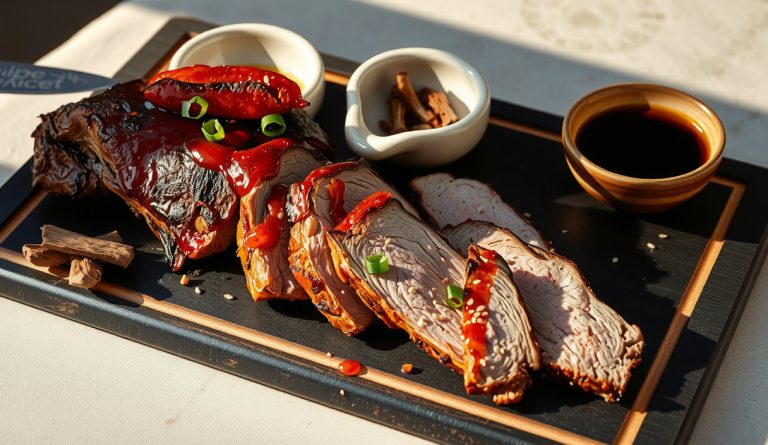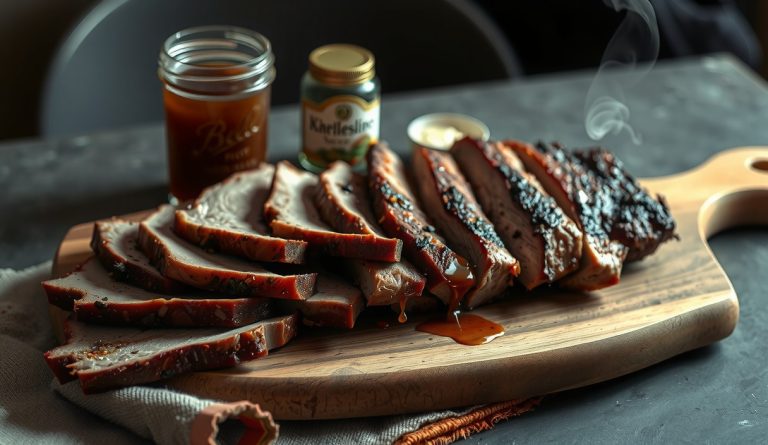
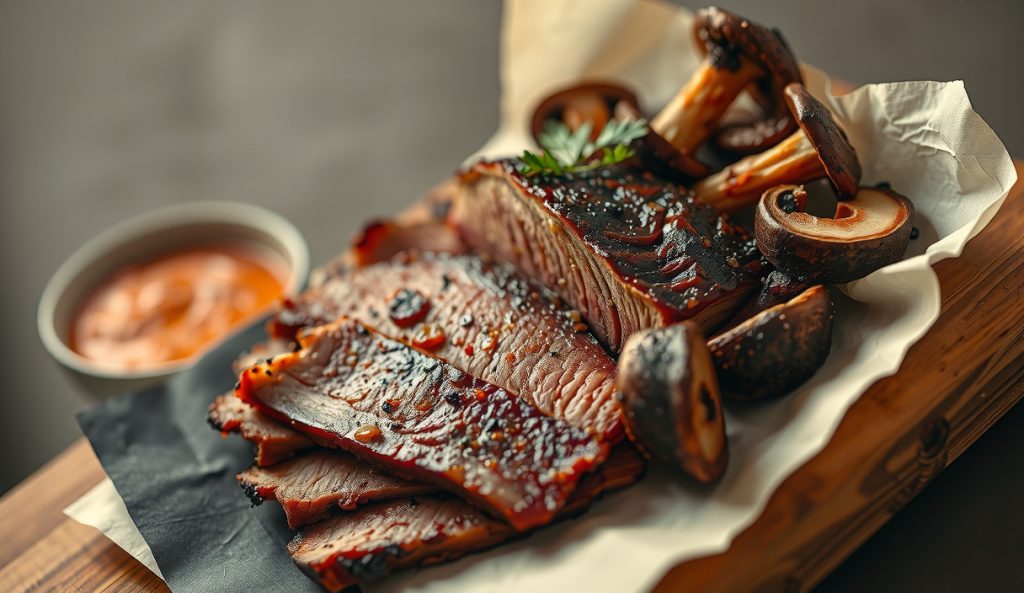
This post is not a replacement for Smoked Brisket with Bone-Broth Glaze. It is a companion — something built with the same pit, the same oak smoke, the same rub philosophy, and its own version of the concentrated-glaze technique, designed to sit beside the brisket at a table that serves both. The goal is longer tables, not higher fences: a vegetarian guest gets something genuinely made for them, not an afterthought pulled from the freezer.
What changes
The analog: king oyster mushroom slabs. Among vegetable candidates — portobello, jackfruit, watermelon, seitan — king oyster mushrooms (Pleurotus eryngii) are the most defensible structural analog for brisket’s sliced presentation. Their dense, fibrous stipe has a protein-rich cell wall matrix that desiccates and develops genuine Maillard browning on the surface at pit temperatures. Slice the stipes lengthwise into 1.5-inch slabs, score the cut faces in a crosshatch pattern to roughly 3mm depth, and the exposed interior develops a bark-like crust during the smoke. Plan on 2–3 pounds of whole king oyster mushrooms for a half-dozen portions. Portobello caps are a viable secondary option for their glutamate depth but lack the fibrous bite; seitan achieves closer texture but introduces gluten and requires separate preparation.
The rub — identical. Apply the canonical Texas rub (coarse kosher salt, 16-mesh black pepper, optional smoked paprika) directly to all cut faces. Salt plays the same role here as on brisket: it draws surface moisture out via osmosis, temporarily raising water activity at the surface, then as that moisture migrates back in and evaporates, it drops water activity toward the 0.5–0.7 window where amino-carbonyl Maillard condensation accelerates. Mushrooms are richer in free amino acids (glutamic acid, alanine) than beef per unit surface area, which actually accelerates browning — you will see color develop faster than on a brisket. Let the salted, rubbed slabs sit uncovered on a wire rack for 30–45 minutes before they go on the smoker.
The glaze — kombu-shiitake reduction. The canonical bone-broth glaze works via concentrated gelatin (above 10% w/w) behaving as a viscoelastic hydrocolloid. To replicate that adhesive, clingy character without animal collagen, build a plant-based equivalent: simmer 2 quarts of water with 40g of dried kombu and 60g of dried shiitake mushrooms for 45 minutes (do not boil — keep at 140–160°F to preserve glutamates and avoid bitterness from kombu’s alginic acid degradation). Strain, then reduce the resulting dashi to approximately half a cup. At that concentration, the combination of kombu-derived fucoidan polysaccharides and shiitake beta-glucans produces a liquid with measurable viscosity and moderate gel strength at room temperature — not as firm as a 10% gelatin solution, but enough to coat and partially re-set on the bark surface. Add 1 tablespoon of white miso at the end of reduction, off heat, for additional umami depth and a small protein contribution that aids surface adhesion.
Smoke and timing. Run the king oyster slabs at 225–240°F (slightly lower than brisket) with oak wood for 2–2.5 hours. Internal temperature is not the target here — visual crust formation and a slight firm-yet-yielding probe resistance are your cues. Apply the warm kombu-shiitake glaze in two coats during the final 30 minutes, allowing each coat to set for 10–12 minutes before the next. The result will not replicate the collagen-rich yielding interior of a great brisket point — nothing plant-based does. What it delivers is genuine smoke penetration, deep Maillard browning, and a savory, clingy umami glaze that belongs on the same table.
What stays the same
The pit setup, the oak smoke, the rub composition, and the glaze-application logic — coat onto a set, hot surface, allow partial re-gelling between coats — all carry over from the canonical method unchanged. You are running the same smoker, the same flavor architecture, and the same concentrated-reduction glaze technique; only the protein matrix and the hydrocolloid source differ.
When this is the better choice
When a vegetarian guest deserves something genuinely pit-made and carefully considered rather than a supermarket veggie burger — and when the host wants a single smoke session that produces both the canonical brisket and a companion that reflects the same culinary seriousness.
The full brisket method, timing, and science that inspired this companion live at the original Smoked Brisket with Bone-Broth Glaze recipe.