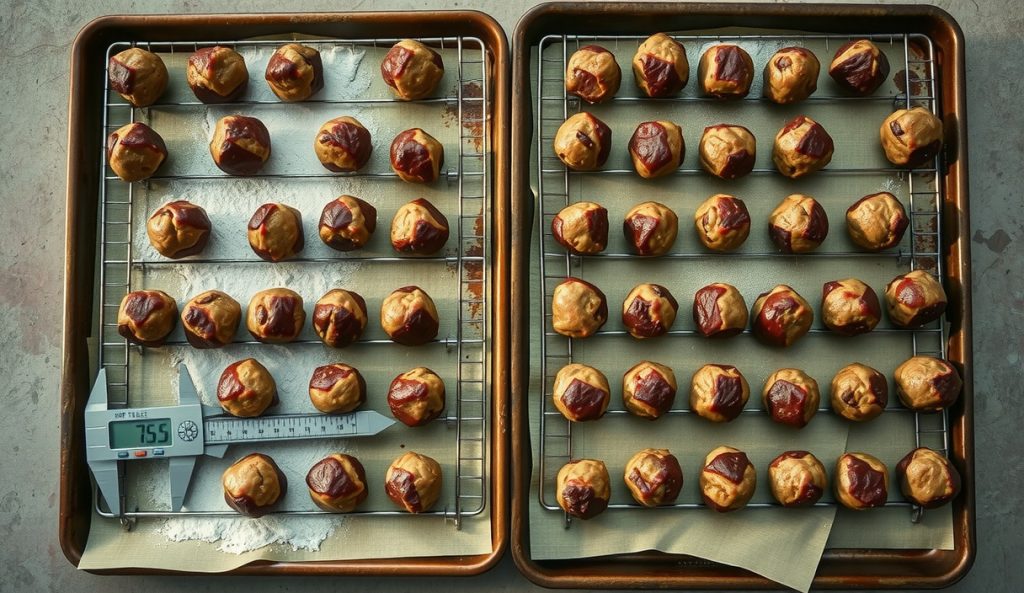
Scaling meatball recipes exposes a problem that does not exist at small batch sizes: as total volume increases, portion uniformity degrades unless it is actively controlled. A meatball even a quarter-inch larger in diameter than its neighbors will lag significantly in internal temperature, meaning by the time the outliers reach 160°F, the smaller meatballs nearby have already overcooked. This large-batch scale-up addresses that problem directly.
What changes when you scale up a gluten-free smoked meatball batch?
The rice flour percentage — approximately 4% of total meat weight — is a stable ratio that scales linearly. At 5 pounds of ground beef, you need approximately 3.2 ounces of rice flour; at 10 pounds, 6.4 ounces. No adjustment is needed: the hydration behavior and starch gel network that forms during cooking scale proportionally with the meat mass. Do not reduce the percentage in large batches as a cost or texture measure — below roughly 3% by weight, the moisture-trapping effect weakens measurably and the meatballs will shed more juice during the smoke.
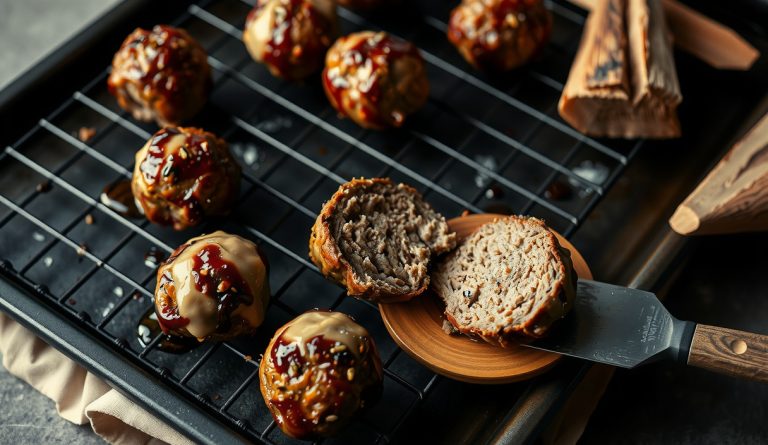
The critical controlled variable in a large batch is diameter. Every meatball must be portioned at exactly 1.75 inches — use a #20 disher (a 1.75-ounce scoop) for reliable uniformity across the entire batch. Heat penetration to the geometric center of a sphere scales with the square of the radius: a meatball at 2 inches diameter has roughly 30% more volume than one at 1.75 inches, which translates directly to a longer lag time to center temperature. Across a crowded smoker grate, this size variance produces an unacceptable spread in final internal temperatures at any single pull point. The disher removes that variable entirely.
What stays the same no matter how large the batch gets?
Cook temperature (225°F), target internal temperature (160°F), wood selection, and all ingredient ratios remain unchanged regardless of batch size. The only operational adjustment for very large batches is ensuring adequate grate spacing — meatballs should not touch, and smoke circulation between them matters for even exterior development.
When is the large-batch scale-up the better choice?
This approach is essential for catering quantities, meal-prep freezer batches, or any event where you are producing more than 40 meatballs in a single cook. At those volumes, eyeballing portions becomes statistically unreliable and cook-time variance compounds into real food safety and quality risk. The #20 disher pays for itself on the first large batch.
Use the full method, equipment, and rub measurements from the original Gluten-Free Smoked Meatballs — Rice-Flour Binder.