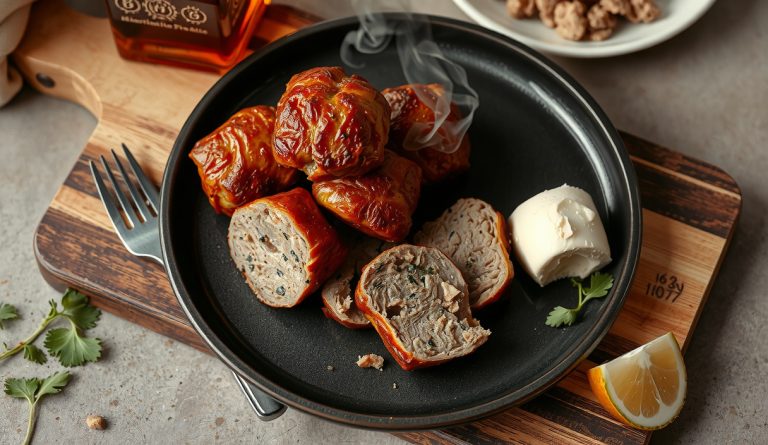
Gluten-Free Smoked Meatballs — Rice-Flour Binder

Equipment
- 1 Offset smoker, pellet grill, or kettle grill with indirect setup Maintain 250°F chamber temp throughout the cook.
- 1 Instant-read thermometer Pull meatballs at exactly 160°F internal for safe carryover to 165°F.
- 1 #20 disher or 1.75-oz cookie scoop Ensures consistent 1.75-inch diameter across all meatballs for even cook time.
- 1 Wire cooling rack set over a sheet pan Use for resting finished meatballs — keeps bottom crust intact.
- 1 Large mixing bowl
- 2-3 Apple wood chunks or chips Soak chips 30 minutes if using a charcoal setup; chunks need no soaking.
Ingredients
Meatball Base
- 2 lbs ground beef, 80/20 chuck Keep refrigerator-cold until mixing.
- 3 tablespoons superfine white rice flour Bob’s Red Mill 1-to-1 superfine or joshinko style. Do not substitute brown rice flour.
- 3 tablespoons whole milk Hydrates the rice starch granules. Substitute unsweetened full-fat oat milk for dairy-free.
- 2 large eggs Whole eggs — yolk provides emulsification, albumen provides heat-set structure.
- 1.5 oz finely grated Parmigiano-Reggiano Grate from a block on a microplane. Approximately 6 tablespoons packed. Omit and see dairy-free variation if needed.
- 4 cloves garlic, minced to a paste Use the flat of a knife to work into a paste after mincing — distributes more evenly than coarse mince.
- 2 tablespoons fresh flat-leaf parsley, finely chopped
- 1.5 teaspoons kosher salt
- 0.75 teaspoon freshly ground black pepper
- 0.5 teaspoon dried oregano
- 0.25 teaspoon red pepper flakes Optional. Omit for a milder profile.
- 1 teaspoon Worcestershire sauce Verify gluten-free labeling — most major US brands (Lea & Perrins) are GF, but always confirm.
For the Smoker
- 2-3 chunks apple wood Or substitute 50/50 hickory and cherry for a bolder smoke profile.
- 1 tablespoon neutral oil For lightly oiling the smoker grate to prevent sticking.

Instructions
Mix and Form
- Combine the rice flour and whole milk in a small bowl. Stir together and let rest for 5 minutes — you want the starch granules to begin absorbing the liquid before the mix goes into the meat. The slurry will thicken slightly.3 tablespoons whole milk, 2 large eggs
- In a large mixing bowl, combine the cold ground beef, hydrated rice flour slurry, eggs, Parmigiano-Reggiano, garlic paste, parsley, salt, black pepper, oregano, red pepper flakes (if using), and Worcestershire sauce. Mix by hand using a folding motion only — do not squeeze or knead. Stop the moment no dry pockets remain. Overworking compresses the protein matrix and produces a rubbery crumb.3 tablespoons superfine white rice flour, 3 tablespoons whole milk, 2 large eggs, 1.5 oz finely grated Parmigiano-Reggiano, 4 cloves garlic, minced to a paste, 2 tablespoons fresh flat-leaf parsley, finely chopped, 1.5 teaspoons kosher salt, 0.75 teaspoon freshly ground black pepper, 0.5 teaspoon dried oregano, 0.25 teaspoon red pepper flakes, 1 teaspoon Worcestershire sauce
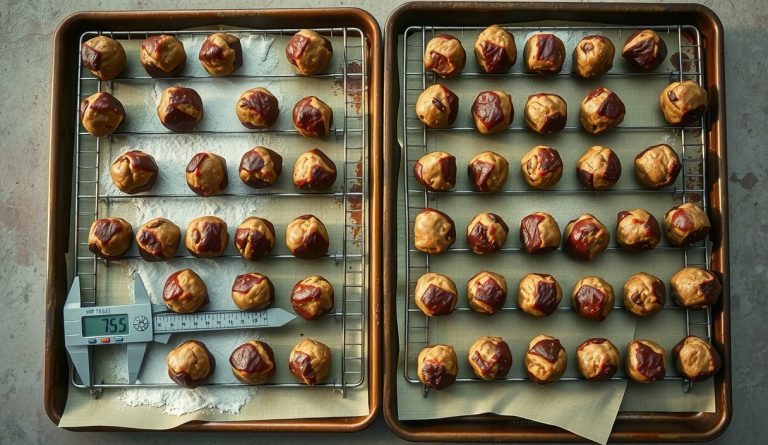
- Using a #20 disher or lightly oiled hands, portion the mixture into balls approximately 1.75 inches in diameter (about 1.75 oz each). You should get roughly 24 meatballs. Place on a parchment-lined sheet pan and refrigerate uncovered for 20 minutes. The chill firms the myosin slightly, helping the balls hold their shape on the smoker grate without flattening.
Fire Up the Smoker
- Prepare your smoker for indirect cooking. Target a stable 250°F (121°C) chamber temperature. Add apple wood chunks or chips — you are aiming for thin blue smoke, not billowing white. White smoke carries excess particulates that deposit acrid creosote on the meatball surface. Give the smoker 15 to 20 minutes to reach temperature and clean smoke before loading.2-3 chunks apple wood
- Lightly oil the smoker grate. Arrange the cold meatballs directly on the grate with at least half an inch of clearance between each ball — airflow around the entire surface is what builds an even crust on all sides.1 tablespoon neutral oil
Smoke
- Close the lid and smoke the meatballs at 250°F without opening the lid for the first 30 minutes. During this window, surface water activity drops below 0.7 and the Maillard browning cascade begins. Opening the lid prematurely drops chamber temp and stalls surface drying.
- After 30 minutes, open the lid and probe one meatball from the side — inserting the thermometer through the equator reaches the geometric center without dragging surface creosote into the core. Continue smoking, checking every 10 minutes, until the internal temperature reads 160°F (71°C). Total smoke time is typically 45 to 55 minutes at 250°F, depending on your smoker and meatball size.
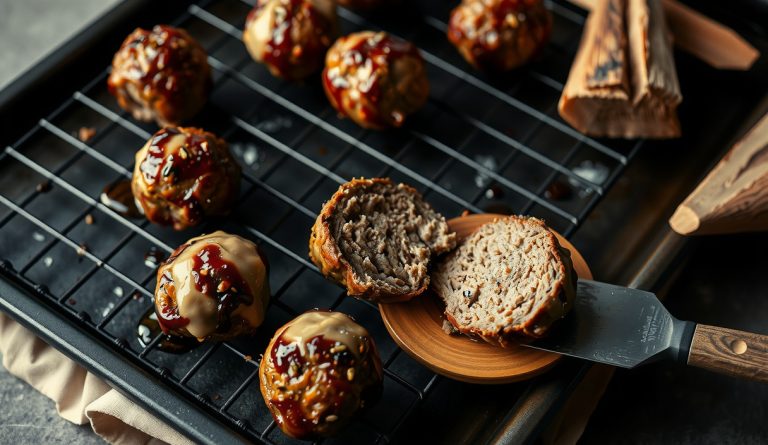
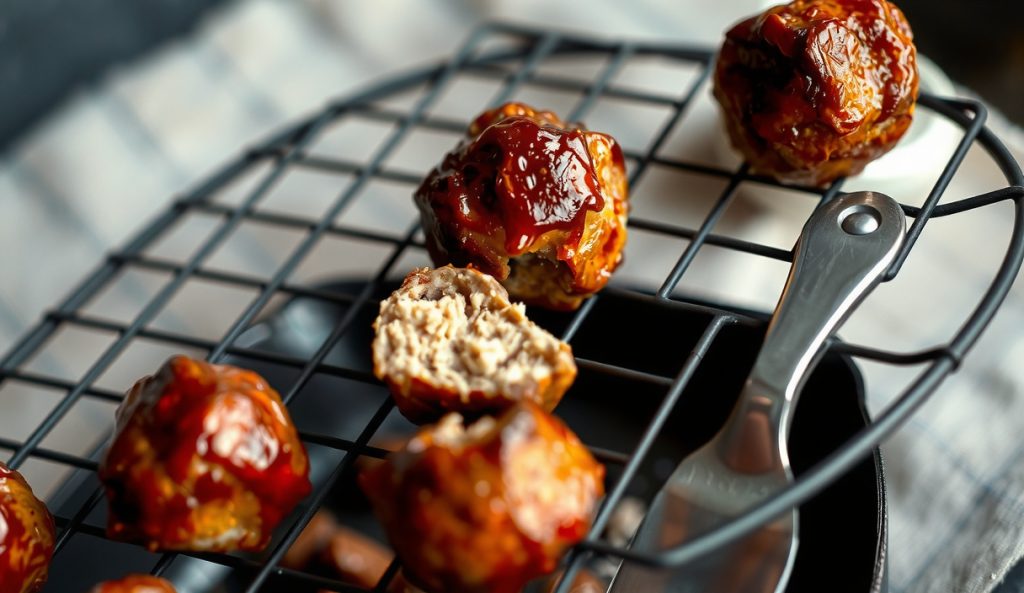
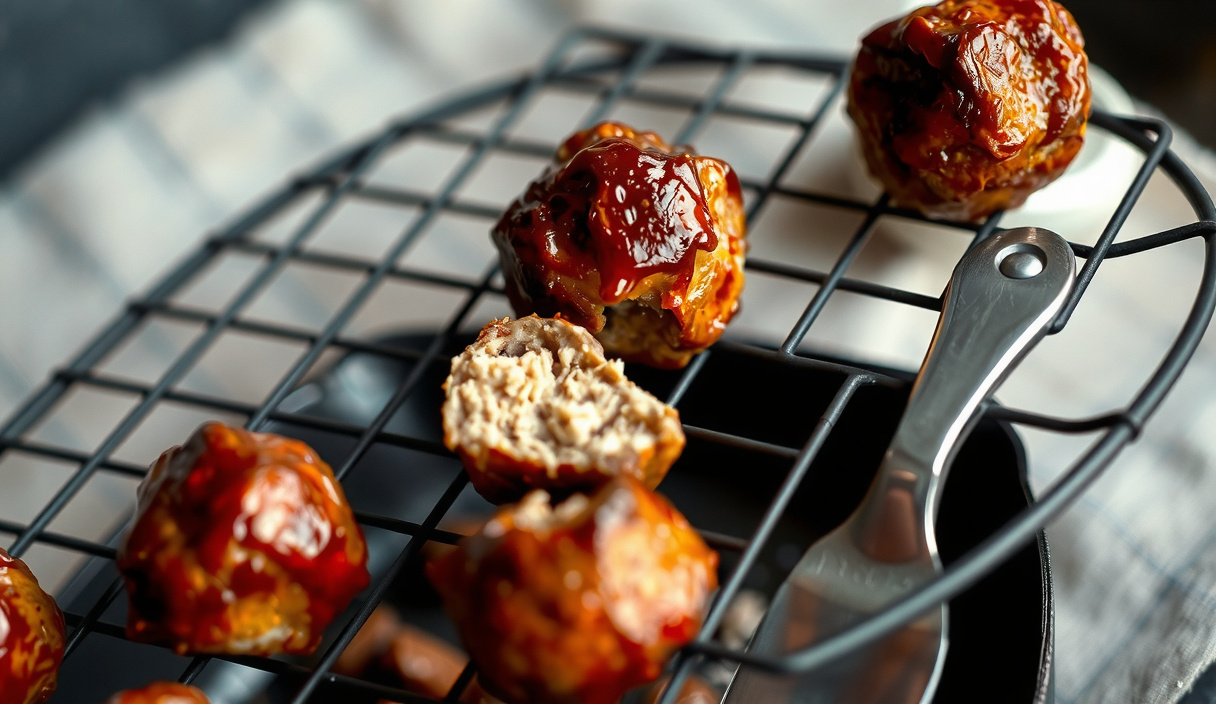
- When the probe reads 160°F, pull all meatballs immediately and transfer to a wire rack set over a sheet pan. Do not place on a flat surface — resting on a plate traps steam and softens the bottom bark. Rest for 5 minutes; carryover will bring the internal temperature to a safe 165°F (74°C) while the crust sets.
Serve
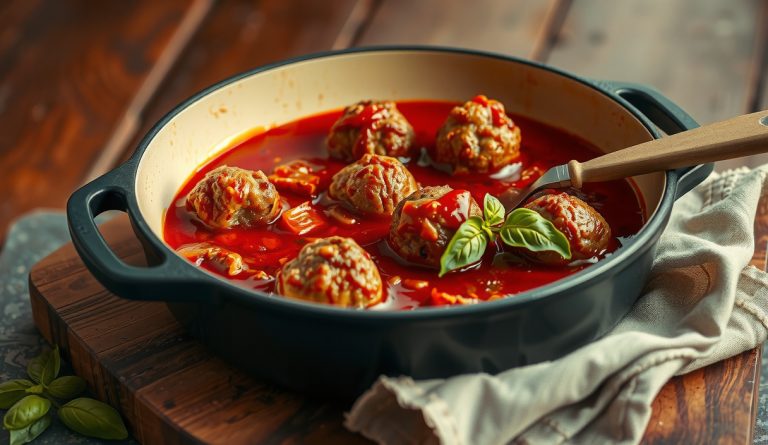
- Serve immediately over gluten-free pasta with marinara, in a gluten-free hoagie roll with provolone, or straight off the rack with a dipping sauce. The meatballs reheat well — warm in a covered skillet with a splash of broth over low heat to reactivate the starch gel and prevent the exterior from drying out.
Notes
Nutrition
I grew up eating my grandmother’s Sunday meatballs — dense, breadcrumb-padded spheres that soaked through a red sauce for four hours. When I committed to gluten-free cooking, I spent two years chasing that same tender, cohesive crumb. Every alternative binding system I tried — almond flour, potato starch, xanthan gum alone — either turned rubbery under heat or crumbled the moment I lifted a meatball off the smoker grate. Rice flour changed the equation, and the physics behind why it works are genuinely interesting.
The moment I added rice flour to a smoked meatball and ran it up to an internal temp of 165°F, the texture finally clicked. There is a specific mechanism at work, and once you understand it, you will never reach for a gluten-containing panade again.
Why does a rice-flour binder work in gluten-free smoked meatballs? The science
Rice flour works as a meatball binder because its starch granules undergo irreversible gelatinization between 155°F and 175°F — precisely the thermal window that coincides with the meatball’s final cook to 160–165°F internal. Traditional meatball panade uses stale white bread soaked in milk: the gluten network stretches under mechanical stress without snapping, trapping steam and fat inside the protein matrix as it cooks. Remove wheat, and you lose that extensible polymer scaffold. Rice flour is the closest direct functional replacement — not because of protein, but because of starch gelatinization. Between 155°F and 175°F, rice starch granules absorb water, swell dramatically, and enter an irreversible phase transition in which amylose and amylopectin chains leach out of the granule and form a continuous, viscous gel network — the same thermodynamic mechanism that sets a béchamel. Inside a meatball cooking to 160–165°F internal, that gelatinization happens after myosin has already denatured (peak ~55°C / 131°F) but before actin collapse (~74°C / 165°F) catastrophically expels bound water. The rice-starch gel occupies the interstitial spaces between muscle fibers and locks moisture in place, performing functionally the same role as the swollen bread-crumb matrix.
Parmesan adds a secondary binding layer that is often overlooked. At cooking temperatures, residual moisture in finely grated aged parmesan activates its concentrated whey proteins, which cross-link with the myosin network via hydrogen bonding. The result is a slightly firmer, more cohesive crumb than rice flour alone would produce — and a measurable uptick in free glutamates, pushing the Maillard reaction on the exterior surface toward deeper melanoidin browning. This is why the crust on these meatballs develops a complexity that plain gluten-free binders cannot achieve.
The smoker itself adds the third dimension. Running a 250°F (121°C) indirect convective environment with cherry or apple wood means the exterior of the meatball heats faster than the core. Surface water activity drops below 0.7 within the first 20 minutes, creating the dry surface boundary layer the Maillard reaction requires — the cascade from Schiff base formation through Strecker degradation yields hundreds of volatile aromatic compounds, most notably pyrazines and furans, that you simply cannot replicate in an oven. The smoke’s dissolved phenolic compounds — guaiacol and syringol — deposit on the exterior and contribute to both color and that characteristic wood-smoke permanence on the palate. Monitor internal temp aggressively: pull at 160°F (71°C) and let carryover bring the meatballs to 165°F (74°C). Overshoot into actin collapse territory and no binder system in the world will save the texture.
What equipment and ingredients do I need?
- Rice flour: Use superfine white rice flour — not brown rice flour. Brown rice has a higher fiber fraction that interferes with starch granule swelling and introduces a grainy mouthfeel above 3% inclusion. Bob’s Red Mill superfine or a Japanese-style joshinko work perfectly.
- Ground beef: 80/20 chuck is the target. The 20% fat fraction provides the intramuscular lipid buffer that carries fat-soluble smoke aromatics. Leaner blends dry out; fattier blends pool rendered fat that disrupts the starch gel.
- Parmesan: Finely grate from a block — pre-grated contains anti-caking agents such as potato starch or cellulose that are technically gluten-free but alter the moisture balance. If strict dairy-free is required, see Variations below.
- Eggs: One large whole egg per pound of meat. The yolk’s LDL lipoprotein complexes stabilize the fat-water interface inside the meatball; the albumen provides heat-set structural reinforcement above 140°F (60°C).
- Smoker type: Offset, pellet, or kettle with indirect setup all work. Target chamber temp 250°F (121°C). Cherry wood delivers mild sweetness; hickory is more aggressive and pairs well with the parmesan’s salt load. Apple is the default recommendation here — neutral and slightly sweet.
- Instant-read thermometer: Non-negotiable. The 5°F window between perfect texture and overcooked actin collapse is real and unforgiving.
Gluten-Free Smoked Meatballs — Rice-Flour Binder
Equipment
- 1 Offset smoker, pellet grill, or kettle grill with indirect setup Maintain 250°F chamber temp throughout the cook.
- 1 Instant-read thermometer Pull meatballs at exactly 160°F internal for safe carryover to 165°F.
- 1 #20 disher or 1.75-oz cookie scoop Ensures consistent 1.75-inch diameter across all meatballs for even cook time.
- 1 Wire cooling rack set over a sheet pan Use for resting finished meatballs — keeps bottom crust intact.
- 1 Large mixing bowl
- 2-3 Apple wood chunks or chips Soak chips 30 minutes if using a charcoal setup; chunks need no soaking.
Ingredients
Meatball Base
- 2 lbs ground beef, 80/20 chuck Keep refrigerator-cold until mixing.
- 3 tablespoons superfine white rice flour Bob’s Red Mill 1-to-1 superfine or joshinko style. Do not substitute brown rice flour.
- 3 tablespoons whole milk Hydrates the rice starch granules. Substitute unsweetened full-fat oat milk for dairy-free.
- 2 large eggs Whole eggs — yolk provides emulsification, albumen provides heat-set structure.
- 1.5 oz finely grated Parmigiano-Reggiano Grate from a block on a microplane. Approximately 6 tablespoons packed. Omit and see dairy-free variation if needed.
- 4 cloves garlic, minced to a paste Use the flat of a knife to work into a paste after mincing — distributes more evenly than coarse mince.
- 2 tablespoons fresh flat-leaf parsley, finely chopped
- 1.5 teaspoons kosher salt
- 0.75 teaspoon freshly ground black pepper
- 0.5 teaspoon dried oregano
- 0.25 teaspoon red pepper flakes Optional. Omit for a milder profile.
- 1 teaspoon Worcestershire sauce Verify gluten-free labeling — most major US brands (Lea & Perrins) are GF, but always confirm.
For the Smoker
- 2-3 chunks apple wood Or substitute 50/50 hickory and cherry for a bolder smoke profile.
- 1 tablespoon neutral oil For lightly oiling the smoker grate to prevent sticking.
Instructions
Mix and Form
- Combine the rice flour and whole milk in a small bowl. Stir together and let rest for 5 minutes — you want the starch granules to begin absorbing the liquid before the mix goes into the meat. The slurry will thicken slightly.3 tablespoons whole milk, 2 large eggs
- In a large mixing bowl, combine the cold ground beef, hydrated rice flour slurry, eggs, Parmigiano-Reggiano, garlic paste, parsley, salt, black pepper, oregano, red pepper flakes (if using), and Worcestershire sauce. Mix by hand using a folding motion only — do not squeeze or knead. Stop the moment no dry pockets remain. Overworking compresses the protein matrix and produces a rubbery crumb.3 tablespoons superfine white rice flour, 3 tablespoons whole milk, 2 large eggs, 1.5 oz finely grated Parmigiano-Reggiano, 4 cloves garlic, minced to a paste, 2 tablespoons fresh flat-leaf parsley, finely chopped, 1.5 teaspoons kosher salt, 0.75 teaspoon freshly ground black pepper, 0.5 teaspoon dried oregano, 0.25 teaspoon red pepper flakes, 1 teaspoon Worcestershire sauce
- Using a #20 disher or lightly oiled hands, portion the mixture into balls approximately 1.75 inches in diameter (about 1.75 oz each). You should get roughly 24 meatballs. Place on a parchment-lined sheet pan and refrigerate uncovered for 20 minutes. The chill firms the myosin slightly, helping the balls hold their shape on the smoker grate without flattening.
Fire Up the Smoker
- Prepare your smoker for indirect cooking. Target a stable 250°F (121°C) chamber temperature. Add apple wood chunks or chips — you are aiming for thin blue smoke, not billowing white. White smoke carries excess particulates that deposit acrid creosote on the meatball surface. Give the smoker 15 to 20 minutes to reach temperature and clean smoke before loading.2-3 chunks apple wood
- Lightly oil the smoker grate. Arrange the cold meatballs directly on the grate with at least half an inch of clearance between each ball — airflow around the entire surface is what builds an even crust on all sides.1 tablespoon neutral oil
Smoke
- Close the lid and smoke the meatballs at 250°F without opening the lid for the first 30 minutes. During this window, surface water activity drops below 0.7 and the Maillard browning cascade begins. Opening the lid prematurely drops chamber temp and stalls surface drying.
- After 30 minutes, open the lid and probe one meatball from the side — inserting the thermometer through the equator reaches the geometric center without dragging surface creosote into the core. Continue smoking, checking every 10 minutes, until the internal temperature reads 160°F (71°C). Total smoke time is typically 45 to 55 minutes at 250°F, depending on your smoker and meatball size.
- When the probe reads 160°F, pull all meatballs immediately and transfer to a wire rack set over a sheet pan. Do not place on a flat surface — resting on a plate traps steam and softens the bottom bark. Rest for 5 minutes; carryover will bring the internal temperature to a safe 165°F (74°C) while the crust sets.
Serve
- Serve immediately over gluten-free pasta with marinara, in a gluten-free hoagie roll with provolone, or straight off the rack with a dipping sauce. The meatballs reheat well — warm in a covered skillet with a splash of broth over low heat to reactivate the starch gel and prevent the exterior from drying out.
Notes
Nutrition
How do I nail gluten-free smoked meatballs every time?
- Cold meat, warm hands: Mix the meatball blend cold — start with refrigerator-temperature ground beef. Mixing warm meat causes myosin to begin cross-linking prematurely, yielding a rubbery crumb before the smoker even lights. Mix only until ingredients are distributed, then refrigerate the formed balls for 20 minutes before loading the smoker.
- Do not pack tight: Overworking compresses air pockets and increases the density of the protein matrix, leaving no room for the starch gel to expand. Mix by hand with a light touch — think folding, not kneading.
- Moisture-balance the panade: Rice flour is drier than bread crumb. If you are pulling your milk measurement from a bread-crumb recipe, add an extra tablespoon of whole milk or broth. Under-hydration starves the starch granules and produces a grainy interior.
- Run thin blue smoke, not billowing white: White billowing smoke contains excess particulates that coat the exterior with acrid creosote. Thin blue smoke means cleaner combustion, a controlled phenolic deposit, and layered flavor rather than harshness.
- Probe from the side, not the top: Inserting the thermometer probe through the side of the meatball reaches the geometric center without disrupting the crust. Top-down probing can drag surface creosote into the interior.
- Rest on a rack, not a plate: Resting on a flat surface traps steam under the meatball and softens the bottom crust. A wire rack preserves the all-around bark developed during the smoke.
What variations can I make to this recipe?
Dairy-free: Replace the parmesan with 2 tablespoons of nutritional yeast plus 1 teaspoon of white miso paste. Nutritional yeast provides free glutamates and a similar Maillard-active amino acid profile without the dairy protein network. The miso supplies ionic strength via salt and a secondary umami layer via glutamate-IMP synergy. Expect a very slightly softer crumb, since the whey-protein cross-linking is no longer present.
Higher smoke intensity: Swap apple wood for a 50/50 blend of hickory and cherry. Hickory drives higher guaiacol concentrations on the surface — assertive, almost bacon-like — while the cherry maintains a mild sweetness that prevents the smoke from reading as bitter. Monitor smoke color carefully; hickory burns hotter and can drift toward white smoke more readily than fruit woods.
Sauce-braised finish: After the full smoke to 160°F internal, transfer the meatballs to a tomato sauce with a pH of approximately 4.2 and braise at a gentle 185°F for 20 minutes. The acid environment will slightly loosen the surface bark but will drive additional collagen hydrolysis in the connective tissue of the chuck, producing a silkier, more unctuous mouthfeel. The rice starch gel is acid-stable in this range and will hold its moisture-trapping structure throughout the braise.
Scaling up: The rice flour percentage — approximately 4% of total meat weight — holds across batch sizes. The critical variable when scaling is keeping meatball diameter consistent at 1.75 inches for every ball. If diameter increases even slightly, cook time extends and the risk of exterior overcooking while the core lags behind increases. Use a #20 disher (1.75-oz scoop) for reliable uniformity across large batches.
Frequently asked questions
Can I use brown rice flour instead of white rice flour? Brown rice flour contains the bran layer, which carries more insoluble fiber and disrupts the continuous starch gel network during gelatinization. The result is a noticeably grittier texture and reduced moisture retention compared to white rice flour. Superfine white rice flour gelatinizes more cleanly and is the strongly preferred option for gluten-free smoked meatballs.
Do I need to sear the meatballs before or after smoking? A pre-sear or post-sear is not required and is generally counterproductive before smoking. The Maillard reaction proceeds efficiently on the smoker surface as water activity drops below 0.7 on the exterior — which happens within the first 15 to 20 minutes at 250°F. A pre-sear adds a lipid-rendered fat-pooling risk and disrupts the geometry of the formed ball before the protein matrix has set. A post-smoke sear over direct high heat for 60 seconds per side will intensify the bark further if maximum crust is the goal, but the smoke-only crust is excellent on its own.
Why do my meatballs crack or split on the smoker? Cracking is almost always a moisture-balance problem with two root causes. First, insufficient liquid in the panade means the rice starch granules cannot fully hydrate and swell, so they resist rather than accommodate the thermal expansion of the protein matrix. Second, meatballs packed too densely have no structural give when steam pressure builds internally. Add a tablespoon of cold milk or beef broth to the mix and lighten hand pressure when forming to prevent both failure modes.