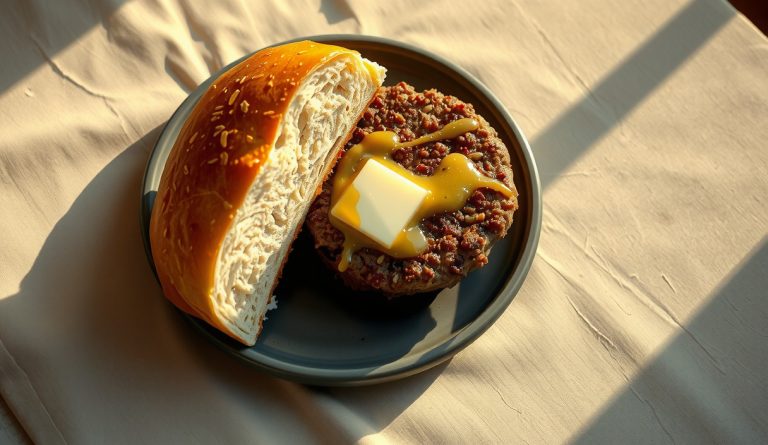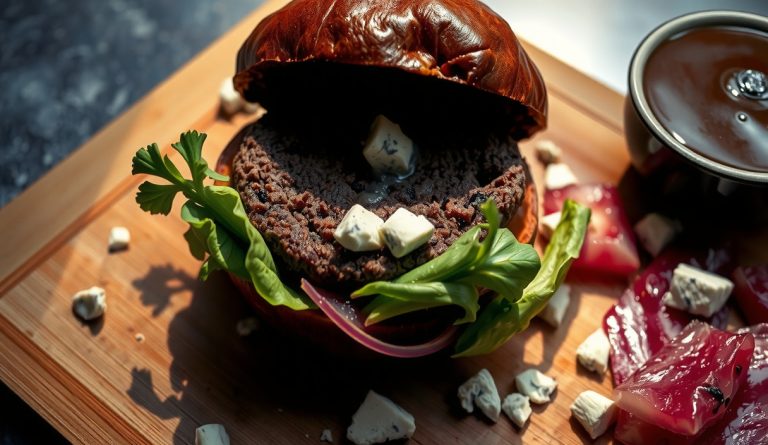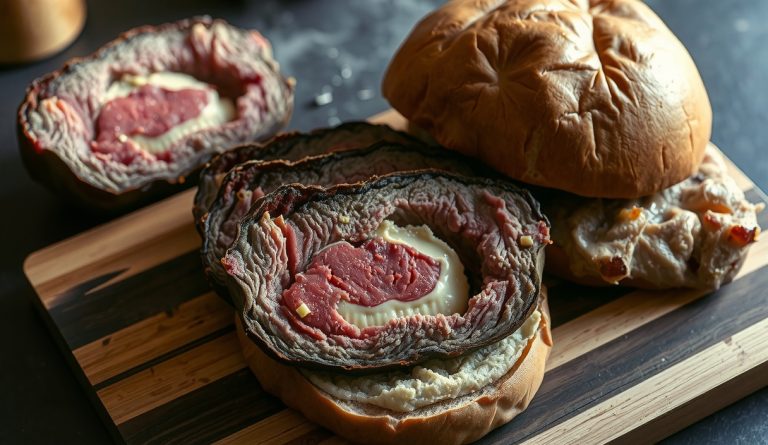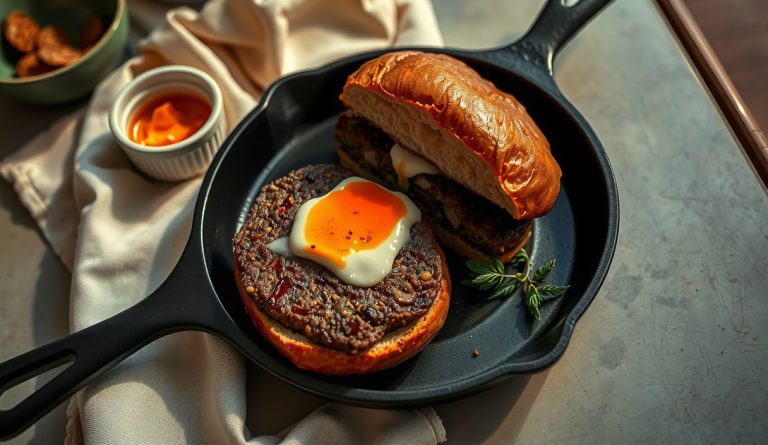
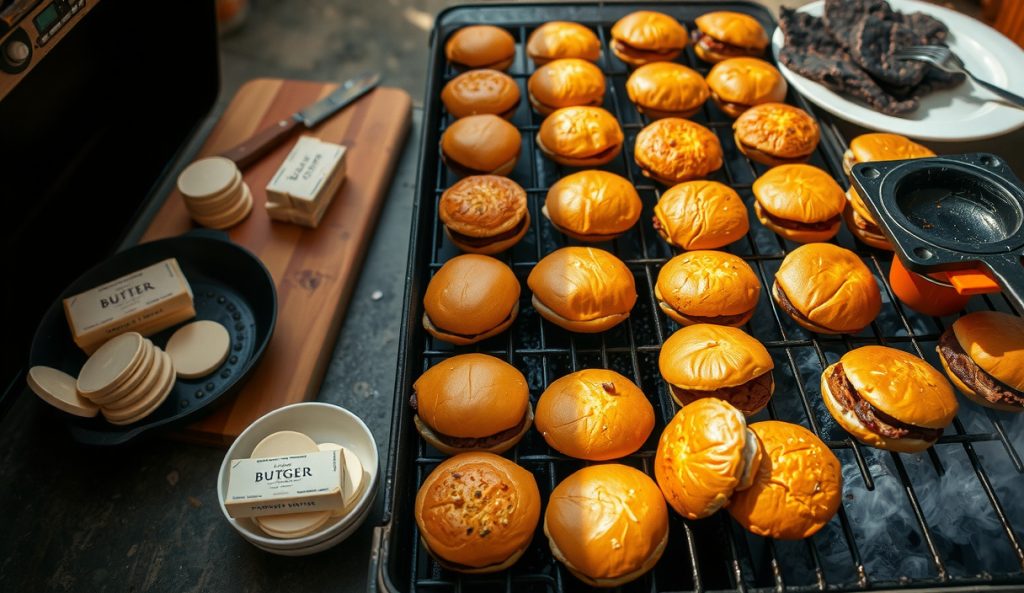
The compound-butter smoked burger scales efficiently for a crowd because the smoke phase is passive and largely indifferent to volume — all patties smoke simultaneously — while ingredient ratios multiply without complication. The single constraint is the sear. A smoked burger that skips a proper high-heat sear loses the crust that contains the molten butter center and the Maillard-derived flavor compounds that define the finished product. Scaling well means protecting that sear regardless of how many patties you are producing.
What changes when you scale up the smoked burger?
Form as many patties as your smoker grate can accommodate, maintaining a minimum 2-inch gap between each patty for even smoke circulation and consistent airflow across all surfaces. All patties can smoke simultaneously — the smoke phase requires no batching. The sear, however, must be run in strict batches. A 12-inch cast iron skillet holds a maximum of two smoked burger patties at once.
Adding a third patty drops the pan surface temperature precipitously: the thermal mass of a standard cast iron skillet, pre-heated to 450–500 °F, cannot recover fast enough when more than two cold-surface patties are placed simultaneously. When pan temperature falls below approximately 300 °F, the Maillard reaction — which requires surface temperatures above roughly 280–300 °F and low surface moisture — stalls completely.
Moisture released from the smoked burger patties accumulates in the pan instead of vaporizing instantly, and the patties steam rather than sear. A steamed smoked burger has a gray, soft exterior that cannot structurally contain the melting compound-butter center. Keep a probe thermometer in the pan between batches and allow full recovery to 450 °F before loading the next pair. Pre-heating a second skillet in parallel is the most efficient way to maintain throughput without compromising crust quality.
What stays the same no matter how many patties you make?
Every element of the canonical smoked burger recipe — grind, seasoning, compound butter composition, disc-forming technique, smoke temperature, pull temperature, and sear duration per patty — scales linearly and remains unchanged. The per-patty process is identical regardless of total batch size.
When is the crowd-scale smoked burger the right call?
The crowd-scale approach is the correct method for backyard parties, tailgates, or any event where the canonical single-batch recipe is insufficient. Because all smoked burger patties smoke simultaneously and only the sear batches, total active cook time scales sublinearly — a cook for twelve takes only modestly longer than a cook for four, provided you have the cast iron capacity prepped in advance.
Use the full method, ingredient ratios, and equipment guidance from the original Smoked Burger with Compound-Butter Center and multiply straight across.