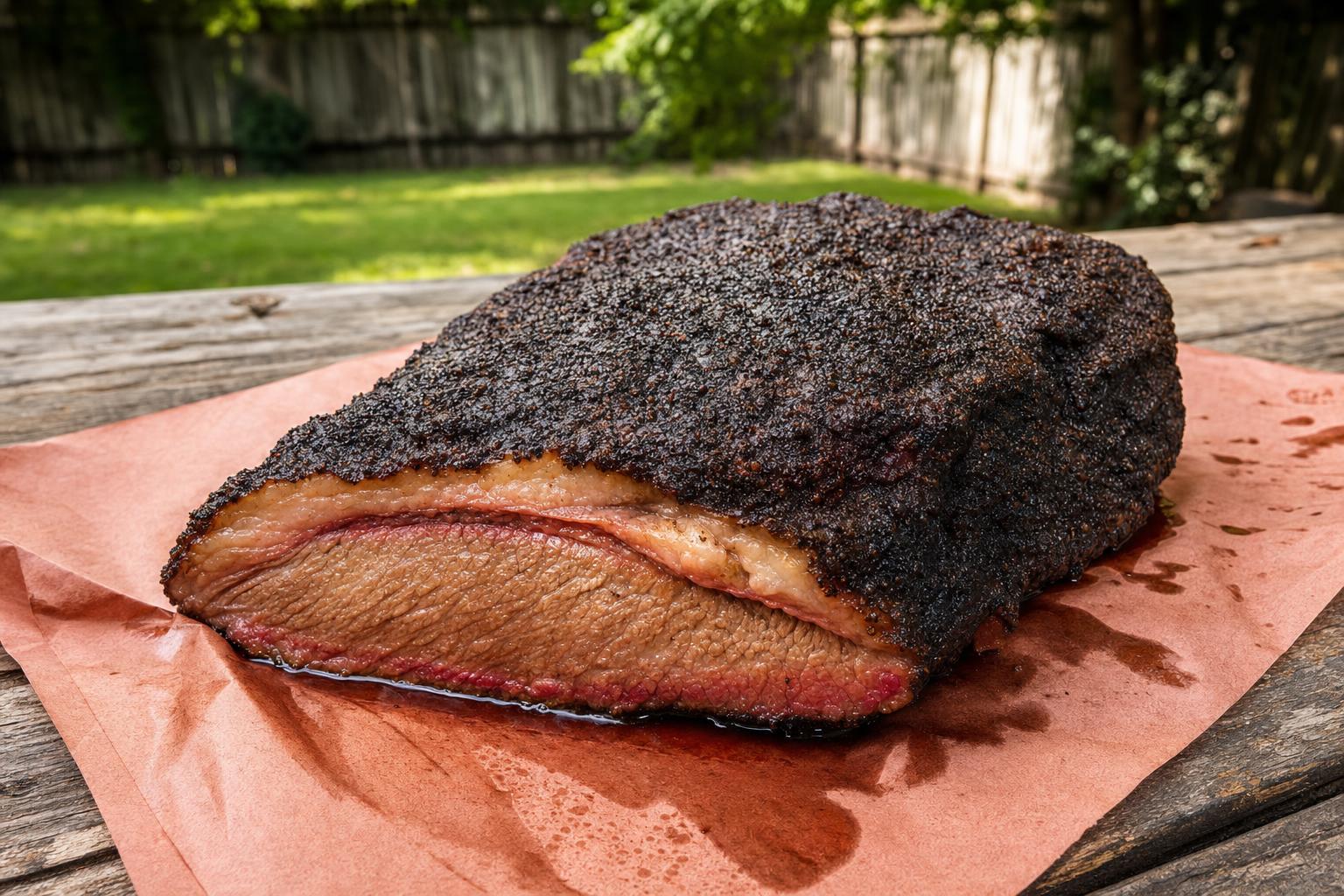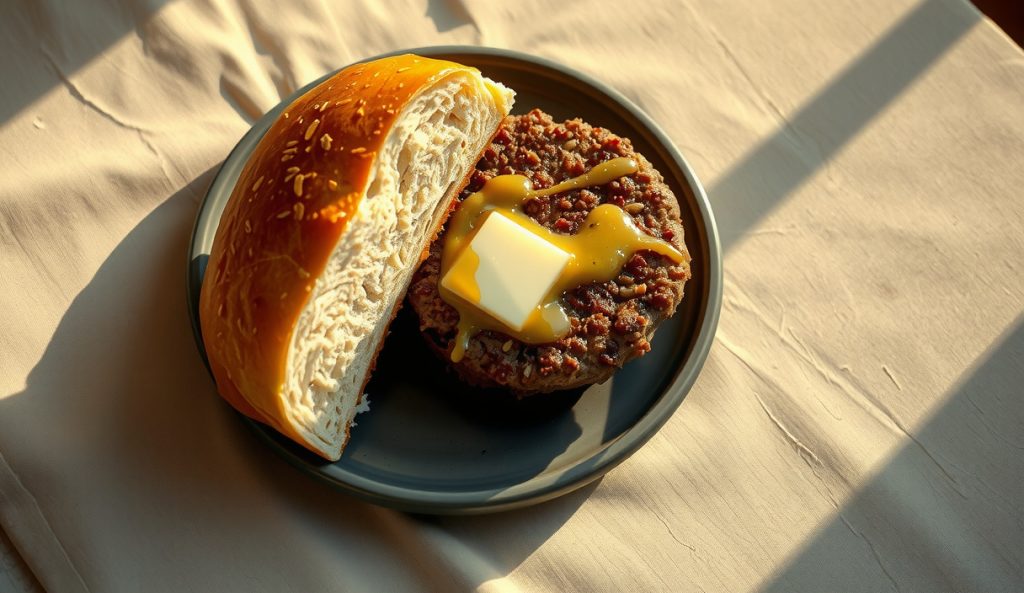
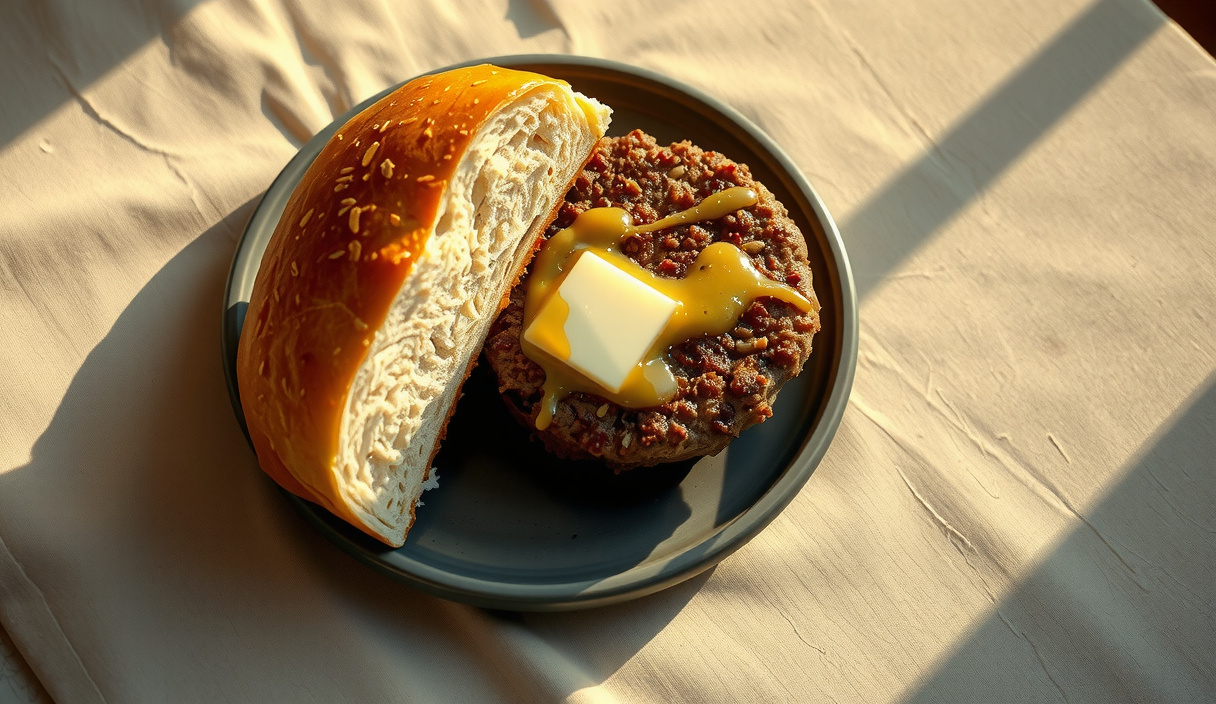
Smoked Burger with Compound-Butter Center
Equipment
- 1 Offset smoker or kettle grill with two-zone setup Maintain 225°F cooking-grate temperature throughout the smoke phase. Calibrate with a separate grate-level thermometer.
- 1 Leave-in instant-read or probe thermometer Required to pull the patty precisely at 110°F internal. Lid thermometers on smokers typically read 30–50°F high.
- 1 12-inch cast-iron skillet Preheat over maximum burner heat for 8–10 minutes before searing. Target surface temperature of 500°F–520°F.
- 1 Parchment-lined sheet pan For freezing compound butter discs solid before forming patties.
- 1 Burger press or 3-inch ring mold
Ingredients
Compound Butter (make ahead)
- 4 tablespoons unsalted butter room temperature, then re-frozen after mixing
- 1 tablespoon fresh flat-leaf parsley finely minced
- 1 teaspoon fresh thyme leaves stripped from stems
- 1 clove garlic minced to a paste with the flat of a knife
- 1 tablespoon finely grated Parmesan adds glutamate depth
- 0.5 teaspoon kosher salt
- 0.25 teaspoon freshly cracked black pepper
Patty
- 1 pound ground chuck, 80/20 fat ratio freshly ground preferred; cold from refrigerator
- 1 teaspoon kosher salt for exterior seasoning; apply 30 minutes before smoking
- 0.5 teaspoon freshly cracked black pepper
- 0.5 teaspoon garlic powder
Wood and Finishing
- 2 chunks cherry or apple wood for the smoker; produces mild, slightly sweet smoke
- 1 tablespoon neutral high-smoke-point oil avocado or refined grapeseed; for the cast iron before searing
For Serving
- 2 brioche or potato buns toasted in residual pan fat
- 2 slices sharp cheddar or American cheese optional; apply in the final 30 seconds of sear under a basting dome
- lettuce, tomato, pickles, and condiments to preference

Instructions
Make the Compound Butter Discs
- In a small bowl, combine the room-temperature butter, parsley, thyme, garlic paste, Parmesan, salt, and pepper. Mix thoroughly with a fork until all aromatics are evenly distributed through the butter fat phase.1 tablespoon fresh flat-leaf parsley, 1 teaspoon fresh thyme leaves, 1 clove garlic, 1 tablespoon finely grated Parmesan, 0.5 teaspoon kosher salt, 0.25 teaspoon freshly cracked black pepper
- Divide the butter mixture in half. Shape each portion into a flat disc approximately 2 inches in diameter and 1/2 inch thick. Place the discs on a parchment-lined sheet pan and freeze for a minimum of 2 hours, or overnight. The discs must be completely solid — no give when pressed — before you form the patties.
Form the Patties
- Divide the cold ground chuck into 4 equal portions (approximately 4 oz each). Working quickly to keep the meat cold, flatten two of the portions into thin base rounds slightly larger than the butter disc. Place one frozen butter disc in the center of each base round, leaving at least 1/2 inch of meat border around the disc.1 pound ground chuck, 80/20 fat ratio
- Flatten the remaining two meat portions into top rounds of the same diameter. Press each top round over a butter disc, then pinch and seal the perimeter firmly all the way around. You should have two sealed patties each approximately 4 inches in diameter and 1 inch thick with a completely encased butter disc. Handle gently — do not overwork the seam. If any butter is visible at the seam, press it closed and refrigerate the patty for 20 minutes to re-solidify.1 pound ground chuck, 80/20 fat ratio
- Season the exterior of both formed patties generously on all sides with kosher salt, black pepper, and garlic powder. Place the patties uncovered on a wire rack over a sheet pan and refrigerate for 30 minutes. This resting period allows the salt to draw surface moisture back into solution, beginning the drying cycle that will accelerate bark development during the smoke phase.1 pound ground chuck, 80/20 fat ratio, 1 teaspoon kosher salt, 0.5 teaspoon freshly cracked black pepper, 0.5 teaspoon garlic powder
Smoke the Patties
- Set up your smoker or two-zone grill to maintain a steady 225°F at the cooking grate. Add cherry or apple wood chunks to your heat source. Allow the smoker to come to temperature and the smoke to run thin and blue before loading the patties — white billowing smoke deposits acrid compounds on the meat surface.2 brioche or potato buns
- Place the seasoned patties on the smoker grate with at least 2 inches of clearance between them. Insert a leave-in probe thermometer horizontally into the center of one patty, targeting the geometric center where the butter disc sits. Close the lid and smoke at 225°F, monitoring internal temperature closely.
- Pull the patties off the smoker when the internal temperature reads exactly 110°F. This typically takes 30–45 minutes at 225°F depending on patty thickness and smoker airflow. At 110°F, the surface will have developed a light bark and absorbed significant smoke aromatics while the interior butter disc remains structurally solid. Do not let the internal temperature exceed 115°F before the sear — each degree of overshoot compromises the butter pocket’s integrity.
- Remove the patties from the smoker and let them rest uncovered at room temperature for 5 minutes while you preheat the cast iron. This rest slightly firms the exterior and stabilizes the surface for the sear.
Sear and Finish
- Place your 12-inch cast-iron skillet over your highest burner setting and preheat for 8–10 minutes. The surface should be smoking hot — a drop of water should evaporate instantly on contact. Add the neutral oil and swirl to coat; it will smoke immediately, which is correct.2 slices sharp cheddar or American cheese
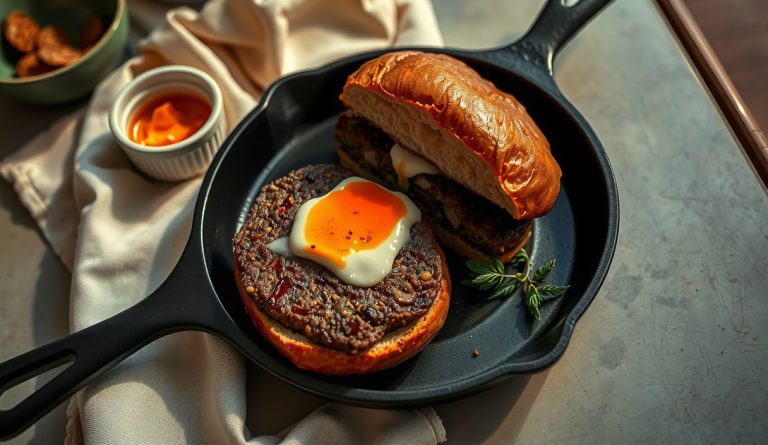
- Place both patties in the skillet. Do not press them down. Sear for 60–90 seconds on the first side — you are targeting deep, dark Maillard crust, not gray steaming. Flip once using a wide spatula. Sear the second side for another 60–90 seconds. If using cheese, place a slice on each patty immediately after the flip and cover the pan with a basting dome or aluminum foil tent for the final 30 seconds to melt under the retained steam.
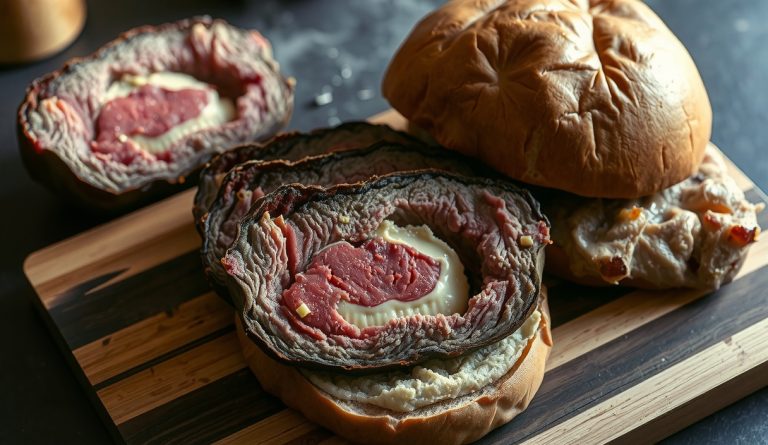
- Remove the patties from the skillet. The internal temperature should now read 130°F–135°F for a medium-rare to medium interior with the butter pocket fully released. Rest the patties on a wire rack for 3 minutes before building the burger — this allows the internal pressure in the butter pocket to equalize and the melted butter to migrate back into the surrounding meat fibers rather than flooding the plate.
- While the patties rest, toast the brioche or potato buns cut-side down in the residual fat in the cast iron for 30–45 seconds until golden. Build the burgers with your preferred toppings and serve immediately.lettuce, tomato, pickles, and condiments
Notes
Nutrition
The best burger I ever ate did not come from a flat-top diner or a Michelin-starred kitchen. It came off a battered offset smoker at 2 a.m. after a competition, and the pitmaster cracked it open to reveal a lagoon of herb-scented butter pooling inside the crust. That moment permanently rewired my approach to ground beef. The burger was not just seasoned — it was internally basted.
This recipe engineers that result deliberately. We form an 80/20 chuck patty around a frozen compound-butter disc, smoke it low and slow at 225°F to build bark and drive smoke penetration while the butter stays locked solid, then blast it on a 500°F cast-iron surface where the Maillard crust forms in under 90 seconds and the butter finally releases — flooding the interior with fat-soluble aromatics at the exact moment the patty reaches its finish temperature. The result is a burger that is simultaneously smoky, seared, and self-basting.
Why does the smoked compound-butter burger work? The science
The smoked compound-butter burger works because the two-stage cook exploits ground beef’s protein-fat matrix at two fundamentally different temperature coordinates — one for smoke absorption, one for crust formation. Ground 80/20 chuck is a composite matrix: roughly 80% lean myofibrillar protein tissue and 20% dispersed fat phase. When you form a patty, you create a loose polymer network held together by surface-tension adhesion between protein strands and fat globules, not by covalent bonds.
During the smoke phase at 225°F, the surface water activity stays high enough to suppress Maillard onset — which requires surface temperatures well above 212°F and local water activity below roughly 0.7 — so instead of browning, the exterior slowly desiccates and absorbs volatile smoke compounds, primarily guaiacol, syringol, and eugenol, that partition strongly into the surface fat phase. Pulling the patty at an internal temperature of 110°F means the center has not yet crossed the myosin denaturation threshold of approximately 120°F–130°F, preserving maximum water-holding capacity in the lean fraction.
The compound-butter disc is the structural heart of this recipe. Frozen solid at 0°F, the butter exists as a crystalline fat lattice — stable β and β’ polymorphic crystal structures that do not begin to melt until they approach their onset near 59°F–95°F depending on the specific triacylglycerol fractions in milkfat. During the low smoke phase, the patty’s interior climbs only to 110°F, meaning the center of the butter disc barely softens. It is the 500°F sear that detonates the release: the exterior proteins denature and cross-link in under 60–90 seconds, forming a rigid crust that mechanically contains the butter as it rapidly crosses its full melt range, creating an internal pressurized pocket of herb-infused liquid fat that bastes the surrounding lean meat from the inside out.
The Maillard cascade at the sear stage is a function of both temperature and water activity. Because the smoke phase has already desiccated the patty surface — dropping local surface water activity well below 0.7 — the crust reaches Maillard-active temperatures almost immediately on contact with the hot cast iron, generating hundreds of volatile carbonyl and pyrazine compounds in the first 30 seconds. This is why the reverse-sear sequence produces a dramatically more complex crust than a direct-sear-only approach: the smoke phase pre-dries the surface and infuses it with aromatic precursors, and the sear converts those precursors into flavor compounds with extraordinary efficiency.
What equipment and ingredients do I need?
- Ground chuck, 80/20: The 20% fat fraction is non-negotiable here. Leaner grinds lack the intramuscular lipid buffer to stay juicy through a two-stage cook, and the fat network is what physically holds the compound butter pocket together as it melts. Ask your butcher to grind fresh; pre-packaged 80/20 works but freshly ground chuck has a looser protein matrix that seals around the butter disc more cleanly.
- Compound butter disc: The disc must be frozen solid before it goes into the patty — this is not optional. Softened butter will simply smear through the meat and never create a discrete pocket. Freeze the discs on a parchment-lined sheet for at least 2 hours, or overnight. Use unsalted butter as your base so you control total sodium precisely.
- Smoker temperature discipline: 225°F pit temperature is the ceiling during the smoke phase. Higher pit temps risk pushing the interior above 110°F before adequate smoke penetration occurs, and they can begin melting the butter disc prematurely. Use a calibrated leave-in probe thermometer — not the lid thermometer on your smoker, which typically reads 30–50°F hotter than the actual cooking grate temperature.
- Cast iron for the sear: You need a surface that holds heat mass, not just a high flame. A 12-inch cast-iron skillet or a plancha preheated over the highest burner setting for 8–10 minutes will be sitting at 500°F–550°F on the cooking surface. A thin stainless pan will temperature-drop the moment the cold patty lands, stalling the Maillard reaction. The mass of cast iron maintains the surface temperature differential needed to generate the crust in under 90 seconds per side.
- Wood selection: Cherry or apple wood for a mild, slightly sweet smoke profile that does not overpower the herb butter. Hickory or oak work but produce a more assertive smoke character — adjust to your preference, but keep the smoke thin and blue, never white and billowing.
Smoked Burger with Compound-Butter Center
Equipment
- 1 Offset smoker or kettle grill with two-zone setup Maintain 225°F cooking-grate temperature throughout the smoke phase. Calibrate with a separate grate-level thermometer.
- 1 Leave-in instant-read or probe thermometer Required to pull the patty precisely at 110°F internal. Lid thermometers on smokers typically read 30–50°F high.
- 1 12-inch cast-iron skillet Preheat over maximum burner heat for 8–10 minutes before searing. Target surface temperature of 500°F–520°F.
- 1 Parchment-lined sheet pan For freezing compound butter discs solid before forming patties.
- 1 Burger press or 3-inch ring mold
Ingredients
Compound Butter (make ahead)
- 4 tablespoons unsalted butter room temperature, then re-frozen after mixing
- 1 tablespoon fresh flat-leaf parsley finely minced
- 1 teaspoon fresh thyme leaves stripped from stems
- 1 clove garlic minced to a paste with the flat of a knife
- 1 tablespoon finely grated Parmesan adds glutamate depth
- 0.5 teaspoon kosher salt
- 0.25 teaspoon freshly cracked black pepper
Patty
- 1 pound ground chuck, 80/20 fat ratio freshly ground preferred; cold from refrigerator
- 1 teaspoon kosher salt for exterior seasoning; apply 30 minutes before smoking
- 0.5 teaspoon freshly cracked black pepper
- 0.5 teaspoon garlic powder
Wood and Finishing
- 2 chunks cherry or apple wood for the smoker; produces mild, slightly sweet smoke
- 1 tablespoon neutral high-smoke-point oil avocado or refined grapeseed; for the cast iron before searing
For Serving
- 2 brioche or potato buns toasted in residual pan fat
- 2 slices sharp cheddar or American cheese optional; apply in the final 30 seconds of sear under a basting dome
- lettuce, tomato, pickles, and condiments to preference
Instructions
Make the Compound Butter Discs
- In a small bowl, combine the room-temperature butter, parsley, thyme, garlic paste, Parmesan, salt, and pepper. Mix thoroughly with a fork until all aromatics are evenly distributed through the butter fat phase.1 tablespoon fresh flat-leaf parsley, 1 teaspoon fresh thyme leaves, 1 clove garlic, 1 tablespoon finely grated Parmesan, 0.5 teaspoon kosher salt, 0.25 teaspoon freshly cracked black pepper
- Divide the butter mixture in half. Shape each portion into a flat disc approximately 2 inches in diameter and 1/2 inch thick. Place the discs on a parchment-lined sheet pan and freeze for a minimum of 2 hours, or overnight. The discs must be completely solid — no give when pressed — before you form the patties.
Form the Patties
- Divide the cold ground chuck into 4 equal portions (approximately 4 oz each). Working quickly to keep the meat cold, flatten two of the portions into thin base rounds slightly larger than the butter disc. Place one frozen butter disc in the center of each base round, leaving at least 1/2 inch of meat border around the disc.1 pound ground chuck, 80/20 fat ratio
- Flatten the remaining two meat portions into top rounds of the same diameter. Press each top round over a butter disc, then pinch and seal the perimeter firmly all the way around. You should have two sealed patties each approximately 4 inches in diameter and 1 inch thick with a completely encased butter disc. Handle gently — do not overwork the seam. If any butter is visible at the seam, press it closed and refrigerate the patty for 20 minutes to re-solidify.1 pound ground chuck, 80/20 fat ratio
- Season the exterior of both formed patties generously on all sides with kosher salt, black pepper, and garlic powder. Place the patties uncovered on a wire rack over a sheet pan and refrigerate for 30 minutes. This resting period allows the salt to draw surface moisture back into solution, beginning the drying cycle that will accelerate bark development during the smoke phase.1 pound ground chuck, 80/20 fat ratio, 1 teaspoon kosher salt, 0.5 teaspoon freshly cracked black pepper, 0.5 teaspoon garlic powder
Smoke the Patties
- Set up your smoker or two-zone grill to maintain a steady 225°F at the cooking grate. Add cherry or apple wood chunks to your heat source. Allow the smoker to come to temperature and the smoke to run thin and blue before loading the patties — white billowing smoke deposits acrid compounds on the meat surface.2 brioche or potato buns
- Place the seasoned patties on the smoker grate with at least 2 inches of clearance between them. Insert a leave-in probe thermometer horizontally into the center of one patty, targeting the geometric center where the butter disc sits. Close the lid and smoke at 225°F, monitoring internal temperature closely.
- Pull the patties off the smoker when the internal temperature reads exactly 110°F. This typically takes 30–45 minutes at 225°F depending on patty thickness and smoker airflow. At 110°F, the surface will have developed a light bark and absorbed significant smoke aromatics while the interior butter disc remains structurally solid. Do not let the internal temperature exceed 115°F before the sear — each degree of overshoot compromises the butter pocket’s integrity.
- Remove the patties from the smoker and let them rest uncovered at room temperature for 5 minutes while you preheat the cast iron. This rest slightly firms the exterior and stabilizes the surface for the sear.
Sear and Finish
- Place your 12-inch cast-iron skillet over your highest burner setting and preheat for 8–10 minutes. The surface should be smoking hot — a drop of water should evaporate instantly on contact. Add the neutral oil and swirl to coat; it will smoke immediately, which is correct.2 slices sharp cheddar or American cheese
- Place both patties in the skillet. Do not press them down. Sear for 60–90 seconds on the first side — you are targeting deep, dark Maillard crust, not gray steaming. Flip once using a wide spatula. Sear the second side for another 60–90 seconds. If using cheese, place a slice on each patty immediately after the flip and cover the pan with a basting dome or aluminum foil tent for the final 30 seconds to melt under the retained steam.
- Remove the patties from the skillet. The internal temperature should now read 130°F–135°F for a medium-rare to medium interior with the butter pocket fully released. Rest the patties on a wire rack for 3 minutes before building the burger — this allows the internal pressure in the butter pocket to equalize and the melted butter to migrate back into the surrounding meat fibers rather than flooding the plate.
- While the patties rest, toast the brioche or potato buns cut-side down in the residual fat in the cast iron for 30–45 seconds until golden. Build the burgers with your preferred toppings and serve immediately.lettuce, tomato, pickles, and condiments
Notes
Nutrition
How do I nail it every time? Tips for the smoked compound-butter burger
- Freeze the butter discs completely solid. If the disc has any give when you press it, it will distribute through the meat during forming rather than creating a discrete pocket. When in doubt, give the discs another 30 minutes in the freezer.
- Do not overwork the meat when forming. Aggressive handling compresses the protein matrix, expelling surface moisture and creating a dense texture that resists the butter pocket. Mix seasoning in with the meat, divide, press a well with your thumb, drop the disc in, and close it over — 10 seconds of contact maximum.
- Pull the patty at exactly 110°F internal during the smoke phase. At this temperature the center is still below myosin denaturation onset and the butter disc is structurally intact. Every degree you overshoot during smoke is a degree of juice and butter containment you lose before the sear even starts.
- Let the seared patty rest for 3 minutes before cutting. The internal butter pocket is under pressure immediately post-sear. Cutting too early releases the butter onto the board rather than letting it absorb into the surrounding meat fibers as they relax. A 3-minute rest drops the internal pressure and allows the butter to migrate back into the lean matrix.
- Preheat the cast iron aggressively. Eight to ten minutes over maximum burner heat is not optional. A surface thermometer reading of 500°F–520°F is your target. Below 450°F and you are braising in rendered fat, not searing — you will get gray rather than crust.
- Season the exterior of the patty, not just the butter. The smoke phase needs surface seasoning to pull moisture to the exterior early, accelerating bark development. Salt the outside of the formed patty 30 minutes before it goes on the smoker so osmosis can draw surface moisture back into solution and begin the drying cycle.
What variations can I make on the smoked compound-butter burger?
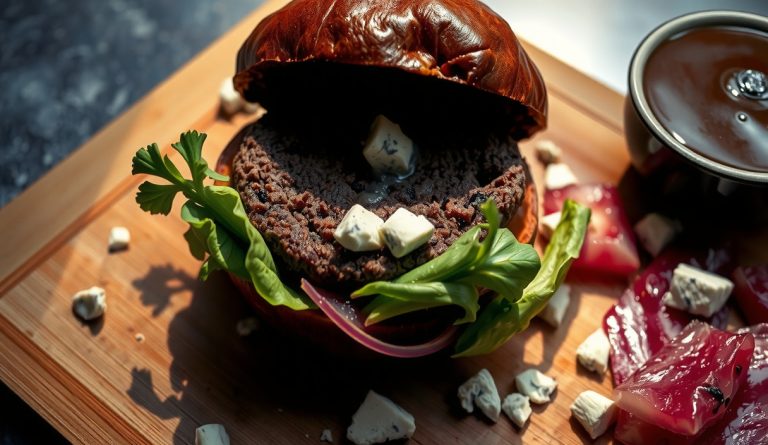
Blue cheese compound butter: Substitute 2 tablespoons of crumbled Roquefort or Gorgonzola for the Parmesan in the compound butter. The blue cheese contributes glutamates that amplify umami alongside the smoke character, and the higher moisture content of blue cheese means the disc will melt faster — reduce your sear time to 60 seconds per side to avoid over-melting the pocket before the crust sets.
Brisket blend: Swap the straight 80/20 chuck for a 70/30 blend of chuck and brisket point, ground together. The higher fat content and increased collagen fraction in brisket point provides more gelatin-forming potential during the smoke phase, resulting in a richer, more unctuous interior. Form and cook identically, but expect the patty to shrink slightly more during the sear due to the higher fat render.
Spiced butter for a Texas profile: Replace the herb compound butter with a compound built from cumin, smoked paprika, ancho chile powder, and a touch of brown sugar. Use hickory or post oak wood in the smoker to match the bold spice register. This variation skews toward Texas barbecue flavor architecture and pairs naturally with a sharp cheddar melt applied in the final 30 seconds of the sear under a basting dome.
Scaling for a crowd: This recipe scales linearly — form as many patties as your smoker grate allows, maintaining a minimum of 2 inches between patties for even smoke circulation. The sear must happen in batches to avoid crowding the cast iron. Crowded pans drop surface temperature below the Maillard threshold and steam the patties rather than searing them. Two patties per 12-inch skillet is the absolute maximum.
Frequently asked questions
Can I make the smoked compound-butter burger entirely on a gas grill without a dedicated smoker? Yes. Set up a two-zone fire — all burners off on one side, one burner on low on the other. Place a foil packet of wood chips over the active burner to generate smoke. Put the patties over the off side with the lid closed, target 225°F ambient, and monitor the internal temperature with a probe. When the patties hit 110°F, move them directly over the hottest burner for the sear. The smoke penetration will be lighter than a dedicated offset but the compound butter mechanism works identically.
What happens if the butter pocket leaks during forming? If you can see butter at the seam when you close the patty, the disc was not frozen hard enough or the meat was overworked and warm. Press the seam firmly and refrigerate the formed patty for 20 minutes before it goes on the smoker — the cold rest will re-solidify any surface butter and tighten the protein matrix around the disc. A patty that leaks slightly during the smoke phase will still deliver good results; the butter simply bastes the exterior rather than the interior.
Why does this recipe require 80/20 chuck specifically and not a leaner grind? The 20% fat fraction serves two simultaneous functions: it provides the intramuscular lipid phase that keeps the lean meat moist through a two-stage cook that takes the interior well above 130°F by the time the sear finishes, and it mechanically lubricates the protein matrix around the compound butter disc, allowing the disc to remain as a discrete pocket rather than fragmenting through the lean tissue. Below 80/20, the patty becomes structurally drier and the butter pocket tends to rupture during the high-heat sear rather than releasing gradually.