Smoked Meatloaf — Bacon-Weave Wrapped
Equipment
- 1 Smoker (offset, pellet, kettle, or kamado) Set up for indirect cooking at a stable 250°F
- 1 Wire rack Elevated rack allows smoke contact on all sides
- 1 Sheet pan (half-size) Lined with foil to catch bacon drippings
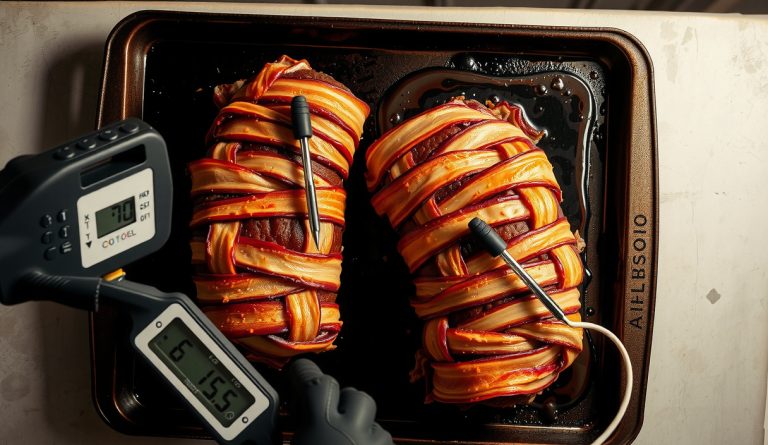
- 1 Instant-read thermometer Probe from the side into the geometric center of the loaf
- 1 Large mixing bowl
- 1 sheet Plastic wrap Used to build and roll the bacon weave cleanly
Ingredients
Panade
- 2 slices white sandwich bread crusts removed, torn into rough pieces
- ⅓ cup whole milk warmed slightly to accelerate starch absorption
Meat Mixture
- 1 lb 80/20 ground beef chuck kept cold until mixing
- 1 lb ground pork shoulder not ground loin — you need the fat and collagen
- 2 large eggs beaten
- ½ cup yellow onion finely grated or food-processed to a paste — no large pieces that create steam pockets
- 3 cloves garlic finely minced or pressed
- 2 tbsp Worcestershire sauce
- 2 tbsp ketchup
- 1 tsp kosher salt
- 1 tsp black pepper freshly ground
- 1 tsp smoked paprika
- ½ tsp dried thyme
- ½ tsp dry mustard powder
Bacon Weave
- 12 strips standard-cut bacon not thick-cut — standard-cut renders fully within the cook window
Optional BBQ Glaze
- ¼ cup BBQ sauce your house sauce; applied in the last 20 minutes only

Instructions
Make the Panade
- Combine the torn bread pieces and warm whole milk in a small bowl. Press the bread down into the milk and let it soak for 5 minutes, until the bread is completely saturated and collapses when squeezed. Mash into a rough paste with a fork. The goal is a homogeneous, wet slurry — no dry crumb remaining. This is the structural spacer that prevents protein over-cross-linking during the long smoke.1/3 cup whole milk
Build the Meat Mixture
- In a large mixing bowl, combine the ground beef, ground pork, beaten eggs, grated onion, minced garlic, Worcestershire sauce, ketchup, kosher salt, black pepper, smoked paprika, dried thyme, dry mustard powder, and the panade paste. Using your hands, mix until the ingredients just disappear into a uniform mass — stop the moment it is homogeneous. Overworking develops myosin cross-links before cooking and produces a rubbery, dense loaf. Work fast; warm hands smear the fat phase.1 lb 80/20 ground beef chuck, 1 lb ground pork shoulder, 2 large eggs, 1/2 cup yellow onion, 3 cloves garlic, 2 tbsp Worcestershire sauce, 2 tbsp ketchup, 1 tsp kosher salt, 1 tsp black pepper, 1 tsp smoked paprika, 1/2 tsp dried thyme, 1/2 tsp dry mustard powder, 1/3 cup whole milk
- Refrigerate the meat mixture for 20 minutes. This firms the fat phase and makes the loaf easier to form a clean freehand shape without sticking to your hands.
Build the Bacon Weave
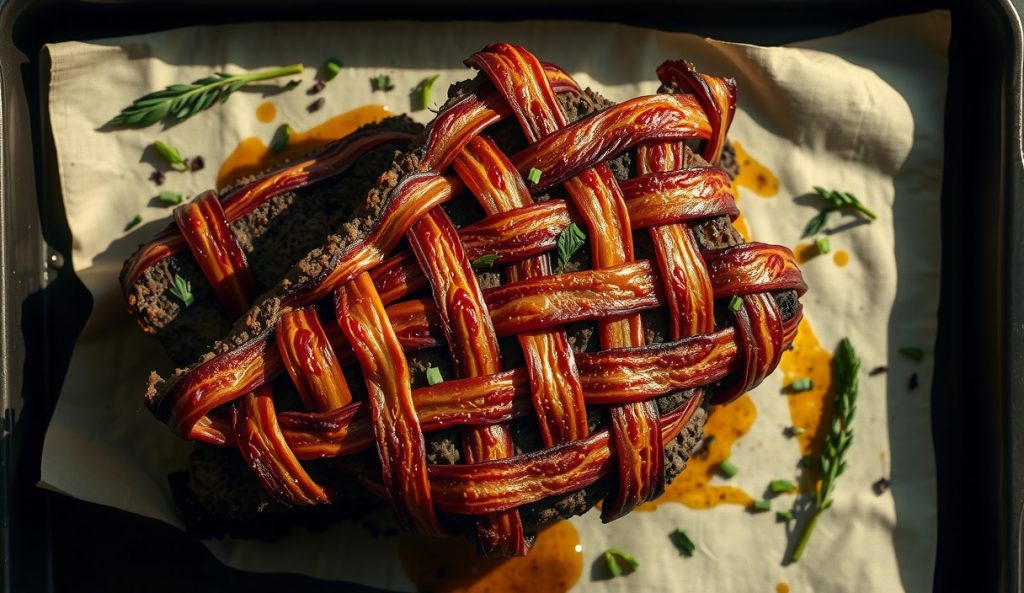
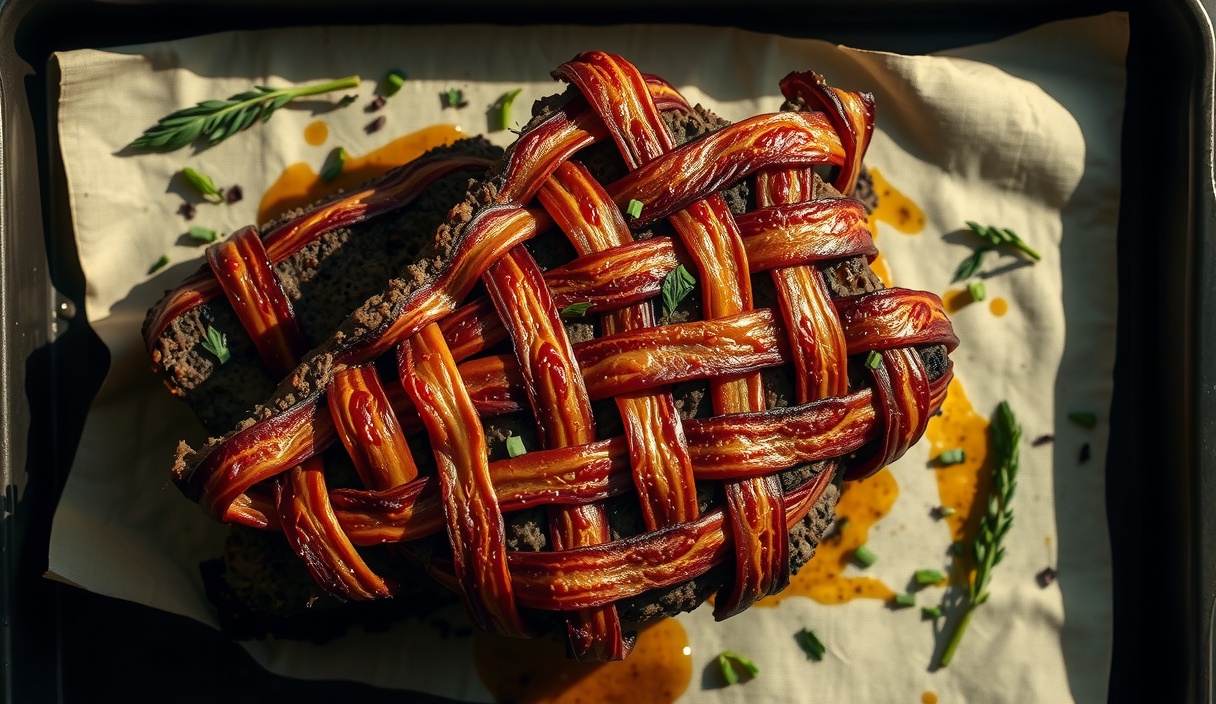
- Lay a sheet of plastic wrap (about 16 inches long) flat on your work surface. Arrange 6 strips of bacon vertically, side by side, slightly overlapping. Fold every other strip back halfway. Lay one horizontal strip of bacon across the unfolded strips at the fold point. Unfold the folded strips back over the horizontal strip. Now fold the alternate strips back and lay a second horizontal strip. Continue weaving until you have a tight 6×6 weave. You should have a woven mat roughly 10 x 10 inches.12 strips standard-cut bacon
Form and Wrap the Loaf
- Remove the meat mixture from the refrigerator. On a separate piece of plastic wrap, shape the mixture into a tight log approximately 9 inches long and 4 inches wide, using wet hands and gentle pressure — do not pack it hard. A light touch keeps the structure open enough to trap the fat as it renders.
- Center the formed loaf near the edge of the bacon weave. Using the plastic wrap beneath the weave as a sling, roll the bacon weave tightly around the loaf, overlapping the edges on the underside. Press the seam side down. Tuck any overhanging bacon ends underneath. Peel away all plastic wrap. Place the wrapped loaf seam-side down on the wire rack set over the foil-lined sheet pan. Pat the surface dry with paper towels to remove any surface moisture — a dry surface means bacon fat renders into browning reactions rather than steaming.12 strips standard-cut bacon
Fire Up the Smoker
- Preheat your smoker to a stable 250°F using indirect heat. Add cherry or apple wood — two to three fist-size chunks for an offset or kettle, or set a pellet grill to cherry/apple blend. Allow the smoker to settle and produce clean, thin blue smoke before loading the loaf. Thick white smoke at the start deposits acrid creosote compounds on the surface.
Smoke the Meatloaf
- Place the wire rack with the loaf into the smoker, seam-side of the bacon down. Close the lid and maintain 250°F throughout the cook — adjust your vents or feed rate as needed. Do not open the smoker in the first 60 minutes; every lid-lift dumps heat and smoke and extends the cook time by 10 to 15 minutes.
- Begin probing from the side at the 2-hour mark. The loaf will likely be in the 130–145°F range. Around 150°F you may notice a plateau — a temperature stall lasting 20 to 30 minutes — caused by evaporative cooling and collagen hydrolysis drawing energy away from the heat-up curve. Hold your smoker at 250°F and wait it out. This stall window is where the gelatin-rich texture is being built.
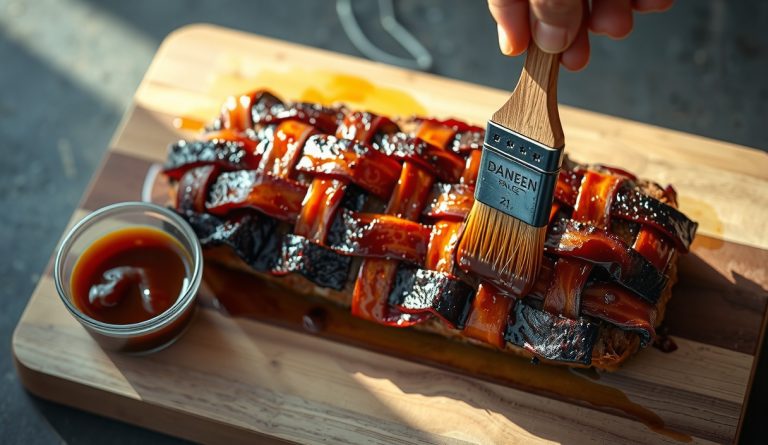
- Optional BBQ glaze: Once the loaf hits 145°F internal, brush the bacon surface with a thin layer of BBQ sauce. Apply a second coat 10 minutes later. The sugar in the sauce caramelizes against the rendered bacon fat, producing a lacquered shell. Skip this step if you prefer clean smoke bark.1/4 cup BBQ sauce
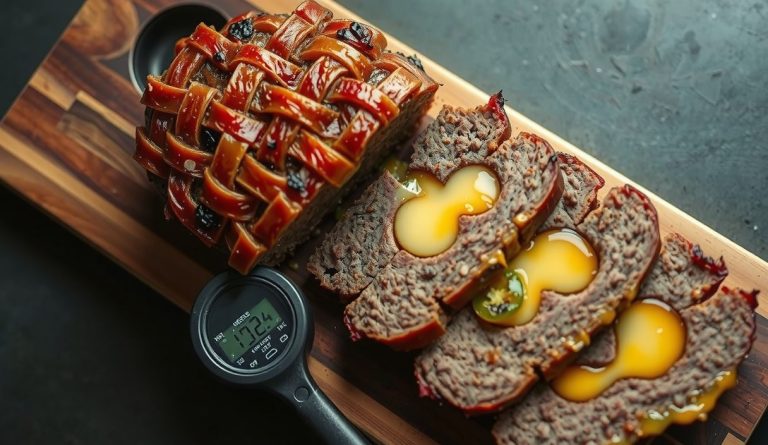
- Pull the loaf from the smoker when the center reads 160°F on your instant-read thermometer. This achieves full USDA safety compliance for ground meat while staying below the 165°F threshold where actin networks fully collapse and water-holding capacity craters irreversibly. Total cook time is typically 3 to 3.5 hours at a true 250°F.
Rest and Serve
- Transfer the loaf (still on the rack) to a cutting board and tent loosely with foil. Rest for a minimum of 10 minutes — during this time the carryover heat will push the center to 163–165°F, and the protein network will reabsorb the internal moisture gradient. Slicing before the rest releases that moisture onto the board rather than keeping it in the loaf. Slice crosswise into 3/4-inch rounds and serve immediately.
Notes
Nutrition
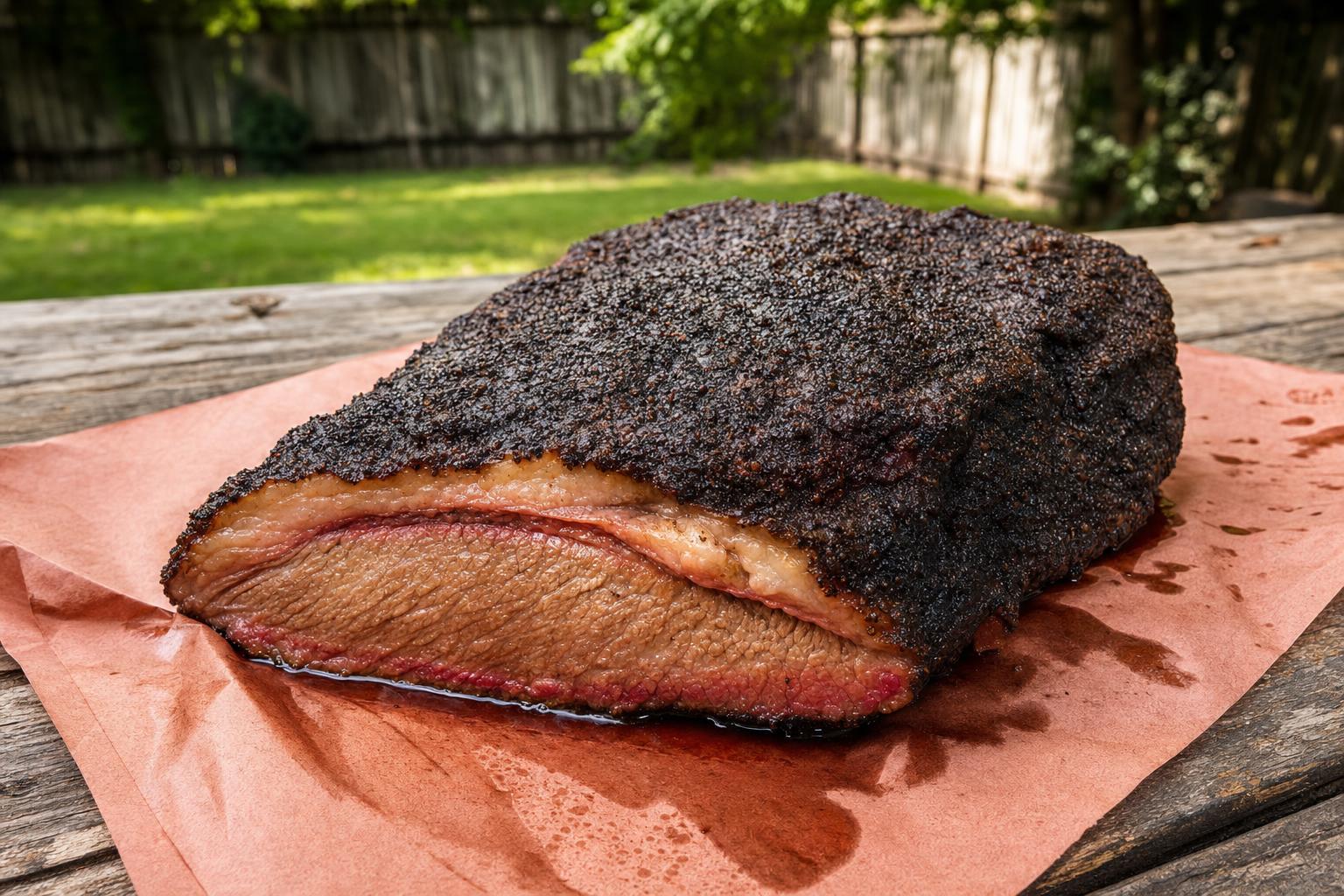
The first time I pulled a bacon-weave meatloaf off the smoker and sliced it open, the whole backyard went silent. You could hear the bark crackle. The cross-section looked like a deli terrine — deep smoke ring bleeding into a uniform, pale-pink interior, every slice holding together without a single crack. No crumbling, no greasy puddle on the board. That is not an accident. That is physics doing exactly what you told it to do.
Classic oven meatloaf suffers because most cooks skip the science and go straight to the mixing bowl. What you get is a dense, rubbery brick — the result of myosin over-cross-linking and unmanaged moisture loss. The smoker compounds the risk: low-and-slow cooking means extended time in the protein-denaturation window. Get the formulation wrong and you spend four hours creating expensive dog food. Get it right and you have the best thing you have served all summer.
Why does smoked bacon-weave meatloaf work? The science
The textural architecture of this loaf hinges on three interlocking mechanisms, each one tuned to the 250°F smoker environment. Understanding them is the difference between a loaf that slices clean and one that crumbles or seizes.
The panade — milk-soaked breadcrumbs — is not filler. It is a hydrated starch-protein sponge. When bread absorbs warm whole milk, the starch granules partially gelatinize and swell, while milk proteins denature and complex with the gluten network. This creates a plasticized matrix that physically interrupts the continuity of the meat protein network. Without the panade, every myosin and actin strand bonds laterally during cooking, squeezing out free water and producing the rubbery, livery texture that makes meatloaf a punchline. The panade acts as a spacer, capping the density of cross-links and retaining moisture within the gel network as it sets — think of it as the emulsifier in a sausage, bridging the fat and protein phases and preventing the structure from seizing.
The 80/20 beef-to-pork blend is a fat-geometry decision as much as a flavor one. Pork carries a higher proportion of unsaturated fatty acids and a lower-melting-point lipid fraction, rendering smoothly between 130°F and 150°F. As the loaf climbs through the 140–155°F internal range, that pork fat liquefies and migrates into the surrounding protein matrix, self-basting the interior. Beef fat, with its higher saturated content and steeper solid-fat-content curve, holds its structure longer, providing the body that keeps the loaf from going greasy or collapsing. The Maillard reaction requires surface temperatures well above 285°F — impossible in a 250°F smoker — but the bacon weave solves this elegantly. Bacon fat renders and pools against the loaf surface, conducting localized high-heat reactions at the meat-to-bacon interface, generating melanoidin pigments and pyrazine-family aromatics that migrate into the outer centimeter of the loaf. The result is a pseudo-bark with genuine browning complexity.
Smoke is a tunable variable. At 250°F, convective heat transfer through the smoker air column is gentle, averaging a conduction rate into the loaf of roughly 1°F per two minutes once the surface is dry. This slow ramp keeps the loaf below the 160–170°F evaporative-stall zone for longer than a high-heat cook would, giving collagen from the pork shoulder component additional time to hydrolyze into gelatin. That dissolved gelatin re-deposits into the meat matrix as the loaf approaches target temperature, adding the glossy, lip-coating quality that separates a great meatloaf from a good one. The target of 160°F internal achieves full USDA safety compliance for ground meat while keeping the loaf just below the 165°F threshold where actin networks fully collapse and water-holding capacity craters irreversibly.
What equipment and ingredients do I need?
- Smoker type: Offset, kettle, pellet, or kamado — all work at 250°F indirect. Pellet grills maintain the steadiest temp with the least intervention, which matters on a 3-plus-hour cook.
- Wood choice: Cherry or apple over hickory. Hickory at low-and-slow penetrates deeply and can turn bitter on a high-surface-area loaf. Cherry gives a mahogany bark color and a mild, slightly sweet smoke that complements pork without bullying it.
- Meat selection: Ask your butcher for 80/20 ground chuck for the beef. The pork should be ground pork shoulder (not loin) — you need the fat and collagen. Pre-made meatloaf mix from the grocery case is usually 60/20/20 beef-pork-veal, which also works.
- Bacon for the weave: Use standard-cut (not thick-cut) regular-sodium bacon. Thick-cut does not render fully in the cook window and stays rubbery. Standard-cut renders its fat by 155°F and produces the tight, lacquered weave you are after.
- Instant-read thermometer: Non-negotiable. Probe from the side into the geometric center of the loaf. Do not trust time alone.
- Wire rack and sheet pan: Allows smoke circulation on all sides and catches dripping bacon fat. Line the pan with foil for cleanup.
Smoked Meatloaf — Bacon-Weave Wrapped
Equipment
- 1 Smoker (offset, pellet, kettle, or kamado) Set up for indirect cooking at a stable 250°F
- 1 Wire rack Elevated rack allows smoke contact on all sides
- 1 Sheet pan (half-size) Lined with foil to catch bacon drippings
- 1 Instant-read thermometer Probe from the side into the geometric center of the loaf
- 1 Large mixing bowl
- 1 sheet Plastic wrap Used to build and roll the bacon weave cleanly
Ingredients
Panade
- 2 slices white sandwich bread crusts removed, torn into rough pieces
- ⅓ cup whole milk warmed slightly to accelerate starch absorption
Meat Mixture
- 1 lb 80/20 ground beef chuck kept cold until mixing
- 1 lb ground pork shoulder not ground loin — you need the fat and collagen
- 2 large eggs beaten
- ½ cup yellow onion finely grated or food-processed to a paste — no large pieces that create steam pockets
- 3 cloves garlic finely minced or pressed
- 2 tbsp Worcestershire sauce
- 2 tbsp ketchup
- 1 tsp kosher salt
- 1 tsp black pepper freshly ground
- 1 tsp smoked paprika
- ½ tsp dried thyme
- ½ tsp dry mustard powder
Bacon Weave
- 12 strips standard-cut bacon not thick-cut — standard-cut renders fully within the cook window
Optional BBQ Glaze
- ¼ cup BBQ sauce your house sauce; applied in the last 20 minutes only
Instructions
Make the Panade
- Combine the torn bread pieces and warm whole milk in a small bowl. Press the bread down into the milk and let it soak for 5 minutes, until the bread is completely saturated and collapses when squeezed. Mash into a rough paste with a fork. The goal is a homogeneous, wet slurry — no dry crumb remaining. This is the structural spacer that prevents protein over-cross-linking during the long smoke.1/3 cup whole milk
Build the Meat Mixture
- In a large mixing bowl, combine the ground beef, ground pork, beaten eggs, grated onion, minced garlic, Worcestershire sauce, ketchup, kosher salt, black pepper, smoked paprika, dried thyme, dry mustard powder, and the panade paste. Using your hands, mix until the ingredients just disappear into a uniform mass — stop the moment it is homogeneous. Overworking develops myosin cross-links before cooking and produces a rubbery, dense loaf. Work fast; warm hands smear the fat phase.1 lb 80/20 ground beef chuck, 1 lb ground pork shoulder, 2 large eggs, 1/2 cup yellow onion, 3 cloves garlic, 2 tbsp Worcestershire sauce, 2 tbsp ketchup, 1 tsp kosher salt, 1 tsp black pepper, 1 tsp smoked paprika, 1/2 tsp dried thyme, 1/2 tsp dry mustard powder, 1/3 cup whole milk
- Refrigerate the meat mixture for 20 minutes. This firms the fat phase and makes the loaf easier to form a clean freehand shape without sticking to your hands.
Build the Bacon Weave
- Lay a sheet of plastic wrap (about 16 inches long) flat on your work surface. Arrange 6 strips of bacon vertically, side by side, slightly overlapping. Fold every other strip back halfway. Lay one horizontal strip of bacon across the unfolded strips at the fold point. Unfold the folded strips back over the horizontal strip. Now fold the alternate strips back and lay a second horizontal strip. Continue weaving until you have a tight 6×6 weave. You should have a woven mat roughly 10 x 10 inches.12 strips standard-cut bacon
Form and Wrap the Loaf
- Remove the meat mixture from the refrigerator. On a separate piece of plastic wrap, shape the mixture into a tight log approximately 9 inches long and 4 inches wide, using wet hands and gentle pressure — do not pack it hard. A light touch keeps the structure open enough to trap the fat as it renders.
- Center the formed loaf near the edge of the bacon weave. Using the plastic wrap beneath the weave as a sling, roll the bacon weave tightly around the loaf, overlapping the edges on the underside. Press the seam side down. Tuck any overhanging bacon ends underneath. Peel away all plastic wrap. Place the wrapped loaf seam-side down on the wire rack set over the foil-lined sheet pan. Pat the surface dry with paper towels to remove any surface moisture — a dry surface means bacon fat renders into browning reactions rather than steaming.12 strips standard-cut bacon
Fire Up the Smoker
- Preheat your smoker to a stable 250°F using indirect heat. Add cherry or apple wood — two to three fist-size chunks for an offset or kettle, or set a pellet grill to cherry/apple blend. Allow the smoker to settle and produce clean, thin blue smoke before loading the loaf. Thick white smoke at the start deposits acrid creosote compounds on the surface.
Smoke the Meatloaf
- Place the wire rack with the loaf into the smoker, seam-side of the bacon down. Close the lid and maintain 250°F throughout the cook — adjust your vents or feed rate as needed. Do not open the smoker in the first 60 minutes; every lid-lift dumps heat and smoke and extends the cook time by 10 to 15 minutes.
- Begin probing from the side at the 2-hour mark. The loaf will likely be in the 130–145°F range. Around 150°F you may notice a plateau — a temperature stall lasting 20 to 30 minutes — caused by evaporative cooling and collagen hydrolysis drawing energy away from the heat-up curve. Hold your smoker at 250°F and wait it out. This stall window is where the gelatin-rich texture is being built.
- Optional BBQ glaze: Once the loaf hits 145°F internal, brush the bacon surface with a thin layer of BBQ sauce. Apply a second coat 10 minutes later. The sugar in the sauce caramelizes against the rendered bacon fat, producing a lacquered shell. Skip this step if you prefer clean smoke bark.1/4 cup BBQ sauce
- Pull the loaf from the smoker when the center reads 160°F on your instant-read thermometer. This achieves full USDA safety compliance for ground meat while staying below the 165°F threshold where actin networks fully collapse and water-holding capacity craters irreversibly. Total cook time is typically 3 to 3.5 hours at a true 250°F.
Rest and Serve
- Transfer the loaf (still on the rack) to a cutting board and tent loosely with foil. Rest for a minimum of 10 minutes — during this time the carryover heat will push the center to 163–165°F, and the protein network will reabsorb the internal moisture gradient. Slicing before the rest releases that moisture onto the board rather than keeping it in the loaf. Slice crosswise into 3/4-inch rounds and serve immediately.
Notes
Nutrition
How do I nail it every time? Tips for smoked meatloaf success
- Do not overwork the meat. Mix until the ingredients just disappear. Over-mixing develops myosin cross-links before cooking even begins — the loaf will be dense and springy, not tender. Use your hands, and stop the moment the mixture is homogeneous.
- Cold hands, cold meat. The fat emulsion in the mix is heat-sensitive. If your hands warm the fat above 50°F, it starts to smear out of the protein matrix. Work quickly, or chill the meat mixture for 20 minutes before forming and weaving.
- Weave on plastic wrap first. Lay out the bacon weave on a sheet of plastic wrap, form the loaf separately, then flip the loaf onto the weave and use the plastic wrap to roll it tight. This is the difference between a clean, professional weave and a collapsed mess.
- Dry the surface before smoking. Pat the formed, wrapped loaf with paper towels. Surface moisture creates an evaporative barrier that delays bark formation and can produce a steamed, pale exterior under the bacon. A dry surface means the bacon fat renders directly into browning reactions.
- Watch the stall. Around 150–155°F internal, the loaf may plateau for 20–30 minutes as collagen hydrolysis and surface evaporation trade energy. Do not panic and crank the heat. Hold 250°F and let the stall pass — this is where the best texture is being built.
- Rest before slicing. Ten minutes minimum. The internal temperature will rise 3–5°F from carryover, and the protein network needs time to reabsorb the expressed moisture gradient. Slice too early and the juices run out onto the board instead of staying in the loaf.
What variations can I make to this smoked meatloaf?
BBQ glaze finish: In the last 20 minutes of the cook — once the loaf hits 145°F internal — brush the bacon surface with a thin layer of your house BBQ sauce. The sugar in the sauce will caramelize against the hot, rendered bacon fat, creating a lacquered shell. Apply in two thin coats spaced 10 minutes apart rather than one thick coat, which can burn or slide off.
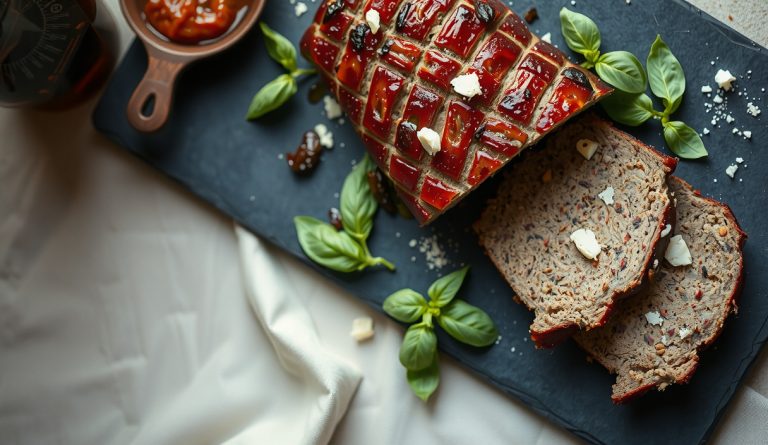
Italian-style: Swap the Worcestershire and ketchup for a combination of San Marzano tomato paste and a tablespoon of balsamic vinegar in the meat mixture. Add a quarter-cup of finely grated Pecorino Romano and a tablespoon of dried oregano. The lactose in the cheese provides additional Maillard browning substrates at the meat-to-bacon interface.
Heat and cheese stuffed: Before forming, flatten the meat mixture into a rectangle on plastic wrap, layer sliced pepper jack cheese and pickled jalapeño strips across the center, then roll and seal the loaf around the filling. The cheese melts into a molten core by 155°F internal. Probe from the end of the loaf to avoid puncturing the cheese pocket.
Scaling up: This recipe produces a two-pound loaf serving six to eight. For a crowd, build two separate loaves rather than one giant loaf — heat penetration into a very large mass becomes uneven and the outer inch will overcook before the center reaches 160°F. Keep each loaf at two to three pounds maximum.
Frequently asked questions about smoked bacon-weave meatloaf
Can I use a loaf pan on the smoker? No — a loaf pan shields three sides and the bottom from smoke and airflow, producing an uneven bark and a steamed bottom. The wire rack setup is essential for getting smoke contact and convective heat on all sides. If you need shape support, form the loaf freehand and it will hold just fine; the bacon weave acts as a structural exoskeleton.
Why smoke smoked meatloaf at 250°F and not 225°F or 275°F? At 225°F the cook stretches past four hours, and the extended surface dwell time can produce a bitter, over-smoked exterior — especially with cherry or hickory wood. At 275°F the bacon weave can go from rendered to burnt before the interior hits 160°F, and you lose the slow collagen-hydrolysis window that gives the loaf its gelatin-rich texture. 250°F is the sweet spot where the Maillard-adjacent browning in the bacon, the collagen hydrolysis, and the protein-set timeline align.
My meatloaf cracked open on the smoker — what happened? Cracking is almost always a hydration or mixing problem. Either the panade was too dry (the bread was not fully saturated with milk before mixing), the mixture was overmixed and developed too tight a protein network that could not expand under steam pressure, or the loaf was formed too tightly and sealed too many air pockets inside. For the next cook, let the bread soak until it falls apart when squeezed, mix until just combined, and use wet hands to form the loaf with gentle pressure rather than packing it like a snowball.