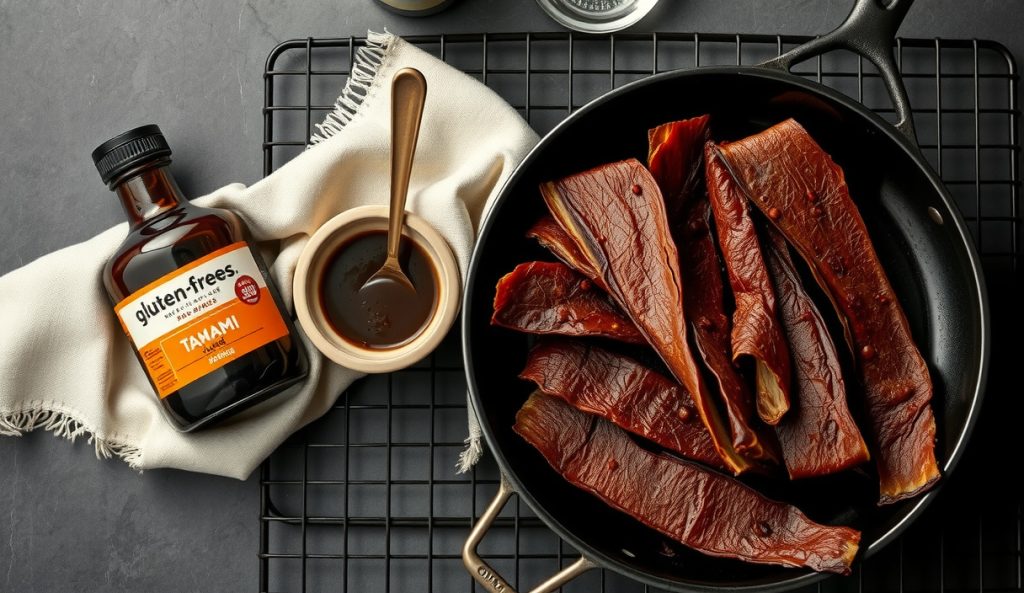
Standard soy sauce is brewed with wheat — typically around 15 to 20 percent of the grain bill — which places it firmly off-limits for anyone managing celiac disease or non-celiac gluten sensitivity. Tamari, by contrast, is a Japanese-style soy sauce brewed with little to no wheat, and most commercial tamari products sold in the United States are certified gluten-free. The substitution is functionally transparent: tamari carries nearly identical sodium concentration, glutamate levels, and water activity to conventional soy sauce, so no formulation adjustments are needed beyond the swap itself.
What changes when you make this gluten-free?
Substitute tamari 1:1 for soy sauce — volume, weight, and timing are unchanged. The second checkpoint is Worcestershire sauce: most US-produced Worcestershire formulations use distilled malt vinegar that tests below the 20 ppm gluten threshold, but some British formulations use undistilled malt vinegar, which retains detectable gluten peptides. Check the label or contact the manufacturer if you are cooking for someone with celiac disease rather than a general gluten preference. If your Worcestershire source is uncertain, substitute with a certified gluten-free Worcestershire or a blend of apple cider vinegar and tamarind concentrate (1 teaspoon each per tablespoon of Worcestershire) as a functional equivalent. The marinade’s overall flavor profile is very slightly rounder and less wheaty with tamari, a difference most tasters cannot identify blind.
What stays exactly the same in this adaptation?
Every element of the smoked beef jerky method — marinade soak duration, slice thickness, smoker temperature, wood choice, drying time, and the bend-test doneness benchmark — is entirely unchanged. This gluten-free adaptation is a label-reading exercise, not a cooking adjustment.
When is the gluten-free version the better choice?
This adaptation is the default choice any time someone in the household or at the event has celiac disease, a wheat allergy, or a diagnosed gluten sensitivity. It is also a reasonable default for general batches if you regularly cook for mixed groups — tamari is widely available, similarly priced to quality soy sauce, and the flavor difference in a finished jerky is negligible.
Use the full method, equipment, and all other marinade measurements from the original Smoked Beef Jerky — Lean Round.