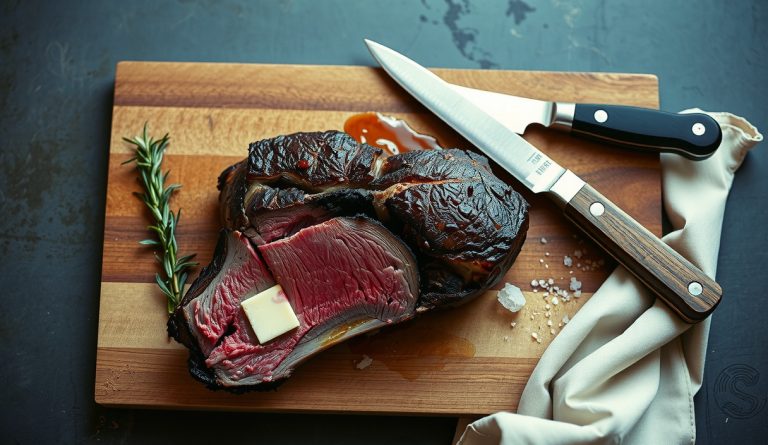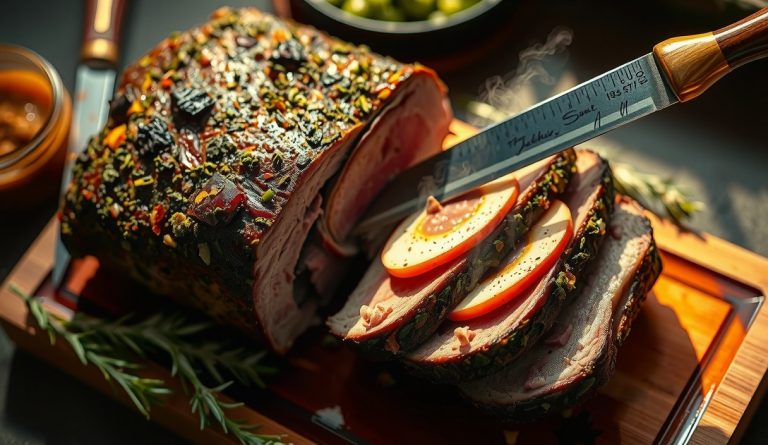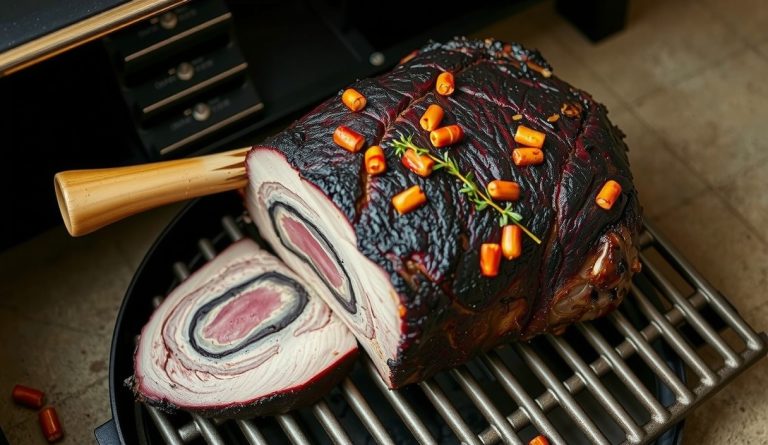
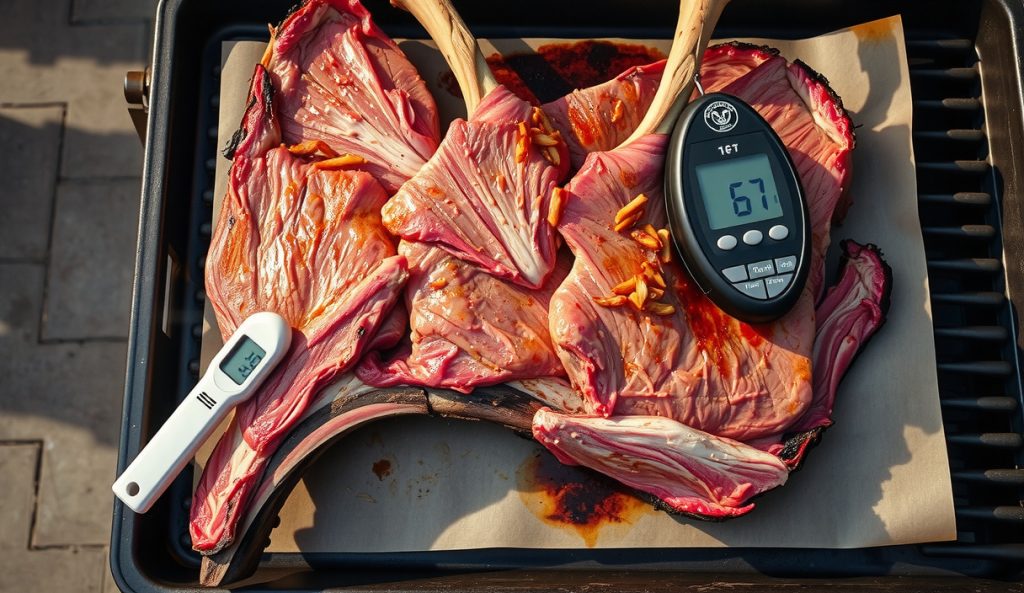
Moving from a 2- or 3-bone roast to a 4- or 5-bone roast changes the cook in one fundamental way: thermal mass. A 5-bone bone-in prime rib can weigh 18 to 22 pounds trimmed, and that volume of cold, dense protein takes far longer to equilibrate from surface to core than a smaller cut. The low-and-slow phase stretches from the canonical 5 to 6 hours to 8 to 10 hours at 225°F, and the pull temperature shifts downward to account for greater carryover.
Scaling up to a 4- or 5-bone roast does not require new technique — it requires patience and an accurate leave-in thermometer probe placed at the geometric center of the roast, away from bone.
What changes when you scale up to a 4- or 5-bone roast?
Pull a 5-bone prime rib at 118°F internal rather than the canonical 120 to 122°F used for smaller cuts. The increased thermal mass stores more latent heat in the outer layers, and that energy continues driving toward the center during the rest period. Carryover on a roast of this size adds 8 to 12°F over a 30-to-45-minute rest, compared to 6 to 8°F for a smaller cut. Pulling the large roast at 118°F gives a reliable window to finish squarely in the medium-rare zone without overshooting.
Do not attempt to accelerate the cook by raising the smoker temperature to 250°F or higher. At elevated temperatures, the exterior of the prime rib reaches the Maillard threshold and begins building a crust while the core is still below 100°F. The result is a thickening band of gray, overcooked meat around the perimeter — the exact gradient problem that reverse-sear methodology is designed to prevent. The physics are straightforward: heat diffusivity in beef muscle is approximately 1.4 × 10⁻⁷ m²/s, a value low enough that a larger cross-section simply requires more time regardless of surface heat input.
What stays the same when scaling to a larger prime rib?
The following elements carry over from the standard method without modification when scaling to a 4- or 5-bone roast:
- Smoker temperature: 225°F throughout the low-and-slow phase
- Rub ratios scaled by weight
- Dry brine timeline
- Reverse-sear sequence at 500°F
- Resting approach and probe placement logic
- The bones acting as the natural roasting rack
When is a 4- or 5-bone roast the better choice?
A 4- or 5-bone prime rib is the right call for gatherings of 10 or more where carving theater matters and leftovers are expected and welcome. A larger roast also delivers the deepest smoke penetration per cook: the prime rib spends more cumulative time in the smoke environment, and both the smoke ring and overall flavor depth reflect that extended exposure. Plan the timeline backward from the serving window, because these roasts benefit from an extended hold in a warm cooler if they finish ahead of schedule.
Use the full method, equipment, and rub measurements from the original Smoked Prime Rib — Bone-In, applying only the pull temperature and time adjustments described here.