Smoked Chuck Roast — Poor-Man’s Brisket
Equipment
- 1 Smoker or grill set up for indirect heat Offset, kettle, pellet, or ceramic kamado — all work at 225°F
- 1 Leave-in probe thermometer Non-negotiable — you are cooking to internal temperature
- 1 Instant-read thermometer For confirming pull temp and probe feel at 203°F
- 2 large sheets Unwaxed butcher paper Preferred over foil — vapor-permeable to preserve bark texture
- 1 Wire cooling rack For resting the roast elevated off the cutting board
Ingredients
The Roast
- 3 lb bone-in or boneless chuck roast Choose one with visible marbling and at least 1/4-inch fat cap; bone-in preferred for added collagen
Brisket-Style Dry Rub
- 2 tbsp coarse kosher salt Diamond Crystal or Morton coarse — do not use fine table salt
- 1 tbsp coarse-ground black pepper 16-mesh cracked pepper preferred for bark texture
- 1 tbsp dark brown sugar Packed; provides reducing sugars for Maillard browning and bark development
- 1 tsp garlic powder
- 1 tsp onion powder
- 1 tsp smoked paprika
- ½ tsp cayenne pepper Optional — omit for a milder profile
For the Smoke
- 3 fist-sized chunks of post oak, hickory, or cherry wood Post oak is the Texas standard; hickory adds aggression; cherry deepens bark color

Instructions
Dry Brine (12–24 Hours Before)
- Combine all dry rub ingredients in a small bowl and mix thoroughly. Pat the chuck roast completely dry with paper towels — surface moisture is the enemy of bark formation.1 tbsp coarse-ground black pepper, 1 tbsp dark brown sugar, 1 tsp garlic powder, 1 tsp onion powder, 1 tsp smoked paprika, 1/2 tsp cayenne pepper
- Apply the rub generously on all surfaces of the roast, pressing firmly to adhere. Do not be shy — this is a thick piece of beef and the rub forms the bark. Place uncovered on a wire rack set over a sheet pan and refrigerate for 12 to 24 hours. The salt will initially draw moisture out and then reabsorb into the meat, leaving a tacky, concentrated pellicle on the surface — exactly what you want for Maillard browning.1 tbsp coarse-ground black pepper, 1 tbsp dark brown sugar, 1 tsp garlic powder, 1 tsp onion powder, 1 tsp smoked paprika, 1/2 tsp cayenne pepper
Fire Setup and First Smoke Phase
- Remove the roast from the refrigerator 30 to 45 minutes before smoking to take the chill off the exterior. This is not about bringing it to room temperature — that is a myth for a piece of meat this size — it is about reducing the thermal gradient between the surface and core so bark sets before the center overcooks.
- Set up your smoker for indirect cooking at a steady 225°F. Add 2 to 3 chunks of your chosen wood to establish clean, thin blue smoke. Avoid thick white billowing smoke — that is incomplete combustion and it deposits bitter, acrid compounds on the surface. You want the smoke you can barely see, not the smoke you can smell from the street.3 fist-sized chunks of post oak, hickory, or cherry wood
- Place the chuck roast fat-cap-up directly on the smoker grates over indirect heat. Insert your leave-in probe thermometer into the thickest part of the meat, away from any bone. Close the lid and do not open it for the first 2 hours. You lose approximately 10 minutes of stable temperature every time you open a smoker lid.
- Smoke at 225°F, maintaining steady temperature. Add wood chunks as needed to keep a thin smoke presence — typically one chunk every 60 to 90 minutes depending on your setup. The roast will pass through the myosin denaturation zone (130–140°F) quietly and start showing its smoke ring forming. Monitor temperature but resist intervening.3 fist-sized chunks of post oak, hickory, or cherry wood
The Stall and the Wrap (at 165°F)
- Somewhere between 155°F and 170°F internal, your temperature climb will slow dramatically or stop entirely for 45 minutes to 2 hours. This is the stall — evaporative cooling at the surface is absorbing heat as fast as your smoker delivers it. Do not panic, do not raise the temperature. Watch your probe and wait for 165°F internal.
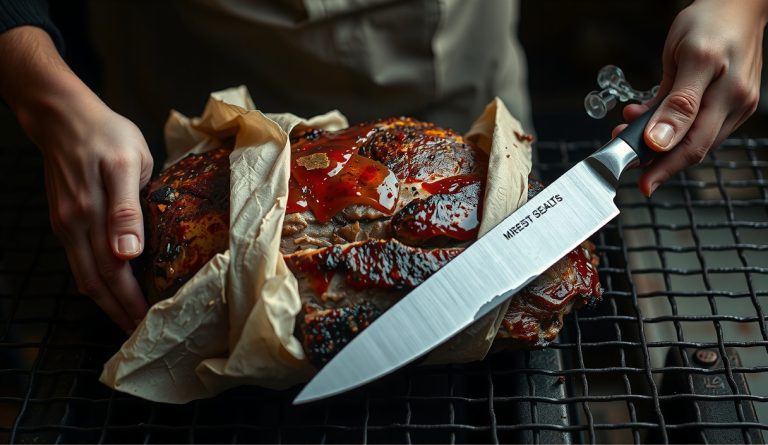
- At 165°F internal, remove the roast from the smoker. Lay two large sheets of unwaxed butcher paper overlapping on a flat surface. Place the roast fat-cap-up in the center and wrap tightly, tucking the sides in like a burrito. The wrap should be snug enough that no steam can easily escape. Return the wrapped roast to the smoker with the probe re-inserted through the paper. This collapses the evaporative cooling mechanism and pushes the roast into the final collagen hydrolysis phase.
Final Push to 203°F
- Continue smoking at 225°F. The temperature will now climb steadily without another significant stall — the wrapped environment creates a humid, high-heat braising atmosphere that accelerates heat transfer into the core. Collagen is hydrolyzing into gelatin throughout this phase.
- Pull the roast at 203°F internal. Before pulling, perform the probe feel test: insert your thermometer probe or a skewer into the thickest section. At 203°F with full collagen conversion, it should slide in with near-zero resistance — like pushing into softened butter. If you feel any springback, give it another 15 minutes and test again. Temperature is a proxy; probe feel is the real signal.
Rest and Slice
- Transfer the wrapped roast to a cutting board or sheet pan and let it rest, still wrapped, for a minimum of 45 minutes — 60 to 90 minutes is better. Carry-over cooking adds another 3°F to 5°F. More importantly, the rest period allows the fully hydrolyzed gelatin to redistribute and slightly re-gel throughout the muscle fibers rather than immediately running off the board when you slice. Do not skip this step.
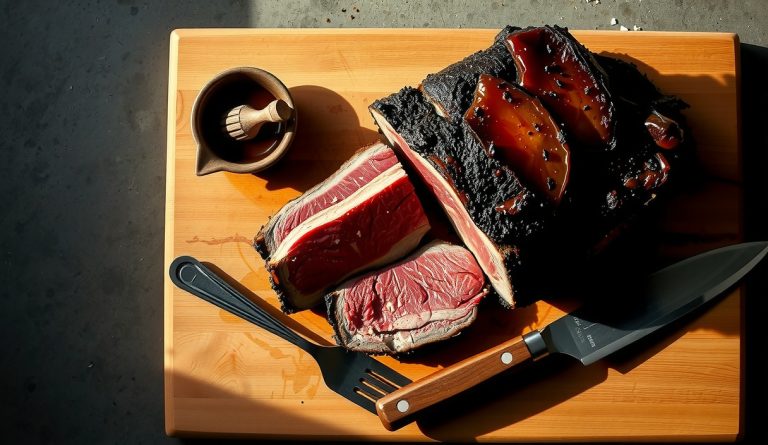
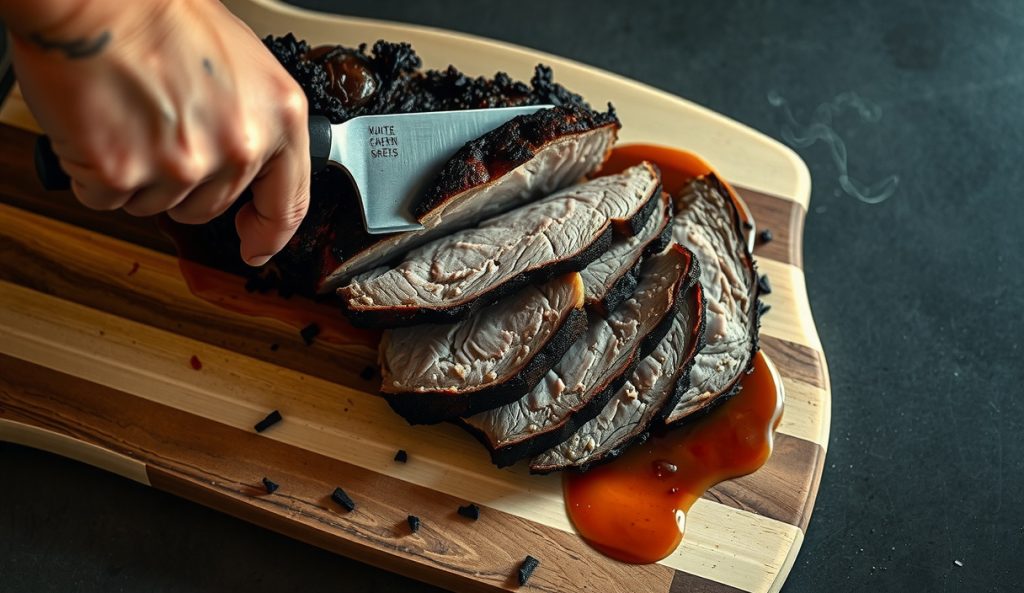
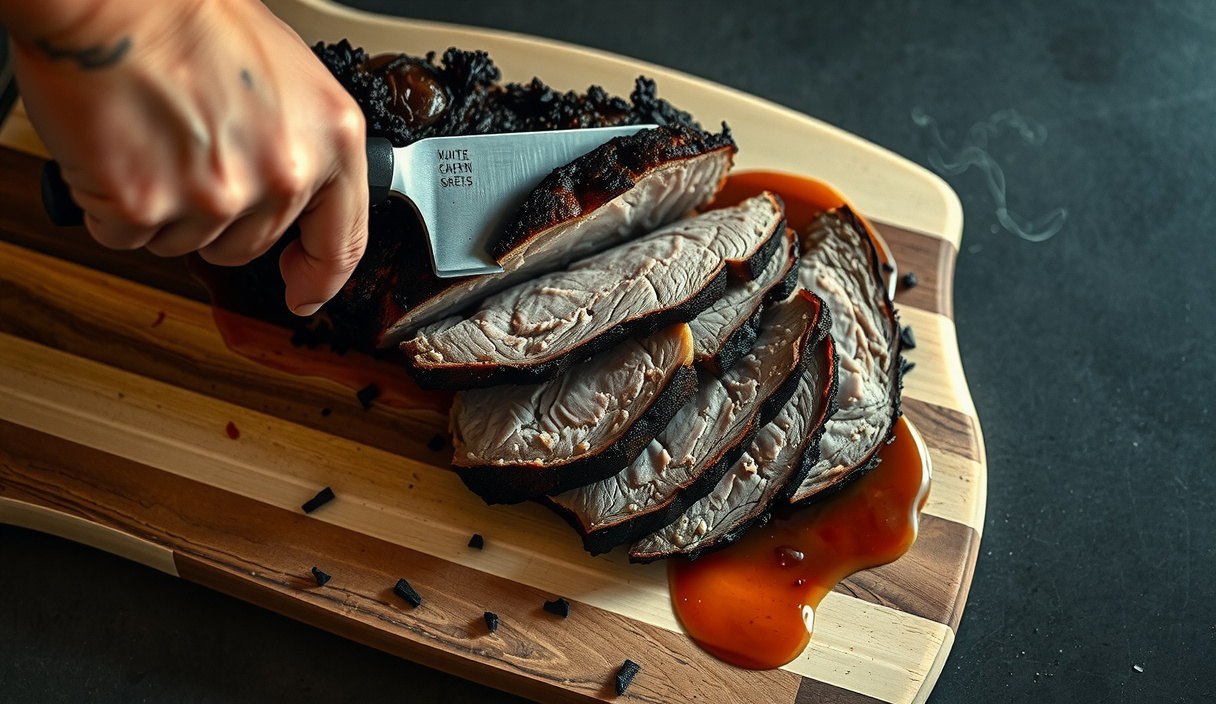
- Unwrap the roast over the cutting board to capture the accumulated juices in the paper — those drippings are pure gelatin-rich jus, and you want them. Identify the grain direction in each muscle section before cutting. Chuck runs in two or three different directions across the roast. Slice against the grain at about 1/4-inch thickness for maximum tenderness. Serve immediately, drizzled with the collected jus.
Notes
Nutrition
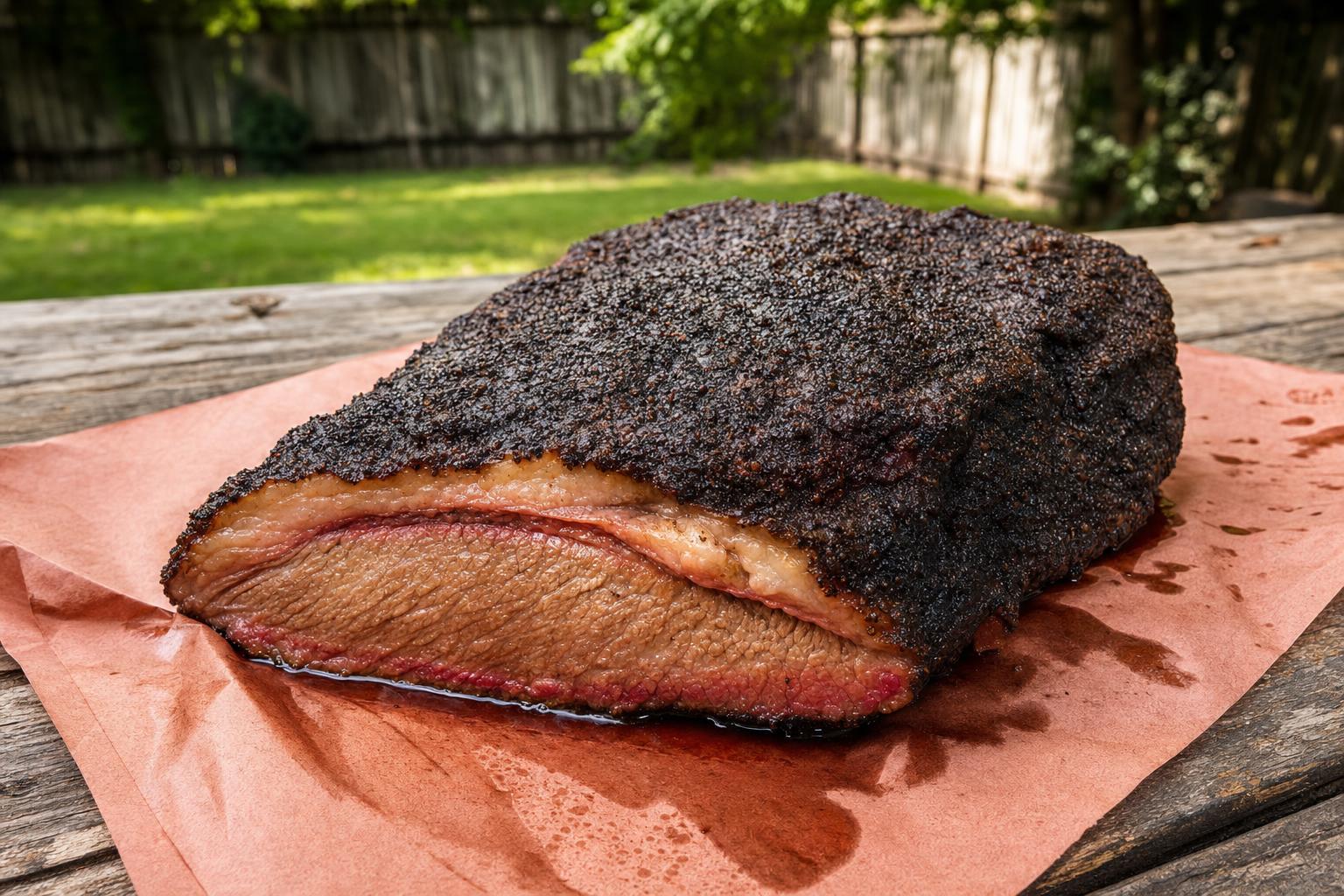
The first time I pulled a chuck roast off the smoker and sliced into it, the bark crackled like a brisket flat, the smoke ring ran a full half-inch deep, and the interior pulled apart in long, glistening fibers that left a fat cap of liquid gelatin on the cutting board. My guests assumed I had spent 14 hours nursing a full packer. I had not. The chuck was done in just under eight hours, cost about a third of the price, and — here is the part nobody tells you — smoked chuck roast is actually more forgiving than brisket because of how collagen-dense the chuck clod is. This is the poor-man’s brisket, and it earns that title honestly.
Chuck roast comes from the shoulder, a muscle group that works hard and accumulates enormous amounts of intramuscular collagen. That collagen is the reason this cut responds so well to low-and-slow smoke. The same thermodynamic pathway that makes brisket succulent — prolonged collagen hydrolysis into soluble gelatin — operates in chuck roast, only the geometry is smaller, which compresses the timeline significantly. Where a full packer brisket might demand 12 to 16 hours, a 3-pound chuck reaches full collagen conversion in 6 to 8 hours at 225°F. That is not a shortcut. That is physics.
Why does smoked chuck roast work? The science
Smoked chuck roast works because its high collagen density converts completely into gelatin during a low-and-slow cook, producing the same pull-apart texture and lip-coating richness that defines great smoked beef — at a fraction of the cost of brisket. The mechanism begins the moment heat is applied.
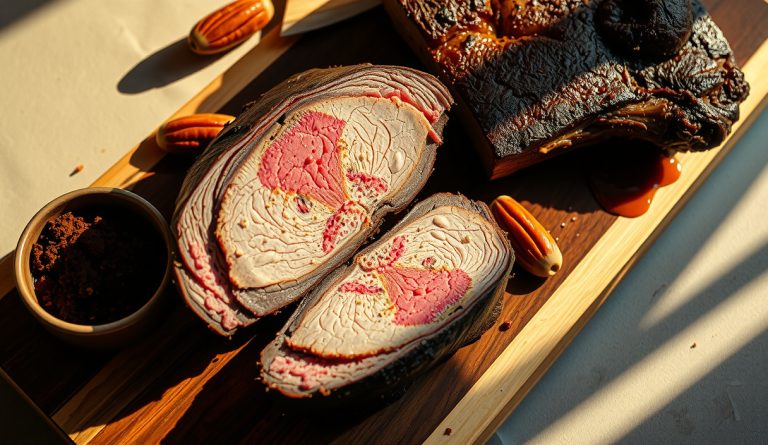
Muscle tissue is a composite biomaterial built from myofibrillar proteins — primarily myosin and actin — suspended in an extensive connective tissue network of type I and type III collagen. When heat is applied slowly, a precise sequential denaturation cascade unfolds. Myosin begins unraveling between 130°F and 140°F, yielding the first signs of tenderness. Sarcoplasmic proteins denature through the 125°F–155°F range, locking in the characteristic reddish-pink color shift at the smoke ring boundary. The real structural event happens at the collagen layer: around 160°F to 165°F, the collagen matrix undergoes thermal shrinkage and contraction, which is why you feel the stall — the meat tightens and expels surface moisture faster than the smoker can replace the latent heat consumed by evaporation. Surface water vaporizing at the boundary layer anchors the skin temperature near 212°F, absorbing energy as fast as the smoker delivers it and holding internal progress hostage for 45 minutes to 2 hours. This is not a malfunction. It is evaporative phase-change physics doing exactly what thermodynamics demands.
Wrapping the chuck roast in butcher paper or foil at 165°F collapses the evaporative cooling mechanism by eliminating the vapor escape route. Heat now transfers directly into the matrix via conduction from the saturated steam environment inside the wrap. This pushes the internal temperature through the collagen hydrolysis window — the conversion of tough, fibrous collagen cross-links into soluble, succulent gelatin is governed by first-order kinetics, proceeding meaningfully above 160°F but accelerating sharply above 180°F. Holding the roast at 200°F to 205°F for the final 1 to 2 hours completes that hydrolysis. The gelatin that was locked in rigid connective tissue sheets now flows freely between the muscle fibers, lubricating every bite and delivering the lip-coating richness that defines great smoked beef. The target of 203°F internal is not arbitrary — it is the empirical sweet spot where actin has been fully denatured and water-holding capacity has partially collapsed, but the gelatin phase has fully compensated by flooding the matrix with colloidal liquid. Chuck roast has an advantage over brisket flat here: higher intramuscular fat and a denser collagen network means more gelatin available per square inch of protein, making it genuinely more difficult to overshoot into dry territory.
The bark that forms on the exterior of smoked chuck roast is a product of two simultaneous reactions. The Maillard cascade — the non-enzymatic browning reaction between free amino groups on the meat surface and carbonyl groups from the rub sugars and reducing sugars present in the beef itself — initiates meaningfully above 280°F at the surface. Even at a 225°F ambient smoker temperature, the dry exterior surface of the roast can spike significantly higher, especially over radiant heat. The coarse salt in the rub draws moisture out via osmosis during the dry-brine period, then the dissolved proteins and amino acids re-absorb, leaving a concentrated, sticky pellicle on the surface that is an exceptionally reactive Maillard substrate. The brown sugar in the rub contributes additional reducing sugars, though at internal cooking temperatures, the real browning action is concentrated entirely in that outer centimeter of surface crust. Water activity at the surface must drop before Maillard browning can proceed — which is why a dry overnight brine is not optional theater, but a physical prerequisite for achieving a legitimate bark.
What equipment and ingredients do I need?
The most critical piece of equipment is a reliable leave-in probe thermometer. Smoked chuck roast is cooked to internal temperature, not to time. A smoker that fluctuates between 215°F and 240°F is perfectly acceptable — the low-and-slow collagen hydrolysis kinetics are not sensitive to a 25-degree ambient variance, but you absolutely need to know when the roast hits 165°F to initiate the wrap, and when it hits 203°F to pull it. Offset smokers, kettle grills set up for two-zone cooking, pellet grills, and ceramic kamados all work. The wood choice matters: oak gives a clean, beef-forward smoke backbone with no sweetness or astringency. Post oak is the Texas standard. Hickory is louder and slightly more aggressive — excellent if you want a deeper smoke punch, but pull back to a smaller wood chunk or two. Cherry adds a subtle fruit note and deepens the mahogany color of the bark without overwhelming the beef. Avoid mesquite for a cook this long — it delivers polycyclic aromatic compound bitterness at extended exposures.
For the roast itself, choose a chuck with visible marbling running through the shoulder blade area and at least a quarter-inch fat cap on one side. The blade bone is fine to leave in — it acts as a heat sink that slows the very center from overcooking and adds collagen directly into the surrounding tissue. For the rub, coarse kosher salt is non-negotiable — fine table salt will over-penetrate and make the bark intensely salty. Diamond Crystal or Morton coarse kosher are both correct. The brown sugar is present to accelerate the Maillard reaction at the bark and provide a very slight caramel sweetness to contrast the smoke bitterness — it is not making this sweet. Keep it at a 2:1 salt-to-sugar ratio by weight. Butcher paper is strongly preferred over foil for the wrap because it is vapor-permeable: it traps enough steam to push through the stall, but it still allows some moisture to escape, which protects the bark from going fully soft and braised under foil.
Smoked Chuck Roast — Poor-Man’s Brisket
Equipment
- 1 Smoker or grill set up for indirect heat Offset, kettle, pellet, or ceramic kamado — all work at 225°F
- 1 Leave-in probe thermometer Non-negotiable — you are cooking to internal temperature
- 1 Instant-read thermometer For confirming pull temp and probe feel at 203°F
- 2 large sheets Unwaxed butcher paper Preferred over foil — vapor-permeable to preserve bark texture
- 1 Wire cooling rack For resting the roast elevated off the cutting board
Ingredients
The Roast
- 3 lb bone-in or boneless chuck roast Choose one with visible marbling and at least 1/4-inch fat cap; bone-in preferred for added collagen
Brisket-Style Dry Rub
- 2 tbsp coarse kosher salt Diamond Crystal or Morton coarse — do not use fine table salt
- 1 tbsp coarse-ground black pepper 16-mesh cracked pepper preferred for bark texture
- 1 tbsp dark brown sugar Packed; provides reducing sugars for Maillard browning and bark development
- 1 tsp garlic powder
- 1 tsp onion powder
- 1 tsp smoked paprika
- ½ tsp cayenne pepper Optional — omit for a milder profile
For the Smoke
- 3 fist-sized chunks of post oak, hickory, or cherry wood Post oak is the Texas standard; hickory adds aggression; cherry deepens bark color
Instructions
Dry Brine (12–24 Hours Before)
- Combine all dry rub ingredients in a small bowl and mix thoroughly. Pat the chuck roast completely dry with paper towels — surface moisture is the enemy of bark formation.1 tbsp coarse-ground black pepper, 1 tbsp dark brown sugar, 1 tsp garlic powder, 1 tsp onion powder, 1 tsp smoked paprika, 1/2 tsp cayenne pepper
- Apply the rub generously on all surfaces of the roast, pressing firmly to adhere. Do not be shy — this is a thick piece of beef and the rub forms the bark. Place uncovered on a wire rack set over a sheet pan and refrigerate for 12 to 24 hours. The salt will initially draw moisture out and then reabsorb into the meat, leaving a tacky, concentrated pellicle on the surface — exactly what you want for Maillard browning.1 tbsp coarse-ground black pepper, 1 tbsp dark brown sugar, 1 tsp garlic powder, 1 tsp onion powder, 1 tsp smoked paprika, 1/2 tsp cayenne pepper
Fire Setup and First Smoke Phase
- Remove the roast from the refrigerator 30 to 45 minutes before smoking to take the chill off the exterior. This is not about bringing it to room temperature — that is a myth for a piece of meat this size — it is about reducing the thermal gradient between the surface and core so bark sets before the center overcooks.
- Set up your smoker for indirect cooking at a steady 225°F. Add 2 to 3 chunks of your chosen wood to establish clean, thin blue smoke. Avoid thick white billowing smoke — that is incomplete combustion and it deposits bitter, acrid compounds on the surface. You want the smoke you can barely see, not the smoke you can smell from the street.3 fist-sized chunks of post oak, hickory, or cherry wood
- Place the chuck roast fat-cap-up directly on the smoker grates over indirect heat. Insert your leave-in probe thermometer into the thickest part of the meat, away from any bone. Close the lid and do not open it for the first 2 hours. You lose approximately 10 minutes of stable temperature every time you open a smoker lid.
- Smoke at 225°F, maintaining steady temperature. Add wood chunks as needed to keep a thin smoke presence — typically one chunk every 60 to 90 minutes depending on your setup. The roast will pass through the myosin denaturation zone (130–140°F) quietly and start showing its smoke ring forming. Monitor temperature but resist intervening.3 fist-sized chunks of post oak, hickory, or cherry wood
The Stall and the Wrap (at 165°F)
- Somewhere between 155°F and 170°F internal, your temperature climb will slow dramatically or stop entirely for 45 minutes to 2 hours. This is the stall — evaporative cooling at the surface is absorbing heat as fast as your smoker delivers it. Do not panic, do not raise the temperature. Watch your probe and wait for 165°F internal.
- At 165°F internal, remove the roast from the smoker. Lay two large sheets of unwaxed butcher paper overlapping on a flat surface. Place the roast fat-cap-up in the center and wrap tightly, tucking the sides in like a burrito. The wrap should be snug enough that no steam can easily escape. Return the wrapped roast to the smoker with the probe re-inserted through the paper. This collapses the evaporative cooling mechanism and pushes the roast into the final collagen hydrolysis phase.
Final Push to 203°F
- Continue smoking at 225°F. The temperature will now climb steadily without another significant stall — the wrapped environment creates a humid, high-heat braising atmosphere that accelerates heat transfer into the core. Collagen is hydrolyzing into gelatin throughout this phase.
- Pull the roast at 203°F internal. Before pulling, perform the probe feel test: insert your thermometer probe or a skewer into the thickest section. At 203°F with full collagen conversion, it should slide in with near-zero resistance — like pushing into softened butter. If you feel any springback, give it another 15 minutes and test again. Temperature is a proxy; probe feel is the real signal.
Rest and Slice
- Transfer the wrapped roast to a cutting board or sheet pan and let it rest, still wrapped, for a minimum of 45 minutes — 60 to 90 minutes is better. Carry-over cooking adds another 3°F to 5°F. More importantly, the rest period allows the fully hydrolyzed gelatin to redistribute and slightly re-gel throughout the muscle fibers rather than immediately running off the board when you slice. Do not skip this step.
- Unwrap the roast over the cutting board to capture the accumulated juices in the paper — those drippings are pure gelatin-rich jus, and you want them. Identify the grain direction in each muscle section before cutting. Chuck runs in two or three different directions across the roast. Slice against the grain at about 1/4-inch thickness for maximum tenderness. Serve immediately, drizzled with the collected jus.
Notes
Nutrition
How do I nail smoked chuck roast every time? Tips
- Do not skip the overnight dry brine. Applying the salted rub 12 to 24 hours in advance draws out moisture, dissolves proteins, and lets the brine reabsorb into the muscle. The result is a concentrated surface pellicle that is dramatically more reactive for Maillard browning. A same-day rub produces a pale, powdery crust — not a bark.
- Resist the wrap too early. Wrapping below 160°F traps too much moisture before the exterior has dried and set enough to form a cohesive bark. The bark will be soft and gray under the paper. Wait until 165°F, which also conveniently coincides with the onset of the stall.
- Pull at 203°F, rest for a minimum of 45 minutes. Carry-over cooking will add another 3°F to 5°F during the rest. More importantly, the rest period allows the gelatin — now fully hydrolyzed and liquid — to redistribute and re-gel slightly throughout the muscle fibers rather than running off the cutting board when you slice.
- Probe feel matters as much as temperature. At 203°F, a probe thermometer inserted into the thickest part of the chuck roast should slide in with near-zero resistance — like pushing into softened butter. If you feel any springback or resistance, give it another 15 minutes and probe again. Temperature is a proxy for collagen conversion; probe feel is the direct measurement.
- Keep your smoker temperature steady, not maxed. Spikes above 275°F will drive the surface into rapid actin denaturation before the core collagen has time to convert, producing a dry exterior ring around a still-tight center. Steady at 225°F is the target. If using a charcoal offset, add fuel in smaller, more frequent amounts rather than large dumps.
- Slice against the grain, and find it first. Chuck muscle runs in two to three different directions. Identify the grain direction on each section before you start slicing. Cutting parallel to the grain produces long, chewy strings. Cutting perpendicular produces short, tender fibers that fall apart properly.
What are the best variations on smoked chuck roast?
Texas-style minimal rub: Strip the rub down to only coarse salt and coarse-ground black pepper at a 1:1 ratio by volume — the classic Aaron Franklin-style approach. This produces an intensely beefy, clean-tasting bark with no sweetness and lets the post oak smoke dominate the flavor profile entirely. You lose a marginal amount of Maillard reactivity from the absent sugar, so give the bark an additional 20 to 30 minutes of unwrapped smoke time before initiating the wrap.
Coffee-chili bark: Add 1 tablespoon of finely ground espresso and 1 teaspoon of ancho chili powder to the base rub. The ground coffee contributes additional Maillard precursors — specifically the chlorogenic acids and melanoidin precursors in roasted coffee are highly reactive with surface amino groups — and the ancho adds fruity, low-heat complexity without overwhelming capsaicin burn. This variation pairs especially well with a cherry or pecan wood smoke.
Larger chuck (4 to 5 lbs): Scale the cook proportionally. A 5-pound chuck will typically require 9 to 11 hours total at 225°F. Everything else — rub ratios, wrap trigger temperature, pull temperature — stays identical. The physics scales with mass, not with a different formula. The only meaningful adjustment is to double-layer the butcher paper to ensure the wrap seal holds through a longer final braise phase.
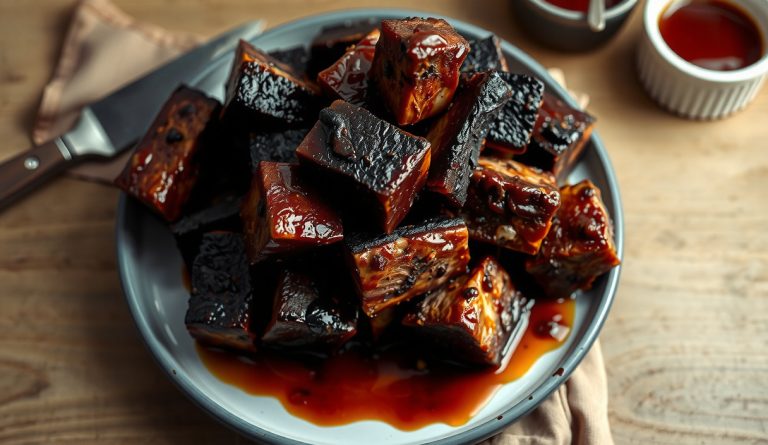
Smoked chuck burnt ends: After the rest, cube the roast into 1-inch pieces, toss in a light coating of your favorite BBQ sauce and a small amount of brown sugar, and return to the smoker uncovered at 250°F for 45 to 60 minutes. The additional heat caramelizes the sauce coating into a sticky, intensely flavored shell around each cube while the already-converted gelatin matrix keeps the interior from drying out. This is arguably the best possible use of leftover smoked chuck roast.
Frequently asked questions about smoked chuck roast
Why does my chuck roast stall for so long — sometimes longer than brisket? The stall duration is a function of surface area relative to mass and the specific fat-to-collagen ratio of the individual cut. A chuck roast has a proportionally larger surface area relative to its volume compared to a full packer brisket, which means more evaporative surface per pound of meat driving the cooling effect. Additionally, chucks from grass-fed or leaner animals have less intramuscular fat to act as a thermal buffer, which can extend the stall. The fix is always the same: wrap at 165°F and let the physics of trapped steam finish the job.
Can I use foil instead of butcher paper for the wrap? Yes, and the cook will complete slightly faster because foil creates a fully sealed, high-humidity braising environment that transfers heat more efficiently into the roast. The trade-off is bark softening — the steam trapped under foil will partially re-hydrate and soften the outer crust you worked to build. If bark texture is the priority, use unwaxed butcher paper. If total cook speed is the priority and you do not mind a softer exterior, foil is a perfectly valid choice and still delivers the full collagen conversion result.
Is a chuck roast actually close to brisket in texture, or is that marketing hyperbole? Smoked chuck roast is genuinely close in the ways that matter most — the gelatin-rich, pull-apart fiber texture and the deep smoke penetration — but there are real differences. Brisket point has a higher fat content and a more uniform grain structure that produces a slightly silkier mouthfeel in the best examples. Chuck has two or three distinct muscle groups running in different directions, which means more textural variation across a single roast. Some people prefer the variety. At roughly one-third the price per pound and 40 percent less cook time, the value proposition is clear regardless of which you prefer.