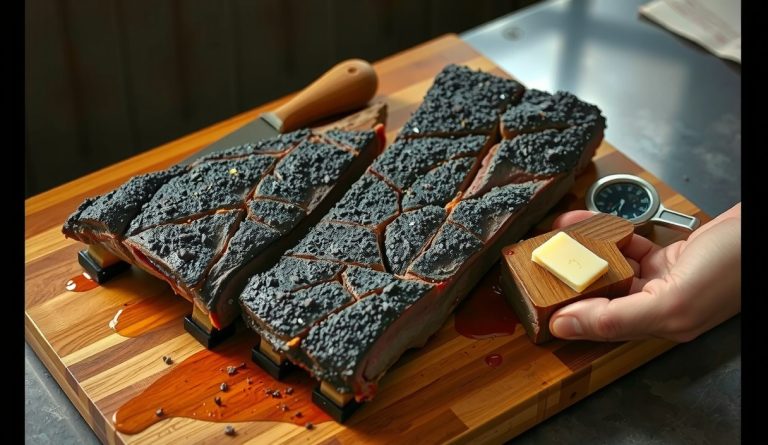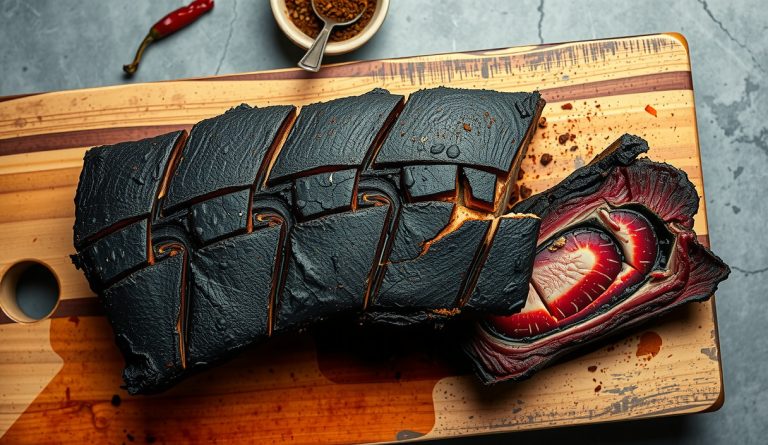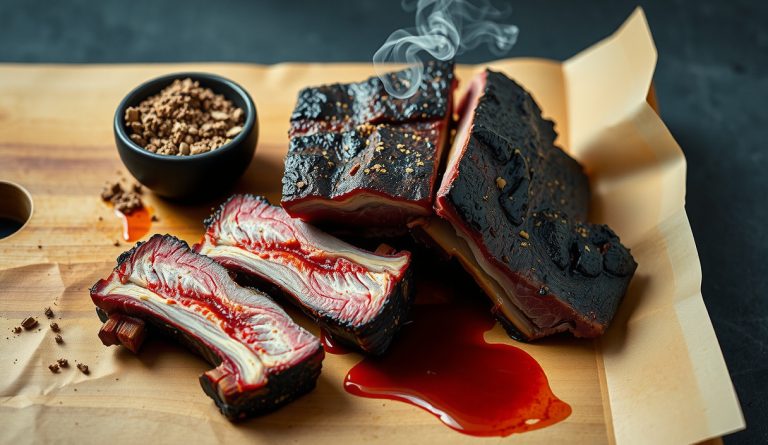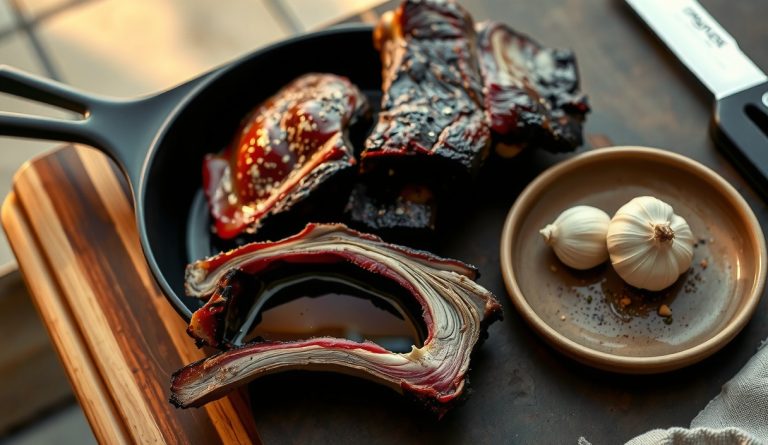
Doubling the number of beef short rib slabs in the smoker does not double the cook time — and understanding why prevents both undercooked and unnecessarily overcooked results. This variation covers the practical physics of scaling the canonical recipe from one slab to two or more, addressing pit management, spacing, and the correct reference point for estimating doneness.
What changes when you scale up smoked beef short ribs?
Cook time scales sub-linearly with total mass because the rate-limiting factor is conductive heat transfer across the thickest cross-section of a single rib, not the aggregate weight of the load. Heat moves through meat by conduction, and the thermal gradient from surface to center is governed by thickness — not by how many identical slabs sit on the grate beside it. At 250°F, a 10-lb slab will take only approximately 1 to 1.5 hours longer than a 5-lb slab of the same thickness — not twice as long. Plan the cook by measuring the thickest individual rib on the thickest slab and using that dimension as the reference, ignoring total rack weight entirely.
Airflow management becomes critical at scale. Do not stack slabs directly on top of one another — maintain clearance around all surfaces so convective air currents can carry heat and moisture away uniformly. Stacking traps a humid microenvironment between the slabs, slowing bark formation and creating uneven browning. If the pit has limited grate area, use a rib rack or a second grate tier with at least two inches of vertical clearance. Rotate slab positions once at the midpoint if the pit has known hot or cold zones.
What stays the same when cooking multiple slabs?
Target pit temperature, wood selection, rub application, and probe-tenderness doneness criteria are all unchanged when scaling smoked beef short ribs. Each slab is done when the thickest rib probes with zero resistance — the scaling principle affects time estimation only, not technique. Do not average probe readings across slabs; pull each slab independently when it hits its own tenderness target.
When is scaling smoked beef short ribs the better choice?
Scaling smoked beef short ribs is the right call for any cook feeding more than four to six people, for meal-prep scenarios where slabs will be sliced and portioned for the week, or for competition-style cooks where efficiency on a single fire matters. The approach is especially valuable when managing a backyard offset or large kettle where adding mass can cause temperature swings — knowing that the time commitment grows modestly rather than proportionally makes fuel and schedule planning far more predictable.
Use the full method, equipment, and rub measurements from the original Smoked Beef Short Ribs.