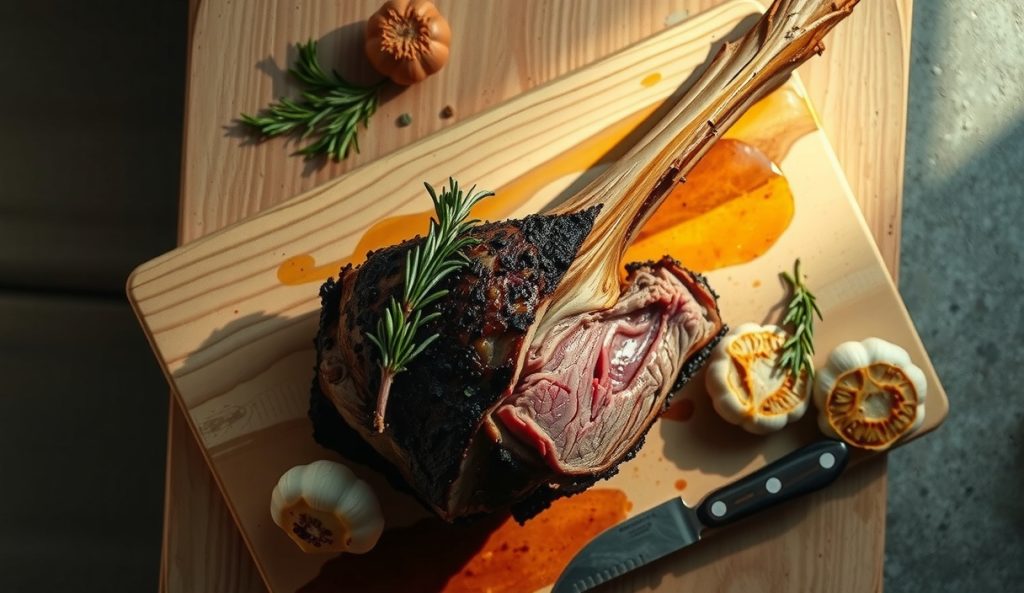
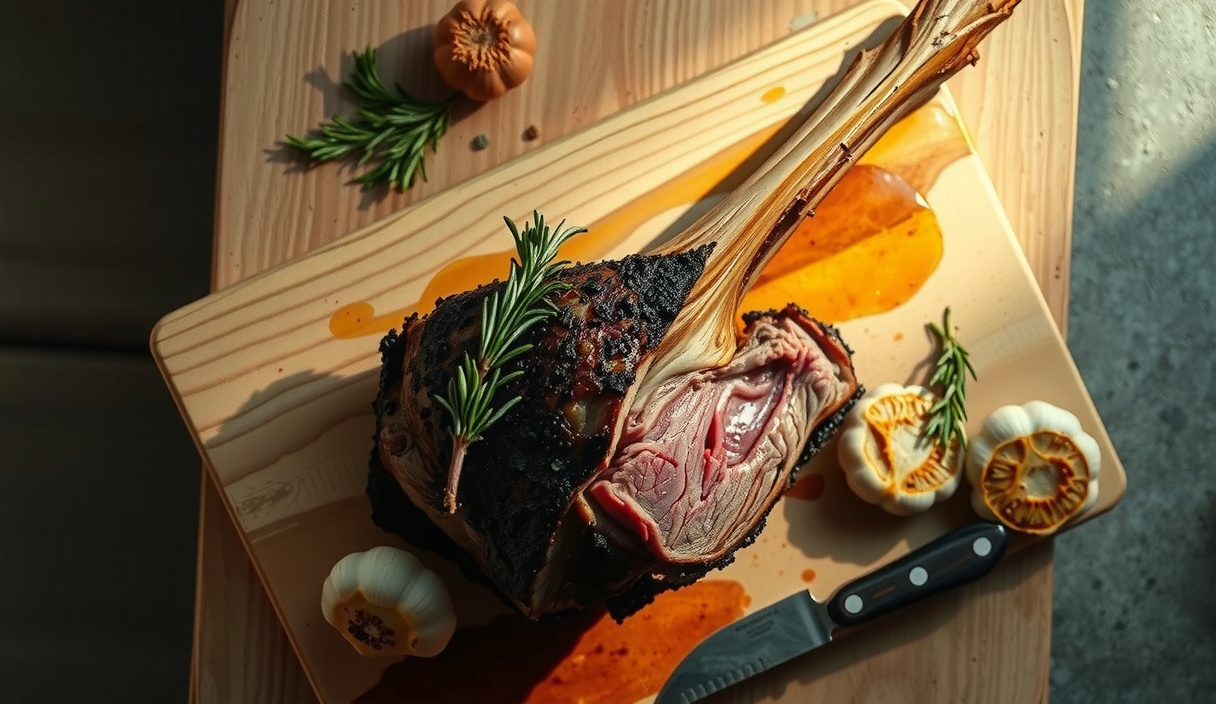
Smoked Leg of Lamb — Garlic-Rosemary Crust

Equipment
- 1 Offset, pellet, or kettle smoker Must hold a steady 275°F at grate level. Calibrate with a separate thermometer — built-in dome gauges read 30–50°F high.
- 1 Dual-probe leave-in thermometer One probe for grate-level ambient temp, one for the deepest point of the sirloin end of the leg.
- 1 Wire rack set inside a half-sheet pan For resting the roast off the pan surface so steam does not soften the bark.
- 1 Carving knife A slicing knife 10–12 inches long; sharp edge is essential for clean cross-grain cuts through the multiple muscle groups.
- 4 to 6 chunks Oak and cherry wood chunks or pellets Approx. 3 oz each. Add at the start and replenish once at the 90-minute mark if using an offset or kettle.
Ingredients
The Lamb
- 1 bone-in leg of lamb, aitch bone removed if possible 4.5 to 6 pounds. Ask the butcher to remove the pelvic aitch bone for easier carving.
- 1 tbsp kosher salt Approximately 1 tsp per pound; scale proportionally to the exact weight of your leg.
- 1 tsp freshly cracked black pepper
Garlic-Rosemary-Mustard Paste
- 8 cloves fresh garlic Pressed or very finely minced into a paste.
- 2 tbsp fresh rosemary needles, finely chopped Stripped from 3 large sprigs; fresh only — dried rosemary loses its critical terpene volatiles.
- 2 tbsp Dijon mustard Smooth or whole-grain. Acts as an emulsion binder and adds mild allyl isothiocyanate pungency to the bark.
- 3 tbsp extra-virgin olive oil
- 1 tsp lemon zest From half a lemon. Volatile citrus terpenes add brightness without dropping the pH of the bark-forming layer.
- 0.5 tsp red pepper flakes Optional. Capsaicin activates TRPV1 receptors, heightening the perception of the warm terpene notes in the rosemary.

Instructions
Day Before (Optional but Recommended)
- Season the leg aggressively with kosher salt and cracked pepper on all surfaces. Place on a wire rack set over a sheet pan and refrigerate uncovered for 8 to 24 hours. The dry-brine draws surface moisture out by osmosis, which is then reabsorbed into the meat, seasoning it internally. The dried exterior surface will produce a firmer, more adherent bark on the smoker.1 tbsp kosher salt, 1 tsp freshly cracked black pepper
Make the Paste and Prep the Leg
- Combine pressed garlic, chopped rosemary, Dijon mustard, olive oil, lemon zest, and red pepper flakes in a small bowl. Stir vigorously until the oil and mustard emulsify into a cohesive paste. The mustard’s natural lecithin-like emulsifiers bind the oil and aqueous phases together, ensuring the paste stays on the meat surface rather than running off.8 cloves fresh garlic, 2 tbsp fresh rosemary needles, finely chopped, 2 tbsp Dijon mustard, 3 tbsp extra-virgin olive oil, 1 tsp lemon zest, 0.5 tsp red pepper flakes
- Using a sharp paring knife, score the fat cap of the leg in a crosshatch pattern, cuts approximately 0.5 inches deep and 1 inch apart. These cuts serve two purposes: they allow the paste to penetrate below the fat membrane into the underlying muscle, and they give rendered fat an escape route so it drips rather than pooling and steaming the bark.
- Work the paste into every surface of the leg — fat cap, lean faces, and especially down into the score cuts. Use your hands to press the paste firmly into the meat. Allow the pasted leg to sit at room temperature for 45 minutes while the smoker comes up to temperature. A cold center dramatically extends cook time and produces an uneven temperature gradient across the roast.8 cloves fresh garlic, 2 tbsp fresh rosemary needles, finely chopped, 2 tbsp Dijon mustard, 3 tbsp extra-virgin olive oil, 1 tsp lemon zest, 0.5 tsp red pepper flakes
Fire and Smoke
- Fire your smoker and stabilize it at a steady 275°F at grate level. Add 3 to 4 chunks of oak and 2 chunks of cherry wood. You are targeting thin blue smoke — barely visible, not white and billowing. White smoke indicates incomplete combustion and excessive phenolic deposition, which produces a bitter, acrid bark. Allow the fire to establish a clean, thin smoke stream before placing the meat.
- Place the leg of lamb bone-side down on the grate, positioned over the indirect heat zone. Insert the meat probe into the deepest point of the sirloin (thick, round) end of the leg, ensuring the probe tip is at least 2 inches from the femur. Bone proximity reads 8 to 12°F higher than the true geometric center and will cause you to pull the roast under-done.
- Smoke at 275°F, maintaining thin blue smoke, until the internal temperature reaches 135°F. Expect approximately 3 to 3.5 hours for a 5-pound leg, though thermal mass variability means your specific time may differ. If you observe the internal temperature plateauing between 115°F and 125°F for 20 to 30 minutes, this is the evaporative stall — surface moisture is absorbing heat as fast as the smoker delivers it. Do not raise the temperature. The stall is extending Maillard time on the bark and will resolve on its own.
Rest and Carve
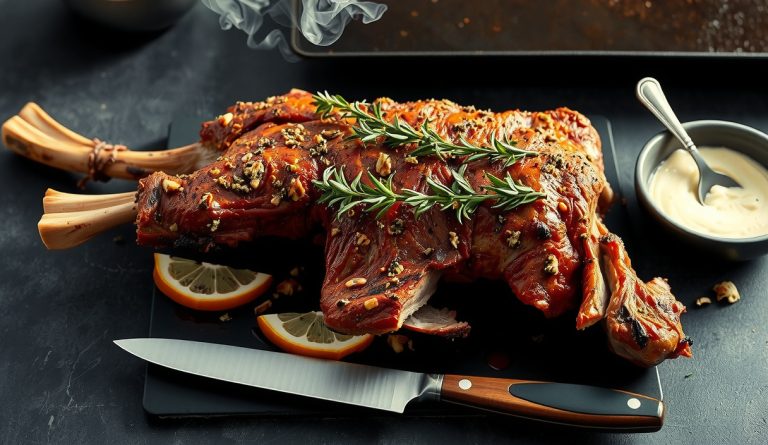
- When the sirloin-end probe reads 135°F, remove the leg from the smoker immediately. Transfer to a wire rack set over a cutting board or sheet pan. Tent loosely with a single sheet of aluminum foil — not tightly wrapped. A tight seal traps steam and collapses the bark. Rest for 25 minutes undisturbed. During rest, thermal equilibration carries the center to approximately 140°F to 142°F as heat flows inward from the hotter outer layers, and the contracted myofibrillar network partially relaxes, reabsorbing expelled moisture.
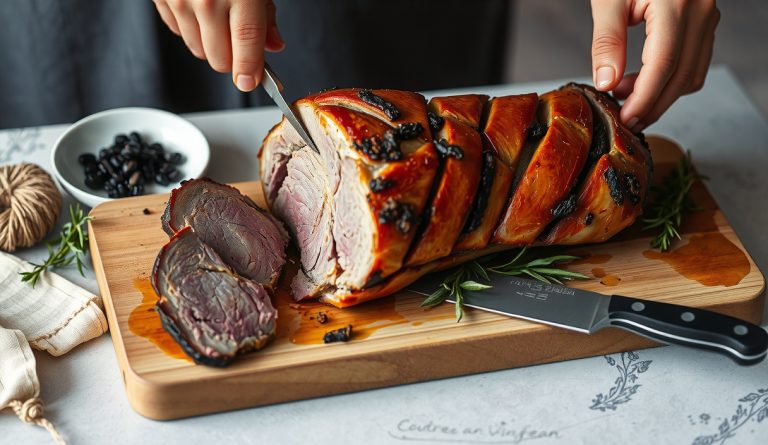
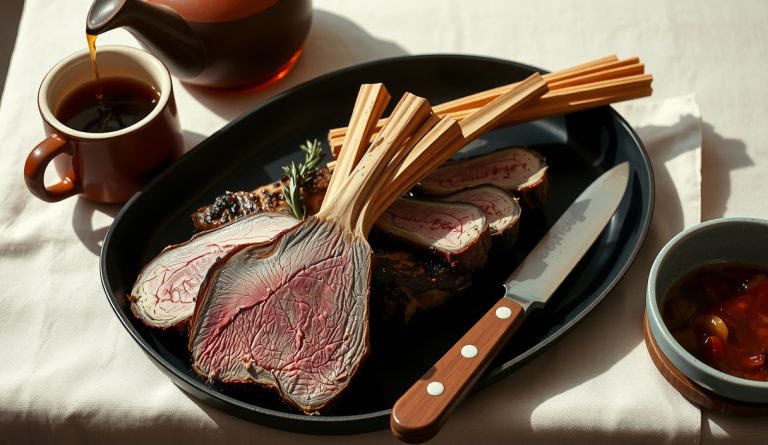
- Carve by working in sections. The leg has multiple muscle groups — sirloin end, top round, bottom round, shank — each with a different grain direction. Identify the grain in each section and slice perpendicular to it in 0.25- to 0.375-inch slices. Slicing against the grain mechanically shortens the muscle fibers and dramatically improves perceived tenderness. Serve immediately.
Notes
Nutrition
The first time I pulled a leg of lamb off a smoker, I understood immediately why the combination of wood smoke and lanolin-rich lamb fat has anchored Mediterranean and Middle Eastern feasts for millennia. Something transformative happens when you apply low, sustained heat and hardwood smoke to a bone-in leg: the fat renders slowly, the collagen in the shank meat hydrates into gelatin, and the bark sets into a crust that crackles under a knife. This is not a difficult cook. It is a patient one — and patience is the one ingredient most modern recipes under-value.
The formula here is deliberately restrained: a paste of garlic, fresh rosemary, Dijon mustard, and olive oil pressed into every surface, then a long ride in the smoke at 275°F until the center hits 135°F. Pull the leg, tent it, and rest it for 25 minutes. What you get is a rosy, juicy interior, a deeply savory bark, and a perfume that will stop conversation cold the moment you carry the leg to the table.
Why does smoked leg of lamb work? The science
Lamb fat is chemically distinct from beef and pork fat in a way that matters at the table. Lamb fat contains elevated concentrations of branched-chain fatty acids — specifically 4-methyloctanoic acid and 4-methylnonanoic acid — which are responsible for the characteristic gamey note that polarizes dinner guests. Those same acids are also the reason lamb has a uniquely high flavor affinity for rosemary: rosemary’s primary terpene volatiles — 1,8-cineole, camphor, and alpha-pinene — are structurally complementary to those branched-chain acids, occupying overlapping aromatic receptor pathways and producing a synergistic, herbaceous-meaty perception that neither ingredient achieves alone. Applying the paste before smoking maximizes this interaction: the lipid-soluble terpenes partition into the surface fat layer during the cook, thermodynamically anchored there rather than volatilizing off into the smoke stream.
Maillard browning on the bark begins at the surface the moment the leg enters the 275°F smoker — well above the 140°C threshold required for amino-carbonyl condensation — but it proceeds relatively slowly because a bone-in leg is a large thermal mass. Water evaporates from the exterior while the internal temperature climbs through the myosin denaturation window (130°F to 140°F), which is exactly where this recipe targets a pull. Myosin has fully denatured and begun cross-linking into a gelled network by 130°F, giving each slice a firm-yet-yielding texture; actin, the protein responsible for catastrophic moisture loss, denatures above 154°F. Pulling at 135°F internal keeps the leg safely in the optimal moisture-retention band. The Dijon mustard in the paste is not decorative: its emulsified oil-and-water structure helps the paste adhere under heat, and its allyl isothiocyanate compounds contribute a mild pungent trigeminal note that brightens bark flavor complexity without registering as mustardy after the long cook.
Collagen in the shank portion of a leg of lamb begins converting to soluble gelatin above 160°F — higher than the target pull temperature. That gap is intentional. The shank end spends more time in the peripheral heat zone than the thicker sirloin end, nudging its connective tissue further along the hydrolysis curve and yielding the fork-tender, almost braised texture that makes shank slices so compelling. The 25-minute rest period under loose foil allows the thermal gradient across the roast to equalize: the outer layers, sitting close to the bark, are hotter than the geometric center. During rest, heat flows inward from those hot outer layers, gently completing the cook and allowing the myofibrillar network — which contracted sharply during peak heat — to relax and reabsorb some of the expelled moisture.
What equipment and ingredients do I need?
The smoker: Any offset, pellet, or kettle-with-snake-method smoker capable of holding 275°F steadily will work. Thin Blue Law: you want thin, barely visible smoke — not white billowing clouds. Thick white smoke deposits acrid, creosote-forward compounds on the bark. For fuel, oak and cherry are the two best performers with lamb. Oak provides a firm, clean hardwood backbone; cherry adds a faint sweetness and a deep mahogany bark color. Avoid mesquite for a long cook — its phenolic load is too aggressive at extended exposure times and will overpower the rosemary paste.
The leg: A bone-in leg between 4.5 and 6 pounds is the sweet spot. Bone-in is non-negotiable here — the femur acts as a heat conductor driving even cooking toward the center, and the periosteum (connective tissue surrounding the bone) contributes collagen to the bark near the bone socket. Ask your butcher to remove the pelvic bone (the aitch bone) if it is still attached; removing the aitch bone makes carving dramatically easier without sacrificing any structural benefit during the cook.
Rosemary: Fresh only. Dried rosemary in a paste loses most of its volatile terpenes during the drying process and contributes a dusty, medicinal character rather than the bright, resinous punch of fresh needles. Strip the needles from three large sprigs and chop them fine — you want roughly 2 tablespoons of tightly packed chopped needles.
Mustard: Whole-grain or smooth Dijon, not yellow American mustard. Dijon sits around pH 3.5 to 4.0 and has a fine-ground particle distribution that produces a stable emulsified paste at room temperature. Yellow mustard runs lower in acidity and higher in turmeric, which would add an off-color and off-flavor to the bark.
Thermometry: A dual-probe thermometer is essentially mandatory. Place the ambient probe in the smoker — do not trust the built-in lid thermometer, which reads the dome rather than the grate level and can be 30°F to 50°F off. Insert the meat probe into the deepest point of the sirloin end, not touching the bone. Pull the leg at 135°F internal; carryover during the 25-minute rest will bring the center to approximately 140°F to 142°F — a textbook medium.
Smoked Leg of Lamb — Garlic-Rosemary Crust
Equipment
- 1 Offset, pellet, or kettle smoker Must hold a steady 275°F at grate level. Calibrate with a separate thermometer — built-in dome gauges read 30–50°F high.
- 1 Dual-probe leave-in thermometer One probe for grate-level ambient temp, one for the deepest point of the sirloin end of the leg.
- 1 Wire rack set inside a half-sheet pan For resting the roast off the pan surface so steam does not soften the bark.
- 1 Carving knife A slicing knife 10–12 inches long; sharp edge is essential for clean cross-grain cuts through the multiple muscle groups.
- 4 to 6 chunks Oak and cherry wood chunks or pellets Approx. 3 oz each. Add at the start and replenish once at the 90-minute mark if using an offset or kettle.
Ingredients
The Lamb
- 1 bone-in leg of lamb, aitch bone removed if possible 4.5 to 6 pounds. Ask the butcher to remove the pelvic aitch bone for easier carving.
- 1 tbsp kosher salt Approximately 1 tsp per pound; scale proportionally to the exact weight of your leg.
- 1 tsp freshly cracked black pepper
Garlic-Rosemary-Mustard Paste
- 8 cloves fresh garlic Pressed or very finely minced into a paste.
- 2 tbsp fresh rosemary needles, finely chopped Stripped from 3 large sprigs; fresh only — dried rosemary loses its critical terpene volatiles.
- 2 tbsp Dijon mustard Smooth or whole-grain. Acts as an emulsion binder and adds mild allyl isothiocyanate pungency to the bark.
- 3 tbsp extra-virgin olive oil
- 1 tsp lemon zest From half a lemon. Volatile citrus terpenes add brightness without dropping the pH of the bark-forming layer.
- 0.5 tsp red pepper flakes Optional. Capsaicin activates TRPV1 receptors, heightening the perception of the warm terpene notes in the rosemary.
Instructions
Day Before (Optional but Recommended)
- Season the leg aggressively with kosher salt and cracked pepper on all surfaces. Place on a wire rack set over a sheet pan and refrigerate uncovered for 8 to 24 hours. The dry-brine draws surface moisture out by osmosis, which is then reabsorbed into the meat, seasoning it internally. The dried exterior surface will produce a firmer, more adherent bark on the smoker.1 tbsp kosher salt, 1 tsp freshly cracked black pepper
Make the Paste and Prep the Leg
- Combine pressed garlic, chopped rosemary, Dijon mustard, olive oil, lemon zest, and red pepper flakes in a small bowl. Stir vigorously until the oil and mustard emulsify into a cohesive paste. The mustard’s natural lecithin-like emulsifiers bind the oil and aqueous phases together, ensuring the paste stays on the meat surface rather than running off.8 cloves fresh garlic, 2 tbsp fresh rosemary needles, finely chopped, 2 tbsp Dijon mustard, 3 tbsp extra-virgin olive oil, 1 tsp lemon zest, 0.5 tsp red pepper flakes
- Using a sharp paring knife, score the fat cap of the leg in a crosshatch pattern, cuts approximately 0.5 inches deep and 1 inch apart. These cuts serve two purposes: they allow the paste to penetrate below the fat membrane into the underlying muscle, and they give rendered fat an escape route so it drips rather than pooling and steaming the bark.
- Work the paste into every surface of the leg — fat cap, lean faces, and especially down into the score cuts. Use your hands to press the paste firmly into the meat. Allow the pasted leg to sit at room temperature for 45 minutes while the smoker comes up to temperature. A cold center dramatically extends cook time and produces an uneven temperature gradient across the roast.8 cloves fresh garlic, 2 tbsp fresh rosemary needles, finely chopped, 2 tbsp Dijon mustard, 3 tbsp extra-virgin olive oil, 1 tsp lemon zest, 0.5 tsp red pepper flakes
Fire and Smoke
- Fire your smoker and stabilize it at a steady 275°F at grate level. Add 3 to 4 chunks of oak and 2 chunks of cherry wood. You are targeting thin blue smoke — barely visible, not white and billowing. White smoke indicates incomplete combustion and excessive phenolic deposition, which produces a bitter, acrid bark. Allow the fire to establish a clean, thin smoke stream before placing the meat.
- Place the leg of lamb bone-side down on the grate, positioned over the indirect heat zone. Insert the meat probe into the deepest point of the sirloin (thick, round) end of the leg, ensuring the probe tip is at least 2 inches from the femur. Bone proximity reads 8 to 12°F higher than the true geometric center and will cause you to pull the roast under-done.
- Smoke at 275°F, maintaining thin blue smoke, until the internal temperature reaches 135°F. Expect approximately 3 to 3.5 hours for a 5-pound leg, though thermal mass variability means your specific time may differ. If you observe the internal temperature plateauing between 115°F and 125°F for 20 to 30 minutes, this is the evaporative stall — surface moisture is absorbing heat as fast as the smoker delivers it. Do not raise the temperature. The stall is extending Maillard time on the bark and will resolve on its own.
Rest and Carve
- When the sirloin-end probe reads 135°F, remove the leg from the smoker immediately. Transfer to a wire rack set over a cutting board or sheet pan. Tent loosely with a single sheet of aluminum foil — not tightly wrapped. A tight seal traps steam and collapses the bark. Rest for 25 minutes undisturbed. During rest, thermal equilibration carries the center to approximately 140°F to 142°F as heat flows inward from the hotter outer layers, and the contracted myofibrillar network partially relaxes, reabsorbing expelled moisture.
- Carve by working in sections. The leg has multiple muscle groups — sirloin end, top round, bottom round, shank — each with a different grain direction. Identify the grain in each section and slice perpendicular to it in 0.25- to 0.375-inch slices. Slicing against the grain mechanically shortens the muscle fibers and dramatically improves perceived tenderness. Serve immediately.
Notes
Nutrition
How do I nail it every time? Tips for a perfect smoked leg of lamb
- Dry-brine 24 hours out if you can. Salt draws moisture to the surface via osmosis, then that brine is reabsorbed, seasoning the meat internally. Season aggressively — 1 teaspoon of kosher salt per pound of meat — and leave the leg uncovered on a wire rack in the refrigerator overnight. The dried surface also takes bark better.
- Do not skip the scoring. The 0.5-inch-deep cuts into the fat cap serve two functions: they allow the paste to penetrate below the surface fat layer, and they give the fat an avenue to render and drip rather than pooling under an intact membrane and steaming the bark soft.
- Rest on the cutting board, not in the pan. Resting the leg in the roasting pan traps steam, which softens the bark you spent three-plus hours building. Set the leg on a wire rack over a cutting board and tent loosely — not tightly — with foil.
- Probe placement determines your pull call. The sirloin end (thick, round end) is the coldest zone. If the probe is in the shank end or near the bone, you will get a reading 8°F to 12°F higher than the true geometric center and pull too early. Insert the probe into the thickest part of the sirloin, at least 2 inches from the bone.
- Smoke stall awareness: Unlike a brisket, a 5-lb leg of lamb rarely hits a pronounced stall, but the internal temperature may plateau between 115°F and 120°F for 20 to 30 minutes as surface evaporation temporarily balances heat input. Do not panic and crank the heat — the stall is doing useful work, extending the time the surface spends in the Maillard zone.
- Carve against the grain. A lamb leg contains multiple muscle groups running in different directions. Work in sections, identifying the grain direction in each muscle group and slicing perpendicular to it. This mechanically shortens the muscle fibers and dramatically improves perceived tenderness regardless of internal temperature.
What are the best variations on this recipe?
Boneless leg for shorter cook times: A butterflied, boneless leg of the same weight will cook approximately 45 minutes faster because removing the bone eliminates the insulating mass at the center and allows heat to penetrate from all sides simultaneously. The tradeoff is a more irregular shape — tie the boneless leg with butcher’s twine at 1.5-inch intervals to approximate an even cylinder. Pull at 130°F internal since carryover will be more aggressive in a boneless roast.
North African spice profile: Swap the rosemary-Dijon paste for a chermoula-inspired rub: 1 tablespoon each of cumin and coriander, 1 teaspoon each of smoked paprika and cinnamon, a pinch of cayenne, 6 garlic cloves, and the juice and zest of one preserved lemon blended with 3 tablespoons of olive oil. The warm spices have high thermodynamic affinity for lamb’s branched-chain fatty acids in the same way rosemary’s terpenes do, producing a deeply aromatic bark with Moroccan resonance. Pair the finished leg with charred flatbread and harissa yogurt sauce.
Higher finish temperature for crowd preference: If the table includes guests who are uncomfortable with medium-pink lamb, smoke the leg to an internal temperature of 150°F instead of 135°F. At 150°F, a larger fraction of the actin has denatured and the meat will present as medium-well — paler in color, firmer in texture. Compensate by resting the leg for a full 30 minutes and serving immediately with a generous drizzle of the pan drippings collected during the cook, which will restore perceived juiciness on the plate.
Scaling for larger groups: A full bone-in leg in the 7-to-8-pound range will add approximately 45 to 60 minutes of cook time at 275°F. The garlic-rosemary paste scales linearly — double the batch for a leg over 7 pounds to ensure full coverage. Do not scale the salt beyond 1 teaspoon per pound or you risk an aggressively salty bark. The rest window should extend to 35 minutes for a roast in this larger size range.
Frequently asked questions
Can I use a gas grill instead of a dedicated smoker? Yes, with a two-zone indirect setup. Place a foil packet of soaked wood chips or chunks over one active burner, set the leg on the unlit side, and dial in a steady 275°F with the lid closed. Replenish the wood packet every 45 minutes. Smoke penetration will be lighter than a dedicated smoker but still produces meaningful bark and flavor.
Does the gamey flavor increase or decrease with the smoke cook? The gamey character softens significantly. The branched-chain fatty acids responsible for the gamey perception are water-soluble and partially volatilize during the extended low-temperature cook. Additionally, the Maillard-derived melanoidins in the bark contribute sweet, nutty, and savory notes that effectively mask the perception of those fatty acids. Guests who self-identify as disliking lamb frequently enjoy this preparation.
How do I store and reheat leftover smoked lamb without drying it out? Slice only what you intend to serve immediately. Store the remaining roast whole, wrapped tightly in butcher paper or foil, refrigerated up to 4 days. To reheat, bring the leg to room temperature over 30 minutes, then place it on a rack in a 300°F oven covered loosely with foil until the center reaches 110°F, approximately 25 to 35 minutes. Resting heat will carry the center to 115°F to 120°F — warm and juicy. Avoid microwave reheating, which generates uneven internal hotspots that push actin past its denaturation threshold locally, creating dry, stringy patches.