Smoked Pastrami from Scratch
Equipment
- 1 Offset smoker, kettle, or pellet grill Must hold a steady 225°F for 6–9 hours
- 1 3.5-gallon food-safe container or brining bag Must fully submerge a 4–5 lb brisket flat
- 1 Digital gram scale Required for precise curing salt measurement
- 1 Instant-read or leave-in probe thermometer Track internal temp through the stall
- 1 Half hotel pan or roasting pan with rack For the steam finish phase; must seal tightly with foil
- 1 Spice grinder or mortar and pestle For cracking coriander and black pepper to medium-coarse texture
Ingredients
Brisket
- 4.5 lb brisket flat Untrimmed, with at least 1/4-inch fat cap; avoid pre-enhanced (injected) cuts
Pink-Cure Brine
- 1 gallon cold water Filtered preferred; divided if needed to dissolve salts
- 150 g kosher salt Diamond Crystal; use 120 g if Morton’s (denser grain)
- 15 g Prague Powder No. 1 (pink curing salt) 6.25% sodium nitrite; weigh precisely on a gram scale — do not estimate by volume
- 75 g dark brown sugar Provides Maillard precursors and balances salinity
- 2 tbsp black peppercorns Whole, lightly cracked
- 1 tbsp coriander seeds Whole
- 4 cloves garlic Smashed
- 2 bay leaves
- 1 tsp mustard seeds Yellow or brown
- 1 tsp red pepper flakes Optional; adds mild heat to the cured interior
Pastrami Rub
- 3 tbsp whole black peppercorns Cracked coarse in a spice grinder or under a heavy skillet — not powdered
- 2 tbsp coriander seeds Cracked coarse; the dominant rub flavor
- 1 tsp garlic powder
- 1 tsp smoked paprika Optional; deepens color and adds a secondary smoky phenolic note
- 1 tsp mustard powder Acts as a binder adhesion agent for the bark
Smoke
- 4 oz rye wood chunks or oak chunks Rye is traditional and lighter; oak is heavier and more widely available
Steam
- 2 cups water Placed in the bottom of the roasting pan to generate steam

Instructions
Make the Brine
- Bring 1 quart of the cold water to a simmer in a large saucepan. Add the kosher salt, Prague Powder No. 1, and brown sugar. Stir until fully dissolved — do not let the brine boil vigorously, as that degrades nitrite. Add the peppercorns, coriander seeds, garlic, bay leaves, mustard seeds, and red pepper flakes. Remove from heat and add the remaining cold water to bring the brine down to below 40°F before use. Do not add the brisket to warm brine.150 g kosher salt, 15 g Prague Powder No. 1 (pink curing salt), 75 g dark brown sugar, 2 tbsp black peppercorns, 1 tbsp coriander seeds, 4 cloves garlic, 2 bay leaves, 1 tsp mustard seeds
Cure the Brisket
- Place the brisket flat in a 3.5-gallon food-safe container or a 2-gallon zip-lock bag. Pour the cold brine over the brisket, ensuring it is fully submerged. Use a plate or zip-lock bag filled with water as a weight if necessary — any exposed surface will cure unevenly and remain grey.
- Refrigerate for 7 days. Flip the brisket once at the halfway mark (day 3 or 4) to promote even brine distribution. The cure is complete when the meat is firm and uniformly pink-grey throughout when you inspect a corner cut — there should be no raw dark-red center remaining.
Rinse and Form the Pellicle
- Remove the brisket from the brine and rinse thoroughly under cold running water for 2 to 3 minutes, scrubbing off any spice debris. Pat completely dry with paper towels. Place fat-cap-up on a wire rack set over a sheet pan. Refrigerate uncovered for 4 to 8 hours, or overnight, until the surface is dry and tacky to the touch. This pellicle is the protein matrix that smoke particulates and the Maillard cascade will anchor to — a wet surface produces steam, not bark.
Apply the Rub and Prep the Smoker
- Crack the black peppercorns and coriander seeds to a coarse texture — you want irregular shards, not powder. Mix with the garlic powder, smoked paprika, and mustard powder. Apply the rub liberally to all surfaces of the brisket, pressing firmly so the crust adheres. Do this 30 minutes before the brisket enters the smoker, not hours before — the volatile aromatic compounds in the crust dissipate rapidly at room temperature.3 tbsp whole black peppercorns, 2 tbsp coriander seeds, 1 tsp garlic powder, 1 tsp smoked paprika, 1 tsp mustard powder
- Set up your smoker for indirect heat and bring it to a stable 225°F (107°C). Add your wood chunks to the fire or smoke chamber. Allow the smoker to produce clean, thin blue smoke before adding the brisket — thick white smoke carries excess creosote and will produce a bitter, astringent bark.4 oz rye wood chunks or oak chunks
Smoke
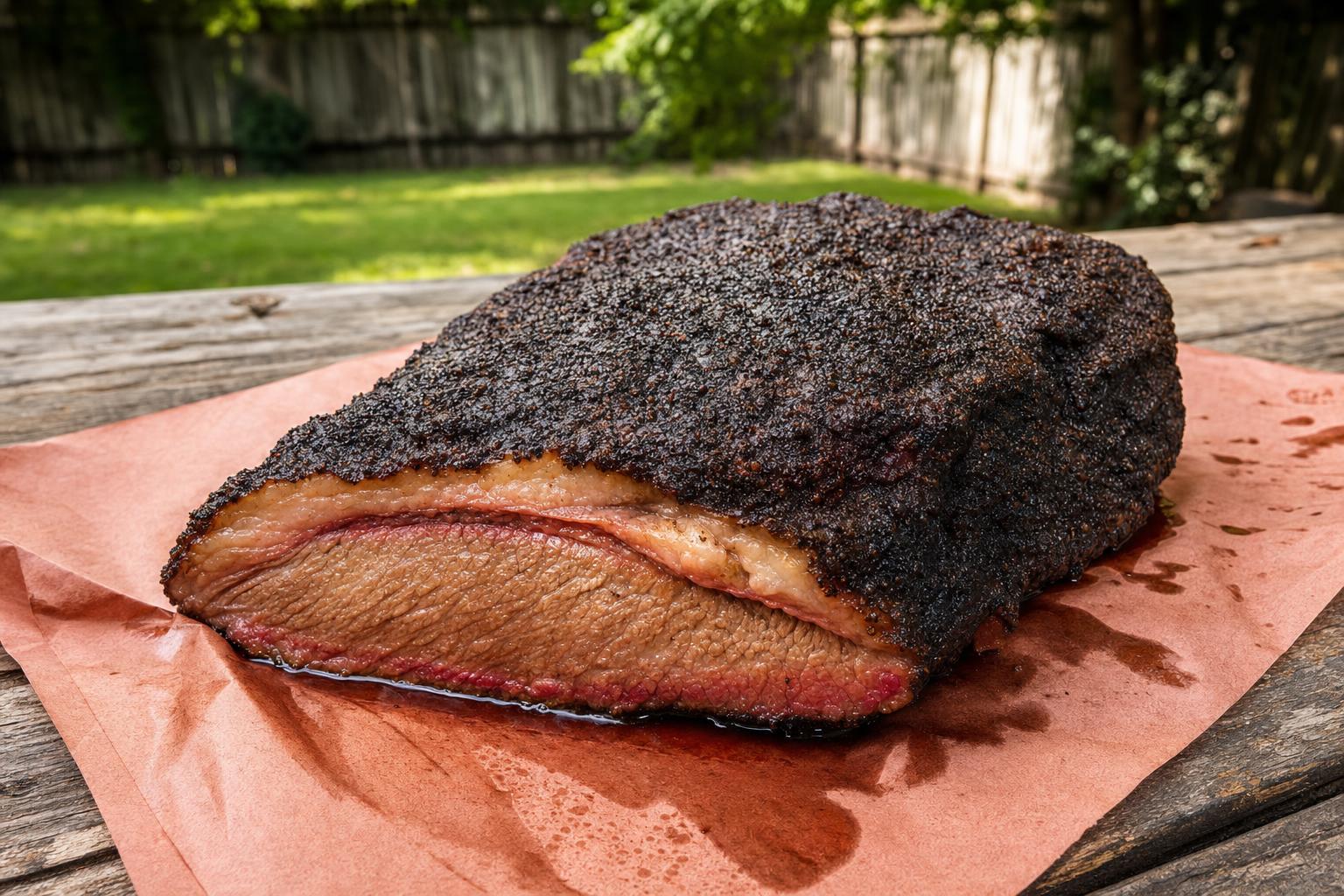
- Place the brisket fat-cap-up on the smoker grate. Insert a probe thermometer into the thickest part of the flat, avoiding fat seams. Smoke at 225°F until the internal temperature reaches 165°F (74°C). This will take approximately 6 to 9 hours depending on the size of the flat and the efficiency of your smoker.
- The stall is real and it is long. Expect the internal temperature to plateau between 150°F and 165°F for 2 to 5 hours as evaporative cooling at the surface matches the heat input from the smoker. Do not raise the smoker temperature. Do not wrap the brisket. The surface must remain exposed to smoke and dry heat for bark formation to complete. The stall breaks on its own as the surface crust fully sets and evaporative cooling slows.
Steam
- Once the brisket reaches 165°F internal, remove it from the smoker and transfer it to a rack set inside a roasting pan or hotel pan. Pour the 2 cups of water into the bottom of the pan — ensure the water does not touch the brisket. Seal the pan tightly with two layers of heavy-duty aluminum foil, crimping firmly around all edges to trap steam.
- Place the sealed pan in a 275°F (135°C) oven. Steam until the internal temperature of the brisket reaches 203°F (95°C), approximately 2 to 3 hours. Hold at 203°F for an additional 30 minutes — this hold window completes the collagen hydrolysis into gelatin. If you check and the foil has ballooned tightly, steam is doing its work; do not unseal early.
- Remove the pan from the oven, unseal one corner of the foil carefully to release the steam burst away from your hands, and allow the brisket to rest uncovered for 20 minutes. This redistributes the gelatin phase and equalizes the internal temperature gradient before slicing.
Slice and Serve
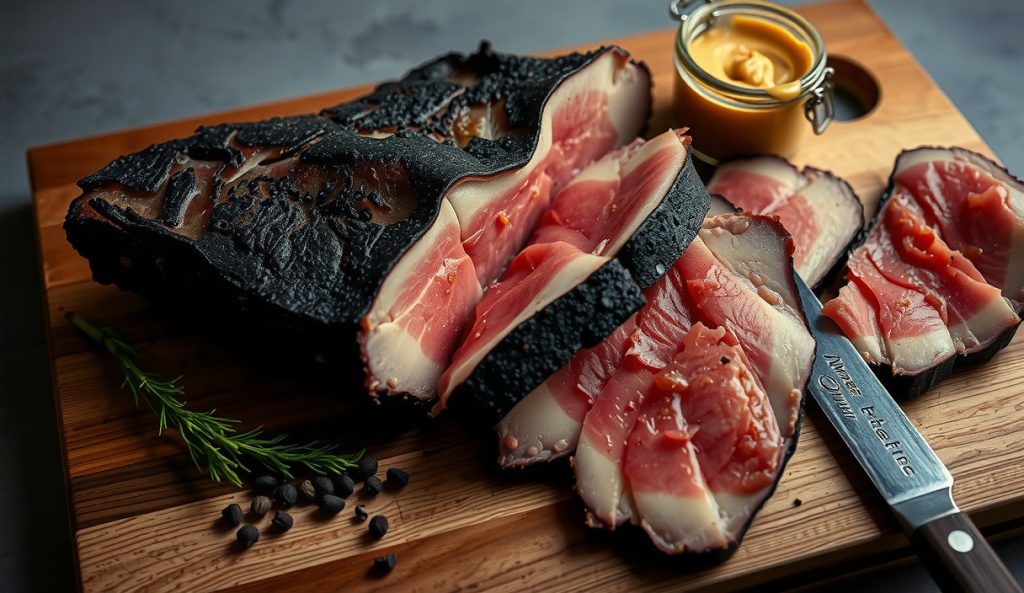
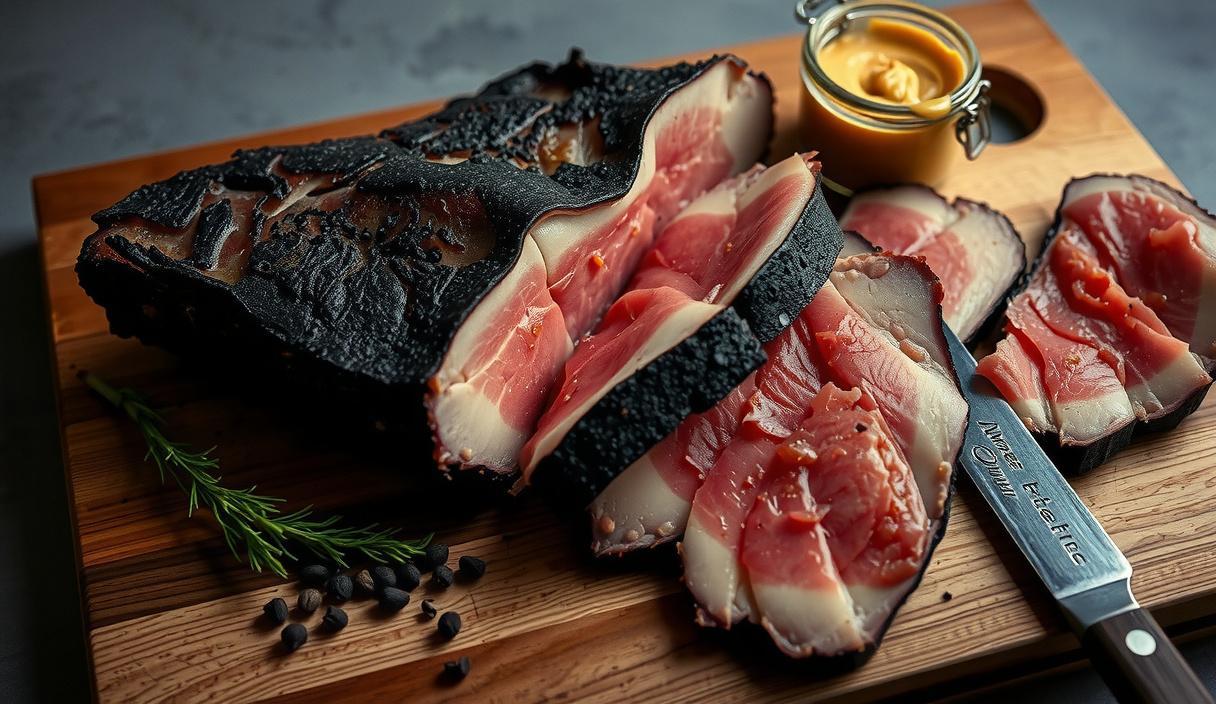
- Identify the grain direction of the brisket flat — the long muscle fibers run in one consistent direction. Slice against the grain, at approximately 3 to 4 millimeters thickness, using a sharp slicing knife with long, smooth strokes rather than a sawing motion. Serve immediately on rye bread with spicy brown mustard, or allow to cool completely before vacuum-sealing for refrigerator storage up to 5 days or freezer storage up to 3 months.
Notes
Nutrition
Pastrami is an act of patience compressed into five stages: cure, rinse, rub, smoke, steam. Each phase does something irreversible to the protein matrix, and understanding the chain is the difference between a limp, grey slab and a brick of dark-barked, pink-centered beef that slices like velvet. American Meathead started chasing a deli-grade result years ago, failed roughly four times, and landed on a protocol anchored entirely in food physics rather than folk wisdom.
The brisket flat is the ideal cut for smoked pastrami — less intramuscular fat than the point, which means the cure penetrates evenly, and the collagen-to-muscle ratio rewards the long steam at the end. This protocol takes the brisket flat from raw to finished across roughly ten days, most of which require nothing from you. Where Flavor Meets the Flame.
Why does smoked pastrami work? The science behind every stage
The seven-day pink-cure brine does three things simultaneously, and each one is non-negotiable for deli-grade pastrami. Sodium chloride at roughly 3% w/w in the brine suppresses water activity (aw) at the surface, inhibiting spoilage-organism growth while osmotic pressure begins driving brine into the muscle fibers. Sodium nitrite — Prague Powder No. 1 at 0.25% of the brine weight, yielding roughly 156 ppm nitrite — reacts with myoglobin under mildly acidic conditions to form nitrosomyoglobin, the vivid pink pigment that survives cooking and defines pastrami’s color. The brine pH, held between 5.8 and 6.2 by the addition of brown sugar and the natural lactic acid environment, accelerates the Amadori rearrangement precursors that will feed the Maillard cascade during smoking.
The 7-day cure window is not arbitrary: diffusion of salt and nitrite through a 3-inch flat follows Fick’s second law, and empirical equilibration data for beef brisket shows approximately 0.6 to 0.8 inches of daily penetration under refrigeration. A 3-inch flat therefore requires at minimum 4 days, and 7 days guarantees full center equilibration with a comfortable safety margin.
Smoking the brisket at 225°F (107°C) drives three overlapping reactions that build the bark and the aromatic profile. Maillard browning initiates on the bark surface almost immediately once the pellicle forms, as water activity at the surface drops below 0.70 during the first 60 to 90 minutes of smoke. The cascade — Schiff base formation, Amadori rearrangement, Strecker degradation — generates the hundreds of volatile organic compounds (VOCs) that define smoked beef’s aromatic complexity: pyrazines, furans, carbonyls, and thiophenols. Internally, myosin denatures between 104°F and 140°F (40–60°C), and collagen begins its thermal shrinkage at roughly 140–150°F (60–65°C). The brisket comes off the smoker at 165°F (74°C) internal — above the USDA whole-muscle beef safety threshold and critically above the stall.
The stall is not failure — it is physics. Between 150°F and 165°F internal temperature, surface evaporation absorbs energy as fast as the smoker delivers it, anchoring the internal temperature for potentially 3 to 5 hours. Do not wrap the brisket to bust through it; doing so steams the bark and collapses the Maillard crust that took 60 to 90 minutes to build. Wait it out at 225°F.
The steam phase is where pastrami earns its defining texture. Steaming the brisket to 203°F (95°C) internal and holding there for 30 to 45 minutes drives collagen hydrolysis at a rate governed by first-order kinetics. Above 185°F (85°C), the rate of collagen-to-gelatin conversion accelerates sharply: triple-helix structures unwind, inter-chain hydrogen bonds rupture, and the resulting soluble gelatin coats every muscle fiber with a lubricating, unctuous gel phase. The actin network has already denatured at 165°F, but the prolonged steam hold at 203°F completes conversion of the remaining insoluble cross-linked collagen — turning what would be a chewy, fibrous slab into something that yields under gentle lateral pressure from a slicing knife. Resting for 20 minutes post-steam allows the internal gelatin to redistribute and the temperature gradient to equalize, so the first slice does not bleed steam-driven moisture.
What equipment and ingredients do I need for smoked pastrami from scratch?
- Prague Powder No. 1 (Pink Curing Salt #1): This is sodium chloride plus 6.25% sodium nitrite. Do not confuse it with Prague Powder No. 2 (for long dry-cures) or Himalayan pink salt (decorative, no nitrite). The pink color of the curing salt is a dye added specifically to prevent accidental consumption. Dose precisely at 1 teaspoon per 5 pounds of meat — or, better, weigh it on a gram scale at 2.75 grams per kilogram of brine. Do not eyeball curing salts.
- Brisket flat: Select a flat with at least a quarter-inch fat cap intact. The cap insulates against drying during the smoke phase. A 4 to 5 pound flat fits a standard half-hotel pan and a 3.5-gallon brine container. Avoid pre-trimmed flats sold in vacuum-sealed retail packaging — they are often pre-enhanced with sodium solutions, which will cause over-salting.
- Rye-wood or oak chunks: Rye wood is the traditional pastrami smoke and provides a lighter, slightly floral phenolic profile. Oak delivers a heavier, more linear smoke. Avoid mesquite, which generates high aldehyde loads that turn acrid on a 6-to-8-hour smoke.
- Instant-read thermometer: Non-negotiable. A probe left in place during the smoke will track the stall in real time. Target 165°F (74°C) before transitioning to steam.
- Roasting pan with rack and foil tent: The steam phase requires a closed, humid environment. A hotel pan with a cup of water, sealed tightly with heavy-duty foil, accomplishes this without specialized equipment. A dedicated steam oven or combi-oven is ideal but not required.
Smoked Pastrami from Scratch
Equipment
- 1 Offset smoker, kettle, or pellet grill Must hold a steady 225°F for 6–9 hours
- 1 3.5-gallon food-safe container or brining bag Must fully submerge a 4–5 lb brisket flat
- 1 Digital gram scale Required for precise curing salt measurement
- 1 Instant-read or leave-in probe thermometer Track internal temp through the stall
- 1 Half hotel pan or roasting pan with rack For the steam finish phase; must seal tightly with foil
- 1 Spice grinder or mortar and pestle For cracking coriander and black pepper to medium-coarse texture
Ingredients
Brisket
- 4.5 lb brisket flat Untrimmed, with at least 1/4-inch fat cap; avoid pre-enhanced (injected) cuts
Pink-Cure Brine
- 1 gallon cold water Filtered preferred; divided if needed to dissolve salts
- 150 g kosher salt Diamond Crystal; use 120 g if Morton’s (denser grain)
- 15 g Prague Powder No. 1 (pink curing salt) 6.25% sodium nitrite; weigh precisely on a gram scale — do not estimate by volume
- 75 g dark brown sugar Provides Maillard precursors and balances salinity
- 2 tbsp black peppercorns Whole, lightly cracked
- 1 tbsp coriander seeds Whole
- 4 cloves garlic Smashed
- 2 bay leaves
- 1 tsp mustard seeds Yellow or brown
- 1 tsp red pepper flakes Optional; adds mild heat to the cured interior
Pastrami Rub
- 3 tbsp whole black peppercorns Cracked coarse in a spice grinder or under a heavy skillet — not powdered
- 2 tbsp coriander seeds Cracked coarse; the dominant rub flavor
- 1 tsp garlic powder
- 1 tsp smoked paprika Optional; deepens color and adds a secondary smoky phenolic note
- 1 tsp mustard powder Acts as a binder adhesion agent for the bark
Smoke
- 4 oz rye wood chunks or oak chunks Rye is traditional and lighter; oak is heavier and more widely available
Steam
- 2 cups water Placed in the bottom of the roasting pan to generate steam
Instructions
Make the Brine
- Bring 1 quart of the cold water to a simmer in a large saucepan. Add the kosher salt, Prague Powder No. 1, and brown sugar. Stir until fully dissolved — do not let the brine boil vigorously, as that degrades nitrite. Add the peppercorns, coriander seeds, garlic, bay leaves, mustard seeds, and red pepper flakes. Remove from heat and add the remaining cold water to bring the brine down to below 40°F before use. Do not add the brisket to warm brine.150 g kosher salt, 15 g Prague Powder No. 1 (pink curing salt), 75 g dark brown sugar, 2 tbsp black peppercorns, 1 tbsp coriander seeds, 4 cloves garlic, 2 bay leaves, 1 tsp mustard seeds
Cure the Brisket
- Place the brisket flat in a 3.5-gallon food-safe container or a 2-gallon zip-lock bag. Pour the cold brine over the brisket, ensuring it is fully submerged. Use a plate or zip-lock bag filled with water as a weight if necessary — any exposed surface will cure unevenly and remain grey.
- Refrigerate for 7 days. Flip the brisket once at the halfway mark (day 3 or 4) to promote even brine distribution. The cure is complete when the meat is firm and uniformly pink-grey throughout when you inspect a corner cut — there should be no raw dark-red center remaining.
Rinse and Form the Pellicle
- Remove the brisket from the brine and rinse thoroughly under cold running water for 2 to 3 minutes, scrubbing off any spice debris. Pat completely dry with paper towels. Place fat-cap-up on a wire rack set over a sheet pan. Refrigerate uncovered for 4 to 8 hours, or overnight, until the surface is dry and tacky to the touch. This pellicle is the protein matrix that smoke particulates and the Maillard cascade will anchor to — a wet surface produces steam, not bark.
Apply the Rub and Prep the Smoker
- Crack the black peppercorns and coriander seeds to a coarse texture — you want irregular shards, not powder. Mix with the garlic powder, smoked paprika, and mustard powder. Apply the rub liberally to all surfaces of the brisket, pressing firmly so the crust adheres. Do this 30 minutes before the brisket enters the smoker, not hours before — the volatile aromatic compounds in the crust dissipate rapidly at room temperature.3 tbsp whole black peppercorns, 2 tbsp coriander seeds, 1 tsp garlic powder, 1 tsp smoked paprika, 1 tsp mustard powder
- Set up your smoker for indirect heat and bring it to a stable 225°F (107°C). Add your wood chunks to the fire or smoke chamber. Allow the smoker to produce clean, thin blue smoke before adding the brisket — thick white smoke carries excess creosote and will produce a bitter, astringent bark.4 oz rye wood chunks or oak chunks
Smoke
- Place the brisket fat-cap-up on the smoker grate. Insert a probe thermometer into the thickest part of the flat, avoiding fat seams. Smoke at 225°F until the internal temperature reaches 165°F (74°C). This will take approximately 6 to 9 hours depending on the size of the flat and the efficiency of your smoker.
- The stall is real and it is long. Expect the internal temperature to plateau between 150°F and 165°F for 2 to 5 hours as evaporative cooling at the surface matches the heat input from the smoker. Do not raise the smoker temperature. Do not wrap the brisket. The surface must remain exposed to smoke and dry heat for bark formation to complete. The stall breaks on its own as the surface crust fully sets and evaporative cooling slows.
Steam
- Once the brisket reaches 165°F internal, remove it from the smoker and transfer it to a rack set inside a roasting pan or hotel pan. Pour the 2 cups of water into the bottom of the pan — ensure the water does not touch the brisket. Seal the pan tightly with two layers of heavy-duty aluminum foil, crimping firmly around all edges to trap steam.
- Place the sealed pan in a 275°F (135°C) oven. Steam until the internal temperature of the brisket reaches 203°F (95°C), approximately 2 to 3 hours. Hold at 203°F for an additional 30 minutes — this hold window completes the collagen hydrolysis into gelatin. If you check and the foil has ballooned tightly, steam is doing its work; do not unseal early.
- Remove the pan from the oven, unseal one corner of the foil carefully to release the steam burst away from your hands, and allow the brisket to rest uncovered for 20 minutes. This redistributes the gelatin phase and equalizes the internal temperature gradient before slicing.
Slice and Serve
- Identify the grain direction of the brisket flat — the long muscle fibers run in one consistent direction. Slice against the grain, at approximately 3 to 4 millimeters thickness, using a sharp slicing knife with long, smooth strokes rather than a sawing motion. Serve immediately on rye bread with spicy brown mustard, or allow to cool completely before vacuum-sealing for refrigerator storage up to 5 days or freezer storage up to 3 months.
Notes
Nutrition
How do I nail smoked pastrami every time? Six critical tips
- Do not skip the pellicle formation step. After rinsing the brisket and before applying the rub, air-dry the surface uncovered in the refrigerator for 4 to 8 hours. A dry, tacky surface allows smoke particulates to adhere and the Maillard cascade to initiate rapidly. A wet surface steams before it browns, producing a thin, pale bark.
- Weigh your curing salt — do not measure by volume. A loose teaspoon and a packed teaspoon of Prague Powder can differ by 30%. Underdosing means incomplete nitrosomyoglobin formation and a food-safety risk; overdosing produces a harsh, metallic flavor. Target 2.75 grams per kilogram of brine.
- Do not panic during the stall. The internal temperature of the brisket will plateau between 150°F and 165°F for several hours as evaporative cooling matches heat input. Raising smoker temperature to bust through the stall pushes surface temperatures above the optimal Maillard range and accelerates actin over-denaturation. Wait it out at 225°F.
- Apply the rub immediately before smoking, not before the pellicle rest. Black pepper and coriander are highly volatile at room temperature. Applying the rub 24 hours early causes significant VOC loss and a muted crust. Apply 30 minutes before the brisket enters the smoker.
- Rest after steaming, not after smoking. The smoke phase ends at 165°F, so the brisket can go directly into the steam setup without a rest. The final 20-minute rest — tented — happens after the steam phase, when gelatin redistribution and thermal equalization matter most for slicing integrity.
- Slice against the grain, thin. Brisket flat muscle fibers run in one consistent direction. Slicing with the grain produces long, chewy strands regardless of collagen conversion. Against the grain, at 3 to 4 millimeter thickness, the muscle fascicles are cut short and the gelatin phase dominates perceived texture.
What variations can I make on smoked pastrami?
Point-cut pastrami: The brisket point carries significantly more intramuscular fat and collagen than the flat. The same cure protocol applies, but the smoke phase may run 1 to 2 hours longer due to the thicker geometry and higher fat mass acting as a thermal buffer. The final product will be richer, more unctuous, and less uniform in slice — ideal for chopped pastrami sandwiches or hash applications rather than the classic thin-sliced deli presentation.
Whole packer pastrami: A whole packer brisket (10 to 14 pounds) requires scaling the brine to a 6-gallon vessel and extending the cure to 10 to 14 days to achieve full center equilibration. Smoke time increases to 10 to 14 hours. The point and flat will finish at different rates; use a probe in the flat, which is the limiting factor. This is a weekend-plus-a-week commitment and yields enough pastrami to justify the time investment only if you are feeding a crowd or plan to vacuum-seal and freeze portions.
Short-rib or chuck roll pastrami: The cure and smoke protocol transfers directly to bone-in short ribs or a boneless chuck roll. Short ribs particularly benefit from this treatment — the high collagen content of the intercostal muscle converts aggressively during the steam phase, and the bone conducts heat in ways that create interesting bark geometry. Reduce the cure time to 4 to 5 days for a 2-inch thick short rib plate, as the thinner geometry equilibrates faster. Smoke and steam targets remain identical: 165°F (74°C) off the smoker, 203°F (95°C) out of the steam.
Spice rub variants: The canonical pastrami rub is black pepper and coriander seed at roughly a 2:1 ratio. Regional and chef-driven variations layer in mustard seed, smoked paprika, dried chili flake, or fennel pollen. If adding dried sugars (e.g., turbinado) to the rub, reduce the smoke temperature by 10°F to 215°F (102°C) to prevent the lower Maillard onset temperature of simple reducing sugars from pushing the bark into pyrolysis before the internal target is reached.
Frequently asked questions about smoked pastrami from scratch
Can I skip the steam phase and eat the pastrami off the smoker at 165°F? Technically yes, but the result is a smoked corned beef, not pastrami. At 165°F (74°C), collagen has begun to shrink and tighten but has not undergone meaningful hydrolysis into gelatin. The texture will be firm and slightly chewy rather than the silky, pull-apart quality that defines the category. The steam phase is not optional if deli-grade results are the target.
Why does pastrami turn grey in the center even when pink curing salt is used? A grey center is almost always a cure penetration failure. Either the cure time was too short for the thickness of the flat, the brine concentration was too low, or the brisket was not fully submerged throughout the cure. Nitrite must reach every point of the muscle to convert myoglobin to nitrosomyoglobin. Use a weight or plate to keep the flat fully submerged, verify brine salinity with a calculator, and allow the full 7 days for a 3-inch flat.
Can the brisket be cured and then frozen before smoking? Yes, with one caveat. Freeze the brisket after rinsing and drying, before applying the rub. Frozen cured brisket holds well for up to 3 months. Thaw under refrigeration for 48 hours before proceeding with the pellicle rest, rub application, and smoke. Do not freeze the cured brisket in brine — extended brine exposure during freeze-thaw cycles will over-salt the outer layers and create a concentration gradient that makes even slicing difficult.