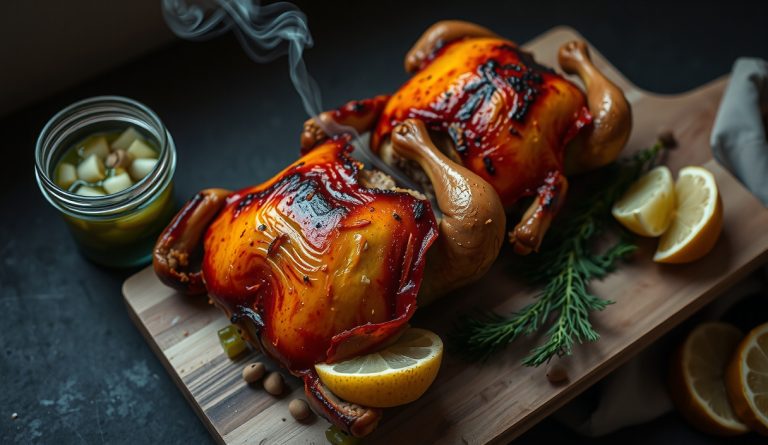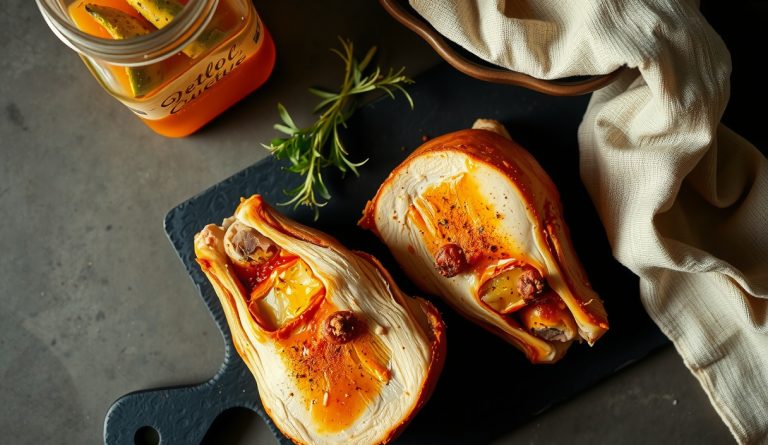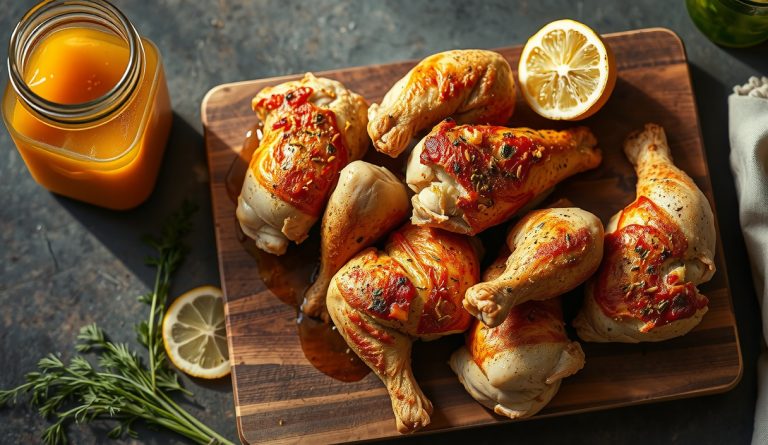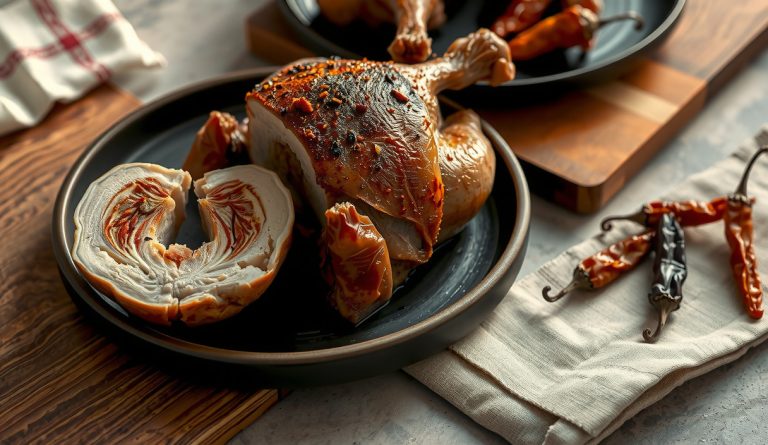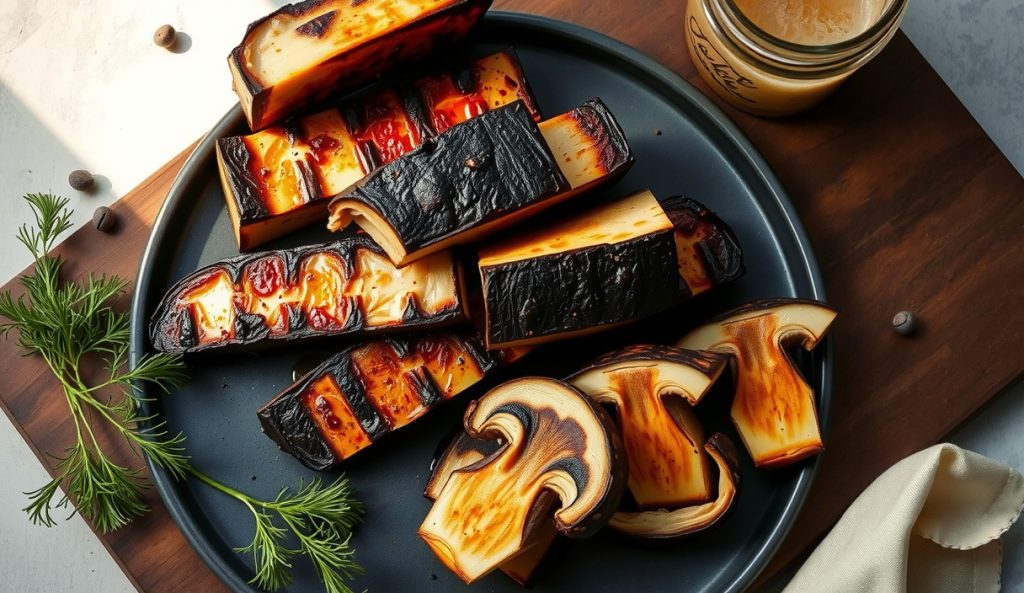
This is not a replacement for smoked chicken. It is a companion dish that belongs on the same table, earns its place through the same fermentation and fire logic, and gives vegetarian guests something made with intention rather than apology. The vehicle is king oyster mushrooms (Pleurotus eryngii), halved lengthwise through the stem. Their dense, fibrous stem tissue has a collagen-like structural protein matrix that responds to lactic acid marination in a meaningful — if not identical — way to chicken muscle. The thesis: same brine, same rub, same wood, different biology, honest result.
What changes between chicken and mushroom — and why does it matter?
The analog and why. King oyster mushrooms are chosen specifically for their stem architecture. The stems are composed primarily of glucan polysaccharides and chitin, not collagen, but the acid in the lacto-fermented brine still does useful work: it partially hydrolyzes surface chitin and swells the glucan matrix, which increases moisture retention during the high-heat smoke phase and creates a more porous surface for smoke phenolic deposition. Jackfruit is the common pulled-pork analog but performs poorly here — its cellular structure collapses under extended smoke and it lacks the surface area for bark. Portobello caps absorb water excessively and steam rather than crust. King oyster stems hold their geometry to 185°F internal, which allows genuine Maillard browning on the cut face.
Brine application. Submerge the halved king oyster mushrooms in the lacto-fermented pickle brine for 45–60 minutes at room temperature — not overnight. Fungal tissue is far more permeable than muscle; an extended soak produces an aggressively sour interior that overwhelms the smoke and rub contributions. 45 minutes delivers lactic acid surface penetration to approximately 3–4mm depth, which is sufficient to carry the dill-garlic aromatic signature without acidifying the interior flesh.
Rub application. Apply the canonical dry rub (with or without the brown sugar, per your preference — it contributes meaningful Maillard color on the cut face of the stem) directly to the cut surfaces after patting dry. The exposed stem flesh is high in free amino acids (glutamate, alanine), which react readily with the carbonyl groups from the rub’s sugar via Maillard chemistry. King oyster mushroom stems will achieve genuine bark — not as structurally thick as chicken skin bark, but a real, mahogany, aromatic crust.
Smoke and temperature. Smoke the mushrooms cut-face-up at 250°F with cherry wood, the same as the canonical recipe. Target 45–55 minutes until the cut face develops a deep brown crust and the stem flesh yields slightly when pressed but holds its shape. There is no food-safety internal temperature target for fungi; the goal is texture and Maillard color. The carvone and limonene from the dill brine volatilize early, and the guaiacol from cherry wood deposits on the surface protein-glucan film exactly as it does on the chicken pellicle. Smoke flavor penetration is comparably deep because the marinated surface film functions as a phenolic adhesion layer by the same mechanism.
What stays exactly the same as the canonical smoked chicken recipe?
The lacto-fermented brine, the complete dry rub formula, cherry wood selection, 250°F smoker temperature, and the aromatic logic of the dish — lactic acid, dill terpenes, garlic sulfides, and smoke phenolics working in concert — are identical to the canonical smoked chicken recipe. The table smells the same. The bark carries the same mahogany color. The flavor narrative is continuous across both proteins.
When is the mushroom companion the better choice to serve?
Serve the king oyster mushroom companion alongside the chicken for a mixed table, or as a standalone centerpiece for vegetarian guests who deserve the same fermentation-and-fire technique rather than a foil-wrapped afterthought. King oyster mushrooms also smoke faster, finishing in 45–55 minutes, so they can go on the grate during the last hour of the chicken cook and come off together — no separate fire management required.
The full fermentation protocol and canonical smoking method are at the original recipe — the brine and rub used there are applied here without modification.