Smoked Duck Breast with Crispy Skin

Equipment
- 1 Cast iron skillet (12-inch or larger) Must have sufficient thermal mass to hold temperature when cold duck contacts the pan. Preheat on medium-high for 5 minutes minimum before use.
- 1 Smoker (offset, pellet, or charcoal) Must hold a stable 250°F. Preheat fully with wood chunks loaded before duck goes on.
- 1 Dual-probe wireless instant-read thermometer One probe in the breast muscle, one monitoring smoker ambient temperature. Time-based cooking will fail here — chase the internal temp target.
- 1 Boning or fillet knife Must be sharp. A dull blade compresses rather than cuts the skin, closing score channels and tearing the surface.
- 1 Heavy grill press or foil-wrapped brick Used to maintain full skin-to-pan contact during rendering. Ensures even fat expulsion across the entire surface.
- 1 Wire cooling rack set over a sheet pan For resting. Elevates the breast off any surface moisture, allowing ambient airflow to maintain skin crispness during the rest period.
- 4 to 6 Cherry or apple wood chunks Not chips — chunks burn longer and more consistently. Avoid mesquite or hickory, which overwhelm duck’s delicate fat character.
Ingredients
Duck and Dry Brine
- 2 whole Moulard or Pekin duck breasts About 10–14 oz each. Skin-on, bone-out. Fresh strongly preferred over frozen. Pat completely dry with paper towels before scoring.
- 1 teaspoon kosher salt Diamond Crystal. If using Morton’s, reduce to 3/4 teaspoon. Applied to both sides of the breast.
- ½ teaspoon freshly cracked black pepper Applied to the flesh side only just before searing. Do not apply to the skin before the dry brine rest — it can draw extra moisture.
Optional Pan Sauce
- 2 tablespoons rendered duck fat Reserved from the pan after rendering. Use this, not additional oil.
- 2 medium shallots Thinly sliced. Sweated in the reserved fat to build the sauce base.
- ½ cup dry red wine A Pinot Noir or Syrah works well. Must be reduced completely — no residual raw wine flavor.
- ½ cup duck or chicken stock Low-sodium. Reduced to concentrate gelatin and build body without starch.
- 2 tablespoons cold unsalted butter Cut into cubes. Mounted off heat to finish the sauce — do not boil after adding or the emulsion will break.
- 2 sprigs fresh thyme Added with the wine. Remove before mounting the butter.
- salt and pepper to taste Season the finished sauce after mounting the butter.

Instructions
Dry Brine (12–24 Hours Ahead)
- Pat the duck breasts completely dry on both sides with paper towels. Any surface moisture at this stage will become steam during rendering, impeding Maillard browning.
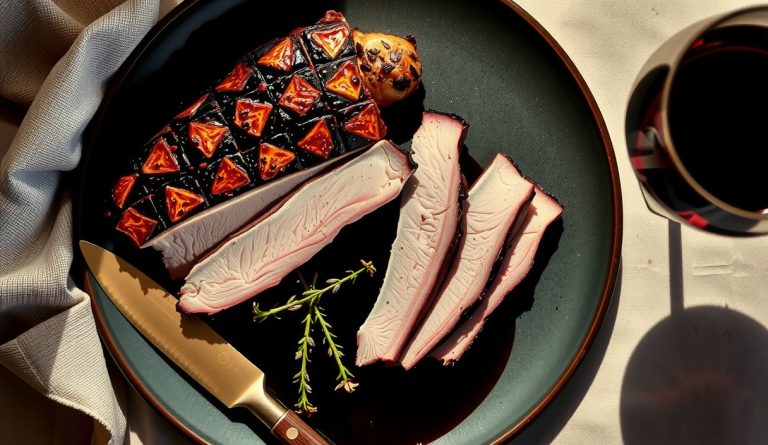
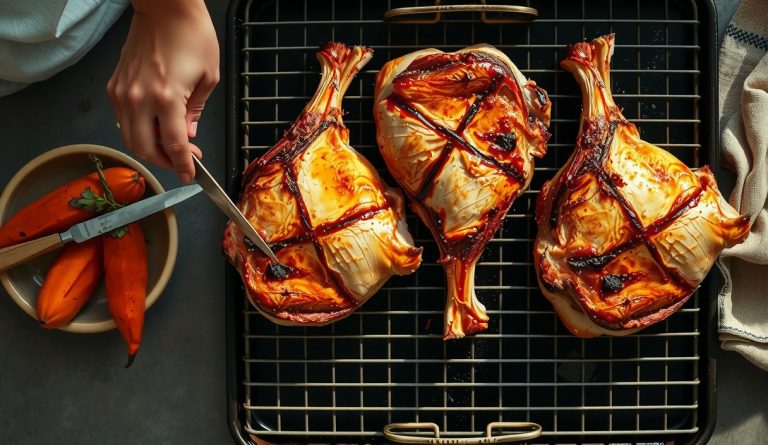
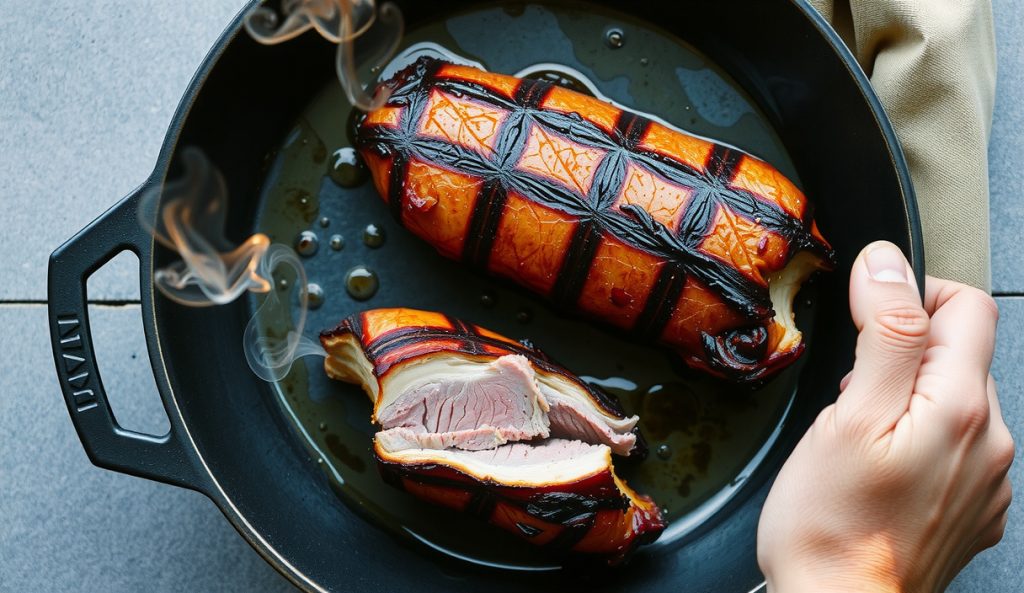
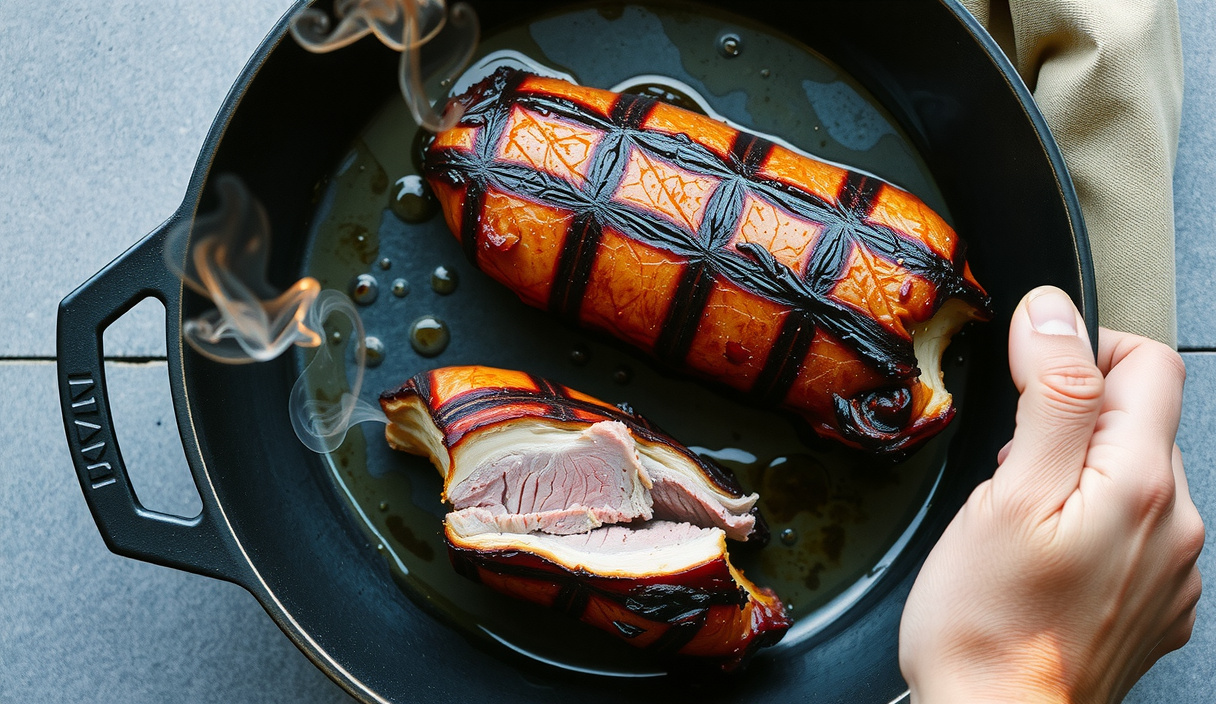
- Using a sharp boning knife, score the skin in a crosshatch pattern: parallel cuts spaced 1/2 inch apart at a 45-degree angle, then rotate and repeat. Cut through the skin and fat to approximately 80% of the fat cap depth — you should see a faint translucent layer of fat remaining above the muscle. Do not cut into the muscle flesh. Scoring too deep causes severe curling during searing.
- Season both sides evenly with kosher salt. Place the breasts skin-side up on a wire rack set over a sheet pan. Refrigerate uncovered for 12–24 hours. The salt will draw surface moisture out, then pull it back in, seasoning deep into the muscle and initiating partial protein denaturation. Do not cover — the circulating refrigerator air dries the skin surface, which is exactly what you want.1 teaspoon kosher salt
Render the Skin (Critical Step)
- Remove the duck from the refrigerator 20–30 minutes before cooking to take the edge off the refrigerator chill. Pat dry again — any condensation on the surface will steam and interfere with the sear. Season the flesh side (not the skin) with freshly cracked black pepper.1/2 teaspoon freshly cracked black pepper
- Place the cast iron skillet on a burner over medium heat. Allow it to preheat for 5 full minutes — no oil, no spray. You will know it’s ready when a drop of water vaporizes instantly on contact.
- Place the duck breasts skin-side down in the cold-start skillet (for slightly more gradual, even rendering) or in the preheated skillet if you prefer more aggressive initial browning. Press firmly with a grill press or foil-wrapped brick for the first 2 minutes to ensure full skin-to-pan contact. Without this pressure, the breast will arch in the center, leaving the skin hovering above the pan surface and stalling fat expulsion.
- Render skin-side down for a total of 10–12 minutes, adjusting heat as needed between medium and medium-high. You should see liquid duck fat pooling actively around the breast within the first 3–4 minutes. If the skin is browning rapidly before fat has pooled, reduce heat slightly. If fat pools but no browning is occurring after 5 minutes, increase heat. Do not flip the breast during this phase. The skin should be deep mahogany and feel rigid and shell-like when pressed.
- Flip the breast and sear the flesh side for 60 seconds only. This brief sear is not about cooking the interior — the smoker handles that. It seals any exposed score-channel muscle and adds minimal Maillard character to the bottom face. Remove from the pan and pour off the rendered fat into a glass jar — it’s gold for later cooking.
Smoke to Temperature
- Preheat your smoker to 250°F (121°C). Load cherry or apple wood chunks and allow the smoker to reach temperature and produce clean, thin blue smoke — not thick white billowing smoke, which signals incomplete combustion and will deposit bitter creosote on the meat.
- Place the rendered duck breasts on the smoker grate skin-side up, at least 2 inches apart for even smoke penetration. Insert your probe thermometer into the thickest part of the muscle, avoiding fat pockets (fat reads lower temperatures than muscle and will give a false-early reading).
- Smoke at 250°F until the internal temperature reads 130°F (54°C). This typically takes 35–45 minutes depending on breast thickness and smoker airflow. Do not open the smoker unnecessarily — each lid-lift drops chamber temp by 20–30°F and extends the cook. Monitor via the wireless thermometer probe.
- Pull the breasts from the smoker at exactly 130°F internal. Do not tent with foil. Rest skin-side up on a wire rack for 8–10 minutes. Carryover cooking will bring the final internal temperature to 133–135°F (56–57°C) — the optimal window for silky, blushing medium-rare duck. The uncovered rest preserves skin crispness; foil would trap steam and undo all the rendering work.
Optional Pan Sauce
- While the duck rests, return 2 tablespoons of the reserved rendered duck fat to the skillet over medium heat. Add the sliced shallots and cook, stirring occasionally, until softened and lightly golden, about 4–5 minutes.2 tablespoons rendered duck fat, 2 medium shallots
- Add the dry red wine and fresh thyme sprigs. Increase heat to medium-high and reduce completely until the pan is nearly dry, about 4–5 minutes. This full reduction eliminates raw alcohol and concentrates the wine’s organic acid and fruity ester profile.1/2 cup dry red wine, salt and pepper to taste
- Add the duck or chicken stock. Reduce by half, about 3–4 minutes, until the sauce coats a spoon and has a light, syrupy viscosity from the concentrated gelatin. Remove the thyme sprigs.1/2 cup duck or chicken stock
- Remove the pan from heat completely. Add the cold butter cubes and swirl or whisk continuously until each piece is fully incorporated and the sauce is glossy and emulsified. Do not return to heat after mounting the butter — the emulsion will break above 180°F. Season with salt and pepper to taste.2 tablespoons cold unsalted butter
Slice and Serve
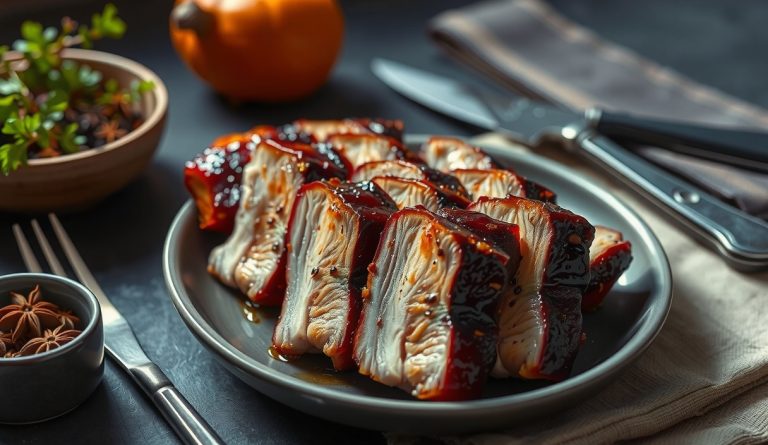
- Slice the rested duck breast against the grain at a 30-degree bias, producing long, elegant planks with the mahogany skin visible on top. Duck muscle fibers run diagonally — slicing perpendicular to those fibers shortens the perceived fiber length, making each bite feel dramatically more tender. Aim for slices approximately 1/4 to 3/8 inch thick.
- Fan the sliced duck on warmed plates, skin-side up to preserve crispness. Spoon the pan sauce around (not over) the duck — pouring sauce directly on the skin will soften it immediately. Serve immediately.
Notes
Nutrition
Duck breast is the cut that humbles confident cooks. You can nail every other protein in your repertoire and still pull a rubbery, pallid slab of waterfowl off the smoker — skin flabby, interior overcooked, fat rendered nowhere. The reason almost always comes down to a sequencing failure: people trust the smoker to do work the smoker physically cannot do.
American Meathead runs the score-render-smoke sequence here, and the order is non-negotiable. A low-and-slow 250°F smoking chamber maintains surface temperatures that are far too cool to liquefy duck’s thick subcutaneous fat layer in any reasonable time window. The skin would steam before it crisped, and the breast would be dry before the fat rendered. The solution is ten minutes of aggressive pan rendering — skin-side down, weight on top, heat on full — before the smoker ever enters the equation. Get that fat liquefied and partially expelled first, then let smoke finish the cook. It is not a shortcut. It is the only path.
Why does smoked duck breast work? The science
Crispy-skinned smoked duck breast requires two distinct heat-transfer modes — direct conduction to render fat, then convective smoke heat to finish the muscle — because no single cooking environment can accomplish both objectives simultaneously. Duck subcutaneous fat is a dense lipid depot sitting between the skin and muscle. Its primary triacylglycerols (TAGs) follow a polymorphic crystallization curve with a melting onset around 86–95°F (30–35°C), but meaningful liquefaction and expulsion require sustained surface-contact temperatures well above 300°F (150°C). At a 250°F smoke chamber, the skin surface equilibrates around 220–230°F via convective air — far short of what is needed to drive the fat from solid-to-liquid at meaningful speed.
The Maillard browning cascade — the amino-carbonyl condensation that produces the mahogany crust and complex volatile organic compounds — does not onset meaningfully until surface temperatures exceed roughly 280°F (140°C), which a low smoker never achieves on skin. Pan rendering forces the skin surface to 350–375°F (177–190°C) via direct conduction, initiating rapid Maillard browning, collapsing the foam-like fat cell structure, and physically expelling liquid fat out of the subcutaneous layer through the score channels. The crosshatch scoring is not decorative: cutting the skin to 80% depth (leaving the muscle intact) shortens the migration path for rendered fat, increasing the effective surface area for expulsion by roughly 4x versus unscored skin.
Once the fat is rendered and the skin is set, the smoker takes over for a thermally gentle finish. Duck myosin denatures beginning around 100–105°F (38–41°C), and the optimal eating window — where actin remains intact and water-holding capacity is near peak — sits between 125–135°F (52–57°C) internal. Push past 145°F (63°C) and actin begins its denaturation cascade, violently contracting the actomyosin complex and expelling intracellular water. The breast turns from silky and blushing to grainy and grey. A 250°F smoke environment lets internal temperature rise slowly — roughly 3–4°F per minute at this mass — giving a wide correction window. Pull the duck breast at 130°F (54°C) and rest uncovered for 8–10 minutes: carryover will add 3–5°F, landing the breast in the sweet spot. The resting phase is not optional — it allows the denatured myosin network to re-associate partially, redistributing intracellular fluid and preventing the first-cut juice flood that ruins the plate.
Smoke penetration is a surface diffusion phenomenon governed by phenolic compound deposition — primarily guaiacol and syringol from lignin pyrolysis — and it occurs most efficiently on moist, cool surfaces. The score channels expose fresh muscle tissue that absorbs smoke compounds readily, while the rendered skin surface, now partially dehydrated, creates a contrasting texture. Cherry wood produces a mild, fruity smoke profile (relatively high in malic acid volatiles) that complements duck’s high intramuscular fat content without overwhelming the iron-rich myoglobin character. The smoke ring — that pink-grey annular layer just under the surface — is a nitric oxide and carbon monoxide interaction with myoglobin, converting it to carboxymyoglobin and nitrosomyoglobin. The smoke ring contributes zero flavor but signals proper smoke exposure depth.
What equipment and ingredients do I need?
Duck breasts (Moulard or Pekin): Moulard (a Muscovy-Pekin cross) is the foie gras industry standard and produces thick, deeply flavored breasts with a fat cap that can exceed half an inch. Pekin breasts are leaner and smaller — they render and smoke faster. Either works; adjust scoring depth and render time accordingly. Fresh is strongly preferred over frozen: freezing disrupts the cellular structure, increasing purge loss and softening the final texture.
Scoring technique: Use a sharp boning or fillet knife. Cut through the skin and fat at 45-degree angles, spacing cuts about half an inch apart, then rotate and repeat to form a crosshatch. Stop before hitting muscle — you will feel the resistance change. Scoring too deep severs muscle fibers and allows the breast to curl violently on the hot pan.
Cast iron or carbon steel pan: Thermal mass is essential. A thin stainless skillet will temperature-drop the moment cold duck hits it, stalling the Maillard reaction. Preheat cast iron on medium-high for at least 5 minutes before the duck goes in — no oil needed, the duck fat is the cooking medium.
Smoker and probe thermometer: Any offset, pellet, or charcoal smoker that can hold a steady 250°F works. A dual-probe wireless thermometer — one ambient, one in the breast — is essential. You are chasing an internal target, not a time window. Cherry or apple wood chunks (not chips) maintain a longer, cleaner smoke burn. Avoid heavy woods like mesquite or hickory; their phenolic intensity will flatten duck’s delicate fat character.
Dry brine salt: Kosher salt applied 12–24 hours ahead draws surface moisture out via osmosis, then that brine is reabsorbed, seasoning deep into the muscle and beginning partial protein denaturation that improves water retention during cooking. Do not skip this step.
Smoked Duck Breast with Crispy Skin
Equipment
- 1 Cast iron skillet (12-inch or larger) Must have sufficient thermal mass to hold temperature when cold duck contacts the pan. Preheat on medium-high for 5 minutes minimum before use.
- 1 Smoker (offset, pellet, or charcoal) Must hold a stable 250°F. Preheat fully with wood chunks loaded before duck goes on.
- 1 Dual-probe wireless instant-read thermometer One probe in the breast muscle, one monitoring smoker ambient temperature. Time-based cooking will fail here — chase the internal temp target.
- 1 Boning or fillet knife Must be sharp. A dull blade compresses rather than cuts the skin, closing score channels and tearing the surface.
- 1 Heavy grill press or foil-wrapped brick Used to maintain full skin-to-pan contact during rendering. Ensures even fat expulsion across the entire surface.
- 1 Wire cooling rack set over a sheet pan For resting. Elevates the breast off any surface moisture, allowing ambient airflow to maintain skin crispness during the rest period.
- 4 to 6 Cherry or apple wood chunks Not chips — chunks burn longer and more consistently. Avoid mesquite or hickory, which overwhelm duck’s delicate fat character.
Ingredients
Duck and Dry Brine
- 2 whole Moulard or Pekin duck breasts About 10–14 oz each. Skin-on, bone-out. Fresh strongly preferred over frozen. Pat completely dry with paper towels before scoring.
- 1 teaspoon kosher salt Diamond Crystal. If using Morton’s, reduce to 3/4 teaspoon. Applied to both sides of the breast.
- ½ teaspoon freshly cracked black pepper Applied to the flesh side only just before searing. Do not apply to the skin before the dry brine rest — it can draw extra moisture.
Optional Pan Sauce
- 2 tablespoons rendered duck fat Reserved from the pan after rendering. Use this, not additional oil.
- 2 medium shallots Thinly sliced. Sweated in the reserved fat to build the sauce base.
- ½ cup dry red wine A Pinot Noir or Syrah works well. Must be reduced completely — no residual raw wine flavor.
- ½ cup duck or chicken stock Low-sodium. Reduced to concentrate gelatin and build body without starch.
- 2 tablespoons cold unsalted butter Cut into cubes. Mounted off heat to finish the sauce — do not boil after adding or the emulsion will break.
- 2 sprigs fresh thyme Added with the wine. Remove before mounting the butter.
- salt and pepper to taste Season the finished sauce after mounting the butter.
Instructions
Dry Brine (12–24 Hours Ahead)
- Pat the duck breasts completely dry on both sides with paper towels. Any surface moisture at this stage will become steam during rendering, impeding Maillard browning.
- Using a sharp boning knife, score the skin in a crosshatch pattern: parallel cuts spaced 1/2 inch apart at a 45-degree angle, then rotate and repeat. Cut through the skin and fat to approximately 80% of the fat cap depth — you should see a faint translucent layer of fat remaining above the muscle. Do not cut into the muscle flesh. Scoring too deep causes severe curling during searing.
- Season both sides evenly with kosher salt. Place the breasts skin-side up on a wire rack set over a sheet pan. Refrigerate uncovered for 12–24 hours. The salt will draw surface moisture out, then pull it back in, seasoning deep into the muscle and initiating partial protein denaturation. Do not cover — the circulating refrigerator air dries the skin surface, which is exactly what you want.1 teaspoon kosher salt
Render the Skin (Critical Step)
- Remove the duck from the refrigerator 20–30 minutes before cooking to take the edge off the refrigerator chill. Pat dry again — any condensation on the surface will steam and interfere with the sear. Season the flesh side (not the skin) with freshly cracked black pepper.1/2 teaspoon freshly cracked black pepper
- Place the cast iron skillet on a burner over medium heat. Allow it to preheat for 5 full minutes — no oil, no spray. You will know it’s ready when a drop of water vaporizes instantly on contact.
- Place the duck breasts skin-side down in the cold-start skillet (for slightly more gradual, even rendering) or in the preheated skillet if you prefer more aggressive initial browning. Press firmly with a grill press or foil-wrapped brick for the first 2 minutes to ensure full skin-to-pan contact. Without this pressure, the breast will arch in the center, leaving the skin hovering above the pan surface and stalling fat expulsion.
- Render skin-side down for a total of 10–12 minutes, adjusting heat as needed between medium and medium-high. You should see liquid duck fat pooling actively around the breast within the first 3–4 minutes. If the skin is browning rapidly before fat has pooled, reduce heat slightly. If fat pools but no browning is occurring after 5 minutes, increase heat. Do not flip the breast during this phase. The skin should be deep mahogany and feel rigid and shell-like when pressed.
- Flip the breast and sear the flesh side for 60 seconds only. This brief sear is not about cooking the interior — the smoker handles that. It seals any exposed score-channel muscle and adds minimal Maillard character to the bottom face. Remove from the pan and pour off the rendered fat into a glass jar — it’s gold for later cooking.
Smoke to Temperature
- Preheat your smoker to 250°F (121°C). Load cherry or apple wood chunks and allow the smoker to reach temperature and produce clean, thin blue smoke — not thick white billowing smoke, which signals incomplete combustion and will deposit bitter creosote on the meat.
- Place the rendered duck breasts on the smoker grate skin-side up, at least 2 inches apart for even smoke penetration. Insert your probe thermometer into the thickest part of the muscle, avoiding fat pockets (fat reads lower temperatures than muscle and will give a false-early reading).
- Smoke at 250°F until the internal temperature reads 130°F (54°C). This typically takes 35–45 minutes depending on breast thickness and smoker airflow. Do not open the smoker unnecessarily — each lid-lift drops chamber temp by 20–30°F and extends the cook. Monitor via the wireless thermometer probe.
- Pull the breasts from the smoker at exactly 130°F internal. Do not tent with foil. Rest skin-side up on a wire rack for 8–10 minutes. Carryover cooking will bring the final internal temperature to 133–135°F (56–57°C) — the optimal window for silky, blushing medium-rare duck. The uncovered rest preserves skin crispness; foil would trap steam and undo all the rendering work.
Optional Pan Sauce
- While the duck rests, return 2 tablespoons of the reserved rendered duck fat to the skillet over medium heat. Add the sliced shallots and cook, stirring occasionally, until softened and lightly golden, about 4–5 minutes.2 tablespoons rendered duck fat, 2 medium shallots
- Add the dry red wine and fresh thyme sprigs. Increase heat to medium-high and reduce completely until the pan is nearly dry, about 4–5 minutes. This full reduction eliminates raw alcohol and concentrates the wine’s organic acid and fruity ester profile.1/2 cup dry red wine, salt and pepper to taste
- Add the duck or chicken stock. Reduce by half, about 3–4 minutes, until the sauce coats a spoon and has a light, syrupy viscosity from the concentrated gelatin. Remove the thyme sprigs.1/2 cup duck or chicken stock
- Remove the pan from heat completely. Add the cold butter cubes and swirl or whisk continuously until each piece is fully incorporated and the sauce is glossy and emulsified. Do not return to heat after mounting the butter — the emulsion will break above 180°F. Season with salt and pepper to taste.2 tablespoons cold unsalted butter
Slice and Serve
- Slice the rested duck breast against the grain at a 30-degree bias, producing long, elegant planks with the mahogany skin visible on top. Duck muscle fibers run diagonally — slicing perpendicular to those fibers shortens the perceived fiber length, making each bite feel dramatically more tender. Aim for slices approximately 1/4 to 3/8 inch thick.
- Fan the sliced duck on warmed plates, skin-side up to preserve crispness. Spoon the pan sauce around (not over) the duck — pouring sauce directly on the skin will soften it immediately. Serve immediately.
Notes
Nutrition
How do I nail smoked duck breast every time? Tips
- Score depth is everything. Too shallow and fat migration pathways are too long, leaving pockets of unrendered fat under the skin. Too deep and you sever muscle, causing violent curling and uneven surface contact with the pan. Aim for about 80% of the fat-cap depth — you will see the faint outline of the muscle through a thin translucent fat layer at the bottom of each cut.
- Start the pan cold-to-warm, then crank. Placing duck skin-side down in a cold pan and raising heat gradually allows the skin to heat evenly before exterior Maillard reactions begin, preventing localized burning before the fat underneath liquefies. Once fat is visibly pooling, 3–4 minutes in, increase to medium-high and press with a weight.
- Never flip during the render phase. Rendering is skin-only contact time. Flipping even briefly interrupts conductive heat transfer and allows the skin to steam rather than sear. The muscle side needs less than 60 seconds of direct heat — it finishes in the smoker.
- Pull 5°F early from the smoker. Carryover cooking is real and meaningful at this mass. At 130°F internal, remove the breast immediately and rest on a wire rack uncovered. Tenting with foil traps steam, softening the skin you just worked hard to crisp. The ambient air rest is the final cooking stage.
- Manage pan fat between render and smoke. The rendered duck fat in the pan is culinary gold — pour it off into a glass jar the moment the breast goes to the smoker. Duck fat is shelf-stable refrigerated for weeks and exceptional for sautéed potatoes, confit vegetables, or reheating leftover smoked breast.
- Slice against the grain at an angle. Duck breast muscle fibers run diagonally. Slicing perpendicular to those fibers at a 30-degree bias shortens perceived fiber length dramatically, making each bite feel more tender regardless of internal temperature.
What variations can I make on smoked duck breast?
Five-spice lacquer finish: Whisk 2 tablespoons of honey, 1 tablespoon of soy sauce, and 1 teaspoon of five-spice powder into a glaze. During the final 10 minutes of smoking — once the breast hits 120°F internal — brush the skin side with one coat of glaze and allow it to set in the smoke. The reducing sugars in the honey (primarily fructose and glucose) lower the Maillard activation threshold and produce a deeply lacquered, aromatic crust. Watch closely; the glaze will caramelize fast at the skin’s surface temperature.
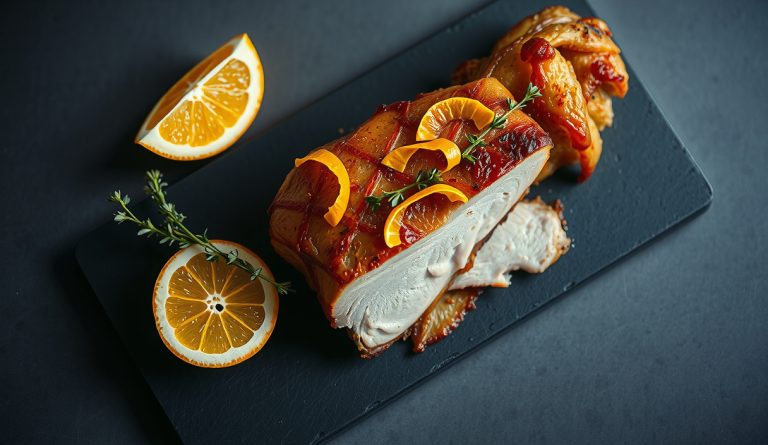
Orange and thyme dry brine: Add 1 teaspoon of finely grated orange zest and 1 teaspoon of dried thyme to the dry brine salt mixture. The citrus oils (primarily limonene) partition into the fat layer during the 24-hour rest period, perfuming the rendered fat with a bright, volatile aromatic note that emerges on first bite. The thyme contributes thymol, a monoterpenoid phenol that pairs naturally with duck’s gamey iron character.
Scaling for service: This technique scales linearly — four breasts render as well as one if your pan accommodates them without crowding. For large batches, render in two stages rather than overcrowding a single pan; moisture evaporation from crowded proteins creates a steaming environment that collapses the Maillard reaction. Smoke capacity is limited by your smoker’s airflow and temperature stability, not the number of breasts. Keep duck breasts fat-side up on the grate and maintain at least 2 inches of separation for even smoke penetration on all surfaces.
Low-carb and keto adaptation: This recipe is inherently very low in carbohydrates. Omit any glaze applications and serve with a pan sauce built from the rendered duck fat, a splash of dry red wine reduced fully, fresh thyme, and a knob of unsalted butter mounted off heat. The resulting sauce is rich, glossy, and keto-compliant — the collagen from a brief addition of duck stock will build body without starch thickening.
Frequently asked questions about smoked duck breast
Can I skip the pan rendering and just smoke duck breast low-and-slow the whole way? Skipping pan rendering produces soft skin and under-rendered fat. A 250°F smoker delivers a skin surface temperature of roughly 220–225°F by convection — below the sustained threshold needed for meaningful fat expulsion from duck’s thick subcutaneous layer. Smoking at 325°F or higher could drive rendering, but at that temperature you lose the gentle internal heat control that protects the muscle. The render-then-smoke sequence exists precisely because crispy skin and a perfectly cooked interior require different heat transfer modes.
What internal temperature should I target for duck breast? Pull duck breast at 130°F (54°C) and let carryover bring the final resting temperature to 133–135°F (56–57°C). This lands squarely in the medium-rare to medium window: the muscle is blushing rose-pink, silky, and retains maximum moisture. FDA food safety guidelines cite 165°F for poultry, but that standard is written for ground poultry and whole birds where surface pathogens can be internalized. An intact duck breast, surface-seared to well above 160°F during the render phase, presents a vanishingly low pathogen risk at these internal temps — the same logic chefs apply to beef steaks and restaurant-grade duck dishes globally.
My duck skin came out soft after smoking. What went wrong? Three likely failure modes explain soft duck skin post-smoke: the render phase was too short and residual unmelted fat softened during smoking; the breast was tented with foil during the rest, trapping steam directly against the skin; or ambient humidity in the smoker was too high. To diagnose: press the skin immediately after pulling from the smoker — it should feel like a thin, rigid shell. If the skin flexes, more render time is needed. If the skin was rigid off the smoker but softened during rest, foil tenting or a damp resting surface is the culprit. Fix: rest duck breast on a wire rack, uncovered, in a warm kitchen with ambient airflow.