Smoked Bacon-Wrapped Quail
Equipment
- 1 Smoker (offset, kamado, pellet, or kettle) Must hold a stable 275°F with convective airflow
- 1 Instant-read thermometer Non-negotiable for a bird this small — insert laterally into the thickest breast meat
- 1 Wire cooling rack set over a sheet pan For air-drying the quail before wrapping
- 8 toothpicks or 4 feet twine Toothpicks or butcher’s twine To secure bacon overlap until rendering locks it in place
- 2 to 3 chunks or 1 cup chips Fruitwood chips or chunks (apple or cherry) Dry chunks preferred; soak chips only for charcoal setups prone to flare-ups
Ingredients
Quail
- 4 whole semi-boneless quail Fresh or fully thawed; about 4 to 5 oz each
- 8 slices thin-cut bacon Standard grocery thin-cut — not thick-cut, which will not render in time
Dry Rub
- 1 tsp kosher salt
- 1 tsp coarse black pepper
- 1 tsp smoked paprika
- 0.5 tsp garlic powder
- 0.25 tsp cayenne pepper Optional — omit for mild
- 0.5 tsp onion powder
Optional Compound Butter (for cavity)
- 2 tbsp unsalted butter Softened to room temperature
- 1 tsp fresh thyme leaves
- 0.5 tsp lemon zest

Instructions
Prep
- Pat each quail completely dry inside and out with paper towels. Set the birds breast-side up on a wire rack set over a sheet pan and refrigerate uncovered for 30 minutes. Removing surface moisture now is the single most important step for achieving crisp bacon — any residual water must evaporate before the bacon surface can exceed 212°F and begin the Maillard browning cascade.
- While the birds air-dry, combine the kosher salt, black pepper, smoked paprika, garlic powder, cayenne, and onion powder in a small bowl. Stir to combine evenly.1 tsp kosher salt, 1 tsp coarse black pepper, 1 tsp smoked paprika, 0.5 tsp garlic powder, 0.25 tsp cayenne pepper, 0.5 tsp onion powder
- Optional compound butter: Work the softened butter with the fresh thyme leaves and lemon zest until fully combined. Set aside at room temperature. If using, place a small teaspoon-sized knob inside each quail cavity before wrapping — it melts at cooking temperature and self-bastes the interior protein matrix throughout the cook.1 tsp fresh thyme leaves, 0.5 tsp lemon zest
- Remove the quail from the refrigerator. Apply the dry rub generously to the exterior skin of each bird — breast, back, legs, and wings. Because the bacon will seal the outside, this seasoning is trapped directly against the skin where it will bloom in the rendered fat. Do not season the bacon slices themselves.1 tsp kosher salt, 1 tsp coarse black pepper, 1 tsp smoked paprika, 0.5 tsp garlic powder, 0.25 tsp cayenne pepper, 0.5 tsp onion powder
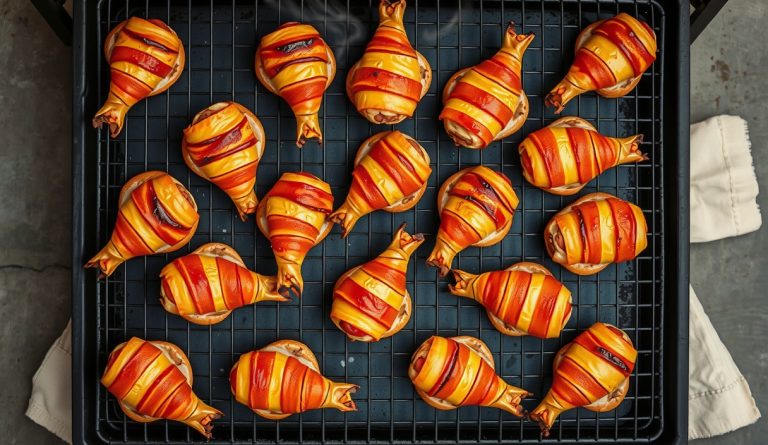
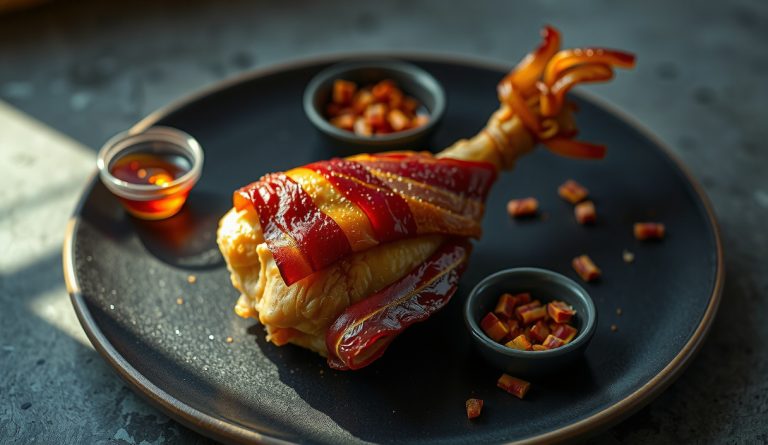
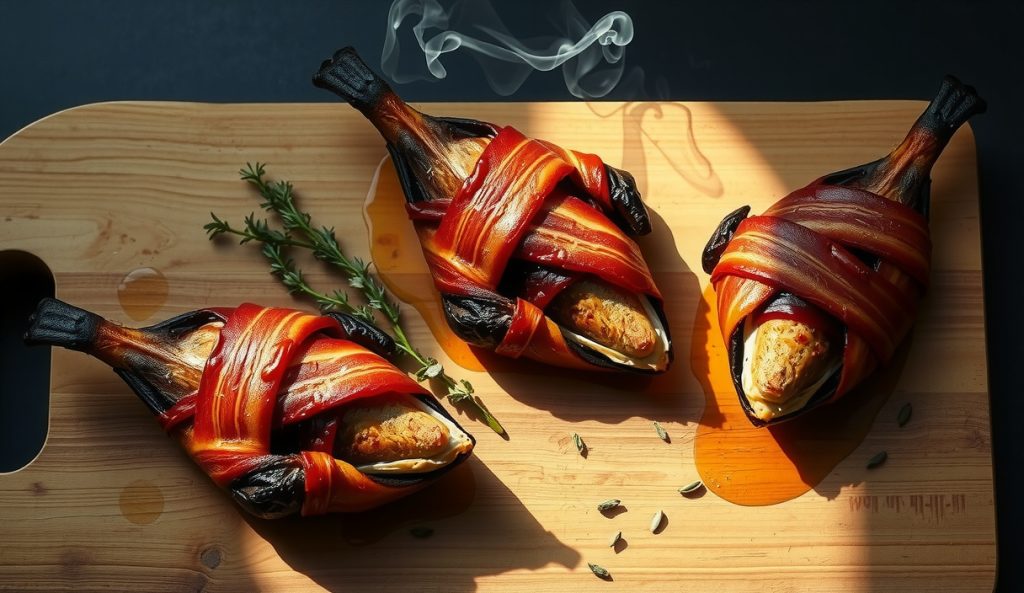
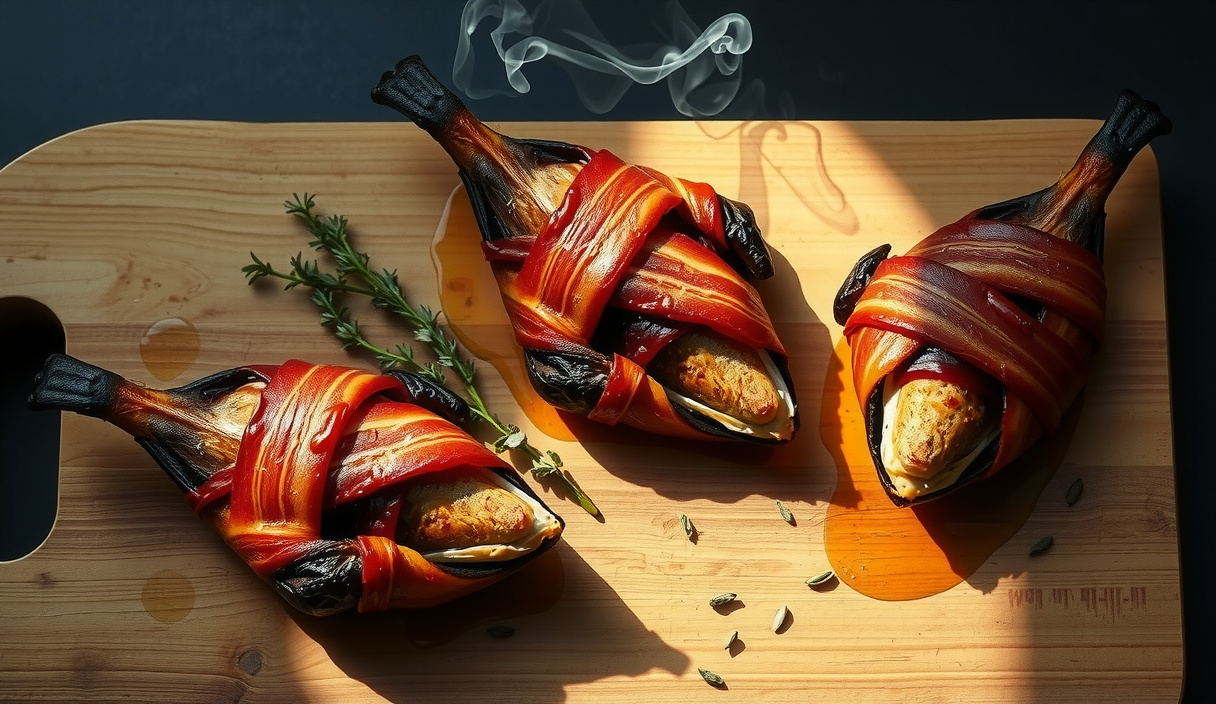
- Lay two slices of thin-cut bacon flat on your work surface, overlapping them slightly in a cross or offset-stripe pattern. Place one seasoned quail breast-side down at the center. Pull the bacon slices up and around the bird, overlapping the ends on the breast side. Secure the overlap with two toothpicks or tie with a short length of butcher’s twine. The bacon should be snug but not so tight that it compresses the breast — you want rendered fat to be able to circulate under the bacon layer during the cook. Repeat for all four birds.8 slices thin-cut bacon
Fire up the smoker
- Fire up your smoker and bring it to a stable 275°F. Allow at least 20 minutes for the temperature to fully stabilize with clean convective airflow before adding the birds. Add your fruitwood chunks or chips now — apple and cherry combust at temperatures that produce moderate phenolic concentrations (guaiacol and syringol), delivering a sweet, gentle smoke signature that complements rather than competes with quail’s mild gamey iron notes. Ensure you are producing thin blue smoke, not thick white billowing smoke; the latter indicates incomplete combustion and will deposit acrid creosote on the food.
Smoke
- Place the bacon-wrapped quail breast-side up directly on the grate, spaced at least two inches apart on all sides for proper convective airflow. Do not crowd — stagnant steam trapped between birds delays bark development on the bacon and adds unpredictable time to the cook.8 slices thin-cut bacon
- Close the lid and smoke at 275°F without opening for the first 25 minutes. During this window the bacon surface is making contact with the grate on the underside and the chamber convective heat on the top, simultaneously developing a crust from both sides. Opening the lid during this phase releases accumulated smoke, drops the chamber temperature, and extends your cook time.
- At the 25-minute mark, insert your instant-read thermometer into the thickest part of the breast meat, angling the probe horizontally to avoid bone contact. A bone-contact reading will be artificially high — bone conducts heat faster than muscle. You are looking for 163°F as your pull temperature; carryover during the 5-minute rest will finish the work to 165°F. If the birds are below 155°F, close the lid and check every 5 minutes. Typical finish time is 40 to 50 minutes total at a true, stable 275°F.
- When the birds hit 163°F internal, remove them from the smoker immediately and transfer to a clean wire rack. The bacon should be deeply bronzed to mahogany — if it looks pale and flaccid at this temperature, see the failure-mode tip in the blog post above. Tent loosely with aluminum foil and rest for exactly 5 minutes. Do not skip the rest; carryover will bring the internal temperature to a safe 165°F while allowing the rendered liquid bacon fat to redistribute back into the quail skin rather than pooling on the cutting board when the bird is split.
Serve
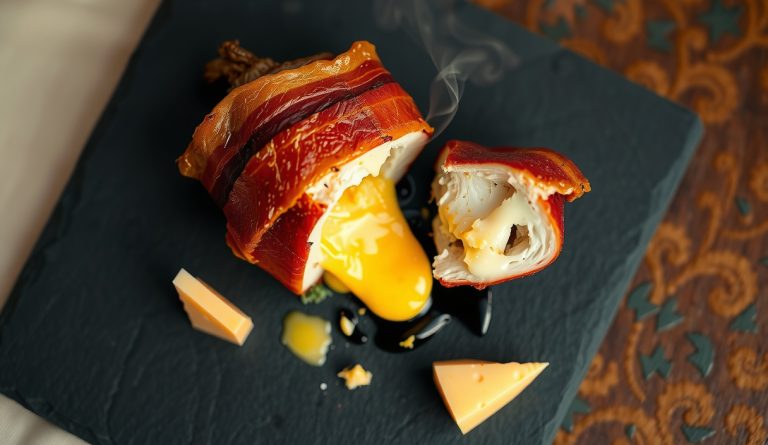
- Remove toothpicks or twine. Serve each quail whole — they are finger food. The diner splits the bird by pressing down along the breastbone with both thumbs, opening it flat. The juices that run out at this point should be clear with a pink tinge from the smoke ring; this is normal and does not indicate undercooking. Pair with simple sides that do not compete: creamy grits, roasted root vegetables, or a sharp dressed arugula salad. A dry, bright red wine — Grenache or Zinfandel — or a cold lager works exceptionally well with the bacon-smoke-game flavor profile.
Notes
Nutrition
Quail is the gunslinger of the smoker — small, fast, and unforgiving if you blink. The bird is almost entirely breast meat with virtually no intramuscular fat, which means the margin between succulent and sawdust is roughly ten degrees of internal temperature. That is the whole engineering problem. Wrapping each bird in a single layer of thin-cut bacon solves it in two ways simultaneously: the fat renders outward through the bacon and self-bastes the quail skin underneath, and the bacon itself forms a Maillard-active shell that takes on color and flavor while the bird inside stays at a gentler thermal gradient. The result is a two-texture experience — shatteringly crisp, savory bacon exterior followed by a juicy, lightly gamey interior that tastes unmistakably of hardwood smoke.
Smoked bacon-wrapped quail works on an offset stick burner, a ceramic kamado, and a pellet grill. The physics do not care which platform you choose; they care about holding 275°F chamber temperature with good convective airflow and getting those birds to 165°F internal without stalling. At 275°F the bacon renders fast enough to crisp while the quail chest cavity never sees a destructive temperature spike. Four birds come off the grate in roughly 45 minutes — fast enough for a weeknight, dramatic enough for company.
Why does bacon-wrapped quail work? The science
Bacon-wrapped quail works because the bacon simultaneously shields the lean quail muscle from direct convective heat and acts as a pre-optimized Maillard delivery vehicle — two problems solved by one ingredient. Quail muscle is predominantly fast-twitch white fiber, giving it a mild gamey note from myoglobin and a lean protein matrix dominated by myosin and actin. Myosin begins denaturing around 120°F, triggering the loss of raw translucency. The critical danger threshold is actin collapse at 160–165°F: when the actomyosin complex contracts violently, it expels bound water and the bird dries irreversibly. Holding the smoker at 275°F with steady convective airflow means heat transfer is rapid enough to push through the plateau — quail are too small to stall the way a brisket does — but slow enough that the thermal gradient from skin to center stays gentle, letting the core temperature stabilize at 165°F without overshooting into the desiccation zone above 170°F.
Bacon is doing double molecular duty on smoked quail. First, its fat phase — rendered triglycerides in the β’ crystal lattice that melt between roughly 90°F and 110°F — transitions to liquid and migrates toward the quail skin via capillary action, functioning as an external basting medium that raises effective water activity on the bird surface and prevents the evaporative cooling that would otherwise delay Maillard onset. Second, the bacon itself is a Maillard reactor loaded with reducing sugars from the cure and free amino acids released by partial protein hydrolysis during the curing process. At 275°F chamber temperature, the bacon surface exceeds the 140°C threshold for Schiff base formation within the first 15 minutes, generating pyrazines, furans, and heterocyclic aromatics — the compounds responsible for the deep, caramelized pork note that layers perfectly with quail’s iron-forward gaminess. Without the bacon, sugar and fat would need to be applied externally to achieve the same cascade.
Wood choice modulates the final volatile organic compound profile via phenolic extraction from burning lignin. Fruitwoods — apple, cherry, peach — produce lower concentrations of guaiacol and syringol, the dominant smoke phenols, delivering a lighter aromatic signature that does not compete with quail’s inherent flavor. Hickory and oak sit mid-spectrum and are perfectly appropriate. Mesquite combusts at higher temperatures and generates elevated phenolic levels; in a 45-minute cook at 275°F it reads as assertive but not overpowering. Whatever wood you choose, keep the combustion clean — dirty, incomplete-combustion smoke produces acrid, creosote-heavy deposits that mask the quail rather than accent it.
What equipment and ingredients do I need?
- Smoker at 275°F: Offset, kamado, pellet, or kettle with a snake setup all work. You need stable convective airflow — stagnant hot air prolongs the cook and risks uneven bark development on the bacon.
- Instant-read thermometer: Non-negotiable for a bird this small. A 1°F lag reading on a quail translates directly to overdone or underdone. Insert the probe laterally into the thickest part of the breast, angled away from bone.
- Thin-cut bacon: Standard grocery-store thin-cut (not thick-cut) renders completely at 275°F without turning chewy. Thick-cut does not finish rendering in the window before the quail hits temp, leaving rubbery fat on a cooked bird — the worst of both worlds.
- Whole semi-boneless quail: Widely available fresh or frozen. Semi-boneless birds (backbone and most ribs removed, leg and wing bones intact) cook more evenly and are dramatically easier to eat. Full bone-in quail work, just add 5 minutes and accept slightly more awkward tableside carving.
- Toothpicks or butcher’s twine: Needed to secure the bacon overlap during the first 20 minutes, before the collagen in the bacon begins contracting and gripping the bird on its own.
- Fruitwood chips or chunks: Apple or cherry are ideal flavor complements. Soak chips only if using a charcoal smoker prone to flare-ups; chunks go in dry. Pellet grillers use whatever blend is already loaded.
Smoked Bacon-Wrapped Quail
Equipment
- 1 Smoker (offset, kamado, pellet, or kettle) Must hold a stable 275°F with convective airflow
- 1 Instant-read thermometer Non-negotiable for a bird this small — insert laterally into the thickest breast meat
- 1 Wire cooling rack set over a sheet pan For air-drying the quail before wrapping
- 8 toothpicks or 4 feet twine Toothpicks or butcher’s twine To secure bacon overlap until rendering locks it in place
- 2 to 3 chunks or 1 cup chips Fruitwood chips or chunks (apple or cherry) Dry chunks preferred; soak chips only for charcoal setups prone to flare-ups
Ingredients
Quail
- 4 whole semi-boneless quail Fresh or fully thawed; about 4 to 5 oz each
- 8 slices thin-cut bacon Standard grocery thin-cut — not thick-cut, which will not render in time
Dry Rub
- 1 tsp kosher salt
- 1 tsp coarse black pepper
- 1 tsp smoked paprika
- 0.5 tsp garlic powder
- 0.25 tsp cayenne pepper Optional — omit for mild
- 0.5 tsp onion powder
Optional Compound Butter (for cavity)
- 2 tbsp unsalted butter Softened to room temperature
- 1 tsp fresh thyme leaves
- 0.5 tsp lemon zest
Instructions
Prep
- Pat each quail completely dry inside and out with paper towels. Set the birds breast-side up on a wire rack set over a sheet pan and refrigerate uncovered for 30 minutes. Removing surface moisture now is the single most important step for achieving crisp bacon — any residual water must evaporate before the bacon surface can exceed 212°F and begin the Maillard browning cascade.
- While the birds air-dry, combine the kosher salt, black pepper, smoked paprika, garlic powder, cayenne, and onion powder in a small bowl. Stir to combine evenly.1 tsp kosher salt, 1 tsp coarse black pepper, 1 tsp smoked paprika, 0.5 tsp garlic powder, 0.25 tsp cayenne pepper, 0.5 tsp onion powder
- Optional compound butter: Work the softened butter with the fresh thyme leaves and lemon zest until fully combined. Set aside at room temperature. If using, place a small teaspoon-sized knob inside each quail cavity before wrapping — it melts at cooking temperature and self-bastes the interior protein matrix throughout the cook.1 tsp fresh thyme leaves, 0.5 tsp lemon zest
- Remove the quail from the refrigerator. Apply the dry rub generously to the exterior skin of each bird — breast, back, legs, and wings. Because the bacon will seal the outside, this seasoning is trapped directly against the skin where it will bloom in the rendered fat. Do not season the bacon slices themselves.1 tsp kosher salt, 1 tsp coarse black pepper, 1 tsp smoked paprika, 0.5 tsp garlic powder, 0.25 tsp cayenne pepper, 0.5 tsp onion powder
- Lay two slices of thin-cut bacon flat on your work surface, overlapping them slightly in a cross or offset-stripe pattern. Place one seasoned quail breast-side down at the center. Pull the bacon slices up and around the bird, overlapping the ends on the breast side. Secure the overlap with two toothpicks or tie with a short length of butcher’s twine. The bacon should be snug but not so tight that it compresses the breast — you want rendered fat to be able to circulate under the bacon layer during the cook. Repeat for all four birds.8 slices thin-cut bacon
Fire up the smoker
- Fire up your smoker and bring it to a stable 275°F. Allow at least 20 minutes for the temperature to fully stabilize with clean convective airflow before adding the birds. Add your fruitwood chunks or chips now — apple and cherry combust at temperatures that produce moderate phenolic concentrations (guaiacol and syringol), delivering a sweet, gentle smoke signature that complements rather than competes with quail’s mild gamey iron notes. Ensure you are producing thin blue smoke, not thick white billowing smoke; the latter indicates incomplete combustion and will deposit acrid creosote on the food.
Smoke
- Place the bacon-wrapped quail breast-side up directly on the grate, spaced at least two inches apart on all sides for proper convective airflow. Do not crowd — stagnant steam trapped between birds delays bark development on the bacon and adds unpredictable time to the cook.8 slices thin-cut bacon
- Close the lid and smoke at 275°F without opening for the first 25 minutes. During this window the bacon surface is making contact with the grate on the underside and the chamber convective heat on the top, simultaneously developing a crust from both sides. Opening the lid during this phase releases accumulated smoke, drops the chamber temperature, and extends your cook time.
- At the 25-minute mark, insert your instant-read thermometer into the thickest part of the breast meat, angling the probe horizontally to avoid bone contact. A bone-contact reading will be artificially high — bone conducts heat faster than muscle. You are looking for 163°F as your pull temperature; carryover during the 5-minute rest will finish the work to 165°F. If the birds are below 155°F, close the lid and check every 5 minutes. Typical finish time is 40 to 50 minutes total at a true, stable 275°F.
- When the birds hit 163°F internal, remove them from the smoker immediately and transfer to a clean wire rack. The bacon should be deeply bronzed to mahogany — if it looks pale and flaccid at this temperature, see the failure-mode tip in the blog post above. Tent loosely with aluminum foil and rest for exactly 5 minutes. Do not skip the rest; carryover will bring the internal temperature to a safe 165°F while allowing the rendered liquid bacon fat to redistribute back into the quail skin rather than pooling on the cutting board when the bird is split.
Serve
- Remove toothpicks or twine. Serve each quail whole — they are finger food. The diner splits the bird by pressing down along the breastbone with both thumbs, opening it flat. The juices that run out at this point should be clear with a pink tinge from the smoke ring; this is normal and does not indicate undercooking. Pair with simple sides that do not compete: creamy grits, roasted root vegetables, or a sharp dressed arugula salad. A dry, bright red wine — Grenache or Zinfandel — or a cold lager works exceptionally well with the bacon-smoke-game flavor profile.
Notes
Nutrition
How do I nail smoked bacon-wrapped quail every time?
- Dry the birds completely before wrapping. Surface moisture delays bacon Maillard onset by at least 10 minutes because that water must evaporate before the bacon surface can exceed 212°F. Pat dry with paper towels, then let the quail air-dry on a rack in the refrigerator uncovered for 30 minutes minimum.
- Season inside the cavity, not just the exterior. The bacon seals the outside; any rub applied under the bacon layer is physically trapped against the quail skin and cannot blow off during the cook. Apply your rub to the exposed skin before wrapping.
- Stabilize your smoker temperature before the birds go on. A 20-minute warm-up window ensures the chamber is at a true, steady 275°F — not climbing through it. Quail placed on a rising-temperature smoker will have uneven bacon rendering and unpredictable finish times.
- Do not flip mid-cook. The bacon spiral needs uninterrupted contact with the grate to develop the bottom crust. Flipping risks unwrapping a bird that has not yet rendered enough fat to hold the bacon in place.
- Rest for five minutes tented with foil. This allows carryover temperature to equalize — expect a 3°F to 5°F rise — and lets the bacon fat, now liquid, redistribute back into the quail skin rather than running off the moment you cut. Skipping the rest wastes 15 minutes of smoking work in five seconds of cutting.
- Failure mode — pale, rubbery bacon at 165°F internal: Your chamber temperature dropped below 250°F during the cook. The bird hit safe temp before the bacon finished rendering. Solution: pull the birds at 160°F internal and finish for 3 minutes directly over a hot zone or under a broiler. The bacon will crisp and residual carryover will bring the quail to 165°F.
What variations can I try with this recipe?
Stuffed cavity: A teaspoon of compound butter — softened butter worked with fresh thyme, minced garlic, and lemon zest — placed inside the cavity before wrapping transforms the interior into a self-basting, aromatic environment. The butter melts around 90°F and pools inside the breast cavity, continuously bathing the interior protein matrix in fat and aromatic volatiles. Do not overfill; excess butter will leak through the neck opening and drip onto the grate, potentially causing flare-ups.
Spiced bacon rub: Before wrapping, coat the bacon slices (not the quail skin) with a thin layer of brown sugar, smoked paprika, and cayenne. The sugar accelerates Maillard onset on the bacon exterior, adding a lacquered, almost candied crust. Because the sugar sits on the bacon rather than directly on the quail skin, it is protected from direct convective drying and forms a proper caramelized layer rather than a burnt shell. Reduce the smoker temperature by 10°F to 265°F to give the sugar-laden bacon slightly more time before it crosses into pyrolysis territory.
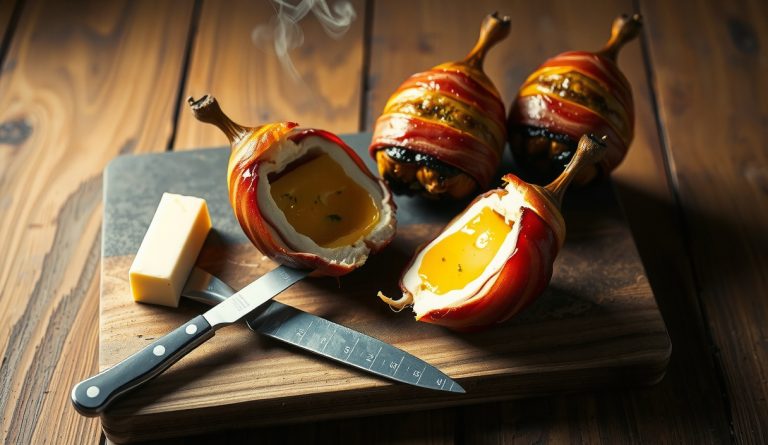
Pepper-jack stuffed: A half-ounce cube of pepper-jack or Gruyère placed inside the cavity melts at 275°F chamber temperature around the 25-minute mark. The molten cheese fuses with the released quail juices inside the cavity, creating a savory sauce that is revealed when the diner splits the bird. The fat in the cheese also further lubricates the interior protein matrix. Use a semi-hard, low-moisture cheese; fresh mozzarella contains too much water and steams the inside of the bird rather than enriching it.
Scaling: This recipe scales without any physical change to the cooking parameters — smoker temperature, target internal temperature, and estimated cook time remain identical whether you cook two birds or twelve. The practical limit is grate space; quail need at least two inches of clearance on all sides for proper convective airflow. Crowding the grate traps steam between birds, delays bark development on the bacon, and adds 10 to 15 minutes to the cook time unpredictably.
Frequently asked questions
Can I use frozen quail? Yes — thaw completely in the refrigerator overnight before smoking. A frozen quail placed directly on the smoker will have a dramatically cold center that takes 20 extra minutes to come up to temperature, during which the bacon exterior overcooks and the skin turns rubbery. Once thawed and fully dried, frozen quail perform identically to fresh.
Why smoke quail at 275°F instead of the low-and-slow 225°F used for brisket? At 225°F, quail cooks so slowly that the bacon spends an extended period in the 150°F–200°F range — warm enough to render fat but not hot enough to drive Maillard browning on the exterior. The result is pale, greasy, flaccid bacon over a bird that has technically hit temperature but lacks any textural contrast. At 275°F, the higher convective energy pushes the bacon surface past 300°F on the grate-contact side within the first 15 minutes, initiating the browning cascade while the quail interior climbs gently. The higher temperature is the correct tool for a small, lean, quickly-cooking bird.
What internal temperature is safe for quail? The USDA classifies quail as poultry with a safe minimum internal temperature of 165°F, measured in the thickest part of the breast. Unlike duck or squab, where pink breast meat is culinarily accepted by many cooks, quail breast at sub-165°F internal has a wet, slightly translucent texture that most diners find unappealing regardless of food safety considerations. Pull the birds at 163°F and let carryover finish the work — the quail will land right on target.