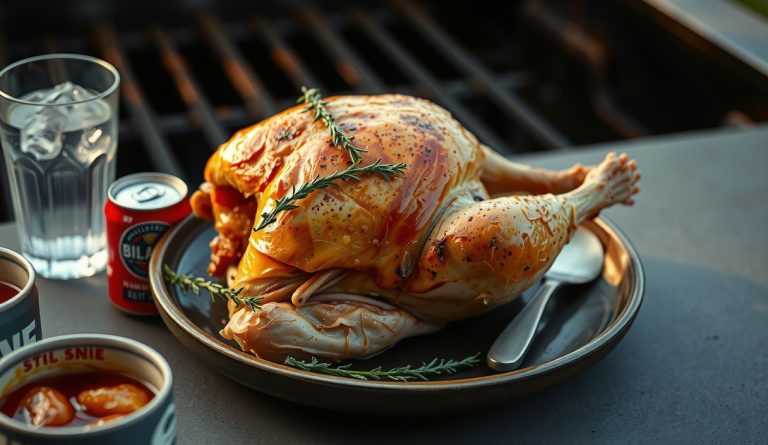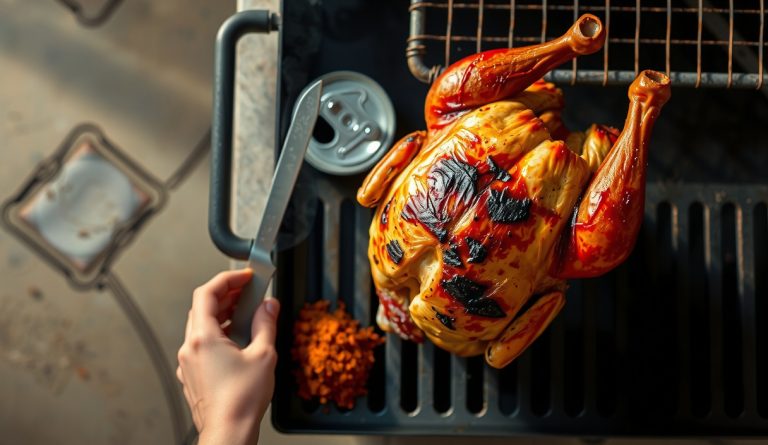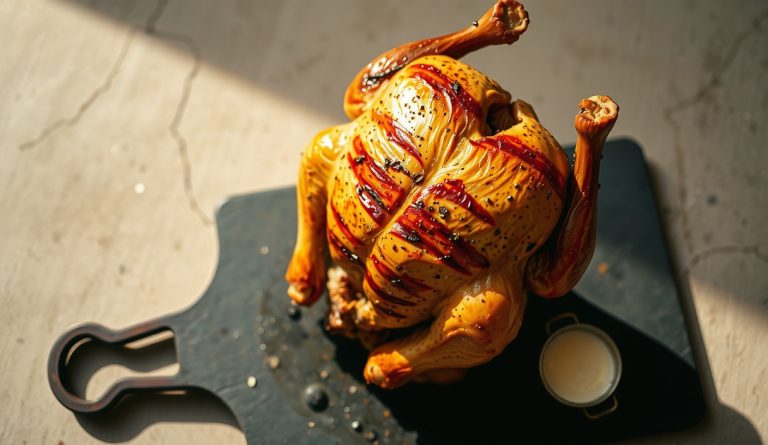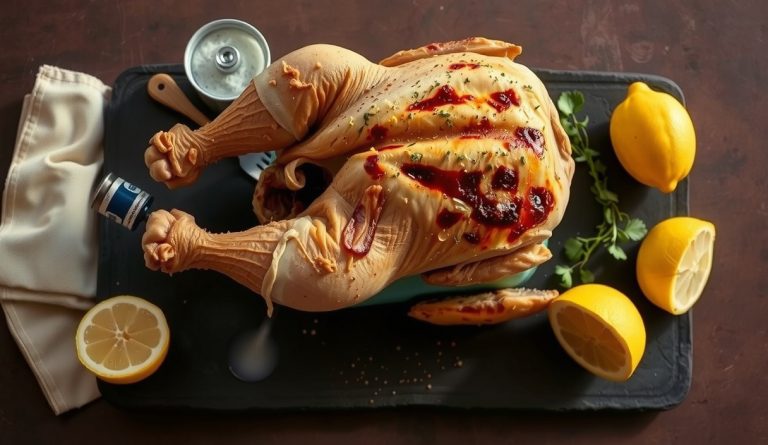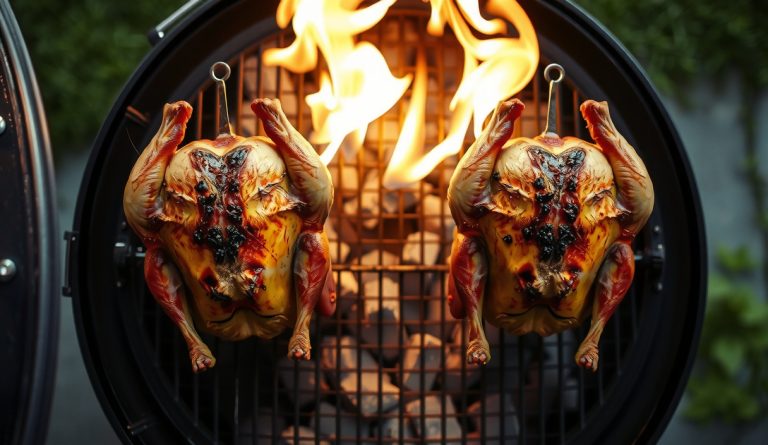
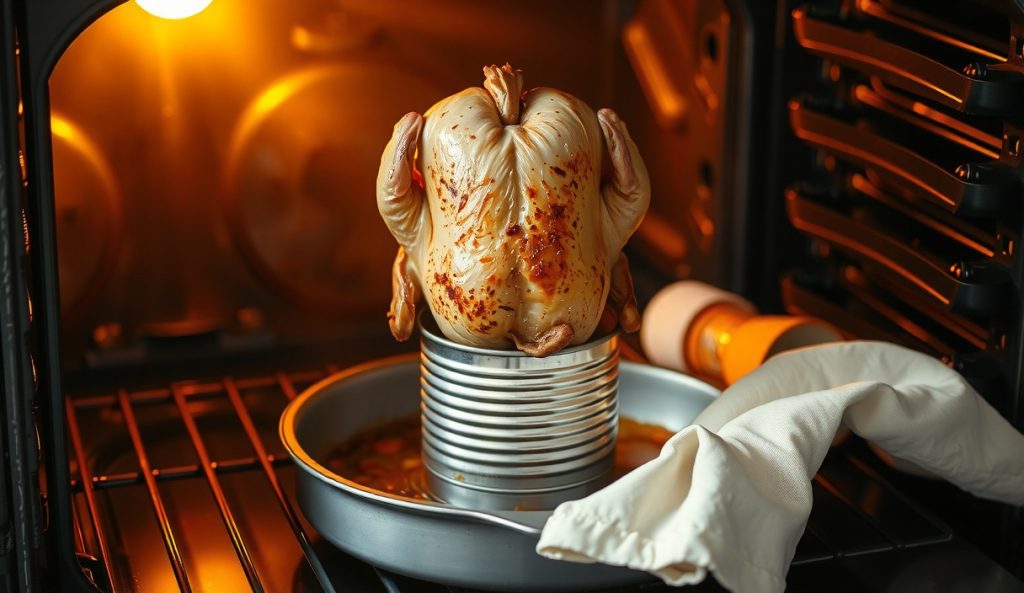
The two mechanisms that make Beer-Can Chicken work — a high-pH baking powder rub that accelerates Maillard browning and a partially filled can that moderates cavity humidity — are both purely thermal and entirely independent of a grill. They function in a 375°F convection or conventional oven exactly as they do over indirect charcoal heat. What the oven cannot replicate is combustion-derived smoke and the radiant intensity of live fire, which together produce the crust depth and aromatic complexity that define the grilled version. That is a real tradeoff. It is not, however, enough of one to produce a bad chicken.
What changes when you move Beer-Can Chicken to the oven?
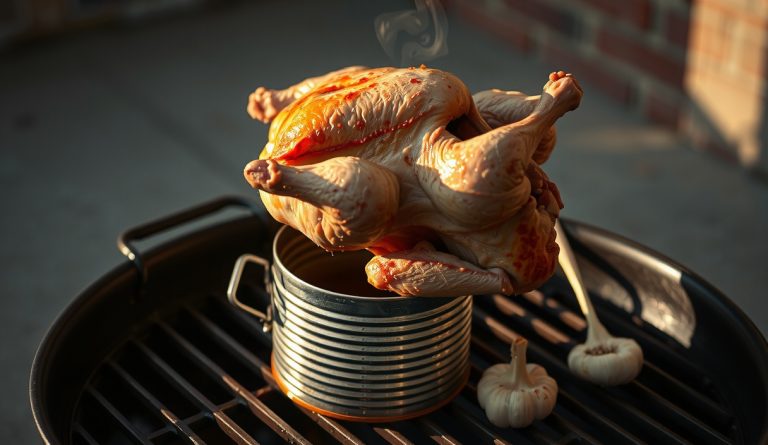
Preheat the oven to 375°F with a rack in the lower-third position — lower-third placement keeps the bird further from the broiler element and reduces the risk of the breast skin over-browning before the thigh reaches temperature. Stand the can-mounted bird on a rimmed sheet pan fitted with a wire rack. The wire rack is not optional: it lifts the bird off the pan surface, allowing hot air to circulate under the drip zone and preventing the underside skin from braising in its own rendered fat, which would soften it considerably.
Roast the chicken uncovered for 65 to 80 minutes depending on bird size — a 3.5-pound bird will land toward the lower end; a 5-pound bird toward the upper. Begin probing at 60 minutes. Dry oven air does not carry the same moisture-wicking convective energy as grill airflow over live coals, and the absence of wood smoke means the outer meat layer will not develop a smoke ring.
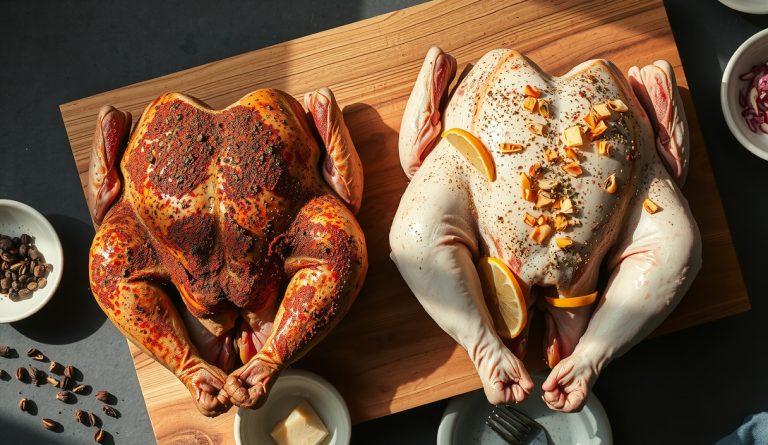
The baking powder in the rub raises skin pH to approximately 8–9, lowering the Maillard onset temperature from roughly 280°F to closer to 250°F — so browning begins earlier and progresses more evenly — but the maximum crust color achievable under a home oven ceiling of 375°F is shallower than what a two-zone grill at the same set temperature produces through radiant supplementation. The skin will be crispy. It will not be identically dark.
What stays the same in the oven version?
The dry-brine protocol — kosher salt and baking powder applied at least one hour before cooking and ideally overnight — carries over without modification. The can remains half-filled. Target internal temperature is 165°F at the thickest part of the thigh. The 10-minute post-cook rest is unchanged and is, if anything, more important in the oven version because the lower radiant intensity means the bird exits the oven with a slightly smaller thermal gradient between exterior and interior, making rest time critical for juice redistribution.
When is the oven version the better choice?
Use the oven variation in winter, in apartments, during rain, or any time grill access is unavailable. It is also the right approach when cooking for guests who are sensitive to smoke flavor, or when the chicken is destined for a dish — tacos, grain bowls, salads — where smoke character would compete with other components.
Use the full method, equipment, and rub measurements from the original Beer-Can Chicken on the Grill.