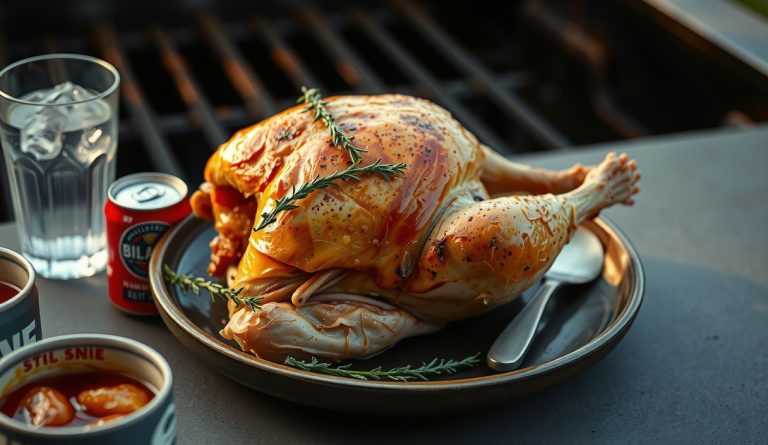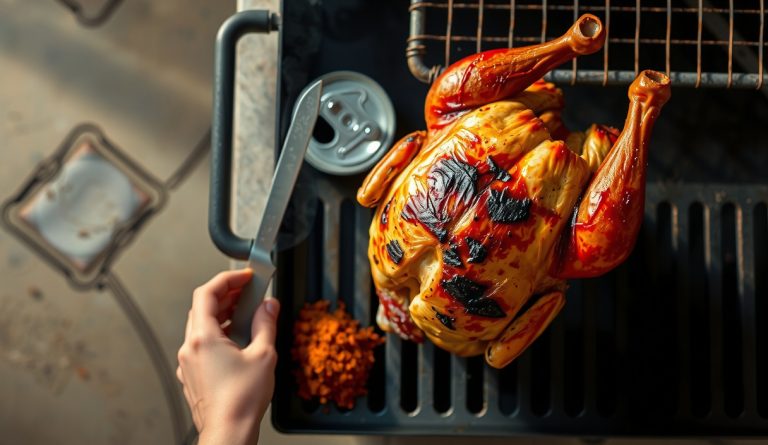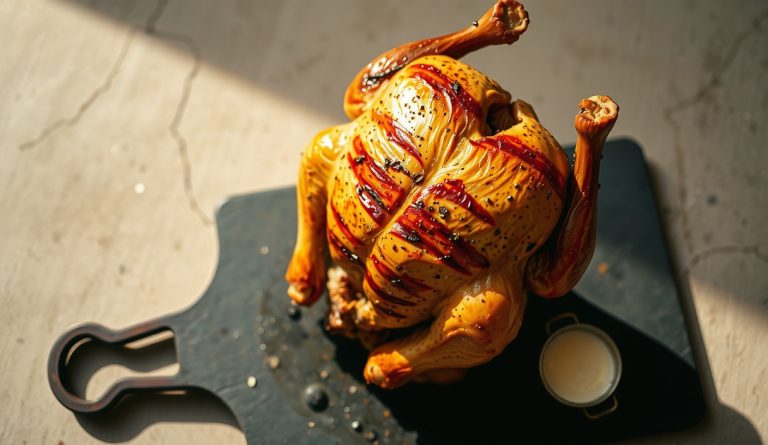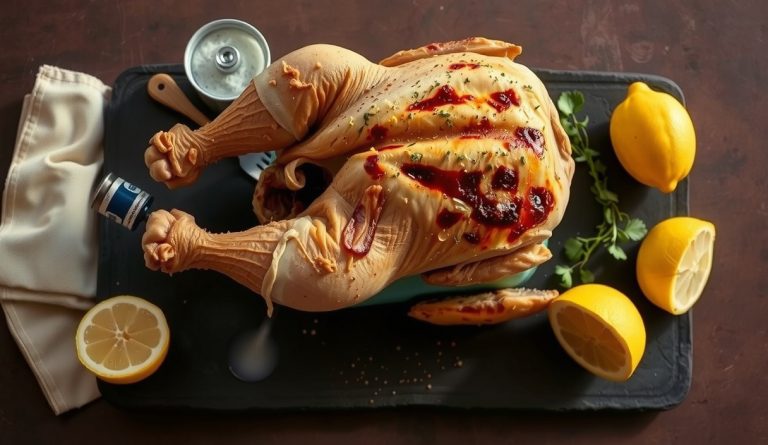
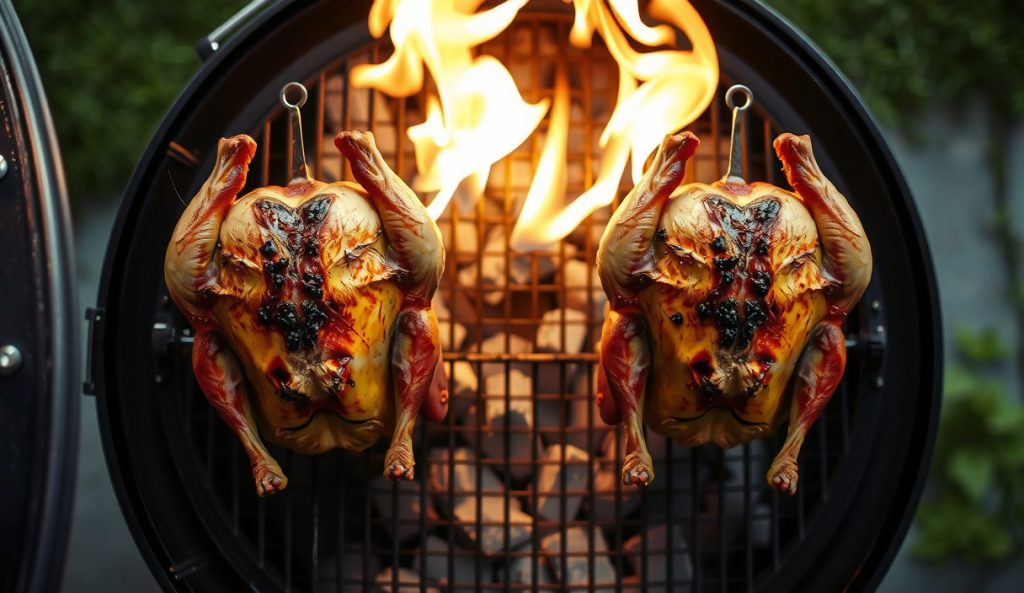
Doubling the output of a beer-can chicken cook on a 22-inch kettle is straightforward, but it requires deliberate placement and one additional mid-cook step. The physics of cooking two birds in an enclosed dome differ from cooking one: combined thermal mass is higher, radiant heat distribution is less symmetrical, and airflow around each bird is partially obstructed by its neighbor. All three issues are manageable with a back-to-back arrangement, coals distributed on four sides, and a single 180-degree rotation at the midpoint.
What changes when you cook two beer-can chickens at once?
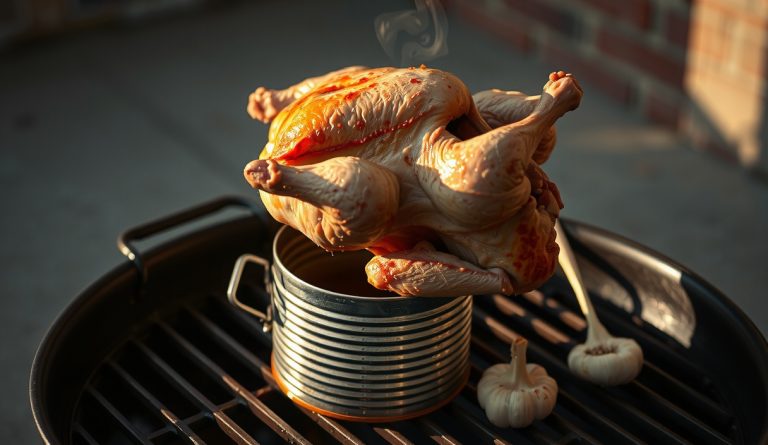
Place both can-mounted birds back-to-back over a shared drip pan in the center of the grill grate. Stagger the cans slightly — offset them by 2 to 3 inches laterally — so the birds do not lean into each other as they cook. When two large thermal masses occupy the center of a kettle, they create a low-convection shadow zone between them where heat circulation slows. The 2-to-3-inch stagger opens that gap enough to restore airflow symmetry around both birds.
Distribute lit coals in four roughly equal banks around the perimeter of the grill rather than in two opposing banks as you would for a single bird. Four-sided coal distribution reduces the left-to-right heat differential that a two-bird arrangement amplifies. Add 10 to 15 minutes to the total cook time to account for the increased thermal load. At the 45-minute mark, rotate both birds 180 degrees on their cans — this swaps which side of each bird faces the hotter coal banks and equalizes crust development across the full exterior.
Do not skip the 180-degree rotation. On a kettle with any asymmetry in coal distribution — which describes nearly all of them — one side of each bird will otherwise run 15 to 20°F hotter than the other, producing uneven browning and a meaningful internal temperature differential between the breast sides.
What stays the same when scaling to two birds?
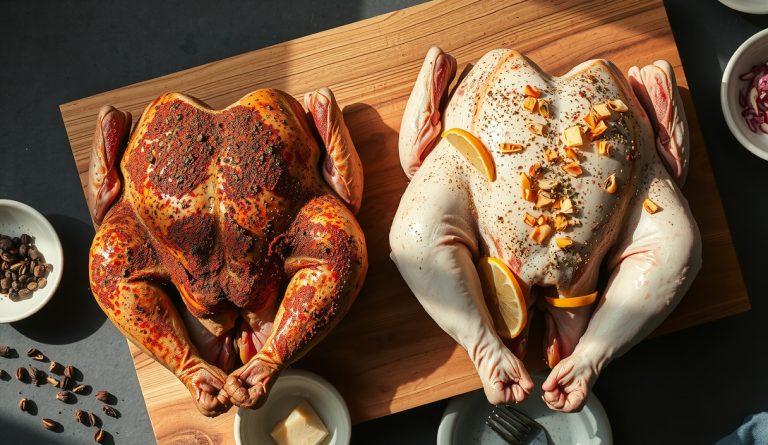
Dry-brine each bird individually using the canonical salt and baking powder ratios from the base recipe — scaling the rub is simply a matter of doubling the batch. Target internal temperature remains 165°F at the thickest part of the thigh on both birds, measured independently. Rest each bird for the same 10-minute period before carving. Can fill level — half-full — does not change regardless of flock size.
When is two-bird scaling the better choice?
Two-bird scaling is the right call for any gathering of six or more, or any time you want to serve a second bird later in the week. Two birds cooked simultaneously on the same fire produce nearly identical results per bird as one, and the incremental fuel cost is negligible. The efficiency argument is strong: one fire, one monitoring session, twice the yield.
Leftovers from a properly dry-brined whole bird reheat better than almost any other chicken format. The brine mechanics that protect moisture during the cook — elevated water-holding capacity in the muscle proteins — continue to buffer moisture loss during gentle reheating, making the second bird as valuable cold or reheated as it is fresh off the grill.
Use the full method, equipment, and rub measurements from the original Beer-Can Chicken on the Grill.