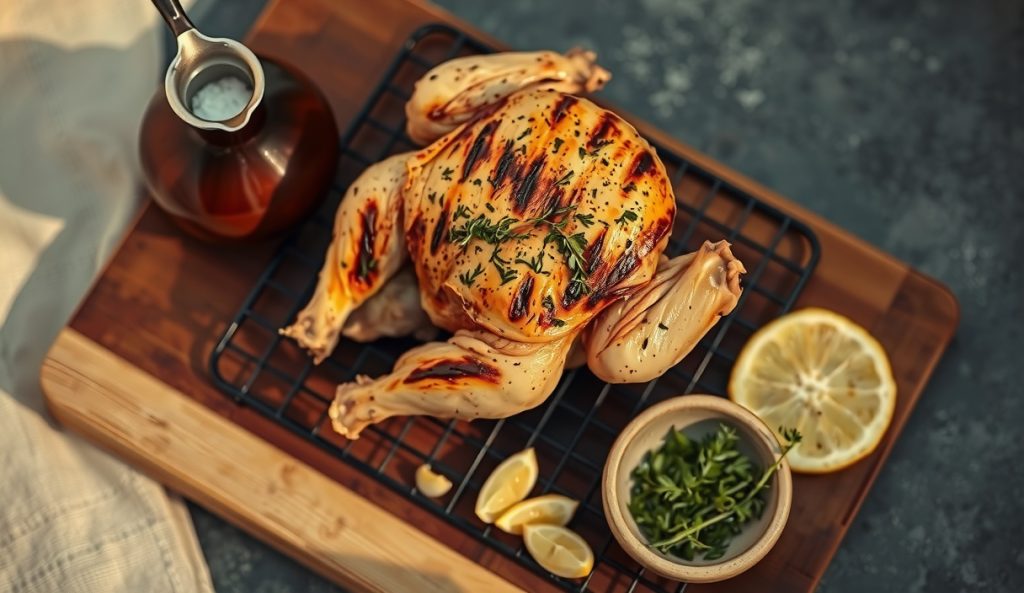
The canonical lemon-garlic spatchcock chicken contains no gluten-bearing ingredients and no dairy in its base form — no adaptation is required for those two dietary frameworks. The one modification worth understanding is the low-sodium version, which involves a single ingredient omission with a specific and predictable effect on crust texture.
What changes in the low-sodium version?
Omit the kosher salt from the marinade entirely. Season only at the table with a low-sodium salt substitute or with no added salt at all. The lemon juice, zest, and raw garlic carry substantial aromatic complexity — organic acids, limonene, allicin — that provide brightness and perceived seasoning without sodium amplification. The dish remains flavorful.
The one measurable trade-off is in crust development. Salt reduces the water activity of the skin surface — it draws moisture outward during the marinade period, leaving a drier exterior that browns faster and more evenly under the Maillard reaction, which requires temperatures above approximately 280°F and a low-moisture surface to proceed efficiently. Without salt in the marinade, the spatchcock chicken skin retains more surface moisture. The Maillard browning during the final high-heat sear still occurs, but crust color and crispness will be slightly less pronounced. Patting the skin thoroughly dry with paper towels immediately before placing the bird on the grill partially compensates for the absent water-activity reduction.
What stays the same in the low-sodium adaptation?
All other marinade components, the marinade timing, grill temperature, indirect cook duration, internal temperature target, and the final sear remain unchanged. The structural and flavor contribution of lemon, garlic, olive oil, and herbs is not sodium-dependent — removing salt from the marinade does not require any compensating adjustments to those elements.
When is the low-sodium adaptation the better choice?
This adaptation is the correct choice for guests managing hypertension or following a clinically low-sodium diet, for households cooking for mixed dietary needs without wanting to prepare a separate dish, or any time the canonical recipe is wanted and the only constraint is sodium content. The gluten-free and dairy-free status of the canonical spatchcock chicken recipe requires no modification whatsoever — it applies by default.
Use the full marinade ratios, spatchcock method, grill setup, and sear timing from the original Grilled Spatchcock Chicken — Lemon-Garlic.