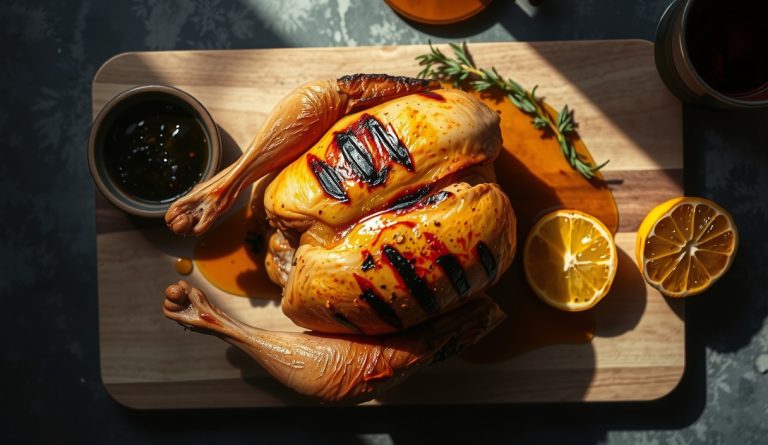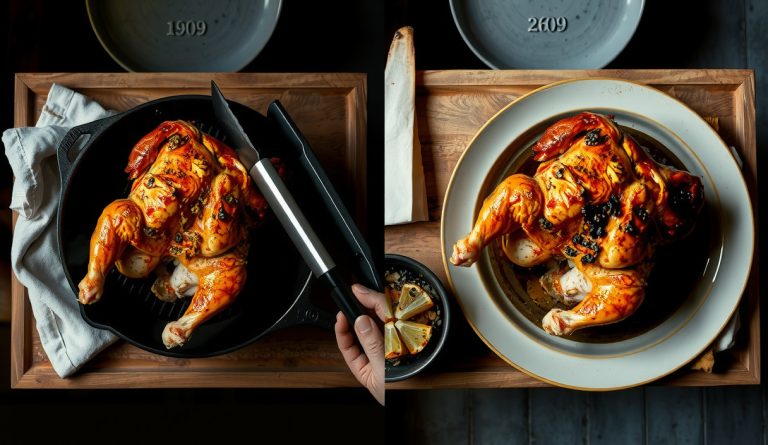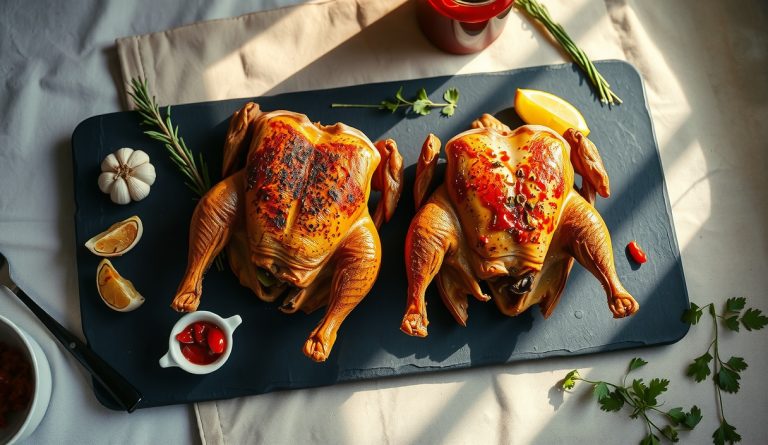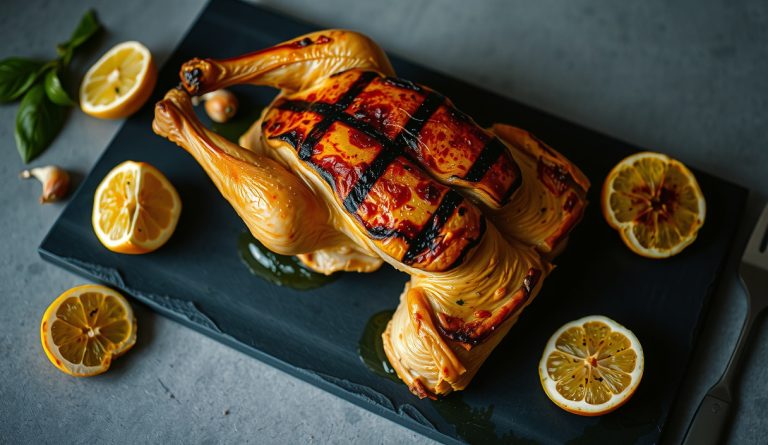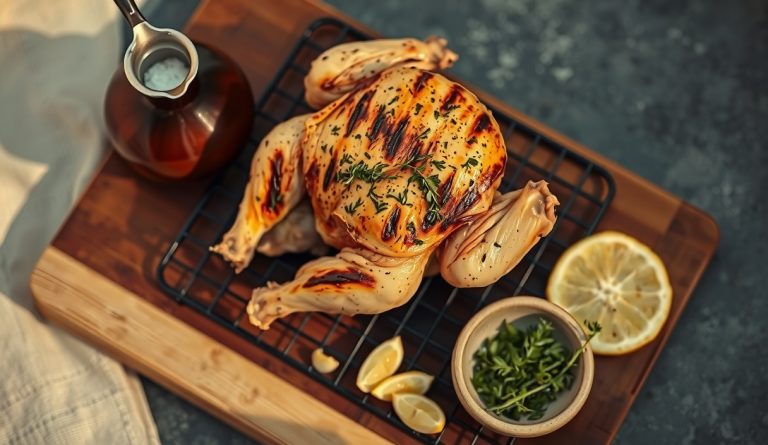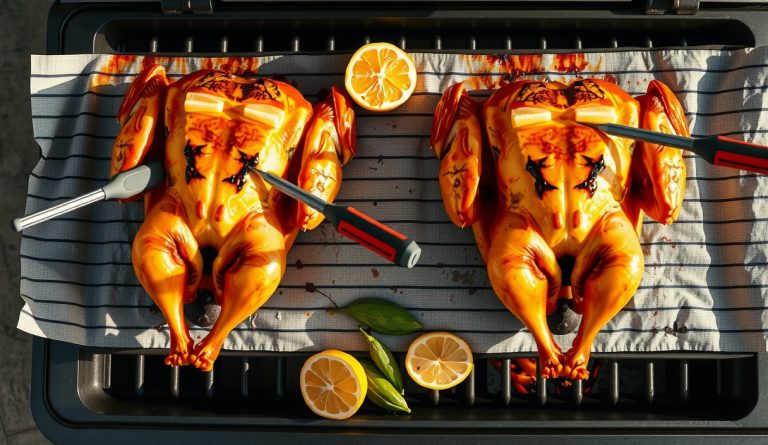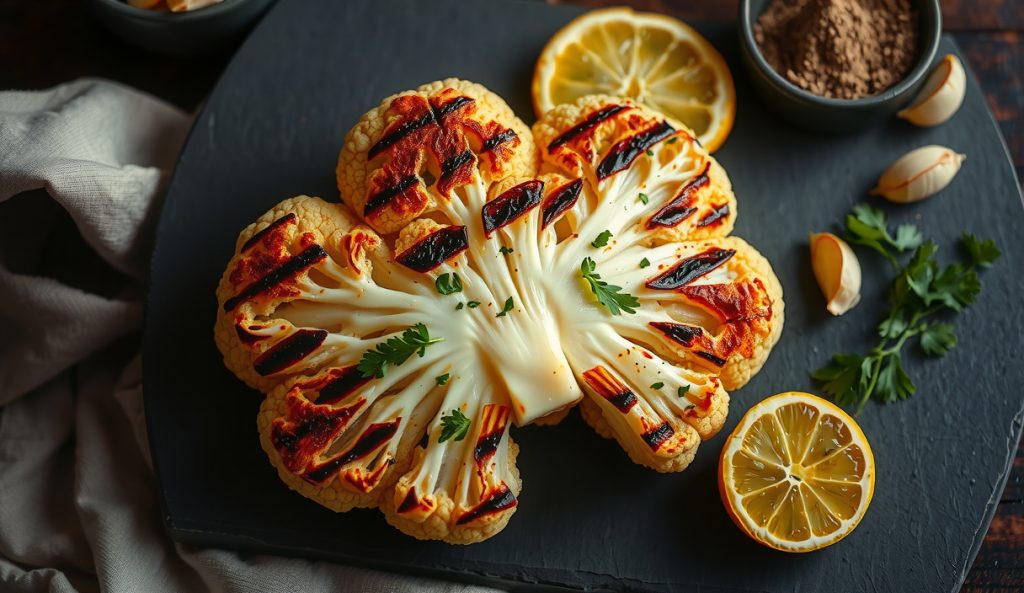
This grilled king oyster mushroom dish is not a vegetarian replacement for spatchcock chicken — it is a vegetarian companion engineered for the same table, the same fire, and the same flavor architecture. The canonical Grilled Spatchcock Chicken — Lemon-Garlic rests on three pillars: lemon-acid brightness, fat-carried garlic and thyme volatiles, and high-heat Maillard development across a broad, flat surface. King oyster mushrooms — Pleurotus eryngii — are the strongest plant-world analog for all three. Their dense, meaty stipe has a fiber and water structure that rewards the same two-zone indirect-then-sear approach used for the bird.
What changes when you swap chicken for king oyster mushrooms?
The protein: king oyster mushrooms, halved longitudinally. Select the largest king oyster mushrooms available — stipes 2–3 inches in diameter. Halve each mushroom lengthwise through the cap and stipe to create broad, flat planks, then score the cut face in a shallow cross-hatch 3 mm deep on a 1 cm grid. The scoring accomplishes two things simultaneously: it dramatically increases surface area for Maillard reaction development, and it mechanically opens the dense mycelial fiber bundles so the marinade’s olive oil phase — carrying garlic organosulfur volatiles and thyme’s carvacrol — can penetrate below the surface rather than pooling on top. Without scoring, king oyster’s exterior is hydrophobic enough that marinade sits on the surface and flares off before it can flavor the interior.
The marinade: identical, with one adjustment. Use the canonical lemon-garlic-thyme marinade exactly as written for the chicken, but extend the marination window to 20–30 minutes. Because king oyster mushrooms contain no myofibrillar protein network to over-denature, a longer soak is safe — up to a 45-minute maximum. The citric acid slightly firms the mushroom surface by compressing cell-wall pectin, which actively helps prevent limpness on the grill. Do not push past 45 minutes: prolonged acid exposure begins breaking down the chitin-glucan cell wall structure, creating a soft, waterlogged texture that will steam rather than sear.
Smoke uptake mechanics. King oyster stipes are approximately 90% water by weight raw, but denser and drier than most mushrooms. As the mushroom heats on the indirect zone, free water in the outer cells evaporates rapidly, concentrating umami compounds — glutamate and 5′-GMP — at the surface and creating a low-moisture boundary layer that smoke particles adhere to. Use the same wood recommended for the canonical chicken: fruitwood (apple or cherry) or mild oak. The evaporating cell water generates a continuous condensation-and-reabsorption cycle that draws smoke compounds inward, making king oyster genuinely smoke-receptive in a way that tofu or seitan is not.
Temperature and technique. Place the mushrooms cut-face-down on indirect heat at 375–400°F and cook until fully tender through the stipe. An instant-read thermometer reading of 185°F internal confirms full cell-wall collapse and maximum texture. Finish 90 seconds per side over direct high heat to drive the Maillard cascade across both the cut face and the rounded cap side. The scored cut face will develop deep mahogany color; the cap side will blister and char at the edges. Pull the mushrooms, rest two minutes, and finish with a squeeze of charred lemon exactly as you would the chicken.
What stays the same between the chicken and the mushroom companion?
The lemon-garlic-thyme marinade, the two-zone fire setup at 400°F, the fruitwood smoke, the charred lemon finish, and the presentation logic are identical across both dishes. Both the spatchcock chicken and the king oyster planks come off the same grill in roughly the same time window — which is precisely the point. This companion belongs on the same platter as the bird, not relegated to a separate, apologetic side dish.
When is the king oyster mushroom companion the better choice?
The grilled king oyster companion earns its place when a table includes vegetarians and meat-eaters who want to eat together — not from offset menus. King oyster mushrooms do not replicate chicken’s protein density or collagen structure, but they deliver genuine smoke flavor, real Maillard complexity, and the same lemon-garlic-thyme character as the bird beside them. King oyster’s natural glutamate content provides a savory depth that most vegetables cannot match, and the scored, charred cut face is visually compelling enough that the mushroom will not look like an afterthought next to a magazine-cover spatchcocked bird.
For the full marinade ratios, grill setup, and fire management that underpin both dishes, follow the original recipe.