
Roasted Pineapple and Habanero Margarita

Ingredients
- ½ Habanero Pepper
- 2 oz Silver Tequila
- 1 oz Simple Syrup
- 1 oz Fresh Lime Juice
- ½ cup Roasted Pineapple
- ½ oz Agave Nectar
- 1 Small Pineapple slice
- 1 Thin Habanero slice

Instructions
- Preparation: Begin by roasting pineapple chunks until they are caramelized to enhance their sweetness.1/2 cup Roasted Pineapple
- Muddle: Muddle a slice of habanero pepper (adjust amount based on heat preference) with the roasted pineapple to release their flavors.1/2 Habanero Pepper
- Mix: Combine the muddled mixture with silver tequila, fresh lime juice, simple syrup, and agave nectar in a shaker filled with ice.2 oz Silver Tequila, 1 oz Simple Syrup, 1 oz Fresh Lime Juice, 1/2 oz Agave Nectar
- Shake: Shake well until the mixture is well-chilled.
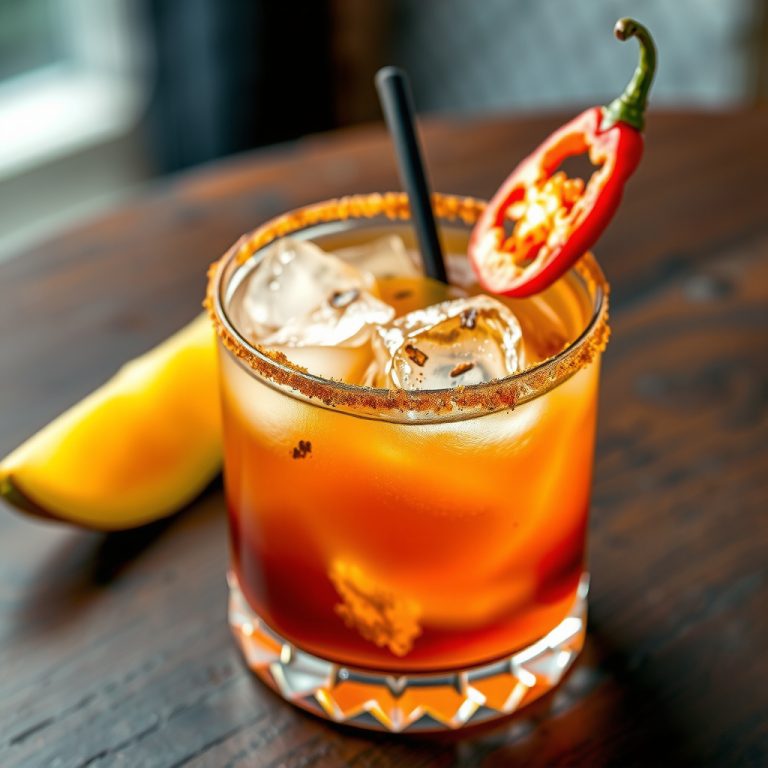
- Strain and Serve: Strain into a glass rimmed with a mixture of sea salt and chili powder, over fresh ice.
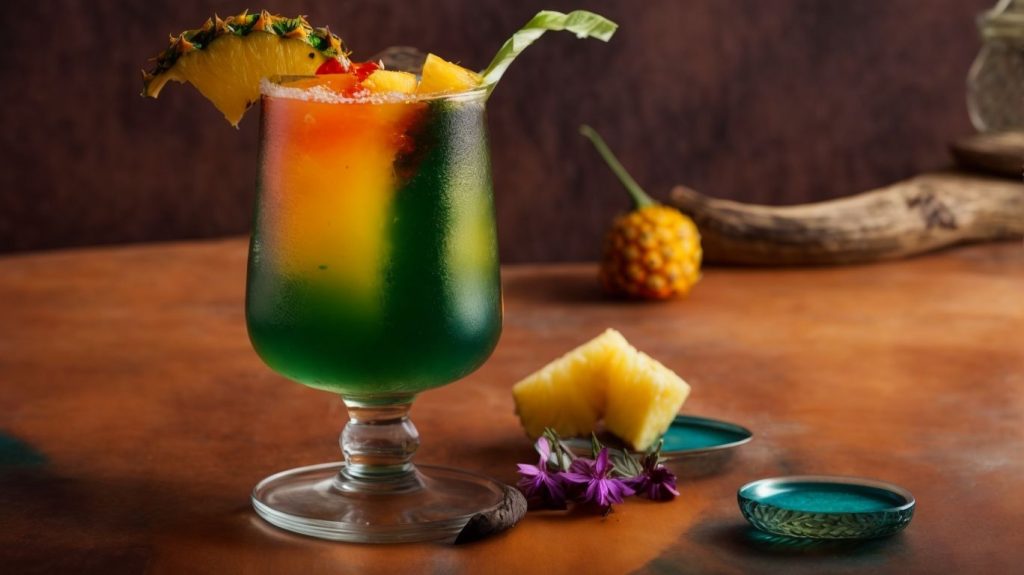
- Garnish: Garnish with a slice of grilled pineapple and a habanero pepper for an eye-catching presentation.1 Small Pineapple slice, 1 Thin Habanero slice
Notes
Nutrition
There is a moment, somewhere between the first caramelized edge of pineapple on a hot grate and the back-of-throat burn of a fresh habanero, when you understand exactly what this drink is trying to do. The Roasted Pineapple and Habanero Margarita is not a subtle cocktail. It is a study in controlled extremes — sweetness pushed past its comfort zone by Maillard heat, citrus acid cutting through residual sugars, capsaicin volatiles riding the ethanol carrier straight to your trigeminal nerve. This is where flavor meets the flame, and it earns that phrase more literally than most recipes on this site.
The base framework is a classic margarita — blanco tequila, fresh lime, sweetener — but the roasted pineapple component transforms it from familiar to genuinely compelling. This is a drink that rewards patience at the grill or under a broiler, and offers absolutely zero forgiveness if you skip that step and use canned fruit. The difference is not cosmetic. It is chemical.
Why does the Roasted Pineapple and Habanero Margarita work? The science
Roasting pineapple above 320°F (160°C) triggers two simultaneous chemical processes that raw fruit cannot replicate, and those processes are the entire foundation of this cocktail. Raw pineapple sits at roughly 11–13 Brix — meaning 11–13 grams of dissolved sugars per 100 grams of juice. Apply dry heat and caramelization begins as fructose and sucrose degrade into hundreds of flavor-active compounds including diacetyl, furans, and hydroxyacetone, the source of that toasty, almost rum-like depth. Simultaneously, Maillard browning accelerates on the surface, producing melanoidins and additional volatile aromatics that raise the perceived complexity of the fruit by an order of magnitude. When you muddle that roasted pineapple into a shaker, you are not adding fruit juice — you are adding a concentrated aromatic library that raw pineapple simply cannot provide.
The habanero brings capsaicin (8-methyl-N-vanillyl-6-nonenamide) and its analogue dihydrocapsaicin, both nonpolar lipophilic molecules with a strong affinity for ethanol. Silver tequila, typically bottled at 40% ABV (80 proof), acts as a more efficient capsaicin solvent than water alone, which is why muddling habanero directly into an ice-and-spirit shaker extracts heat faster and more thoroughly than muddling into a water-based mixer. The partition coefficient of capsaicin strongly favors the ethanol phase, meaning the tequila is actively pulling capsaicin out of the pepper cell walls during the muddle-and-shake process. Half a habanero yields a drink that is assertively hot but not punishing; a quarter habanero produces a manageable warmth, and removing seeds and pith reduces capsaicin density by roughly 30–40%.
Fresh lime juice at roughly 6–7% titratable acidity — predominantly citric acid, pH approximately 2.2–2.4 — accomplishes two things simultaneously in the Roasted Pineapple and Habanero Margarita. First, it balances the elevated residual Brix from roasted pineapple and the added sweeteners by driving perceived sweetness down through acid contrast, a sensory phenomenon governed by cross-modal suppression. Second, citric acid mildly denatures bromelain, the protease enzyme native to raw pineapple that can cause mucosal irritation; roasting already deactivates most bromelain above 160°F (71°C), so together with the acid, the finished cocktail is smooth-drinking despite its aggressive ingredient profile. The dual sweeteners — simple syrup and agave nectar — are not redundant: simple syrup (roughly 1.0 Brix per gram in solution) provides immediate sweetness, while agave nectar contributes fructose-forward sweetness with a faint vegetal mineral note that echoes the tequila’s own agave origin, reinforcing varietal coherence in the glass.
What equipment and ingredients do I need?
Silver tequila — also labeled blanco or plata — is the correct call for this recipe, not reposado or añejo. Barrel aging introduces vanillin, lactones, and tannin extraction products from oak that compete with the roasted pineapple’s caramel notes rather than complementing them. A good blanco reads clean: cooked agave, citrus zest, faint pepper. Look for 100% agave on the label; mixto tequilas containing added sugars will muddy the sweetener balance you are deliberately calibrating with the syrup and agave nectar.
For roasting the pineapple, a cast-iron grill pan at 450–500°F (232–260°C) or a broiler set to high with the rack 4 inches from the element will both achieve the surface browning needed within 8–12 minutes, turning once. You want visible caramelization — amber to deep brown at the edges — without carbonization. Black char means acrolein and bitter degradation products you do not want in the shaker. The rimming mixture of sea salt and chili powder is functional, not merely decorative: salt suppresses bitterness from the lime-acid-tequila interface and amplifies sweetness perception, while chili powder on the rim delivers a low-level capsaicin primer that primes your trigeminal system before the first sip hits.
Roasted Pineapple and Habanero Margarita
Ingredients
- ½ Habanero Pepper
- 2 oz Silver Tequila
- 1 oz Simple Syrup
- 1 oz Fresh Lime Juice
- ½ cup Roasted Pineapple
- ½ oz Agave Nectar
- 1 Small Pineapple slice
- 1 Thin Habanero slice
Instructions
- Preparation: Begin by roasting pineapple chunks until they are caramelized to enhance their sweetness.1/2 cup Roasted Pineapple
- Muddle: Muddle a slice of habanero pepper (adjust amount based on heat preference) with the roasted pineapple to release their flavors.1/2 Habanero Pepper
- Mix: Combine the muddled mixture with silver tequila, fresh lime juice, simple syrup, and agave nectar in a shaker filled with ice.2 oz Silver Tequila, 1 oz Simple Syrup, 1 oz Fresh Lime Juice, 1/2 oz Agave Nectar
- Shake: Shake well until the mixture is well-chilled.
- Strain and Serve: Strain into a glass rimmed with a mixture of sea salt and chili powder, over fresh ice.
- Garnish: Garnish with a slice of grilled pineapple and a habanero pepper for an eye-catching presentation.1 Small Pineapple slice, 1 Thin Habanero slice
Notes
Nutrition
How do I nail the Roasted Pineapple and Habanero Margarita every time?
- Do not skip the roast. Raw pineapple lacks the caramelization compounds that define this drink. Unroasted fruit produces a flat, candy-sweet result with none of the toasty backbone the recipe is built around.
- Control habanero heat by contact time, not just quantity. The longer habanero sits in direct contact with the tequila in the shaker, the more capsaicin is extracted. If you muddle and then take time to assemble other ingredients, the drink will be hotter than intended. Muddle last, directly before adding ice and shaking.
- Use fresh lime juice only. Bottled lime juice is pasteurized, which drives off the most volatile aromatic esters and terpenes responsible for lime’s brightness. Bottled juice also contains sodium metabisulfite preservatives that interact poorly with habanero phenols at this pH. Squeeze to order.
- Shake harder and longer than you think. The Roasted Pineapple and Habanero Margarita needs approximately 20–25% dilution to tame the capsaicin and integrate the dense muddled fruit. A 12–15 second vigorous shake with a full shaker tin of ice is not excessive.
- Double-strain through a fine mesh. Pineapple fiber and habanero seeds in the finished glass are a texture problem. A Hawthorne strainer plus a fine mesh strainer catches all particulate and delivers a clean pour over fresh ice.
- Balance the rim application. Press only the outer edge of the glass into the salt-chili mixture — a half-rim if in doubt. A full rim can over-salt every sip and overwhelm the acid-sweet calibration you worked to achieve.
What are the best variations on this recipe?
Smoked pineapple version. Instead of oven-roasting or broiling, run pineapple chunks over indirect heat on a charcoal grill with a small chunk of fruitwood — apple or cherry — for 20–25 minutes at 275°F (135°C) before finishing over direct flame. The cold-smoke phase deposits guaiacol and 4-methylguaiacol on the pineapple surface before caramelization locks in structure, adding a genuine smoke-phenol layer that amplifies perceived complexity in a way no liquid smoke additive can replicate. This version pairs especially well with a mezcal split: replace 1 oz of tequila with 1 oz of joven mezcal for layered smoke without overwhelming the fruit.
Lower-heat build for guests. For a crowd-friendly batch, eliminate fresh habanero from the muddle entirely and substitute a habanero-infused simple syrup — steep one split habanero in 1 cup of hot 1:1 simple syrup for 15 minutes, strain, and refrigerate. This gives you precise, reproducible heat control across every pour and eliminates batch-to-batch variability from muddling. Dose at 0.5 oz per cocktail as a starting point and adjust upward.
Frozen format. Blend roasted pineapple, habanero, tequila, lime, and sweeteners with 1.5 cups of crushed ice for a frozen margarita that reads closer to a paleta than a poolside slushie. The fat-like texture of frozen dilution coats the palate and slows capsaicin binding to TRPV1 receptors, making the heat feel slower-building and longer-lasting — a genuinely different sensory experience than the shaken version.
Non-alcoholic riff. Replace tequila with a combination of 1.5 oz Seedlip Spice 94 (for its aromatic bitterness) and 0.5 oz white grape juice. Increase agave nectar to 1 oz to compensate for the lost ethanol body. Capsaicin extraction will be less efficient in a lower-ABV environment, so consider extending the muddle time to 45–60 seconds and allowing the mixture to rest for 2 minutes before shaking.
Frequently asked questions
Can I roast the pineapple ahead of time? Yes, and refrigerating roasted pineapple for up to 48 hours actually improves the cocktail. Roasted pineapple held in an airtight container continues to undergo low-temperature esterification, which mellows sharp fructose edges and deepens the caramel note. Store in an airtight container to prevent absorption of refrigerator odors, which will transfer directly into the shaker.
Why both simple syrup and agave nectar — can I just use one? You can use one sweetener, but the dual-sweetener structure is deliberate. Simple syrup dissolves instantly in a cold shaker and provides neutral sweetness that does not compete with the pineapple. Agave nectar is roughly 1.4–1.5 times sweeter than simple syrup by weight due to its higher fructose content, and it contributes a faint herbal vegetal quality that creates continuity with the tequila’s agave character. Using only simple syrup produces a flatter finish; using only agave nectar can make the Roasted Pineapple and Habanero Margarita taste slightly syrupy if not carefully measured.
My margarita tastes more bitter than spicy — what went wrong? Two culprits are most likely. First, habanero seeds and white pith carry bitter alkaloids in addition to capsaicin; if the muddle was aggressive and those cell walls fully ruptured, you extracted bitterness alongside heat. Switch to flesh-only habanero with seeds and pith removed. Second, over-squeezed lime — pressing the rind rather than just the pulp — releases bitter limonin and nomilin compounds from the peel. Use a hand press or citrus reamer that contacts only the pulp, not the rind, and squeeze once firmly rather than wringing repeatedly.