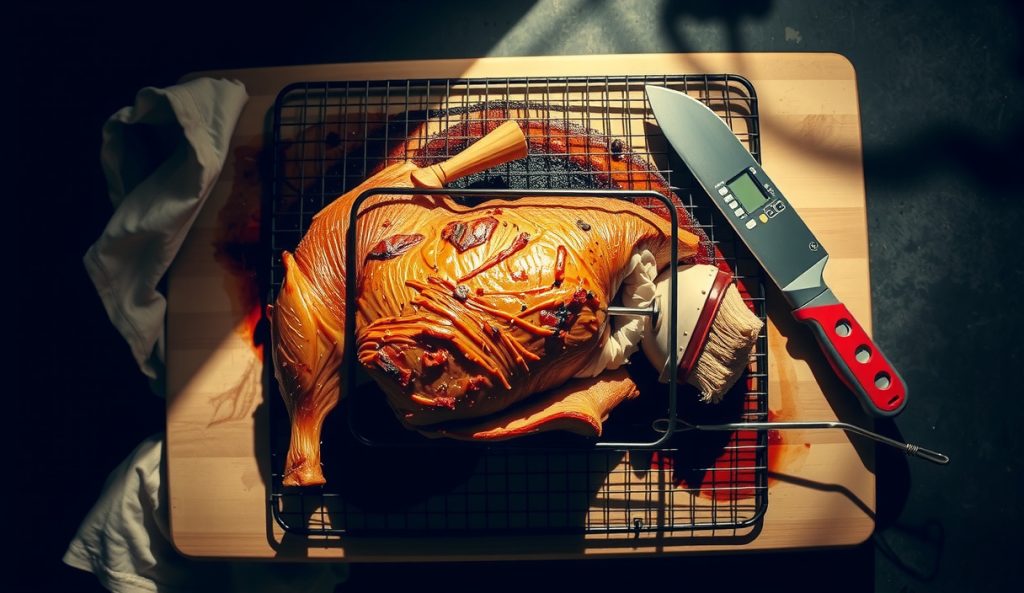
A bone-in pork shoulder is the preferred cut for Carolina pulled pork, but boneless shoulders are more commonly stocked at supermarkets and warehouse retailers. When boneless is what is available, the cook is absolutely viable — it requires exactly two specific adjustments: a shorter estimated cook window and a revised doneness-test protocol. Every other element of the method carries over without modification.
What changes when you go boneless — and why?
The bone in a pork shoulder functions as both a thermal insulator and a delayed-heat reservoir. Dense cortical bone has a lower thermal diffusivity than surrounding muscle tissue, meaning the bone conducts heat more slowly into the deepest fibers of the butt. Remove the bone, and those deepest fibers are now surrounded on all sides by meat with relatively higher thermal conductivity — the geometric core of a boneless shoulder reaches target temperature 1 to 2 hours earlier than a bone-in shoulder of comparable weight.
In practical terms: begin checking internal temperature at hour 9 rather than waiting for the expected 11-to-13-hour window for a bone-in shoulder, and check every 30 to 45 minutes once you are past the stall.
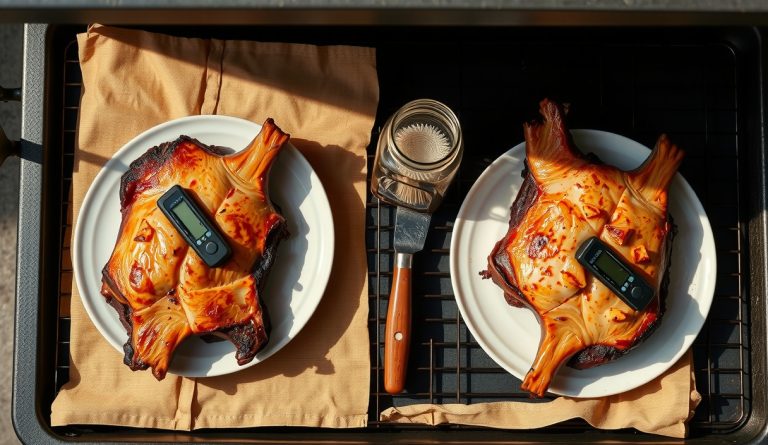
The bone-slide test — the point at which the blade bone pulls cleanly from the meat with zero resistance, confirming full collagen conversion — is no longer available on a boneless shoulder. In its absence, rely on two signals together: a calibrated thermometer reading of 203°F at the geometric center of the thickest part of the shoulder, and the probe-feel test, in which a temperature probe or skewer inserted into multiple points meets no resistance and slides through as if entering softened butter. Both signals must be present before pulling the shoulder from the smoker. A reading of 203°F alone is not sufficient if the probe still meets any resistance — collagen hydrolysis may be incomplete in a thicker section.
What stays exactly the same on a boneless shoulder?
The following elements are identical to the canonical bone-in method and require no adjustment when using a boneless shoulder:
- Pit temperature target
- Dry rub formula and application
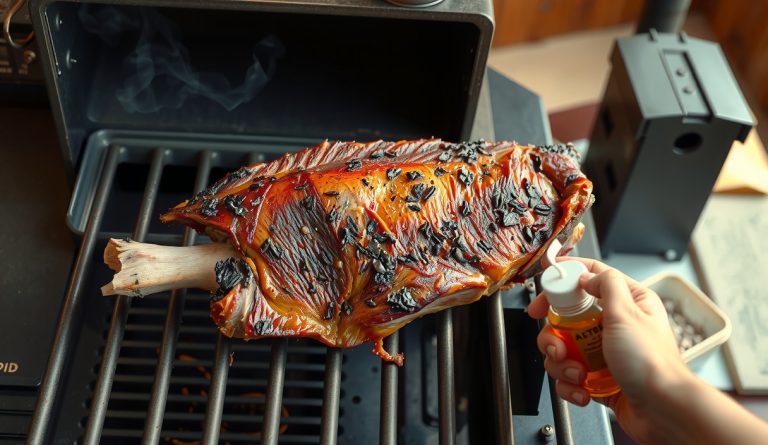
- Mop recipe and mop schedule
- Stall management approach
- Minimum one-hour rest before pulling
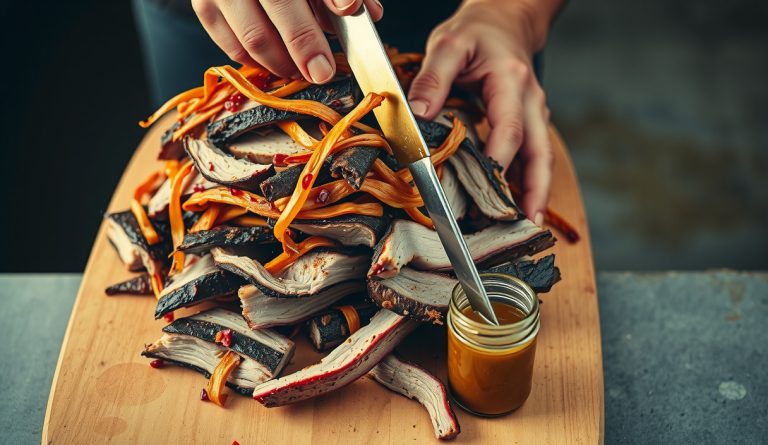
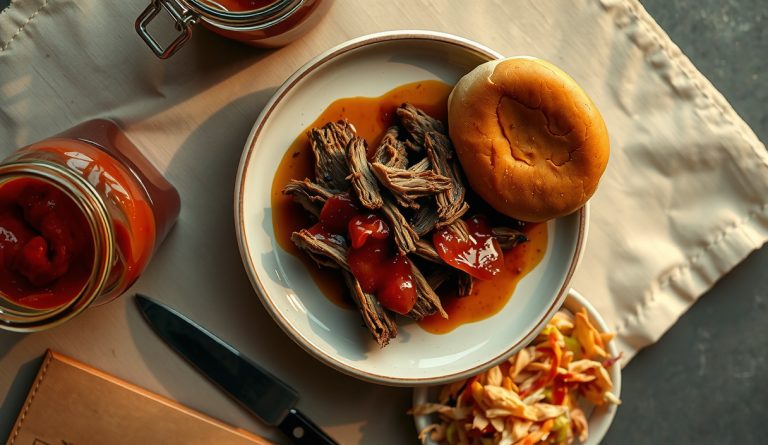
- Pulling and serving method
The only differences are the earlier check-in time (hour 9 instead of hour 11) and the exclusive reliance on the 203°F thermometer reading plus probe-feel for determining doneness.
When is the boneless adaptation the better choice?
This adaptation is the right call when bone-in shoulder is unavailable at your butcher or grocery, when you are working a tighter timeline and can use the 1-to-2-hour savings, or when you are serving guests who prefer boneless pulled pork for ease of eating and plating. The finished product is texturally and flavor-equivalent to the bone-in version when cooked to full collagen conversion — the difference is purely in sourcing and cook management, not in the plate.
Use the full method, equipment, and rub measurements from the original Carolina Pulled Pork with Eastern NC Vinegar Mop.