Carolina Pulled Pork with Eastern NC Vinegar Mop

Equipment
- 1 Offset smoker, kettle grill, or pellet grill Must hold a stable 225°F chamber temperature for 12+ hours. Verify grate temperature with a secondary probe.
- 1 Dual-channel leave-in wireless thermometer One probe for the meat (away from bone), one probe at grate level. Non-negotiable for a 12-hour cook.
- 1 Mop brush or spray bottle A 16-oz standard basting brush or a food-grade spray bottle both work. The spray bottle applies a thinner, more even coat.
- 2 sheets Butcher paper For optional wrapping at the stall and mandatory resting. Do not use foil — it traps steam and softens bark.
- 1 Dry cooler or insulated bag For the post-cook rest. Line with a clean towel, place wrapped shoulder inside, close lid. Holds temperature for 2+ hours.
- 1 Large cutting board Minimum 18×24 inches. You will be pulling 8-10 pounds of meat and need the real estate.
Ingredients
Pork
- 1 bone-in pork shoulder (Boston butt), 8-10 lbs Do not use enhanced or pre-brined pork. Bone-in only — the bone is a collagen reservoir and a doneness indicator.
Dry Rub
- 3 tablespoons kosher salt Diamond Crystal preferred. If using Morton’s, reduce to 2 tablespoons — it is roughly twice as dense by volume.
- 2 tablespoons coarsely ground black pepper 16-mesh or coarser grind. Fine pepper creates a muddy bark crust.
- 1 tablespoon smoked paprika
- 1 teaspoon cayenne pepper
Eastern NC Vinegar Mop
- 2 cups unfiltered apple cider vinegar Raw, unfiltered with 5% acidity. Bragg or a local producer. Do not substitute distilled white vinegar.
- 1 cup water
- 2 tablespoons crushed red pepper flakes Standard grocery-store heat level. Scale up to 3 tablespoons for serious heat.
- 1 tablespoon kosher salt
- 1 teaspoon coarsely ground black pepper
For the Smoker
- 4 lbs oak wood chunks or splits Post oak or white oak preferred. Use as your primary fuel flavor base.
- 2 lbs hickory wood chunks Accent wood only. More than a 1:2 hickory-to-oak ratio turns acrid on a long cook.

Instructions
Day Before: Dry Brine
- Combine the kosher salt, black pepper, smoked paprika, and cayenne in a small bowl. Mix until evenly distributed.2 tablespoons coarsely ground black pepper, 1 tablespoon smoked paprika, 1 teaspoon cayenne pepper
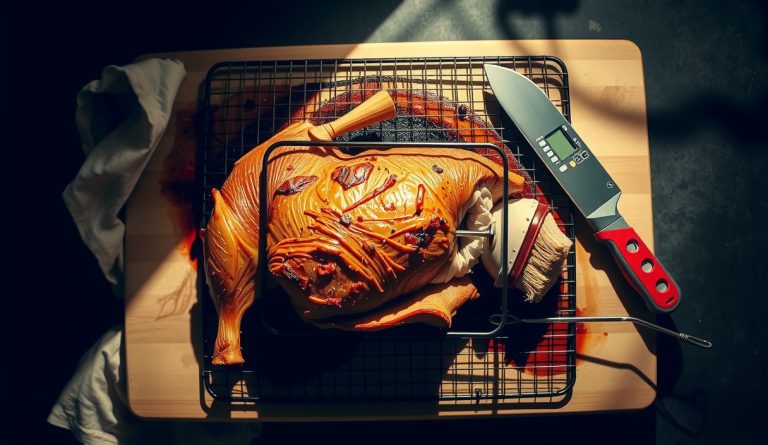
- Pat the pork shoulder completely dry with paper towels. Apply the dry rub aggressively on all surfaces, including the fat cap and the bone-exposed end. Work the rub into any crevices. You want complete coverage — no bare patches.
- Place the shoulder uncovered on a wire rack set over a sheet pan in the refrigerator for 12-24 hours. The salt will draw surface moisture out initially, then pull it back in, seasoning deep into the first centimeter of meat. Do not skip this step.
Day Of: Prep and Fire
- Remove the shoulder from the refrigerator 1 hour before cooking. The cold interior of a large butt extends the stall dramatically — a tempered start shaves 30-45 minutes off the low-temperature climb.
- Build your fire and stabilize the smoker at 225°F at grate level. This may take 45-60 minutes depending on your setup. Use a charcoal chimney for a clean base fire, then add your wood. On an offset, place oak splits in the firebox to establish your coal bed before adding a single hickory chunk. On a kettle, set up a two-zone fire with coals banked to one side and 2-3 wood chunks nestled into the coals.1 tablespoon kosher salt, 1 teaspoon coarsely ground black pepper
- Combine all vinegar mop ingredients in a non-reactive container — glass or stainless. Stir to dissolve the salt. Do not heat the mop. It goes on cold, which creates a brief surface-temperature drop that accelerates bark re-drying after application. Set aside at room temperature.2 cups unfiltered apple cider vinegar, 1 cup water, 2 tablespoons crushed red pepper flakes, 4 lbs oak wood chunks or splits, 2 lbs hickory wood chunks
The Cook
- Place the shoulder fat-cap up on the grate, away from direct heat on an offset, or over the cool zone on a kettle. Insert your meat probe into the deepest part of the largest muscle mass — aim for the geometric center, avoiding the bone. The probe tip should not touch bone; bone reads 15-20°F hotter than meat.
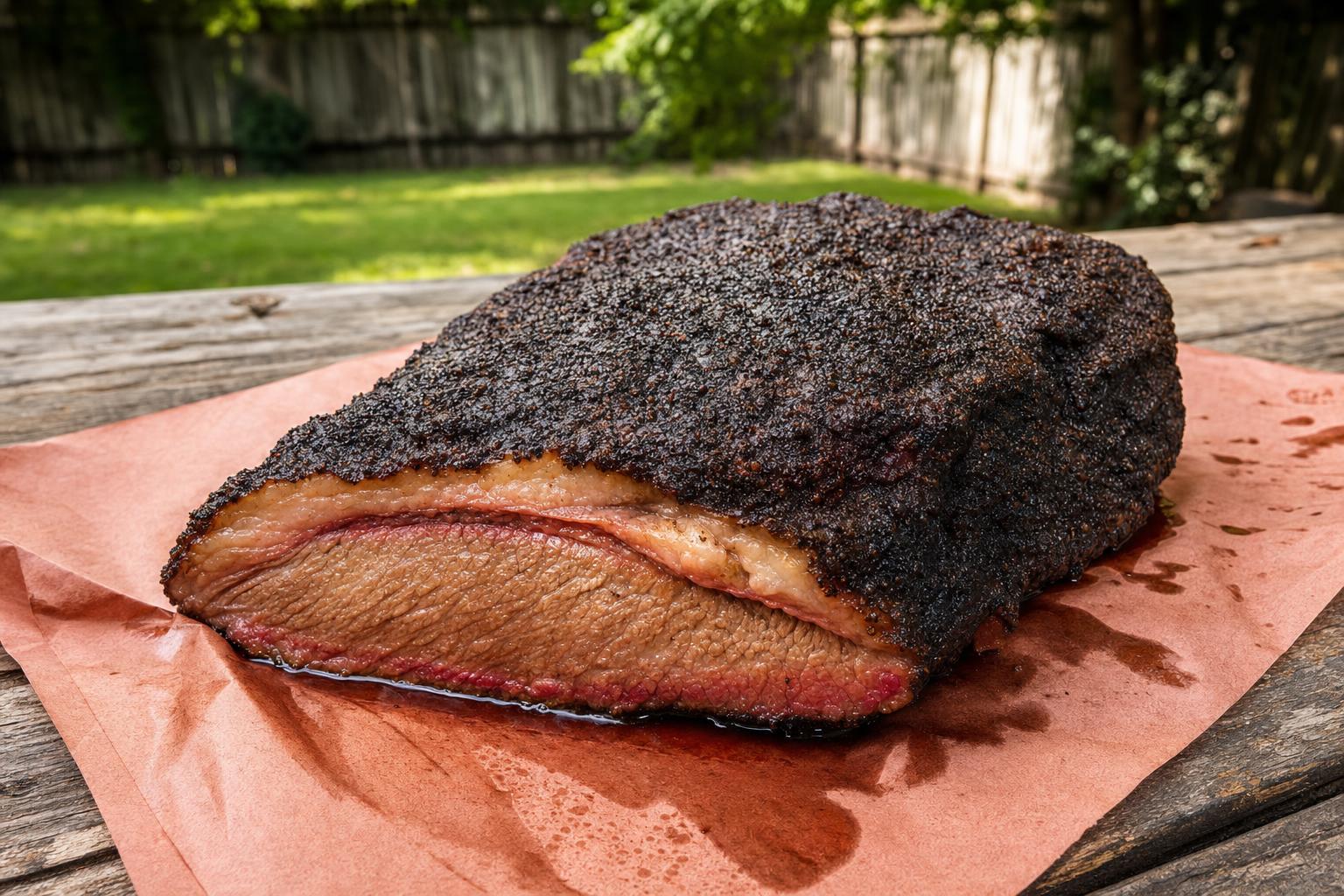
- Close the lid and do not open it for the first 4 hours. Maintain chamber temperature at 225°F by adjusting intake vents and adding wood as needed. The smoke ring — the pink layer just under the bark — develops in this window. Opening the lid interrupts it.
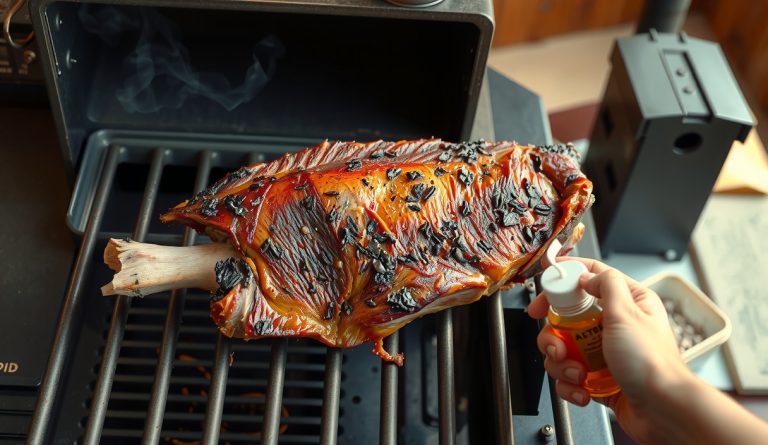
- At hour 5, open the lid and assess the bark. It should be dark mahogany to almost black on raised edges, dry and tacky to the touch. If the surface is still moist or pale, close the lid and check again at hour 6. Do not apply mop to a wet or underdeveloped bark.
- Once bark is set and dry, apply the first coat of vinegar mop using your brush or spray bottle. Work quickly and close the lid. Apply mop every 45-60 minutes from this point forward. Each application should be light — you are refreshing the surface moisture and acid, not drowning the bark. If the bark softens noticeably after mopping, extend your intervals to 90 minutes and leave the lid cracked for 5 minutes post-application to re-dry the surface.2 cups unfiltered apple cider vinegar, 1 cup water, 2 tablespoons crushed red pepper flakes, 4 lbs oak wood chunks or splits, 2 lbs hickory wood chunks
- Expect the internal temperature to stall between 155°F and 168°F. This is evaporative cooling physics — the stall can last 2-4 hours. Do not raise the chamber temperature to push through it. If you are on a hard deadline after hour 10 and the internal has not cleared 190°F, wrap the shoulder tightly in two layers of butcher paper and return to the smoker. This eliminates the evaporation mechanism and drives the internal up within 60-90 minutes.
- When the internal reaches 195°F, flip the shoulder fat-cap down. This firms the meat-side bark during the final push and insulates the top of the shoulder from direct radiant heat. Continue cooking to an internal temperature of 203°F.
- At 203°F, perform the probe-slide test: insert your probe vertically into the thickest muscle mass. It should slide in with the resistance of softened butter — no fibrous drag. If you feel resistance, add 30 minutes and recheck. The bone should wiggle freely when you push it laterally.
Rest and Pull
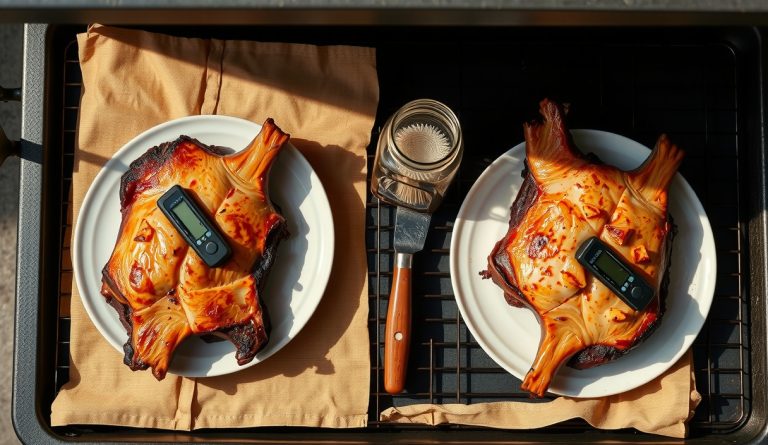
- Remove the shoulder from the smoker and wrap it in two layers of butcher paper. Place it in a dry cooler lined with a clean towel. Close the cooler and rest for 45-60 minutes minimum. The internal temperature will continue to climb 3-5°F during this time, then slowly decline. The gelatin re-absorbs into the muscle fibers during this phase. Do not skip or shorten the rest.
- Unwrap the shoulder over a large cutting board — capture any accumulated juices in the paper and reserve them. Pull the bone free with your hand; it should release with no resistance. Discard the bone or add it to stock.
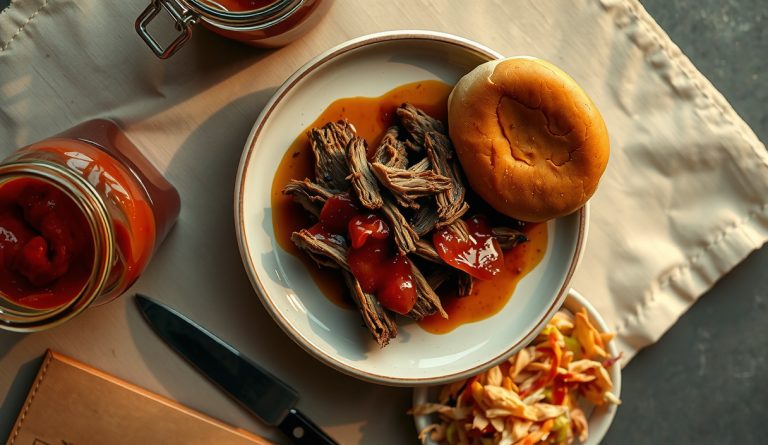
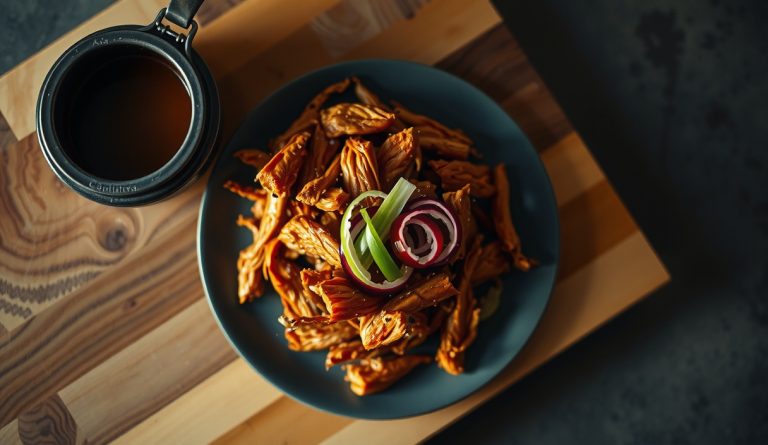
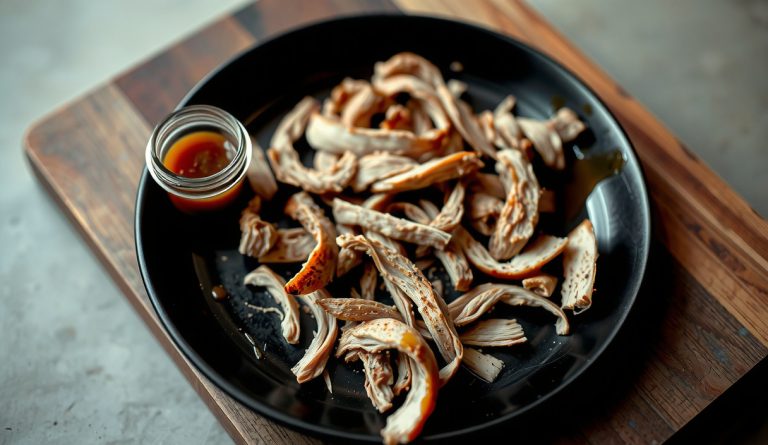
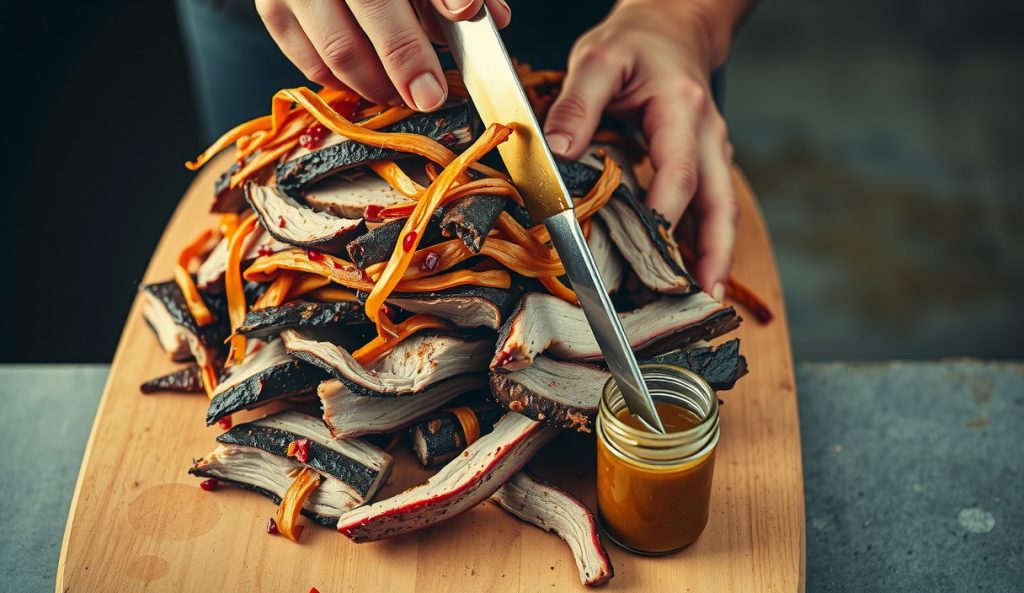
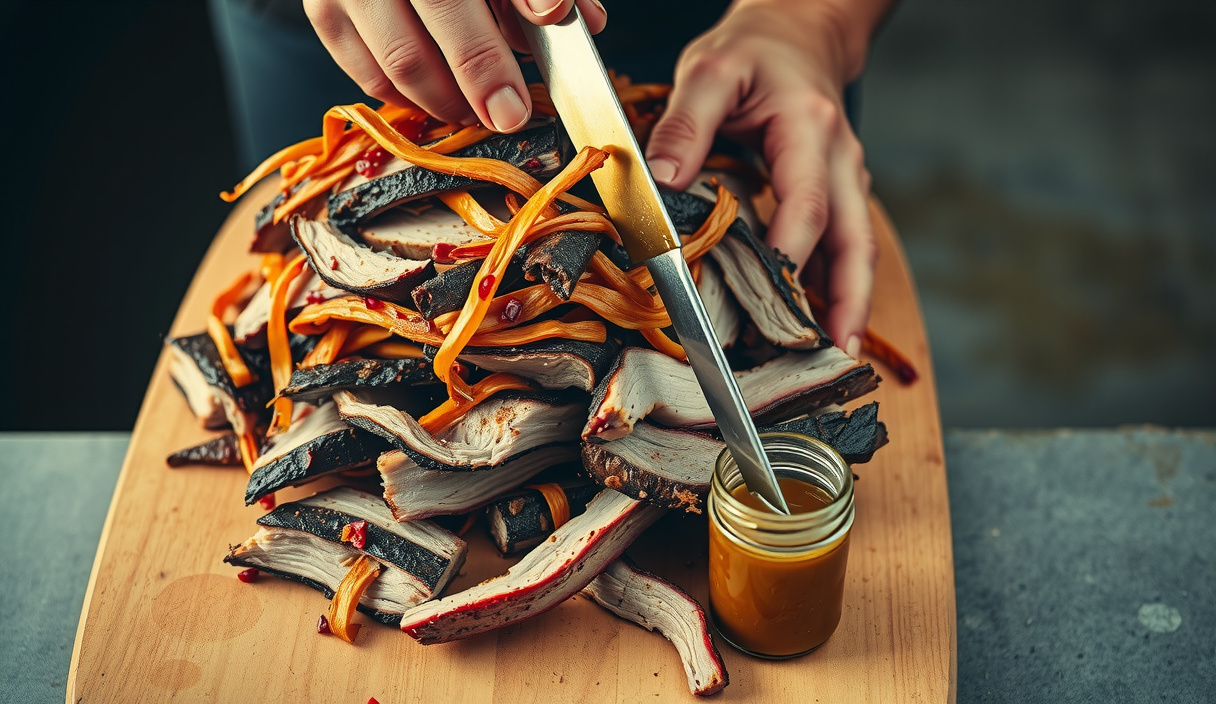
- Pull the pork by hand, working along the grain of the muscle fibers and removing any large fat deposits or unrendered collagen. Tear into long strands rather than chopping — chopped pulled pork is a different product with different texture mechanics. Season the pulled meat with reserved resting juices and an additional 2-3 tablespoons of vinegar mop, tossed to distribute evenly. Taste and adjust with more mop and salt as needed.2 cups unfiltered apple cider vinegar, 1 cup water, 2 tablespoons crushed red pepper flakes, 4 lbs oak wood chunks or splits, 2 lbs hickory wood chunks
Notes
Nutrition
The first time I stood over a whole pork shoulder at two in the morning, mop brush in hand, I understood why Eastern North Carolina pitmasters guard their recipes with the ferocity of a patent attorney. There is almost nothing here: a bone-in butt, salt, red pepper, and vinegar so sharp it makes your eyes water when you lift the smoker lid. And yet the result — strands of bark-laced pork collapsing under their own weight — is one of the most fully realized things American fire cooking has ever produced. No tomato. No sugar. Just the pig, the smoke, and acid doing the work collagen started.
This is a recipe about commitment more than technique. Twelve to fourteen hours is not negotiable. A 225°F chamber is not a suggestion. And 203°F internal is the number where a decade of connective tissue chemistry pays off in a single probe slide. Follow the physics, and the pork will tell you when it is done.
Why does Eastern NC pulled pork work? The science
Carolina pulled pork works because pork shoulder contains 15–20% collagen by dry tissue weight in its hardest-working muscles, and sustained low heat converts that collagen into gelatin — the physical source of the meat’s fall-apart texture. Pork shoulder — specifically the Boston butt — is a composite of myofibrillar proteins, intramuscular fat, and a dense web of collagen running through the muscle groups that do the most postural work on a living animal. At temperatures above 55°F internal, collagen begins a slow endothermic phase transition: the triple-helix structure unwinds and the protein hydrolyzes into soluble gelatin. This is a first-order kinetic process — time and temperature together determine the extent of conversion, not temperature alone.
At 225°F ambient, the shoulder takes 10–14 hours to accumulate enough total thermal energy to drive collagen hydrolysis deep into the thickest part of the cut. Rushing the cook with higher chamber temperatures compresses that window but simultaneously drives the internal past the 155–165°F zone where actomyosin contracts and purges moisture before collagen conversion is complete. The result is dry meat wrapped in rendered gelatin — a textural contradiction the low-and-slow protocol specifically avoids.
The stall is the single most misunderstood event in barbecue. Around 155–165°F internal, the shoulder can sit motionless on the thermometer for two to four hours. This is not a failure of the smoker — it is evaporative cooling: free surface moisture vaporizing at a rate that absorbs incoming radiant and convective energy as fast as the firebox delivers it, anchoring the surface temperature near 212°F and stalling the internal climb. The Maillard cascade that built the bark is already complete by this point — bark formation requires a dry, high-temperature surface above roughly 300°F for the initial amino-carbonyl condensation — so the stall is simply a patience problem. Wrapping in butcher paper raises the local vapor pressure at the surface, reducing evaporative loss and accelerating the internal climb without the braising effect of foil, which can soften bark. Leave this choice to your smoke goals.
Eastern NC vinegar mop is doing chemistry, not just flavor delivery. Apple cider vinegar (pH approximately 3.0–3.5) applied repeatedly during the cook does three things: it keeps the surface pH slightly acidic, which shifts the Maillard equilibrium toward faster condensation at the boundary layer between wet and dry surface zones; it hydrolyzes surface collagen slightly faster at the crust level; and its acidity contrasts the fat-soluble volatile compounds that accumulate in rendered intramuscular lipid — the partition coefficient of wood smoke compounds shifts toward the vapor phase in high-acid, low-fat environments, making each mop application amplify perceived smokiness on the finish. The red pepper flakes contribute capsaicin, a TRPV1 agonist, which triggers thermoreceptor activation and extends perceived warmth long after the fat-soluble pungency compounds have been absorbed. There is no tomato in Eastern NC mop — that is a Piedmont and Lexington tradition — because tomato solids caramelize on a hot surface and mask the clean acid-smoke interface that defines this style.
What equipment and ingredients do I need?
Pork shoulder, bone-in (Boston butt): Buy the biggest you can find — 8 to 10 pounds. The bone runs through the center and acts as a heat sink, extending the cook time but also providing a collagen-rich internal scaffold. When that bone pulls clean with zero resistance, the shoulder is at the finish line. Avoid enhanced or pre-brined shoulders; the added sodium phosphate solution inflates water weight and muddies the bark chemistry.
Wood choice: Eastern NC tradition calls for hardwood coals, historically hickory and oak burned down to embers in a separate firebox. For a charcoal offset or kettle, use a 2:1 ratio of oak to hickory by weight. Hickory alone turns acrid after hour six. If running a pellet smoker, 100% hickory pellets at 225°F will read hotter at grate level than the controller displays — verify with a secondary probe.
Apple cider vinegar: Use unfiltered, raw ACV with 5% acidity. Filtered white distilled vinegar technically works but lacks the residual malic acid and ester compounds that add aromatic complexity to the mop. Do not reduce the mop — keep it thin so it penetrates surface cracks in the bark rather than sitting on top.
Red pepper flakes: Standard grocery-store crushed red pepper is fine. For regional authenticity, use dried cayenne flakes rather than Korean gochugaru, which carries a sweetness that muddies the clean heat profile.
Thermometry: Two probes are the minimum — one for grate-level chamber temperature and one positioned in the deepest part of the shoulder, away from the bone. The target is 203°F internal. At 195°F the shoulder is safe and sliceable. At 203–205°F collagen conversion is complete and the meat pulls into long strands under minimal mechanical force. Beyond 210°F the rendered gelatin begins purging back out of the meat.
Carolina Pulled Pork with Eastern NC Vinegar Mop
Equipment
- 1 Offset smoker, kettle grill, or pellet grill Must hold a stable 225°F chamber temperature for 12+ hours. Verify grate temperature with a secondary probe.
- 1 Dual-channel leave-in wireless thermometer One probe for the meat (away from bone), one probe at grate level. Non-negotiable for a 12-hour cook.
- 1 Mop brush or spray bottle A 16-oz standard basting brush or a food-grade spray bottle both work. The spray bottle applies a thinner, more even coat.
- 2 sheets Butcher paper For optional wrapping at the stall and mandatory resting. Do not use foil — it traps steam and softens bark.
- 1 Dry cooler or insulated bag For the post-cook rest. Line with a clean towel, place wrapped shoulder inside, close lid. Holds temperature for 2+ hours.
- 1 Large cutting board Minimum 18×24 inches. You will be pulling 8-10 pounds of meat and need the real estate.
Ingredients
Pork
- 1 bone-in pork shoulder (Boston butt), 8-10 lbs Do not use enhanced or pre-brined pork. Bone-in only — the bone is a collagen reservoir and a doneness indicator.
Dry Rub
- 3 tablespoons kosher salt Diamond Crystal preferred. If using Morton’s, reduce to 2 tablespoons — it is roughly twice as dense by volume.
- 2 tablespoons coarsely ground black pepper 16-mesh or coarser grind. Fine pepper creates a muddy bark crust.
- 1 tablespoon smoked paprika
- 1 teaspoon cayenne pepper
Eastern NC Vinegar Mop
- 2 cups unfiltered apple cider vinegar Raw, unfiltered with 5% acidity. Bragg or a local producer. Do not substitute distilled white vinegar.
- 1 cup water
- 2 tablespoons crushed red pepper flakes Standard grocery-store heat level. Scale up to 3 tablespoons for serious heat.
- 1 tablespoon kosher salt
- 1 teaspoon coarsely ground black pepper
For the Smoker
- 4 lbs oak wood chunks or splits Post oak or white oak preferred. Use as your primary fuel flavor base.
- 2 lbs hickory wood chunks Accent wood only. More than a 1:2 hickory-to-oak ratio turns acrid on a long cook.
Instructions
Day Before: Dry Brine
- Combine the kosher salt, black pepper, smoked paprika, and cayenne in a small bowl. Mix until evenly distributed.2 tablespoons coarsely ground black pepper, 1 tablespoon smoked paprika, 1 teaspoon cayenne pepper
- Pat the pork shoulder completely dry with paper towels. Apply the dry rub aggressively on all surfaces, including the fat cap and the bone-exposed end. Work the rub into any crevices. You want complete coverage — no bare patches.
- Place the shoulder uncovered on a wire rack set over a sheet pan in the refrigerator for 12-24 hours. The salt will draw surface moisture out initially, then pull it back in, seasoning deep into the first centimeter of meat. Do not skip this step.
Day Of: Prep and Fire
- Remove the shoulder from the refrigerator 1 hour before cooking. The cold interior of a large butt extends the stall dramatically — a tempered start shaves 30-45 minutes off the low-temperature climb.
- Build your fire and stabilize the smoker at 225°F at grate level. This may take 45-60 minutes depending on your setup. Use a charcoal chimney for a clean base fire, then add your wood. On an offset, place oak splits in the firebox to establish your coal bed before adding a single hickory chunk. On a kettle, set up a two-zone fire with coals banked to one side and 2-3 wood chunks nestled into the coals.1 tablespoon kosher salt, 1 teaspoon coarsely ground black pepper
- Combine all vinegar mop ingredients in a non-reactive container — glass or stainless. Stir to dissolve the salt. Do not heat the mop. It goes on cold, which creates a brief surface-temperature drop that accelerates bark re-drying after application. Set aside at room temperature.2 cups unfiltered apple cider vinegar, 1 cup water, 2 tablespoons crushed red pepper flakes, 4 lbs oak wood chunks or splits, 2 lbs hickory wood chunks
The Cook
- Place the shoulder fat-cap up on the grate, away from direct heat on an offset, or over the cool zone on a kettle. Insert your meat probe into the deepest part of the largest muscle mass — aim for the geometric center, avoiding the bone. The probe tip should not touch bone; bone reads 15-20°F hotter than meat.
- Close the lid and do not open it for the first 4 hours. Maintain chamber temperature at 225°F by adjusting intake vents and adding wood as needed. The smoke ring — the pink layer just under the bark — develops in this window. Opening the lid interrupts it.
- At hour 5, open the lid and assess the bark. It should be dark mahogany to almost black on raised edges, dry and tacky to the touch. If the surface is still moist or pale, close the lid and check again at hour 6. Do not apply mop to a wet or underdeveloped bark.
- Once bark is set and dry, apply the first coat of vinegar mop using your brush or spray bottle. Work quickly and close the lid. Apply mop every 45-60 minutes from this point forward. Each application should be light — you are refreshing the surface moisture and acid, not drowning the bark. If the bark softens noticeably after mopping, extend your intervals to 90 minutes and leave the lid cracked for 5 minutes post-application to re-dry the surface.2 cups unfiltered apple cider vinegar, 1 cup water, 2 tablespoons crushed red pepper flakes, 4 lbs oak wood chunks or splits, 2 lbs hickory wood chunks
- Expect the internal temperature to stall between 155°F and 168°F. This is evaporative cooling physics — the stall can last 2-4 hours. Do not raise the chamber temperature to push through it. If you are on a hard deadline after hour 10 and the internal has not cleared 190°F, wrap the shoulder tightly in two layers of butcher paper and return to the smoker. This eliminates the evaporation mechanism and drives the internal up within 60-90 minutes.
- When the internal reaches 195°F, flip the shoulder fat-cap down. This firms the meat-side bark during the final push and insulates the top of the shoulder from direct radiant heat. Continue cooking to an internal temperature of 203°F.
- At 203°F, perform the probe-slide test: insert your probe vertically into the thickest muscle mass. It should slide in with the resistance of softened butter — no fibrous drag. If you feel resistance, add 30 minutes and recheck. The bone should wiggle freely when you push it laterally.
Rest and Pull
- Remove the shoulder from the smoker and wrap it in two layers of butcher paper. Place it in a dry cooler lined with a clean towel. Close the cooler and rest for 45-60 minutes minimum. The internal temperature will continue to climb 3-5°F during this time, then slowly decline. The gelatin re-absorbs into the muscle fibers during this phase. Do not skip or shorten the rest.
- Unwrap the shoulder over a large cutting board — capture any accumulated juices in the paper and reserve them. Pull the bone free with your hand; it should release with no resistance. Discard the bone or add it to stock.
- Pull the pork by hand, working along the grain of the muscle fibers and removing any large fat deposits or unrendered collagen. Tear into long strands rather than chopping — chopped pulled pork is a different product with different texture mechanics. Season the pulled meat with reserved resting juices and an additional 2-3 tablespoons of vinegar mop, tossed to distribute evenly. Taste and adjust with more mop and salt as needed.2 cups unfiltered apple cider vinegar, 1 cup water, 2 tablespoons crushed red pepper flakes, 4 lbs oak wood chunks or splits, 2 lbs hickory wood chunks
Notes
Nutrition
How do I nail it every time? Tips for the cook
- Start fat-cap up, flip at the stall. Fat cap up allows rendered fat to baste the meat as it drips. Once the shoulder hits the stall around 160°F internal, flip fat-cap down so the remaining cook time firms the bark on the meat side while the fat cap insulates from direct radiant heat below.
- Do not open the lid during the first four hours. Every lid-lift dumps 25–40 minutes of accumulated thermal energy and smoke ring development. The smoke ring (myoglobin nitric oxide reaction) is complete by 140°F internal — after that, smoke compounds are depositing on the bark, not penetrating. Lid discipline matters most early.
- Apply mop only above 160°F internal. Applying acidic mop to a cold, raw surface will slow bark formation dramatically. Wait until the exterior is set and dry — a dark, tacky pellicle — before the first mop application. After that, mop every 45–60 minutes.
- The probe-slide test overrides the thermometer. At 203°F, insert the probe vertically into the thickest muscle mass. If it slides in with the resistance of softened butter, pull the shoulder. If there is any fibrous drag, give it another 30 minutes. Collagen conversion is the target, not a number.
- Rest is not optional. A 45–60 minute rest, bone-in, wrapped loosely in butcher paper and a towel inside a dry cooler, allows the gelatin to re-absorb into the muscle fibers as temperature equilibrates. Pulling the shoulder immediately after the cook dumps rendered gelatin onto the cutting board instead of keeping it in the meat.
- Pull by hand, not by claws. Bear claws shred the meat into short segments and destroy the long muscle strand architecture that defines good pulled pork. Two forks are acceptable. Hands, once the shoulder is cool enough to handle, are ideal — you can feel the connective tissue and remove it as you go.
What variations can I make on this recipe?
Piedmont / Lexington style: Add 2 tablespoons of ketchup and 1 tablespoon of brown sugar to the mop base to cross into the Lexington dip tradition. This introduces tomato-derived lycopene and sucrose into the surface chemistry — the sucrose will caramelize faster at high surface temperatures, so monitor bark development more closely after the stall. The flavor profile shifts from pure acid-heat to a sweet-sour-heat triangle that is equally legitimate, simply different geography.
Scaling for a larger crowd: Two bone-in shoulders in the same smoker do not double the cook time, but they increase the thermal mass in the chamber and will extend the stall by 30–60 minutes. Account for this in the timeline. Do not stack shoulders — both need even airflow on all sides for consistent bark development. The mop recipe scales linearly: 1 cup ACV per shoulder is the base unit.
Boneless shoulder: If a boneless shoulder is the only option, reduce estimated cook time by 1–2 hours and check internal temperature starting at hour 9. The bone acts as a thermal insulator and delayed-heat reservoir; without it, the deepest muscle mass heats faster. All other technique remains identical. The bone-slide test is no longer available, so rely entirely on probe-feel and a thermometer reading of 203°F.
Pellet grill adaptation: Run the pellet grill at 225°F and verify grate temperature with a secondary probe — most pellet controllers run 10–15°F hotter at the grate than the display reads. Use a smoke tube packed with soaked hickory chips for supplemental smoke output during the first 4 hours; pellet combustion at low settings produces a clean burn with lower particulate output than an offset, which reduces smoke ring development and perceived smokiness on the finish. The vinegar mop protocol is unchanged.
Frequently asked questions
Why does my bark keep going soft after I apply the mop? Soft bark after mopping is almost always caused by applying liquid to a surface that has not fully dried and set. The mop’s water content rehydrates the still-forming crust. Apply mop only after hour 5–6, when the surface is visibly dark and dry to the touch. After application, leave the lid cracked for 5 minutes to allow surface evaporation before closing fully — this re-dries the outer crust rather than trapping steam against it.
My internal temperature stalled at 165°F for four hours. What do I do? Nothing — the stall is working exactly as intended. If time is truly constrained after hour 10 and the internal is still below 190°F, wrap the shoulder tightly in two layers of butcher paper and return it to the smoker. This suppresses surface evaporation, eliminates the stall mechanism, and drives the internal to 203°F typically within 90 minutes. Some bark crispness on the wrapped surfaces will be sacrificed, but internal texture will be identical.
Can I finish this in the oven? Yes, without sacrificing the result in any meaningful way. Smoke compounds deposit on the surface and penetrate the bark during the first 5–6 hours when the surface is tacky and reactive. After the stall, the bark has set and additional smoke exposure yields diminishing returns. If the smoker runs out of fuel or the weather turns, wrap the shoulder in butcher paper and finish at 250°F in the oven. The collagen hydrolysis chemistry is identical — it does not care whether the heat source is wood combustion or an electric element.