Cold-Smoked Cured Bacon — Home-Cured

Equipment
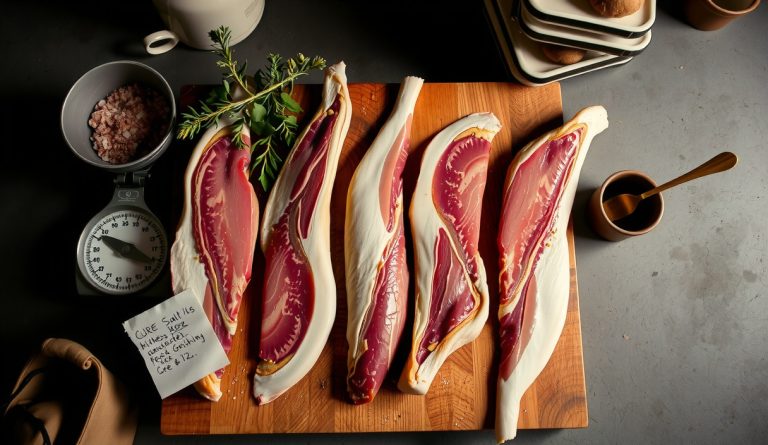
- 1 Digital kitchen scale (0.1g resolution) Required for precise cure measurement — do not use volume measures for pink salt
- 1 Large zip-lock bag or vacuum sealer For 7-day refrigerator cure; vacuum seal is preferred for even cure distribution
- 1 Wire rack set over a sheet pan For pellicle formation — allows airflow on all sides of the belly
- 1 Cold smoke generator (maze-style) or offset smoker Must hold chamber temperature at or below 85°F throughout the 8-hour smoke session
- 1 Ambient probe thermometer Clip inside the smoking chamber to monitor chamber temperature continuously
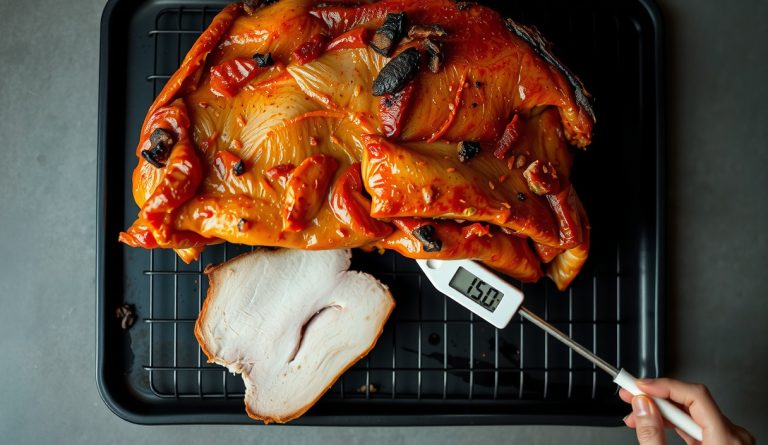
- 1 Instant-read thermometer For verifying doneness of cooked slices at service (145°F internal minimum)
- 1 Sharp slicing knife or deli slicer Slice the belly very cold — near-frozen — for clean, even slices
Ingredients
The Cure (calculated by belly weight)
- 2 kg fresh pork belly, skin-on or skinless Even thickness 1.5–2.5 inches; flat center-cut preferred; weigh your specific piece and recalculate cure amounts accordingly
- 5 g Prague Powder #1 (pink cure salt #1) Exactly 0.25% of belly weight — for a 2 kg belly this is 5.0 g; recalculate precisely for your slab weight
- 50 g fine sea salt Exactly 2.5% of belly weight — for a 2 kg belly this is 50 g
- 30 g brown sugar, packed Exactly 1.5% of belly weight — for a 2 kg belly this is 30 g; dark brown sugar adds deeper molasses notes
Cold Smoke
- 2 cups hardwood smoking dust or fine chips (hickory, applewood, or cherrywood) Fine dust for maze generators; chips for offset setups — avoid any resinous softwood
Optional Finishing Crust (before smoking)
- 2 tbsp coarsely cracked black pepper Press into surface after pellicle forms and just before smoking; omit for classic plain bacon

Instructions
Day 1 — Calculate and Apply the Cure
- Weigh your pork belly on a digital scale and record the exact weight in grams. Calculate your cure amounts precisely: Prague Powder #1 at 0.25% (multiply belly weight in grams by 0.0025), sea salt at 2.5% (multiply by 0.025), and brown sugar at 1.5% (multiply by 0.015). Write these numbers down. Do not estimate.5 g Prague Powder #1 (pink cure salt #1), 50 g fine sea salt, 30 g brown sugar, packed
- Combine the measured Prague Powder #1, sea salt, and brown sugar in a small bowl and mix thoroughly until the pink salt is evenly distributed through the blend. The pink color should be uniform — no concentrated pink streaks.5 g Prague Powder #1 (pink cure salt #1), 50 g fine sea salt, 30 g brown sugar, packed
- Place the pork belly in a large zip-lock bag or on a clean sheet pan. Apply the entire cure blend to all surfaces of the belly — top, bottom, and sides — massaging it in evenly. Every surface must be coated. Place the belly in the zip-lock bag, press out as much air as possible, and seal. If you have a vacuum sealer, use it.5 g Prague Powder #1 (pink cure salt #1), 50 g fine sea salt, 30 g brown sugar, packed
- Refrigerate at 38–40°F (3–4°C). Flip the bag once daily. The belly will begin releasing liquid (purge) within 24 hours as osmotic pressure drives water outward. This is normal and expected — do not drain it.
Days 1–7 — The Cure
- Cure for a minimum of 7 days for a belly up to 2 inches thick. Add 1 day of cure time for every additional half-inch of thickness beyond 2 inches. Flip the bag each day. The belly will firm up noticeably as water is displaced by sodium and as the protein structure tightens. By day 7, the interior should feel uniformly firm with no soft, undercured spots at the center.
Day 7 — Rinse and Form the Pellicle
- Remove the belly from the bag. Rinse it thoroughly under cold running water to remove all surface cure residue. Pat completely dry with paper towels. Taste a thin slice from an edge to check salt level — it should be pleasantly salty but not aggressively so. If it is too salty, soak in cold water for 30 minutes and re-taste.
- Set the belly fat-side up on a wire rack over a sheet pan. Refrigerate uncovered for 12 to 24 hours. Do not cover it. The surface must dry completely and develop a tacky, slightly shiny film — the pellicle. This protein film is the adhesion surface for smoke compounds. Without a proper pellicle, smoke will not bind to the belly. The surface should feel slightly sticky to a clean fingertip when it is ready.
Day 8 — Cold Smoke (8 hours at 80°F)
- Set up your cold smoke generator or offset smoker. Verify the ambient temperature inside the smoking chamber is at or below 85°F before loading the belly. Clip an ambient probe thermometer inside the chamber, separate from any meat probe. If ambient outdoor temperature is above 60°F, use ice in a secondary pan inside the chamber or smoke only during the coolest part of the day.2 cups hardwood smoking dust or fine chips (hickory, applewood, or cherrywood)
- If using an optional pepper crust, press the cracked black pepper firmly into all surfaces of the belly now, before it enters the smoker.2 tbsp coarsely cracked black pepper
- Load the belly into the smoker fat-side up on the rack. Ignite the smoke generator and begin the 8-hour cold smoke session. Monitor chamber temperature continuously — if the chamber rises above 85°F, open a vent or pause the smoke generator. The belly is raw; food safety depends on keeping the smoking environment cold. The internal temperature of the belly should not rise above 60°F during the smoke session. If you are concerned, use a meat probe to monitor it.2 cups hardwood smoking dust or fine chips (hickory, applewood, or cherrywood)
- After 8 hours, the belly surface should be deep mahogany to reddish-brown with a dry, set exterior. Remove from the smoker. At this point the bacon is cured, smoked, and raw. It is not ready to eat — it must be cooked at service. Wrap tightly in butcher paper or plastic wrap and refrigerate.
Slicing and Cooking at Service
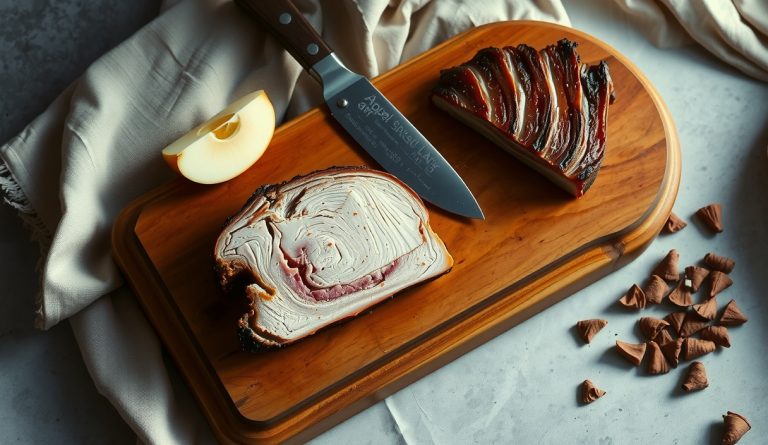
- For cleanest slices, refrigerate the smoked belly until very cold — just above 32°F — or place in the freezer for 30 minutes until firm but not hard. Slice to your preferred thickness (3–4mm for standard breakfast bacon, 6–8mm for thick-cut) using a sharp knife or deli slicer.
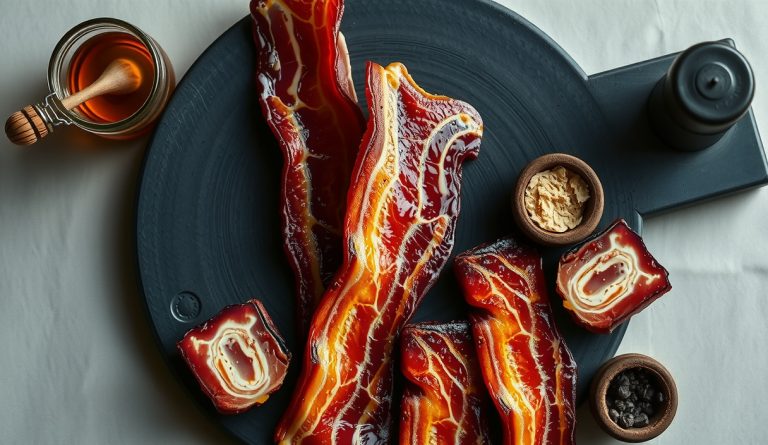
- To cook, place slices in a cold or lightly warm dry skillet or cast-iron pan. Start over medium-low heat to allow fat to render before the lean dries out. Increase heat to medium once fat has begun to render. Cook until the bacon reaches your preferred texture — the lean should reach a minimum internal temperature of 145°F. Rest briefly on a paper towel. Serve immediately.
Notes
Nutrition
There is a specific moment — somewhere around day four of the cure — when you open the refrigerator and the pork belly no longer smells like raw meat. It smells like something in the process of becoming. The pellicle is forming, the surface is tightening, and every molecule of free water is migrating outward while sodium and nitrite are driving inward. That transformation is not magic. It is osmosis, equilibrium curing chemistry, and first-order diffusion kinetics operating in slow, cold, beautiful motion. Home-cured cold-smoked bacon is one of the most technically instructive projects in the entire BBQ canon, and once you do it right, the commodity product at the grocery store becomes a genuinely different food.
This method is built around a 7-day equilibrium cure followed by a cold-smoke session at 80°F. The cure ratios are not guesses — they are calibrated by weight: 0.25% sodium nitrite via pink cure salt #1, 2.5% sea salt, and 1.5% brown sugar, applied to the total mass of the belly. Cold smoke at 80°F deposits phenolic VOCs and guaiacol-family aromatics without triggering actin denaturation in the muscle tissue, keeping the belly raw and safe until you slice and hot-cook it for service. This is the correct sequence. Do not deviate from it.
Why does home-cured cold-smoked bacon work? The science
Curing pork belly is an equilibrium-diffusion problem, and understanding it is what separates precise, safe home bacon from a guess. When you apply salt and cure to the exterior surface of the pork belly, you create a sharp concentration gradient: high solute outside, low solute inside. Osmotic pressure drives water outward while sodium ions diffuse inward via Fick’s law of diffusion — the rate proportional to the concentration gradient and inversely proportional to the thickness of the tissue. This is why a flat belly cures more evenly and predictably than a rolled roast.
The 7-day cure window at 38–40°F is calibrated to allow sodium and chloride to reach near-equilibrium throughout a 2-to-3-inch slab while keeping water activity low enough to suppress pathogen proliferation. Sodium nitrite — delivered at 0.25% via Prague Powder #1, which is 6.25% sodium nitrite by weight — is the critical safety intervention: it inhibits the germination of Clostridium botulinum spores in the anaerobic, reduced-oxygen environment of a vacuum bag or tightly wrapped slab. Nitrite also reacts with myoglobin to form nitrosomyoglobin, producing the characteristic pink cure color and contributing to the cured flavor profile through Maillard-adjacent nitrogen chemistry.
Cold smoke at 80°F operates in a fundamentally different thermodynamic regime than hot smoke. At 80°F, the smoking chamber sits below the denaturation threshold of myosin, which begins at approximately 103–116°F, so the muscle proteins remain in their native, folded state throughout the smoke session — the belly is raw the entire time. What cold smoke contributes is pure volatile organic compound deposition: guaiacol, syringol, 4-methylguaiacol, and phenol condense onto the surface of the pellicle — that tacky, semi-dried protein film that forms during the overnight drying phase — and bind there via physical adsorption. The pellicle is the essential precondition. Without it, smoke does not adhere; it passes over a wet surface and very little deposits. The result of a proper pellicle and a proper cold-smoke session is a deep mahogany bark carrying the full complexity of hardwood combustion aromatics, locked into the exterior of a still-raw belly that will finish cooking in the pan or oven at service.
The brown sugar at 1.5% serves a dual purpose. First, it acts as a humectant, drawing water to the surface to facilitate osmotic exchange. Second, it provides reducing-sugar Maillard precursors that accelerate browning when slices hit a hot pan. Sucrose at these concentrations is not a dominant flavor note — it is a structural and kinetic ingredient. During hot cooking at service, when internal slice temperatures reach 300°F and above on a cast-iron surface, the sugar residues and free amino groups from protein denaturation combine in classic amino-carbonyl condensation: Schiff base formation, Amadori rearrangement, and Strecker degradation yielding the pyrazines and furfurals that define the sensory hallmark of well-cooked bacon. The cure does the safety work. The cold smoke does the aromatic work. The hot pan does the flavor development work. Three distinct thermal regimes, one product.
What equipment and ingredients do I need for cold-smoked bacon?
- Prague Powder #1 (pink cure salt #1): This is NOT a seasoning salt. Prague Powder #1 is 93.75% table salt and 6.25% sodium nitrite, dyed pink to prevent confusion. Do not substitute with cure #2, which contains nitrate and is formulated for long-cured, uncooked products like salami, and do not attempt to omit it. The 0.25% by-weight dose is the established safety floor for short-cure bacon. Source it from a reputable butcher supply and store it away from children and regular salt.
- Pork belly: Skin-on or skinless both work; skinless makes slicing easier. Look for even thickness across the slab — 1.5 to 2.5 inches is ideal. Uneven slabs cure unevenly. Ask your butcher for a flat, fresh, center-cut section.
- Digital kitchen scale (0.1g resolution): The cure ratios for this bacon are calculated by weight, not volume. A 1-gram error in sodium nitrite dosing at this scale matters. Do not use measuring spoons for this recipe.
- Cold smoke generator or offset smoker: You need to hold the smoking chamber at or below 85°F throughout the smoke session. A dedicated cold smoke generator — maze-type filled with fine dust — works inside a closed grill or smoker box. An offset firebox with a long smoke run can achieve this in cool weather. Do not attempt cold-smoking in ambient temperatures above 60°F without a verified method for maintaining cold smoke conditions; you will inadvertently hot-smoke the belly and lose the raw-cure dynamic.
- Wood choice: Applewood and cherrywood produce lighter, fruitier phenolic profiles. Hickory and pecan drive deeper, more aggressive smoke. Avoid resinous softwoods entirely. For a traditional American bacon profile, hickory dust or chips are canonical.
- Instant-read thermometer: Required at service. Bacon must reach 145°F internal when cooked as a standalone item, though at typical pan-fry temperatures the bacon will exceed this easily.
Cold-Smoked Cured Bacon — Home-Cured
Equipment
- 1 Digital kitchen scale (0.1g resolution) Required for precise cure measurement — do not use volume measures for pink salt
- 1 Large zip-lock bag or vacuum sealer For 7-day refrigerator cure; vacuum seal is preferred for even cure distribution
- 1 Wire rack set over a sheet pan For pellicle formation — allows airflow on all sides of the belly
- 1 Cold smoke generator (maze-style) or offset smoker Must hold chamber temperature at or below 85°F throughout the 8-hour smoke session
- 1 Ambient probe thermometer Clip inside the smoking chamber to monitor chamber temperature continuously
- 1 Instant-read thermometer For verifying doneness of cooked slices at service (145°F internal minimum)
- 1 Sharp slicing knife or deli slicer Slice the belly very cold — near-frozen — for clean, even slices
Ingredients
The Cure (calculated by belly weight)
- 2 kg fresh pork belly, skin-on or skinless Even thickness 1.5–2.5 inches; flat center-cut preferred; weigh your specific piece and recalculate cure amounts accordingly
- 5 g Prague Powder #1 (pink cure salt #1) Exactly 0.25% of belly weight — for a 2 kg belly this is 5.0 g; recalculate precisely for your slab weight
- 50 g fine sea salt Exactly 2.5% of belly weight — for a 2 kg belly this is 50 g
- 30 g brown sugar, packed Exactly 1.5% of belly weight — for a 2 kg belly this is 30 g; dark brown sugar adds deeper molasses notes
Cold Smoke
- 2 cups hardwood smoking dust or fine chips (hickory, applewood, or cherrywood) Fine dust for maze generators; chips for offset setups — avoid any resinous softwood
Optional Finishing Crust (before smoking)
- 2 tbsp coarsely cracked black pepper Press into surface after pellicle forms and just before smoking; omit for classic plain bacon
Instructions
Day 1 — Calculate and Apply the Cure
- Weigh your pork belly on a digital scale and record the exact weight in grams. Calculate your cure amounts precisely: Prague Powder #1 at 0.25% (multiply belly weight in grams by 0.0025), sea salt at 2.5% (multiply by 0.025), and brown sugar at 1.5% (multiply by 0.015). Write these numbers down. Do not estimate.5 g Prague Powder #1 (pink cure salt #1), 50 g fine sea salt, 30 g brown sugar, packed
- Combine the measured Prague Powder #1, sea salt, and brown sugar in a small bowl and mix thoroughly until the pink salt is evenly distributed through the blend. The pink color should be uniform — no concentrated pink streaks.5 g Prague Powder #1 (pink cure salt #1), 50 g fine sea salt, 30 g brown sugar, packed
- Place the pork belly in a large zip-lock bag or on a clean sheet pan. Apply the entire cure blend to all surfaces of the belly — top, bottom, and sides — massaging it in evenly. Every surface must be coated. Place the belly in the zip-lock bag, press out as much air as possible, and seal. If you have a vacuum sealer, use it.5 g Prague Powder #1 (pink cure salt #1), 50 g fine sea salt, 30 g brown sugar, packed
- Refrigerate at 38–40°F (3–4°C). Flip the bag once daily. The belly will begin releasing liquid (purge) within 24 hours as osmotic pressure drives water outward. This is normal and expected — do not drain it.
Days 1–7 — The Cure
- Cure for a minimum of 7 days for a belly up to 2 inches thick. Add 1 day of cure time for every additional half-inch of thickness beyond 2 inches. Flip the bag each day. The belly will firm up noticeably as water is displaced by sodium and as the protein structure tightens. By day 7, the interior should feel uniformly firm with no soft, undercured spots at the center.
Day 7 — Rinse and Form the Pellicle
- Remove the belly from the bag. Rinse it thoroughly under cold running water to remove all surface cure residue. Pat completely dry with paper towels. Taste a thin slice from an edge to check salt level — it should be pleasantly salty but not aggressively so. If it is too salty, soak in cold water for 30 minutes and re-taste.
- Set the belly fat-side up on a wire rack over a sheet pan. Refrigerate uncovered for 12 to 24 hours. Do not cover it. The surface must dry completely and develop a tacky, slightly shiny film — the pellicle. This protein film is the adhesion surface for smoke compounds. Without a proper pellicle, smoke will not bind to the belly. The surface should feel slightly sticky to a clean fingertip when it is ready.
Day 8 — Cold Smoke (8 hours at 80°F)
- Set up your cold smoke generator or offset smoker. Verify the ambient temperature inside the smoking chamber is at or below 85°F before loading the belly. Clip an ambient probe thermometer inside the chamber, separate from any meat probe. If ambient outdoor temperature is above 60°F, use ice in a secondary pan inside the chamber or smoke only during the coolest part of the day.2 cups hardwood smoking dust or fine chips (hickory, applewood, or cherrywood)
- If using an optional pepper crust, press the cracked black pepper firmly into all surfaces of the belly now, before it enters the smoker.2 tbsp coarsely cracked black pepper
- Load the belly into the smoker fat-side up on the rack. Ignite the smoke generator and begin the 8-hour cold smoke session. Monitor chamber temperature continuously — if the chamber rises above 85°F, open a vent or pause the smoke generator. The belly is raw; food safety depends on keeping the smoking environment cold. The internal temperature of the belly should not rise above 60°F during the smoke session. If you are concerned, use a meat probe to monitor it.2 cups hardwood smoking dust or fine chips (hickory, applewood, or cherrywood)
- After 8 hours, the belly surface should be deep mahogany to reddish-brown with a dry, set exterior. Remove from the smoker. At this point the bacon is cured, smoked, and raw. It is not ready to eat — it must be cooked at service. Wrap tightly in butcher paper or plastic wrap and refrigerate.
Slicing and Cooking at Service
- For cleanest slices, refrigerate the smoked belly until very cold — just above 32°F — or place in the freezer for 30 minutes until firm but not hard. Slice to your preferred thickness (3–4mm for standard breakfast bacon, 6–8mm for thick-cut) using a sharp knife or deli slicer.
- To cook, place slices in a cold or lightly warm dry skillet or cast-iron pan. Start over medium-low heat to allow fat to render before the lean dries out. Increase heat to medium once fat has begun to render. Cook until the bacon reaches your preferred texture — the lean should reach a minimum internal temperature of 145°F. Rest briefly on a paper towel. Serve immediately.
Notes
Nutrition
How do I nail cold-smoked bacon every time?
- Weigh everything, cure nothing by eye. The single most common failure mode in home-cured bacon is imprecise cure dosing. Weigh the belly to the gram, then calculate each ingredient as a percentage of that weight. Write the numbers down. Pink salt at 0.25% means 2.5 grams per kilogram of belly — so a 2 kg belly takes exactly 5.0 grams of Prague Powder #1. This is not a rounding situation.
- The pellicle is non-negotiable. After the 7-day cure, rinse the belly, pat it dry, and set it uncovered on a wire rack in the refrigerator for 12 to 24 hours. The surface must be dry and slightly tacky before the belly enters the smoker. A wet belly repels smoke. Skipping this step produces a gray, undersmoked slab with uneven color and weak aromatic deposition.
- Monitor ambient smoke temperature continuously. Cold smoke sessions fail when the chamber temperature drifts above 85°F. Use an ambient probe thermometer clipped inside the smoking chamber, separate from any meat probe. If the chamber climbs, open a vent, add ice to the chamber, or pause the smoke generator. The belly is still raw throughout this stage — food safety depends on keeping the session short or using ice for ambient control if temperatures rise above 40°F.
- Do not rush the cure time. Seven days is the minimum for a 2-inch belly at equilibrium salt percentages. Pulling the belly at day five means the center has not yet reached sodium equilibrium — the cure will be uneven, salty at the exterior and under-salted and under-protected at the core. If the belly is thicker than 2.5 inches, extend the cure by one day per additional half-inch of thickness.
- Slice cold, cook hot. The cured, smoked slab slices cleanly when it is very cold — just above freezing. A semi-frozen belly gives precise, even slices with a sharp knife or deli slicer. Cooking should be done in a dry pan or on a griddle at medium heat; the fat needs to render before the lean dries out, which means patient, even heat — not a screaming-hot pan.
- Rest and wrap properly between sessions. If cold-smoking in multiple short sessions — some operators prefer two 4-hour sessions separated by an overnight rest in the refrigerator — return the belly to refrigeration between sessions. The belly must not hold in the 40–140°F danger zone for more than 4 hours cumulative across the entire process.
What variations can I make on this cold-smoked bacon?
Maple and black pepper bacon: Replace half the brown sugar with pure maple syrup, applied by brushing rather than including in the dry cure blend, and press a coarse layer of cracked black pepper into the belly surface after the pellicle forms and just before the smoke session. The maple sugars caramelize aggressively during hot cooking — lower pan temperature by about 10% to prevent scorching. The black pepper phenols complement guaiacol smoke compounds directly.
Applewood-smoked buckboard bacon (pork shoulder): Substitute a Boston butt or pork shoulder for the belly. Shoulder is leaner and has a tighter, denser muscle structure, so extend the cure to 10 days minimum for a 3-inch cut. The result is a less fatty, meatier bacon traditionally called buckboard or cottage bacon, popular in Canadian and British curing traditions. Applewood is the preferred smoke here — it complements the leaner shoulder without overpowering it.
Hot-smoked finish (fully cooked slab): For a fully cooked product that can be eaten without further hot cooking, extend the smoker temperature to 200–225°F after the cold smoke session and bring the belly to an internal temperature of 150°F. The hot-smoked slab is now a fundamentally different product — the fat has partially rendered, the proteins are set, and the refrigerated shelf life changes. Label it clearly. This approach collapses the cold-smoke/hot-cook two-stage model but produces an excellent product for thin shaving over eggs or into sandwiches.
Scaling: This recipe scales linearly by weight because the cure is expressed as a percentage. A 5 kg belly takes exactly 5× the cure amounts listed for a 1 kg belly. Do not mix a large batch of pre-blended cure salt and brown sugar and then try to portion it out — weigh each ingredient individually per slab to maintain precision. For production quantities above 5 kg per batch, consider a vacuum tumbler for more rapid and even cure distribution.
Frequently asked questions about cold-smoked bacon
Is cold-smoked cured bacon safe to eat without cooking it first? No. This is a cold-smoked, cured product, not a ready-to-eat deli product. Cold smoking deposits flavor but does not cook the meat — the belly remains raw throughout the entire cure and smoke process. Always cook slices to a minimum internal temperature of 145°F before eating. The cure protects against Clostridium botulinum in the anaerobic curing environment, but it does not eliminate surface pathogens that may be present on raw pork.
What is the shelf life of home-cured cold-smoked bacon? Wrapped tightly and refrigerated at 38°F, a cured and smoked slab holds well for 2 to 3 weeks. Vacuum-sealed and refrigerated, expect 4 to 6 weeks. Vacuum-sealed and frozen, quality is maintained for up to 6 months. Sliced bacon should be used within 7 days of slicing. Do not leave sliced bacon exposed to open refrigerator air for extended periods — the surface will oxidize and the phenolic smoke compounds will off-gas, dulling the flavor.
Can I use kosher salt or sea salt instead of Prague Powder #1? Sea salt or kosher salt can serve as the primary seasoning salt in this recipe — that is exactly what this recipe specifies. But no other salt can substitute for the Prague Powder #1, which delivers the sodium nitrite. Nitrite is the safety-critical ingredient that inhibits botulism spore germination in this low-oxygen, cured-meat environment. There is no food-safe household substitute. Pink Himalayan salt, celery powder, and other so-called natural cures do not deliver controlled, measurable nitrite concentrations and are not validated as equivalent. Use Prague Powder #1 at the specified dose, or do not make this product.