Keto Pork Belly Burnt Ends with Allulose Glaze

Equipment
- 1 Offset smoker or pellet grill Capable of holding a steady 225–250°F with indirect heat
- 2 Cherry or apple wood chunks One of each; generates moderate, sweet-forward smoke
- 1 Instant-read or leave-in probe thermometer Essential for monitoring stall and finish temperature
- 1 Disposable aluminum foil pan (half-size) For the foil-braise phase with butter and glaze liquid
- 1 Sharp boning or chef knife For cubing the belly into uniform 1.5-inch pieces
- 1 Pastry brush or silicone basting brush For applying glaze in thin, even coats
- 1 Small saucepan For warming and dissolving the allulose glaze
Ingredients
Pork Belly and Dry Rub
- 3 lbs skin-off pork belly Heritage breed preferred; heavy intramuscular marbling
- 3 tablespoons granulated allulose For the dry rub; do not substitute erythritol
- 1 tablespoon kosher salt Diamond Crystal preferred; adjust to taste
- 2 teaspoons black pepper Freshly cracked
- 2 teaspoons smoked paprika Spanish pimenton adds deeper color and sweetness
- 1 teaspoon garlic powder
- 1 teaspoon onion powder
- 1 teaspoon cayenne pepper Adjust to heat preference
- 1 teaspoon mustard powder Dry mustard; provides Maillard precursor amino acids
Allulose Glaze
- ½ cup granulated allulose Primary Maillard-reactive sweetener; do not substitute
- 4 tablespoons unsalted butter Cut into tablespoon pats for even melting
- 2 tablespoons apple cider vinegar Drops glaze pH to 4.5–5.5, accelerating Maillard condensation
- 2 tablespoons soy sauce or coconut aminos Coconut aminos for strict keto; adds umami and Maillard precursors
- 1 teaspoon smoked paprika Reinforces color and smoke note in the glaze
- ½ teaspoon garlic powder
- ⅛ teaspoon xanthan gum Approximately 0.1% w/w; shear-thinning adhesion without gumminess
- 1 tablespoon your favorite keto-certified hot sauce Optional; verify no added sugars or maltodextrin
Braising Liquid
- 4 tablespoons unsalted butter Adds fat-phase lubrication during the covered braise
- ¼ cup beef broth or bone broth Low-sodium; provides collagen-rich liquid environment during braise

Instructions
Prepare and Season the Pork Belly
- Preheat your smoker to 250°F with one cherry wood chunk and one apple wood chunk positioned at the firebox. Allow the smoker to reach temperature and produce a clean, thin blue smoke before placing any meat.
- Pat the pork belly completely dry on all surfaces using paper towels. Moisture on the surface delays the initial bark formation by keeping surface temperature anchored near 212°F via evaporative cooling.
- In a small bowl, combine the dry rub: 3 tablespoons allulose, kosher salt, black pepper, smoked paprika, garlic powder, onion powder, cayenne, and mustard powder. Whisk thoroughly to distribute evenly.3 tablespoons granulated allulose, 1 tablespoon kosher salt, 2 teaspoons black pepper, 2 teaspoons smoked paprika, 1 teaspoon garlic powder, 1 teaspoon onion powder, 1 teaspoon cayenne pepper, 1 teaspoon mustard powder
- Apply the dry rub generously to all six faces of the pork belly slab. Press the rub firmly into the surface to maximize contact between the allulose-amino rub and the meat proteins. Allow to rest uncovered at room temperature for 15 minutes before placing on the smoker.3 tablespoons granulated allulose, 1 tablespoon kosher salt, 2 teaspoons black pepper, 2 teaspoons smoked paprika, 1 teaspoon garlic powder, 1 teaspoon onion powder, 1 teaspoon cayenne pepper, 1 teaspoon mustard powder
Initial Smoke Phase
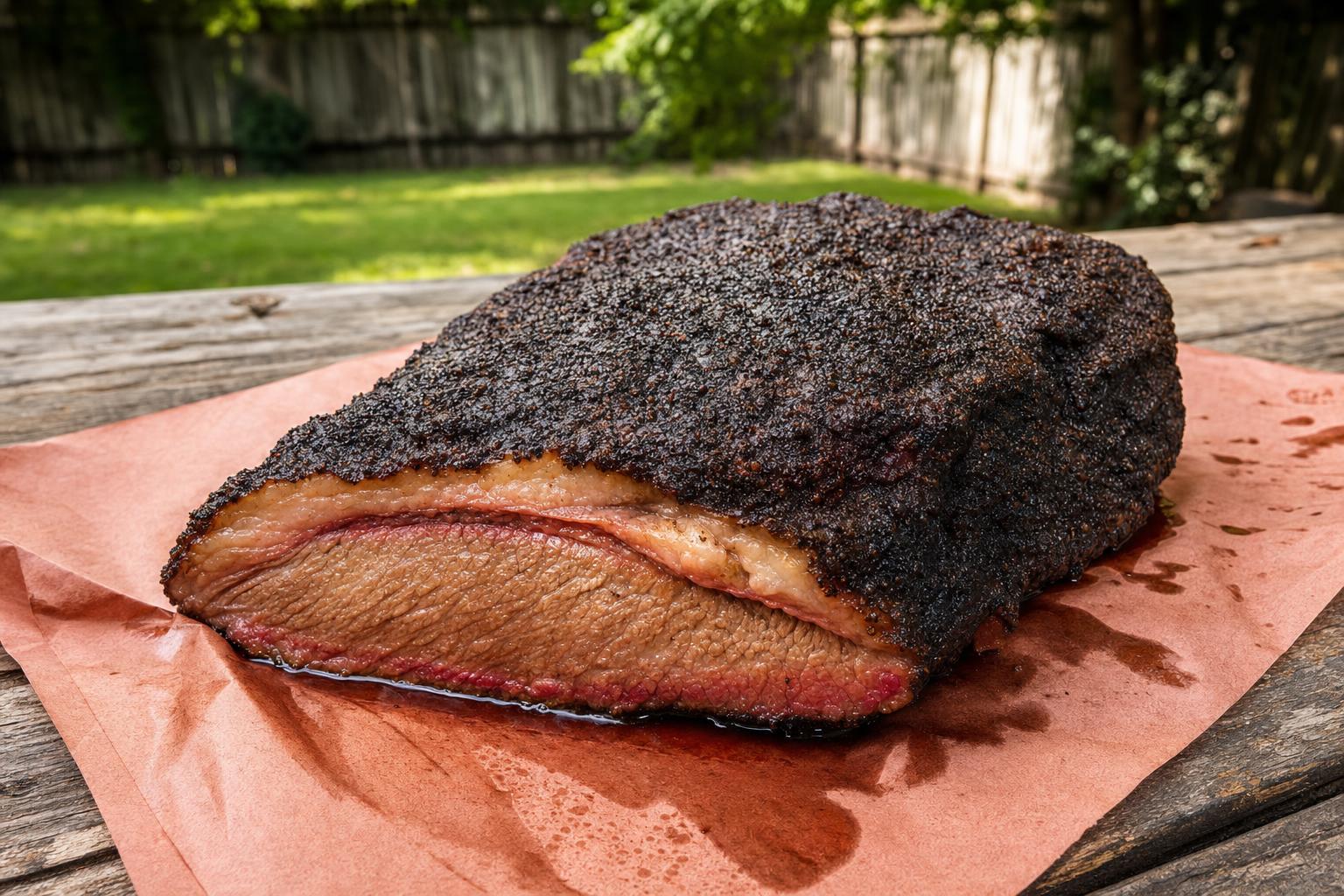
- Place the seasoned pork belly on the smoker grate, fat-side up, over indirect heat. Insert a leave-in probe thermometer into the thickest part of the belly, avoiding fat pockets. Close the lid and smoke at 250°F undisturbed.
- Smoke until the pork belly reaches an internal temperature of 195–205°F, approximately 4 to 5 hours depending on slab thickness. The internal temperature will stall between 160°F and 170°F for 60 to 90 minutes as surface evaporation absorbs thermal energy — this is the collagen-hydrolysis phase. Do not increase smoker temperature during the stall. The fat matrix will keep the interior moist throughout this window.
Cube and Braise
- Remove the pork belly from the smoker and allow it to rest on a cutting board for 10 minutes. This allows the gelatin-rich interior to redistribute before cutting.
- Cut the belly into uniform 1.5-inch cubes. Consistent sizing is critical for even glaze adhesion and uniform finish temperature during the final phase.
- Transfer the cubes to a half-size disposable foil pan. Add 4 tablespoons unsalted butter (cut into pats) and 1/4 cup beef or bone broth to the pan. Toss the cubes gently to coat in the braising liquid.4 tablespoons unsalted butter, 1/4 cup beef broth or bone broth
- Cover the foil pan tightly with aluminum foil and return to the smoker at 250°F. Braise covered for 60 to 75 minutes until the cubes are fully yielding and a probe inserts with no resistance. The collagen-to-gelatin conversion completes during this phase, producing the signature melt-in-the-mouth interior.4 tablespoons unsalted butter, 1/4 cup beef broth or bone broth
Build the Allulose Glaze
- While the cubes braise, prepare the allulose glaze. In a small saucepan over medium-low heat, melt 4 tablespoons unsalted butter. Add 1/2 cup granulated allulose and stir constantly until fully dissolved, approximately 2 minutes. Do not allow the mixture to exceed 250°F at this stage — allulose browning onset occurs around 250–280°F and you want to build the glaze without initiating Maillard reactions in the pan.4 tablespoons unsalted butter, 1/2 cup granulated allulose
- Remove from heat. Add apple cider vinegar, soy sauce or coconut aminos, smoked paprika, garlic powder, and hot sauce (if using). Whisk to combine. The glaze will be thin and fluid — this is correct for a two-coat application.2 tablespoons apple cider vinegar, 2 tablespoons soy sauce or coconut aminos, 1 teaspoon smoked paprika, 1/2 teaspoon garlic powder, 1 tablespoon your favorite keto-certified hot sauce
- Sprinkle xanthan gum over the glaze and whisk vigorously for 30 seconds until fully hydrated with no visible clumps. The glaze will thicken slightly from its initial thin state and become shear-thinning — it will flow easily under brush pressure but cling to the cubes when the brushing shear is removed. Allow glaze to cool to approximately 120°F before applying.1/8 teaspoon xanthan gum
Glaze and Final Set
- Reduce smoker temperature to 225°F. Remove the foil pan from the smoker, uncover, and drain excess braising liquid. Return the cubes to the smoker grate in a single layer with space between each cube to allow smoke and heat to reach all faces.
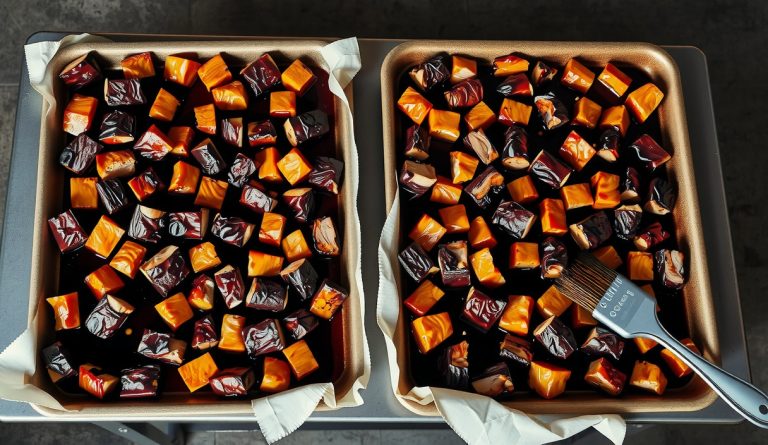
- Apply the first coat of allulose glaze to all exposed faces of the cubes using a pastry or silicone brush. Use light, even strokes — you are depositing a thin, uniform film, not painting on a thick layer. Close the smoker lid.1/2 cup granulated allulose, 4 tablespoons unsalted butter, 2 tablespoons apple cider vinegar, 2 tablespoons soy sauce or coconut aminos, 1 teaspoon smoked paprika, 1/2 teaspoon garlic powder, 1/8 teaspoon xanthan gum, 1 tablespoon your favorite keto-certified hot sauce
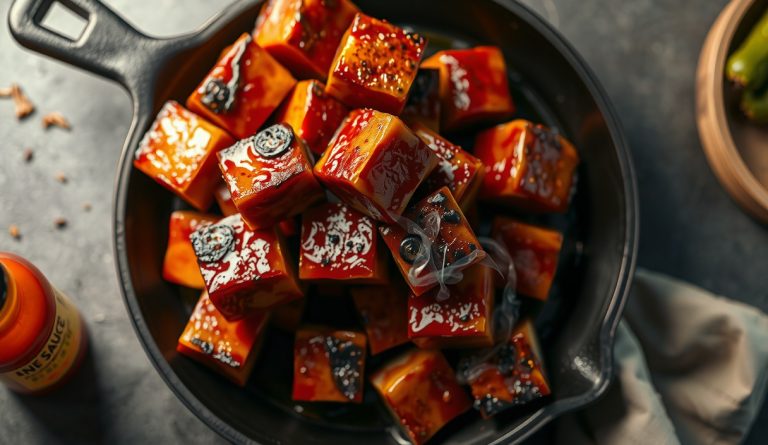
- After 10 to 12 minutes, check the glaze surface. It should appear set and tacky with visible color development. Apply the second coat of glaze, again using light strokes across all faces. Monitor closely — at 225°F, allulose caramelization proceeds quickly and the window between lacquered and bitter is approximately 5 to 8 minutes after the second coat is fully set. The finished surface should be deep mahogany, shiny, and dry to a light touch rather than wet or pooled.1/2 cup granulated allulose, 4 tablespoons unsalted butter, 2 tablespoons apple cider vinegar, 2 tablespoons soy sauce or coconut aminos, 1 teaspoon smoked paprika, 1/2 teaspoon garlic powder, 1/8 teaspoon xanthan gum, 1 tablespoon your favorite keto-certified hot sauce
- Remove the glazed burnt ends from the smoker and rest uncovered on a wire rack for 5 minutes before serving. The rest allows the gelatin interior to firm slightly and the glaze surface to transition from tacky to a true, dry lacquer.
Notes
Nutrition
Burnt ends are supposed to be the reward for patience. You spend the better part of a day tending fire, and in exchange you get these lacquered, smoke-saturated cubes of pork belly — caramelized on every face, yielding in the center, and sticky in a way that makes you lick each finger individually. The problem for anyone eating keto is that every traditional burnt-end glaze is built on a foundation of brown sugar, honey, or both. Swap those out for erythritol and you get a pale, grainy coating with zero browning and a cooling aftertaste that belongs nowhere near a smoker.
The solution is not a better sweetener blend or a lower oven temperature. The solution is allulose — a rare C-3 epimer of fructose that carries essentially zero metabolic calories and a glycemic index of approximately zero, yet participates in the Maillard cascade and caramelization pathway with the same enthusiasm as glucose. The result is a glaze that genuinely browns, genuinely sticks, and genuinely tastes like the real thing, with 3 grams of net carbs per four-ounce serving and no compromise at the smoker.
Why do keto pork belly burnt ends work? The science
Allulose browns and caramelizes because it is a reducing monosaccharide that donates reactive carbonyl groups directly into the Maillard cascade — no hydrolysis step required. The Maillard reaction requires two reactants: a nucleophilic free amino group and an electrophilic carbonyl group. Allulose provides exactly that carbonyl geometry. As a reducing monosaccharide, allulose undergoes Schiff base condensation with the free lysine and alanine residues on the surface proteins of the pork belly at temperatures beginning around 250–280°F — a full 150°F lower than the activation threshold for sucrose caramelization, which first requires enzymatic or thermal hydrolysis into its constituent glucose and fructose units.
That lower activation energy is why the allulose glaze darkens aggressively, and why you must drop the final glaze-set smoker temperature by roughly 15°F compared to a traditional sugar-based protocol. Push past 300°F surface temperature during the glaze phase and allulose will overshoot into bitter, acrid melanoidin accumulation. The window is narrow; a probe thermometer and attentive lid management are non-negotiable at this stage.
Inside the pork belly itself, the physics are governed by the collagen-to-gelatin conversion. Pork belly carries a dense intramuscular collagen network alongside substantial intramuscular fat. At internal temperatures between 160°F and 170°F, surface evaporation absorbs thermal energy as fast as the smoker delivers it — the classic stall — while internal conduction continues slowly. Collagen hydrolysis into soluble gelatin follows first-order kinetics and begins meaningfully above 160°F, but requires sustained time at temperature to achieve completion. At a 250°F smoker, the pork belly needs roughly four to five hours in the initial smoke phase to push through the stall and drive the internal temperature into the 195–205°F range where collagen conversion is sufficient to produce the yielding, pull-apart interior that defines a true burnt end. Actin denaturation and catastrophic water-holding-capacity collapse occur above 74°C (165°F) internal — but the fat matrix of pork belly provides mechanical lubrication that keeps the bite moist even as the myofibrillar proteins tighten, provided you stay in the 195–205°F finish window rather than overshooting into 210°F-plus territory.
The glaze itself is engineered as a low-viscosity emulsion. Combining allulose with butter and a small amount of apple cider vinegar achieves three things simultaneously: the allulose provides Maillard-reactive carbonyls and humectancy that keep the glaze tacky rather than crystalline; the butter provides fat-phase emulsion stability and aroma buffering that sequester smoke volatiles and allow them to re-release slowly on the palate; and the vinegar supplies acetic acid at a concentration that drops the local pH on the glaze surface into the 4.5–5.5 range, accelerating the Maillard condensation rate without introducing enough total acid to trigger reflux or astringency. A pinch of xanthan gum at 0.1% w/w keeps the glaze from sheeting off the cubes too quickly before it sets, providing just enough yield stress to adhere — without crossing into the mucilaginous territory that would mask the smoke and fat-derived aromatics.
What equipment and ingredients do I need?
Pork belly slab: Source skin-off pork belly, ideally from a heritage breed with heavy intramuscular fat marbling. Skin-on belly will insulate the top face and prevent the lacquer from adhering evenly. Aim for 3 to 3.5 pounds before trimming.
Allulose: Use granulated crystalline allulose, not a liquid syrup, for the dry rub component. For the glaze, granulated allulose dissolves completely in warm butter without requiring additional water. Do not substitute erythritol — erythritol does not participate in the Maillard reaction and will produce a pale, gritty result. Do not substitute monk fruit blends unless the primary bulking agent is confirmed allulose rather than erythritol.
Smoker temperature: Hold a steady 250°F. Significant temperature spikes above 275°F during the initial smoke phase will drive surface evaporation too fast, creating a thick bark crust that resists later glaze adhesion. A water pan in the smoker chamber helps moderate humidity and slows surface desiccation during the stall.
Wood choice: Cherry and apple wood generate moderate, sweet-forward smoke compounds — primarily guaiacol and syringol — that pair cleanly with the allulose glaze without introducing the acrid creosote notes of hickory at sustained low-and-slow temperatures. A single cherry chunk plus one apple chunk is sufficient for the full smoke phase.
Xanthan gum: A small pinch — approximately 0.1% of total glaze mass — is sufficient to provide shear-thinning pseudoplasticity. Xanthan gum reduces viscosity under the brushing shear so the glaze applies easily, then recovers body at rest so it clings to the cubes. Do not exceed 0.2% or the glaze will feel gummy and will mask aroma release on the palate.
Keto Pork Belly Burnt Ends with Allulose Glaze
Equipment
- 1 Offset smoker or pellet grill Capable of holding a steady 225–250°F with indirect heat
- 2 Cherry or apple wood chunks One of each; generates moderate, sweet-forward smoke
- 1 Instant-read or leave-in probe thermometer Essential for monitoring stall and finish temperature
- 1 Disposable aluminum foil pan (half-size) For the foil-braise phase with butter and glaze liquid
- 1 Sharp boning or chef knife For cubing the belly into uniform 1.5-inch pieces
- 1 Pastry brush or silicone basting brush For applying glaze in thin, even coats
- 1 Small saucepan For warming and dissolving the allulose glaze
Ingredients
Pork Belly and Dry Rub
- 3 lbs skin-off pork belly Heritage breed preferred; heavy intramuscular marbling
- 3 tablespoons granulated allulose For the dry rub; do not substitute erythritol
- 1 tablespoon kosher salt Diamond Crystal preferred; adjust to taste
- 2 teaspoons black pepper Freshly cracked
- 2 teaspoons smoked paprika Spanish pimenton adds deeper color and sweetness
- 1 teaspoon garlic powder
- 1 teaspoon onion powder
- 1 teaspoon cayenne pepper Adjust to heat preference
- 1 teaspoon mustard powder Dry mustard; provides Maillard precursor amino acids
Allulose Glaze
- ½ cup granulated allulose Primary Maillard-reactive sweetener; do not substitute
- 4 tablespoons unsalted butter Cut into tablespoon pats for even melting
- 2 tablespoons apple cider vinegar Drops glaze pH to 4.5–5.5, accelerating Maillard condensation
- 2 tablespoons soy sauce or coconut aminos Coconut aminos for strict keto; adds umami and Maillard precursors
- 1 teaspoon smoked paprika Reinforces color and smoke note in the glaze
- ½ teaspoon garlic powder
- ⅛ teaspoon xanthan gum Approximately 0.1% w/w; shear-thinning adhesion without gumminess
- 1 tablespoon your favorite keto-certified hot sauce Optional; verify no added sugars or maltodextrin
Braising Liquid
- 4 tablespoons unsalted butter Adds fat-phase lubrication during the covered braise
- ¼ cup beef broth or bone broth Low-sodium; provides collagen-rich liquid environment during braise
Instructions
Prepare and Season the Pork Belly
- Preheat your smoker to 250°F with one cherry wood chunk and one apple wood chunk positioned at the firebox. Allow the smoker to reach temperature and produce a clean, thin blue smoke before placing any meat.
- Pat the pork belly completely dry on all surfaces using paper towels. Moisture on the surface delays the initial bark formation by keeping surface temperature anchored near 212°F via evaporative cooling.
- In a small bowl, combine the dry rub: 3 tablespoons allulose, kosher salt, black pepper, smoked paprika, garlic powder, onion powder, cayenne, and mustard powder. Whisk thoroughly to distribute evenly.3 tablespoons granulated allulose, 1 tablespoon kosher salt, 2 teaspoons black pepper, 2 teaspoons smoked paprika, 1 teaspoon garlic powder, 1 teaspoon onion powder, 1 teaspoon cayenne pepper, 1 teaspoon mustard powder
- Apply the dry rub generously to all six faces of the pork belly slab. Press the rub firmly into the surface to maximize contact between the allulose-amino rub and the meat proteins. Allow to rest uncovered at room temperature for 15 minutes before placing on the smoker.3 tablespoons granulated allulose, 1 tablespoon kosher salt, 2 teaspoons black pepper, 2 teaspoons smoked paprika, 1 teaspoon garlic powder, 1 teaspoon onion powder, 1 teaspoon cayenne pepper, 1 teaspoon mustard powder
Initial Smoke Phase
- Place the seasoned pork belly on the smoker grate, fat-side up, over indirect heat. Insert a leave-in probe thermometer into the thickest part of the belly, avoiding fat pockets. Close the lid and smoke at 250°F undisturbed.
- Smoke until the pork belly reaches an internal temperature of 195–205°F, approximately 4 to 5 hours depending on slab thickness. The internal temperature will stall between 160°F and 170°F for 60 to 90 minutes as surface evaporation absorbs thermal energy — this is the collagen-hydrolysis phase. Do not increase smoker temperature during the stall. The fat matrix will keep the interior moist throughout this window.
Cube and Braise
- Remove the pork belly from the smoker and allow it to rest on a cutting board for 10 minutes. This allows the gelatin-rich interior to redistribute before cutting.
- Cut the belly into uniform 1.5-inch cubes. Consistent sizing is critical for even glaze adhesion and uniform finish temperature during the final phase.
- Transfer the cubes to a half-size disposable foil pan. Add 4 tablespoons unsalted butter (cut into pats) and 1/4 cup beef or bone broth to the pan. Toss the cubes gently to coat in the braising liquid.4 tablespoons unsalted butter, 1/4 cup beef broth or bone broth
- Cover the foil pan tightly with aluminum foil and return to the smoker at 250°F. Braise covered for 60 to 75 minutes until the cubes are fully yielding and a probe inserts with no resistance. The collagen-to-gelatin conversion completes during this phase, producing the signature melt-in-the-mouth interior.4 tablespoons unsalted butter, 1/4 cup beef broth or bone broth
Build the Allulose Glaze
- While the cubes braise, prepare the allulose glaze. In a small saucepan over medium-low heat, melt 4 tablespoons unsalted butter. Add 1/2 cup granulated allulose and stir constantly until fully dissolved, approximately 2 minutes. Do not allow the mixture to exceed 250°F at this stage — allulose browning onset occurs around 250–280°F and you want to build the glaze without initiating Maillard reactions in the pan.4 tablespoons unsalted butter, 1/2 cup granulated allulose
- Remove from heat. Add apple cider vinegar, soy sauce or coconut aminos, smoked paprika, garlic powder, and hot sauce (if using). Whisk to combine. The glaze will be thin and fluid — this is correct for a two-coat application.2 tablespoons apple cider vinegar, 2 tablespoons soy sauce or coconut aminos, 1 teaspoon smoked paprika, 1/2 teaspoon garlic powder, 1 tablespoon your favorite keto-certified hot sauce
- Sprinkle xanthan gum over the glaze and whisk vigorously for 30 seconds until fully hydrated with no visible clumps. The glaze will thicken slightly from its initial thin state and become shear-thinning — it will flow easily under brush pressure but cling to the cubes when the brushing shear is removed. Allow glaze to cool to approximately 120°F before applying.1/8 teaspoon xanthan gum
Glaze and Final Set
- Reduce smoker temperature to 225°F. Remove the foil pan from the smoker, uncover, and drain excess braising liquid. Return the cubes to the smoker grate in a single layer with space between each cube to allow smoke and heat to reach all faces.
- Apply the first coat of allulose glaze to all exposed faces of the cubes using a pastry or silicone brush. Use light, even strokes — you are depositing a thin, uniform film, not painting on a thick layer. Close the smoker lid.1/2 cup granulated allulose, 4 tablespoons unsalted butter, 2 tablespoons apple cider vinegar, 2 tablespoons soy sauce or coconut aminos, 1 teaspoon smoked paprika, 1/2 teaspoon garlic powder, 1/8 teaspoon xanthan gum, 1 tablespoon your favorite keto-certified hot sauce
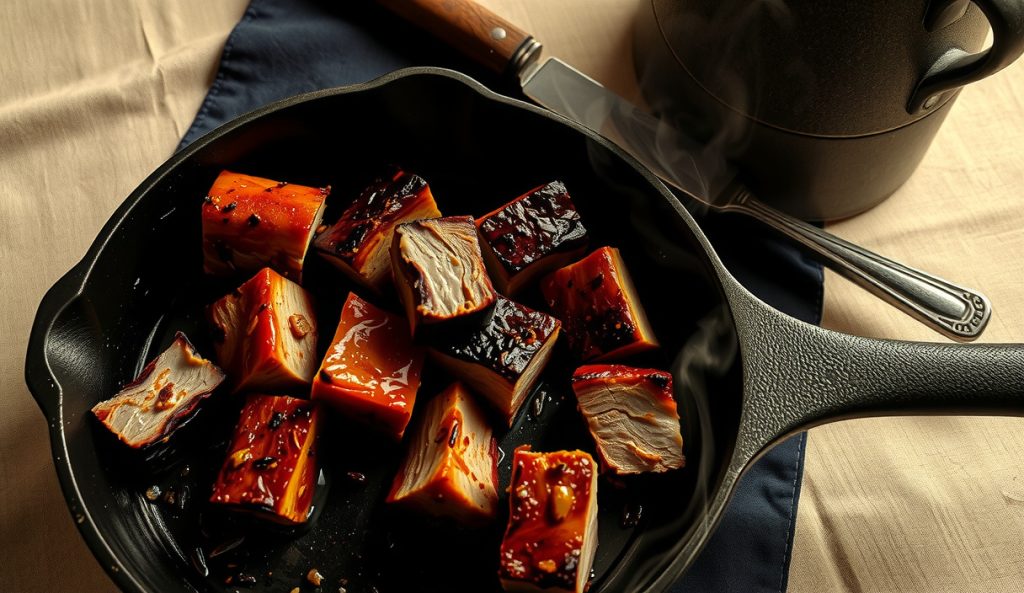
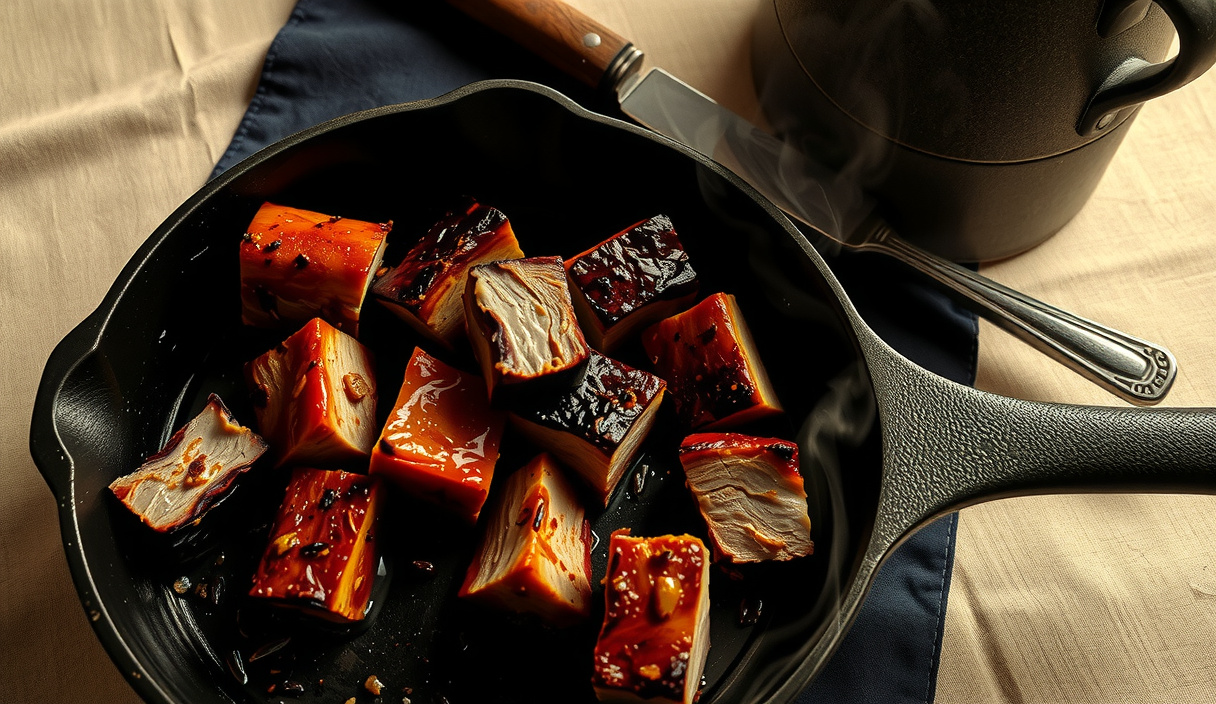
- After 10 to 12 minutes, check the glaze surface. It should appear set and tacky with visible color development. Apply the second coat of glaze, again using light strokes across all faces. Monitor closely — at 225°F, allulose caramelization proceeds quickly and the window between lacquered and bitter is approximately 5 to 8 minutes after the second coat is fully set. The finished surface should be deep mahogany, shiny, and dry to a light touch rather than wet or pooled.1/2 cup granulated allulose, 4 tablespoons unsalted butter, 2 tablespoons apple cider vinegar, 2 tablespoons soy sauce or coconut aminos, 1 teaspoon smoked paprika, 1/2 teaspoon garlic powder, 1/8 teaspoon xanthan gum, 1 tablespoon your favorite keto-certified hot sauce
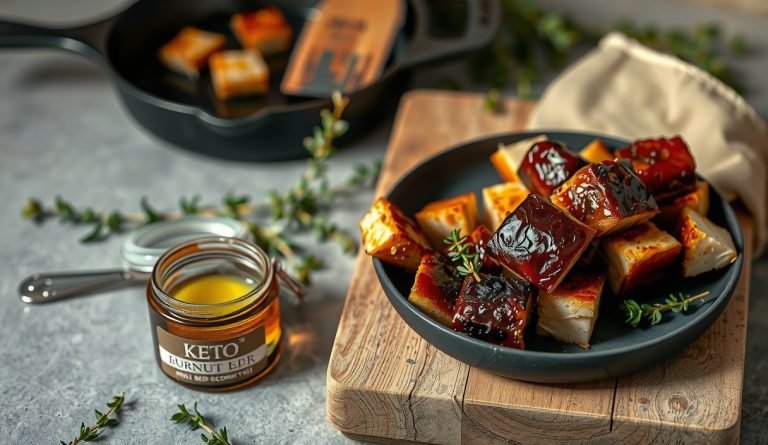
- Remove the glazed burnt ends from the smoker and rest uncovered on a wire rack for 5 minutes before serving. The rest allows the gelatin interior to firm slightly and the glaze surface to transition from tacky to a true, dry lacquer.
Notes
Nutrition
How do I nail it every time? Tips for perfect keto burnt ends
- Do not rush the stall. Between 160°F and 170°F internal, the temperature will plateau for 60 to 90 minutes. This is evaporative cooling doing its job — collagen is hydrolyzing and fat is rendering. Resist the urge to increase smoker temperature. Patience here is the difference between a yielding interior and a chewy one.
- Lower your glaze-phase temperature. When the cubes return to the smoker uncovered for the final glaze set, drop the smoker to 225°F. Allulose browns approximately 50°F earlier than sucrose. At 250°F or above during this phase, the glaze will cross from caramelized to bitter in under ten minutes.
- Apply glaze in two thin coats, not one heavy coat. Each coat needs 10 to 12 minutes to set and develop its Maillard crust before the next layer adheres. A single thick coat pools at the bottom of the cubes and never achieves the all-over lacquer that defines the best burnt ends.
- Rest the cubes before serving. Five minutes off heat allows the gelatin-saturated interior to redistribute and the glaze surface to firm from tacky to a true lacquer. Cutting or serving immediately causes the interior to weep excess moisture.
- Check net carbs on your hot sauce. Many commercial hot sauce additions to the dry rub carry hidden sugars or maltodextrin. Use a pure cayenne powder or a certified keto hot sauce to maintain the 3g net carb target per serving.
- Monitor internal temperature, not time alone. Pork belly thickness varies. A 2-inch belly may hit 205°F internal in 4 hours; a thick 3-inch slab may require 6. Pull on temperature, not on the clock.
What variations can I make on keto pork belly burnt ends?
Spicy chipotle version: Add 1 teaspoon of chipotle powder and 1/2 teaspoon smoked paprika to the dry rub. For the glaze, add 1 tablespoon of a keto-certified chipotle hot sauce. The capsaicin activates TRPV1 receptors, providing a heat perception that sits distinctly on top of the sweet glaze and smoke, creating a three-layer flavor architecture. Monitor glaze temperature carefully — the additional acid from the hot sauce will accelerate Maillard browning further, so reduce the glaze-phase smoker temperature to 215°F.
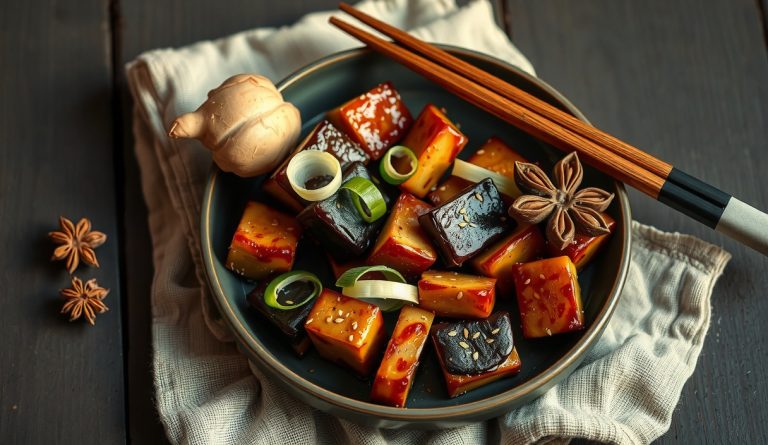
Soy-ginger Asian-inspired version: Replace the smoked paprika in the rub with 1 teaspoon of five-spice powder. Build the glaze with 2 tablespoons of coconut aminos (naturally low-carb) in place of the apple cider vinegar, plus 1 teaspoon of freshly grated ginger. The amino acids and reducing sugars in coconut aminos contribute additional Maillard precursors that produce a deeper, more complex glaze color. This variation pairs well with sesame seeds as a garnish — add them in the final two minutes so they toast lightly without burning.
Dairy-free version: Substitute the unsalted butter in the glaze with refined coconut oil. Coconut oil has a sharper solid-to-liquid transition than butter, so the glaze will be slightly thinner at application temperature. Increase the xanthan gum to 0.15% w/w to compensate for the reduced emulsion viscosity. The resulting glaze will lack the milk-solid Maillard contribution that butter provides, so consider adding an additional tablespoon of allulose to maintain glaze depth.
Scaling for a larger crowd: This recipe scales linearly through the dry rub and glaze. For 6 to 7 pounds of pork belly, double all quantities. The smoke time will increase by 60 to 90 minutes for the initial phase, but the cubing, braising, and glaze phases remain essentially the same duration. Do not crowd the cubes in the foil pan during the braise — use two pans in a single smoker layer to ensure even heat penetration and fat rendering across all surfaces.
Frequently asked questions
Can I use a pellet grill instead of an offset smoker? Yes. Set the pellet grill to 250°F and use a cherry or apple pellet blend. Pellet grills run slightly cleaner combustion than offset smokers, which means lighter smoke deposition. For comparable smoke intensity, add a smoke tube loaded with cherry pellets to the cooking chamber during the first two hours of the initial smoke phase.
Why does the allulose glaze taste slightly different from a sugar glaze even though it browns? Allulose produces a slightly different melanoidin and furanone profile compared to sucrose because the Strecker degradation pathway proceeds through different amino acid intermediates. The flavor is broadly similar — sweet, roasted, caramelized — but some people detect a mild, clean aftertaste that is absent with sucrose. This effect is most pronounced when allulose is used at high concentrations without fat or acid co-ingredients. The butter and vinegar in this glaze buffer that effect significantly by providing additional Strecker precursors and adjusting the pH of the Maillard environment.
Is it safe to use allulose in a foil-wrapped braise alongside butter and vinegar? Yes. Allulose is thermally stable through the entire temperature range used in this recipe. At the braising temperatures involved — an interior smoker environment of 250°F — no degradation products of concern are generated. The FDA has granted allulose GRAS status, and allulose is metabolically inert, passing through the small intestine and being excreted in urine rather than metabolized for energy. The 3g net carb figure per serving reflects the total digestible carbohydrate load of all non-allulose ingredients.