Smoked Stuffed Pork Loin with Spinach, Sun-Dried Tomato & Feta

Equipment
- 1 Smoker or charcoal kettle grill Set up for indirect heat at a stable 275°F; use apple or cherry wood chunks for smoke
- 1 Sharp boning knife Essential for an even butterfly — a dull knife creates ragged, uneven slabs
- 10 lengths Butcher’s twine Pre-cut to 14 inches; cotton only, no synthetics
- 1 Instant-read thermometer Non-negotiable for this lean cut; probe horizontally from the end to reach the geometric center
- 1 Large skillet For wilting the spinach filling
- 1 large sheet Plastic wrap or parchment For rolling and chilling the stuffed loin before tying
Ingredients
Pork Loin
- 1 center-cut boneless pork loin roast, 3 to 3.5 pounds Not pork tenderloin — ask your butcher for the full center-cut loin
- 1.5 tsp kosher salt For dry-brining the butterflied surface
- 1 tsp freshly ground black pepper
- 1 tsp smoked paprika
- 0.5 tsp garlic powder
- 0.5 tsp dried thyme
- 1 tbsp olive oil Rubbed on the exterior after tying to promote bark adhesion
Spinach, Sun-Dried Tomato & Feta Filling
- 1 tbsp olive oil
- 3 cloves garlic, minced
- 10 oz fresh baby spinach About 10 loosely packed cups; will reduce dramatically after wilting
- 0.5 cup oil-packed sun-dried tomatoes, drained and roughly chopped Pat dry briefly on paper towels after draining
- 4 oz block feta cheese, crumbled Brine-packed block feta preferred over pre-crumbled
- 2 tbsp fresh basil, thinly sliced
- 0.25 tsp red pepper flakes Optional for mild heat
- 1 tbsp Dijon mustard Spread on butterflied surface as an adhesive layer before filling
Wood & Smoke
- 2 chunks apple or cherry wood chunks Fist-sized; soak in water 30 minutes if using charcoal

Instructions
Make the Filling
- Heat 1 tablespoon olive oil in a large skillet over medium heat. Add minced garlic and cook, stirring, for 45 seconds until fragrant but not browned.3 cloves garlic, minced, 10 oz fresh baby spinach
- Add spinach in three or four batches, folding each addition until just wilted before adding the next. Total wilting time is 3 to 4 minutes. Season with a pinch of salt and red pepper flakes if using.0.5 cup oil-packed sun-dried tomatoes, drained and roughly chopped, 1 tbsp Dijon mustard
- Transfer wilted spinach to a colander and press firmly with the back of a spoon, then squeeze again by hand in a clean kitchen towel until as much liquid as possible is removed. The spinach should be nearly dry. Roughly chop the squeezed spinach and transfer to a bowl.0.5 cup oil-packed sun-dried tomatoes, drained and roughly chopped
- Add the chopped sun-dried tomatoes, crumbled feta, and fresh basil to the spinach. Fold gently to combine. Taste and adjust seasoning — feta is salty, so additional salt is rarely needed. Set filling aside to cool to room temperature before using.4 oz block feta cheese, crumbled, 2 tbsp fresh basil, thinly sliced, 0.25 tsp red pepper flakes
Butterfly and Season the Loin
- Place the pork loin on a cutting board, fat cap side down. Using a sharp boning knife, make a horizontal cut starting 3/4 inch from the bottom along the long edge, cutting almost all the way through but leaving a 1/2-inch hinge. Open the loin like a book. If the slab is thicker than 3/4 inch in any area, make a second fold-cut on the thick half to create a consistent, even surface. Cover with plastic wrap and pound any thick spots gently with a meat mallet or rolling pin until the entire slab is roughly 3/4 inch thick throughout.
- Sprinkle 1 teaspoon kosher salt, black pepper, smoked paprika, garlic powder, and dried thyme evenly over the interior surface (the side that will hold the filling). Pat gently to adhere. Spread Dijon mustard in a thin, even layer over the same surface — this acts as both a flavor base and an adhesive for the filling.1.5 tsp kosher salt, 1 tsp freshly ground black pepper, 1 tsp smoked paprika, 0.5 tsp garlic powder, 0.5 tsp dried thyme, 2 chunks apple or cherry wood chunks
Fill, Roll, and Tie
- Spread the cooled filling evenly over the mustard-coated interior surface, leaving a 1-inch border along the far long edge to prevent filling blowout during rolling. Press the filling firmly and evenly to remove air pockets.4 oz block feta cheese, crumbled, 2 tbsp fresh basil, thinly sliced, 0.25 tsp red pepper flakes
- Starting from the near long edge, roll the loin tightly and evenly away from you, like a jelly roll. Keep consistent pressure throughout the roll — a tight roll holds the filling securely and creates an even cylinder. The fat cap, if present, should end up on the exterior top of the roll.
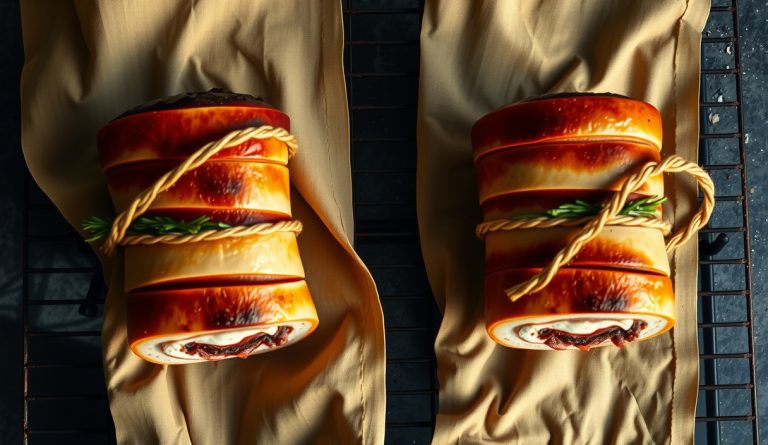
- Tie the roll with pre-cut butcher’s twine at 1.5-inch intervals along the entire length, including two ties within half an inch of each end. Each tie should be snug enough that the roll holds its shape firmly but not so tight that it cuts into the meat. A well-tied loin will maintain its circular cross-section under pressure.
- Rub the exterior of the tied loin with 1 tablespoon olive oil, then season with the remaining 0.5 teaspoon kosher salt and a few turns of black pepper over the entire exterior. For maximum bark, place the tied loin uncovered on a rack over a sheet pan and refrigerate for at least 2 hours or up to overnight. This dries the surface and improves smoke adhesion significantly.1 tbsp olive oil, 1.5 tsp kosher salt
Smoke the Loin
- Prepare your smoker or kettle grill for indirect heat at a stable 275°F. Add apple or cherry wood chunks — two fist-sized pieces is sufficient. Wait until the smoke runs clean and thin (white, acrid smoke means the wood is not fully combusted; thin blue smoke is the target).
- Place the loin directly on the grate on the indirect-heat side, fat side up. Insert your probe thermometer horizontally from the end of the loin so the probe tip rests at the geometric center of the meat mass — not inside the filling pocket. Close the lid.
- Smoke, maintaining 275°F, until the internal temperature reads 145°F. This typically takes 1 hour 30 minutes to 1 hour 45 minutes for a 3 to 3.5 pound loin at this temperature, but cook by temperature, not time. Do not open the smoker more than once or twice to check progress — each lid lift drops the cooking environment by 25°F to 50°F and extends the cook.
- Optional high-heat finish for deeper bark: If the exterior color is paler than desired at 145°F, immediately transfer the loin to direct high heat — screaming-hot grill grates or a cast iron skillet — for 60 to 90 seconds per side. Watch closely: the surface is already dehydrated and will char quickly. The goal is deep mahogany, not black.
Rest and Slice
- Remove the loin from the smoker at 145°F. Tent loosely with foil — do not wrap tightly, which traps steam and softens the bark. Rest for 10 minutes. Internal temperature will carry over 3°F to 5°F during the rest.
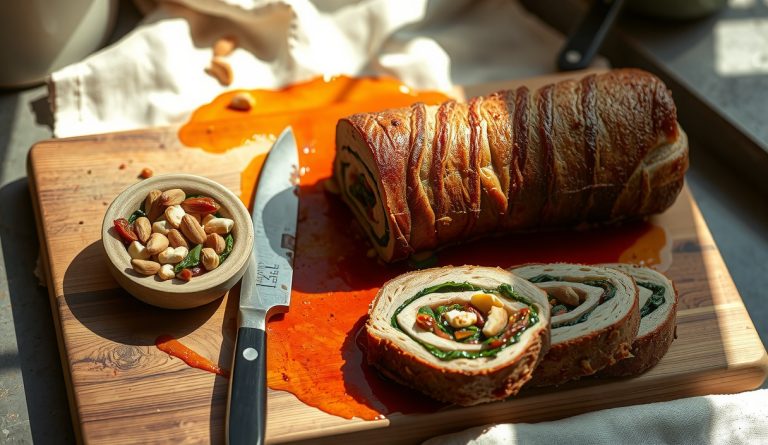
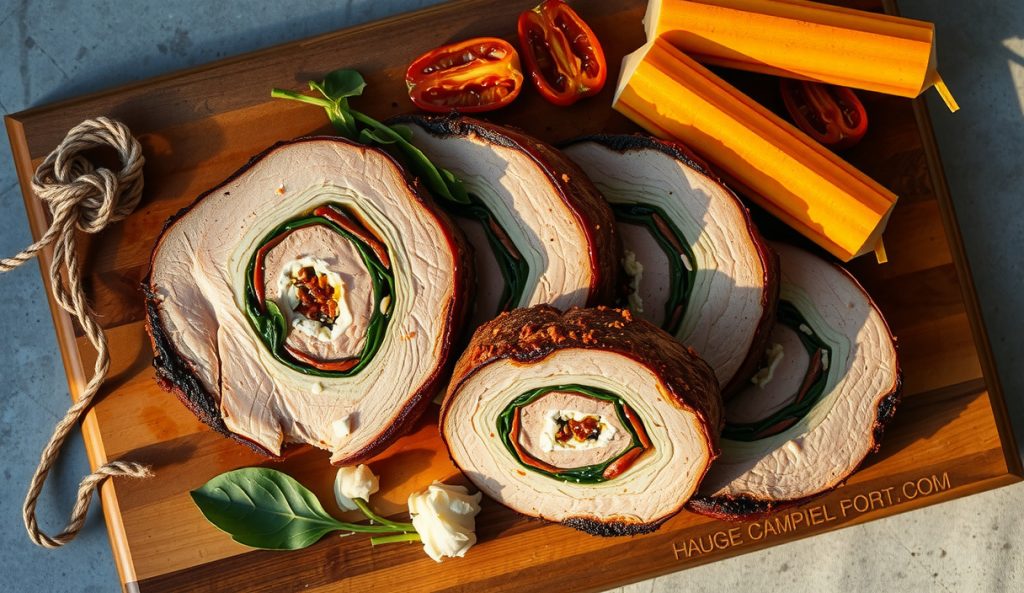
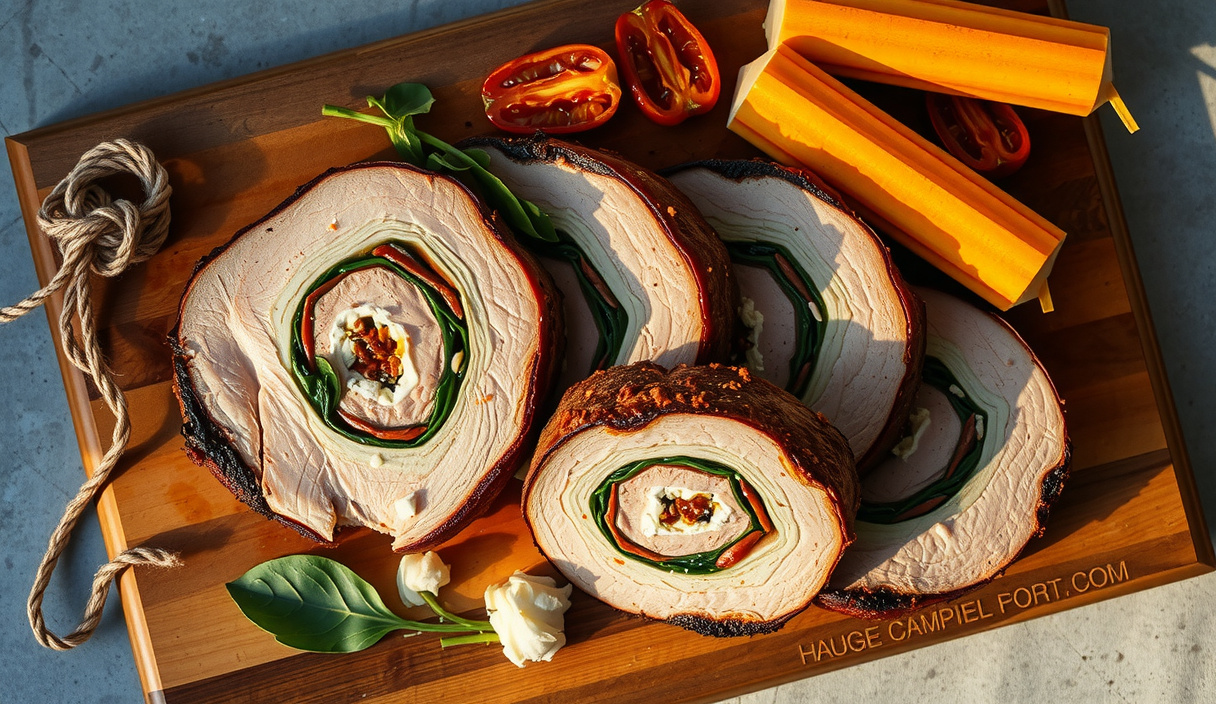
- Remove the twine by cutting each loop and pulling it free before slicing. Using a sharp slicing knife, cut the loin into 3/4-inch to 1-inch rounds. Each slice should reveal a clear spiral of spinach, sun-dried tomato, and feta. Serve immediately.
Notes
Nutrition
There is a particular kind of satisfaction that comes from slicing into a rolled pork loin and watching the spiral unfold — vivid green spinach, deeply red sun-dried tomato, and crumbled feta locked inside a mahogany smoke ring. This is not a complicated recipe. It is a precise one. The butterfly is deliberate. The tie is tight. The smoke temperature is chosen for a reason. And when that probe reads 145°F, you pull it immediately, because the physics demand it.
Pork loin is a lean cut — primarily longissimus dorsi muscle, low in intramuscular fat and connective tissue. That is its blessing and its curse. The smoked stuffed pork loin has no collagen scaffold to melt into gelatin, no marbling to buffer against heat. What pork loin does have is a tight, uniform protein structure that responds beautifully to gentle, indirect heat — and a canvas shape that butterflies flat, fills, and rolls into a perfectly round roast with a mechanical elegance that no other cut matches.
Why does smoked stuffed pork loin work? The science
Pork loin stays juicy at 145°F because that temperature lands precisely past peak myosin coagulation but safely below actin collapse, preserving the fiber network’s water-holding capacity. Pork loin is dominated by myofibrillar proteins — myosin and actin. Myosin begins to denature at approximately 104°F to 136°F (40°C–58°C), losing its raw slickness and beginning to form the gelled, pleasantly firm bite we associate with properly cooked pork. Actin, the structurally stable partner, begins denaturing in earnest at about 165°F to 172°F (74°C–78°C). Every degree past 145°F is a degree closer to the actin contraction that violently expels moisture. At 160°F, you have dry pork. There is no recovering it.
Smoking the stuffed pork loin at 275°F sits in the sweet spot of Maillard kinetics versus cook time. Surface Maillard browning — the non-enzymatic reaction between free amino groups and carbonyl compounds — initiates meaningfully above approximately 280°F to 300°F on a dry surface, but the butterflied exterior arrives at that temperature progressively. The smoke environment delivers additional pyrolysis compounds from the wood that deposit onto the bark as a thin hydrophobic layer, producing a complex, bittered crust with phenolic smoke aroma compounds even without a high-heat sear. A two-minute reverse sear over direct high heat after the pull is the correct intervention if a more aggressive bark is desired — the already-dehydrated surface drives a rapid Maillard cascade without overshooting the internal temperature.
The filling is the final physics story of the smoked stuffed pork loin. Spinach is wilted before rolling, which removes the free water that would otherwise steam the interior and push the protein fibers apart from the inside. Sun-dried tomatoes are low in water activity, high in glutamates (umami synergists), and contribute a pH around 3.8 to 4.2, which subtly acidifies the feta and spinach layer, heightening perceived flavor contrast against the neutral pork. Feta at approximately 0.3% to 0.4% w/w of the filling contributes a salt-acid-fat matrix that seasons the interior without requiring additional surface salt penetration time.
The tie geometry of the stuffed pork loin matters more than most cooks acknowledge. An unevenly tied roast creates density differentials across the cross-section — thin ends cook faster, thick centers lag. Tying at every 1.5 inches, targeting a finished cylinder of roughly uniform 4-inch diameter, makes the heat diffusion path — governed by Fourier’s Law of heat conduction — as consistent as possible from edge to center. This allows a single probe reading to represent the true thermal state of the roast. Probe placement is not optional: dead center of the thickest cross-section, inserted from the end horizontally so the probe tip reaches the geometric center of the meat mass, not the filling pocket.
What equipment and ingredients do I need?
Pork loin, not tenderloin. These are different muscles. Tenderloin is roughly 1 pound and pencil-thin. Loin is 3 to 4 pounds and butterflies into a flat slab approximately 10 inches by 14 inches. Confirm with your butcher before purchasing.
Butcher’s twine. Cotton only — synthetic twine can off-gas under heat. Pre-cut 8 to 10 lengths of about 14 inches before rolling begins. Wet hands make tying easier.
Sun-dried tomatoes. Use the oil-packed variety and press them briefly on paper towels. The residual oil carries fat-soluble flavor compounds that disperse through the filling during cooking. Dry-packed sun-dried tomatoes can work but require a 15-minute soak in warm water first.
Feta. Block feta packed in brine is higher moisture and creamier than pre-crumbled. Pat the block dry and crumble by hand. Pre-crumbled feta is acceptable but often contains anti-caking agents that make the filling slightly drier.
Wood for smoke. Apple and cherry are the classic pork pairings — both produce relatively mild, sweet smoke phenols. Cherry adds a slight mahogany color to the bark. Hickory works but is assertive; use a single small chunk, not a full load, or the filling aromatics will be overpowered.
Instant-read thermometer. Non-negotiable. This cut is too lean to pull by feel. A Thermapen or similar fast-read probe is the single most impactful equipment purchase for this recipe.
Smoker vs. kettle grill. This recipe works on any smoker or kettle grill set up for indirect heat at a stable 275°F. On a kettle, bank coals to one side, add a small water pan on the cold side to buffer temperature swings, and place the loin directly opposite the coals.
Smoked Stuffed Pork Loin with Spinach, Sun-Dried Tomato & Feta
Equipment
- 1 Smoker or charcoal kettle grill Set up for indirect heat at a stable 275°F; use apple or cherry wood chunks for smoke
- 1 Sharp boning knife Essential for an even butterfly — a dull knife creates ragged, uneven slabs
- 10 lengths Butcher’s twine Pre-cut to 14 inches; cotton only, no synthetics
- 1 Instant-read thermometer Non-negotiable for this lean cut; probe horizontally from the end to reach the geometric center
- 1 Large skillet For wilting the spinach filling
- 1 large sheet Plastic wrap or parchment For rolling and chilling the stuffed loin before tying
Ingredients
Pork Loin
- 1 center-cut boneless pork loin roast, 3 to 3.5 pounds Not pork tenderloin — ask your butcher for the full center-cut loin
- 1.5 tsp kosher salt For dry-brining the butterflied surface
- 1 tsp freshly ground black pepper
- 1 tsp smoked paprika
- 0.5 tsp garlic powder
- 0.5 tsp dried thyme
- 1 tbsp olive oil Rubbed on the exterior after tying to promote bark adhesion
Spinach, Sun-Dried Tomato & Feta Filling
- 1 tbsp olive oil
- 3 cloves garlic, minced
- 10 oz fresh baby spinach About 10 loosely packed cups; will reduce dramatically after wilting
- 0.5 cup oil-packed sun-dried tomatoes, drained and roughly chopped Pat dry briefly on paper towels after draining
- 4 oz block feta cheese, crumbled Brine-packed block feta preferred over pre-crumbled
- 2 tbsp fresh basil, thinly sliced
- 0.25 tsp red pepper flakes Optional for mild heat
- 1 tbsp Dijon mustard Spread on butterflied surface as an adhesive layer before filling
Wood & Smoke
- 2 chunks apple or cherry wood chunks Fist-sized; soak in water 30 minutes if using charcoal
Instructions
Make the Filling
- Heat 1 tablespoon olive oil in a large skillet over medium heat. Add minced garlic and cook, stirring, for 45 seconds until fragrant but not browned.3 cloves garlic, minced, 10 oz fresh baby spinach
- Add spinach in three or four batches, folding each addition until just wilted before adding the next. Total wilting time is 3 to 4 minutes. Season with a pinch of salt and red pepper flakes if using.0.5 cup oil-packed sun-dried tomatoes, drained and roughly chopped, 1 tbsp Dijon mustard
- Transfer wilted spinach to a colander and press firmly with the back of a spoon, then squeeze again by hand in a clean kitchen towel until as much liquid as possible is removed. The spinach should be nearly dry. Roughly chop the squeezed spinach and transfer to a bowl.0.5 cup oil-packed sun-dried tomatoes, drained and roughly chopped
- Add the chopped sun-dried tomatoes, crumbled feta, and fresh basil to the spinach. Fold gently to combine. Taste and adjust seasoning — feta is salty, so additional salt is rarely needed. Set filling aside to cool to room temperature before using.4 oz block feta cheese, crumbled, 2 tbsp fresh basil, thinly sliced, 0.25 tsp red pepper flakes
Butterfly and Season the Loin
- Place the pork loin on a cutting board, fat cap side down. Using a sharp boning knife, make a horizontal cut starting 3/4 inch from the bottom along the long edge, cutting almost all the way through but leaving a 1/2-inch hinge. Open the loin like a book. If the slab is thicker than 3/4 inch in any area, make a second fold-cut on the thick half to create a consistent, even surface. Cover with plastic wrap and pound any thick spots gently with a meat mallet or rolling pin until the entire slab is roughly 3/4 inch thick throughout.
- Sprinkle 1 teaspoon kosher salt, black pepper, smoked paprika, garlic powder, and dried thyme evenly over the interior surface (the side that will hold the filling). Pat gently to adhere. Spread Dijon mustard in a thin, even layer over the same surface — this acts as both a flavor base and an adhesive for the filling.1.5 tsp kosher salt, 1 tsp freshly ground black pepper, 1 tsp smoked paprika, 0.5 tsp garlic powder, 0.5 tsp dried thyme, 2 chunks apple or cherry wood chunks
Fill, Roll, and Tie
- Spread the cooled filling evenly over the mustard-coated interior surface, leaving a 1-inch border along the far long edge to prevent filling blowout during rolling. Press the filling firmly and evenly to remove air pockets.4 oz block feta cheese, crumbled, 2 tbsp fresh basil, thinly sliced, 0.25 tsp red pepper flakes
- Starting from the near long edge, roll the loin tightly and evenly away from you, like a jelly roll. Keep consistent pressure throughout the roll — a tight roll holds the filling securely and creates an even cylinder. The fat cap, if present, should end up on the exterior top of the roll.
- Tie the roll with pre-cut butcher’s twine at 1.5-inch intervals along the entire length, including two ties within half an inch of each end. Each tie should be snug enough that the roll holds its shape firmly but not so tight that it cuts into the meat. A well-tied loin will maintain its circular cross-section under pressure.
- Rub the exterior of the tied loin with 1 tablespoon olive oil, then season with the remaining 0.5 teaspoon kosher salt and a few turns of black pepper over the entire exterior. For maximum bark, place the tied loin uncovered on a rack over a sheet pan and refrigerate for at least 2 hours or up to overnight. This dries the surface and improves smoke adhesion significantly.1 tbsp olive oil, 1.5 tsp kosher salt
Smoke the Loin
- Prepare your smoker or kettle grill for indirect heat at a stable 275°F. Add apple or cherry wood chunks — two fist-sized pieces is sufficient. Wait until the smoke runs clean and thin (white, acrid smoke means the wood is not fully combusted; thin blue smoke is the target).
- Place the loin directly on the grate on the indirect-heat side, fat side up. Insert your probe thermometer horizontally from the end of the loin so the probe tip rests at the geometric center of the meat mass — not inside the filling pocket. Close the lid.
- Smoke, maintaining 275°F, until the internal temperature reads 145°F. This typically takes 1 hour 30 minutes to 1 hour 45 minutes for a 3 to 3.5 pound loin at this temperature, but cook by temperature, not time. Do not open the smoker more than once or twice to check progress — each lid lift drops the cooking environment by 25°F to 50°F and extends the cook.
- Optional high-heat finish for deeper bark: If the exterior color is paler than desired at 145°F, immediately transfer the loin to direct high heat — screaming-hot grill grates or a cast iron skillet — for 60 to 90 seconds per side. Watch closely: the surface is already dehydrated and will char quickly. The goal is deep mahogany, not black.
Rest and Slice
- Remove the loin from the smoker at 145°F. Tent loosely with foil — do not wrap tightly, which traps steam and softens the bark. Rest for 10 minutes. Internal temperature will carry over 3°F to 5°F during the rest.
- Remove the twine by cutting each loop and pulling it free before slicing. Using a sharp slicing knife, cut the loin into 3/4-inch to 1-inch rounds. Each slice should reveal a clear spiral of spinach, sun-dried tomato, and feta. Serve immediately.
Notes
Nutrition
How do I nail the smoked stuffed pork loin every time?
- Butterfly evenly or the roll fails. The single most common failure is an uneven butterfly — one end paper-thin, one end a full inch thick. Work slowly with a sharp boning knife, keeping your free hand flat on top of the meat as a guide. Aim for a consistent 3/4-inch slab throughout. An uneven slab rolls into a cone, not a cylinder, and the thin end overcooks before the thick end reaches 145°F.
- Dry the surface before smoke goes on. Pat the exterior of the stuffed pork loin with paper towels immediately before placing the roast in the smoker. Surface moisture suppresses the Maillard reaction and delays bark formation. A dry surface allows smoke compounds to adhere more aggressively and the exterior proteins to begin setting without first having to boil off a water layer.
- Do not skip wilting the spinach. Raw spinach contains roughly 92% water by weight. In a sealed roll under heat, that moisture releases explosively, creating a steam pocket that physically pushes the filling away from the pork protein. Wilted and well-squeezed spinach has shed the majority of its free water, eliminating this failure mode entirely.
- Pull at exactly 145°F, then tent — do not slice immediately. The internal temperature will continue to rise 3°F to 5°F during a 10-minute rest as heat diffuses from the exterior toward the center. Slicing immediately releases juice that has not yet redistributed; tenting allows proteins to partially relax their grip on entrapped moisture. Use foil loosely tented — tight wrapping traps steam and softens the bark.
- Tie every 1.5 inches without exception. Skipping ties at the ends is the most common structural failure. The ends of the roll have the least binding surface and will unravel in the smoker, releasing the filling. Two additional ties, one at each end placed roughly half an inch from the edge, hold the spiral closed throughout the cook.
- If bark is pale, finish with a two-minute high-heat sear. After pulling at 145°F and before resting, place the loin directly over high heat — coals or a screaming-hot cast iron — for 60 to 90 seconds per side. The surface is already dehydrated from the smoke cook, so the Maillard reaction accelerates almost instantly. At this point, going from beautiful bark to scorched takes under 30 seconds.
What variations can I make on this stuffed pork loin?
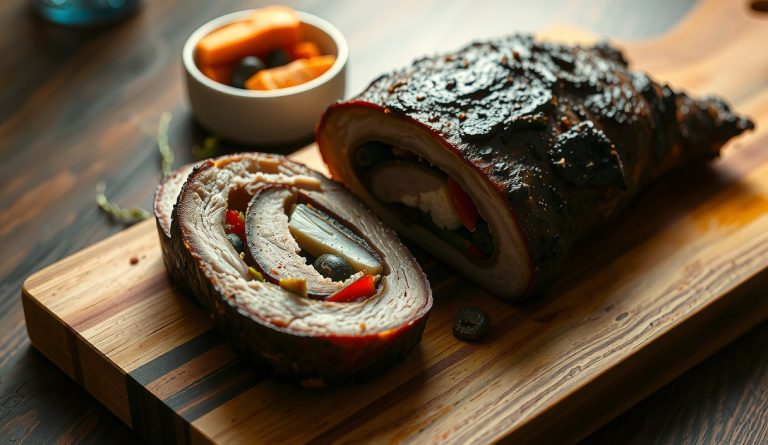
Mediterranean swap. Replace spinach and feta with a filling of roasted red peppers (jarred, well-drained), kalamata olives (roughly chopped), and fresh goat cheese. The goat cheese melts more completely than feta during the cook, creating a creamier interior spiral. The olive oil from the peppers bastes the interior of the roll continuously as the loin cooks.
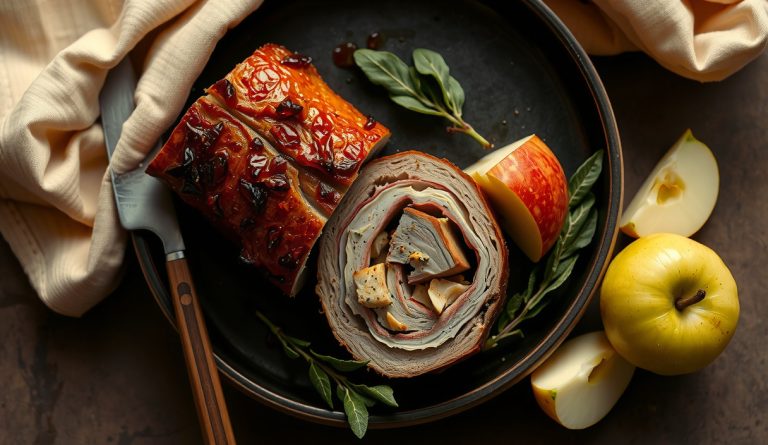
Apple and sage with a brown sugar crust. A classic American pairing. Replace the Mediterranean filling with thinly sliced apple (one Granny Smith), fresh sage leaves, and a tablespoon of whole-grain mustard spread directly on the butterflied surface. Dust the exterior with a 50/50 mix of brown sugar and smoked paprika before tying. The brown sugar caramelizes aggressively — reduce smoker temperature to 250°F to prevent scorching before the center reaches temperature.
Scaling up. A single loin in the 3 to 4 pound range feeds 6 comfortably as a main. For larger gatherings, smoke two loins simultaneously rather than attempting a single larger loin — a 6-pound loin becomes geometrically difficult to butterfly evenly and roll structurally. Two smaller loins provide better surface-area-to-mass ratios for smoke penetration and cook more predictably side by side in the smoker.
Dairy-free. Omit the feta entirely and replace with a tablespoon of nutritional yeast stirred into the wilted spinach, plus an additional tablespoon of chopped pine nuts for fat and texture. The filling will be lighter in flavor, so increase the sun-dried tomato quantity by 50% and add a teaspoon of red wine vinegar directly to the spinach as it wilts to recover the acid note feta would have provided.
Frequently asked questions
Can I prep this the night before? Yes — and you should. A rolled, tied, and dry-brined pork loin rested overnight in the refrigerator develops better bark-forming conditions (lower surface water activity) and allows the salt from both the dry brine and the feta to begin migrating into the outer protein layers, improving moisture retention during the cook. Wrap loosely in plastic, then refrigerate uncovered on a rack for the last 2 to 4 hours of that resting period to dry the exterior.
My filling is leaking out during the cook — what went wrong? Two likely causes: the loin was not tied tightly enough at the ends, or the spinach was not squeezed dry enough and steam pressure is forcing filling out through gaps. If structural failure is severe mid-cook, tent the loin loosely in foil for the remaining cook time, which contains the filling and redirects the steam back into the roast. Do not open the smoker repeatedly — heat loss extends cook time and risks temperature swings.
What internal temperature is safe for the filling? The spinach-feta-tomato filling presents no food safety concern at the temperatures this roast reaches — the feta is already cured, the spinach is pre-cooked, and the interior of the roll will track closely behind the surrounding pork, reaching well above 140°F before the surface hits 145°F. The only food safety critical control point is the pork itself at 145°F with a 3-minute rest, which is the USDA validated pasteurization threshold for whole-muscle pork.