Sous Vide Smoked Pork Belly — 48-Hour

Equipment
- 1 Immersion circulator Must hold ±0.2°F accuracy; 1000W or higher recommended
- 1 Sous vide container or large stock pot Minimum 12-quart capacity; cover with plastic wrap or lid to reduce evaporation over 48 hours
- 1 Vacuum sealer and bags Chamber sealer preferred for fatty cuts; clamp-style works if belly surface is frozen 30 min beforehand
- 1 Cold smoker or offset smoker with cold-smoking capability Target 85–95°F ambient in smoking chamber; Smoke Daddy generator on a covered grill works well
- 1 Apple wood chips or chunks Enough for 4 hours of sustained smolder; soak chips 30 min in water for slower burn
- 2 Probe thermometers One for smoke chamber ambient, one for belly internal temperature
- 1 Large cambro or stock pot for ice bath Must hold the bagged belly submerged in ice water
- 1 Cast iron skillet or carbon steel pan 12-inch minimum; must sustain very high heat without warping
- 1 Grill press or second heavy pan For maintaining fat-cap contact during the sear
- 1 Wire rack set over sheet pan For air-drying belly and resting after sear
Ingredients
Pork Belly
- 3 lbs skin-off pork belly Bone-free slab; fat cap between 0.75 and 1.25 inches thick; skin-on works if you want crackle — score skin in a crosshatch pattern before sealing
Dry Rub
- 1.5 tsp kosher salt Diamond Crystal; if using Morton’s reduce to 1 tsp
- 1 tsp coarsely ground black pepper Fresh-cracked preferred; provides Maillard substrate during the sear
- 1 tsp dark brown sugar Provides reducing sugars for rapid surface browning during the sear without sweetening the meat noticeably
- 0.5 tsp smoked paprika Adds baseline redness and pre-smoke color; optional but improves visual bark development
- 0.25 tsp garlic powder
For Searing
- 1 tbsp neutral high-smoke-point oil Avocado oil or refined sunflower oil; smoke point above 450°F required
Optional Glaze (for service)
- 2 tbsp soy sauce
- 1 tbsp honey
- 1 tsp rice vinegar Adds acid balance to the glaze; optional

Instructions
Day 1: Rub and Seal
- Combine kosher salt, black pepper, dark brown sugar, smoked paprika, and garlic powder in a small bowl. Pat the pork belly completely dry with paper towels — moisture on the surface dilutes the rub and impedes Maillard development during the eventual sear. Apply the rub to all surfaces of the belly, pressing firmly so it adheres. Do not be timid; the rub needs to survive 48 hours in a water bath and still contribute flavor.1 tsp coarsely ground black pepper, 1 tsp dark brown sugar, 0.5 tsp smoked paprika, 0.25 tsp garlic powder
- Vacuum seal the rubbed belly in a single layer. If using a clamp-style sealer, ensure the belly is cold (freeze 30 minutes first) so surface fat does not migrate into the sealing channel. The bag should be sealed completely with zero air pockets — trapped air creates an insulating barrier that prevents accurate temperature transfer from the water to the meat.
- Set your immersion circulator to 158°F (70°C). Allow the bath to come to full temperature before submerging the sealed belly. Clip the bag to the side of the container to keep it fully submerged and away from the circulator intake. Cover the vessel tightly to prevent evaporation — significant water loss over 48 hours can expose the bag. Start the timer: 48 hours.
Day 3: Ice Bath and Pellicle Development
- After 48 hours, remove the bag from the bath. Transfer immediately to an ice-water bath — a large container filled with equal parts ice and cold water. The belly must drop from 158°F to below 40°F within 2 hours. This is not optional; it is the food safety step that prevents clostridium growth in the anaerobic bag. Stir the ice bath periodically and add more ice if needed. A 3-pound belly typically chills to below 40°F internal temperature in 45 to 60 minutes.
- Once chilled, remove the belly from the bag. Reserve any accumulated bag liquid — it is pure pork gelatin and collagen, intensely savory, and can be reduced and used as a sauce base. Pat the belly completely dry on all surfaces with paper towels. For optimal smoke adhesion, place the belly uncovered on a wire rack over a sheet pan and refrigerate uncovered for 1 to 2 hours. This air-drying step forms the pellicle — a dry, tacky, slightly tacky protein surface that accepts smoke cleanly without generating bitter creosote. Do not skip this if you have the time.
Cold Smoking (4 Hours at 85–95°F)
- Prepare your cold-smoking setup and stabilize the ambient temperature inside the smoking chamber between 85°F and 95°F (29–35°C). Place a probe thermometer in the chamber ambient and a second probe in the thickest part of the belly. Begin smoldering your apple wood chips — you want a slow, sustained smolder producing thin blue-white smoke, not thick white billowing smoke. Thick white smoke indicates incomplete combustion and will produce bitter, harsh deposits on the meat surface.
- Place the belly on the smoking grate with at least 2 inches of clearance on all sides. Cold-smoke for 4 hours, maintaining the chamber between 85°F and 95°F throughout. The belly’s internal temperature should not rise more than 5°F above its starting temperature. If the chamber temperature spikes above 100°F, open vents, reduce fuel, or place a tray of ice in the chamber as a thermal buffer. After 4 hours, remove the belly. It will be deeply colored — mahogany to amber — and the surface will feel dry and tacky with smoke deposits.
- Refrigerate the smoked belly uncovered on a rack for at least 30 minutes before searing. This firms the exterior slightly and ensures the cold interior will not carry over from sear heat into an overcooked state. The belly can be held refrigerated at this stage for up to 24 hours before the final sear.
Sear and Serve
- Heat your cast iron skillet over high heat for a full 3 to 4 minutes until the pan is smoking. Add 1 tablespoon of neutral oil and swirl to coat. The oil should immediately begin to shimmer and just begin to smoke.1 tbsp neutral high-smoke-point oil
- Place the belly fat-cap side down into the hot pan. Press firmly with a grill press or a second heavy pan immediately — the fat cap will try to arch away from the hot surface in the first 30 seconds. Apply steady downward pressure for the first 60 to 90 seconds. You will hear violent sizzling and see smoke — this is correct. The fat cap needs to be in contact with the pan to render and blister. Sear fat-cap side for 2 to 3 minutes until deeply golden and beginning to crackle. The surface Maillard reaction is converting the brown sugar, amino acids from the rub, and smoke-deposited carbonyls into hundreds of aromatic compounds simultaneously.1 tbsp neutral high-smoke-point oil
- Flip and sear the meat side for 1 to 2 minutes, then the short sides for 30 seconds each. The total sear should not exceed 6 to 7 minutes — the interior is already cooked and gelatinized at 158°F; the sear is purely about surface transformation and temperature contrast. Remove from the pan and rest on a wire rack for 5 minutes uncovered.
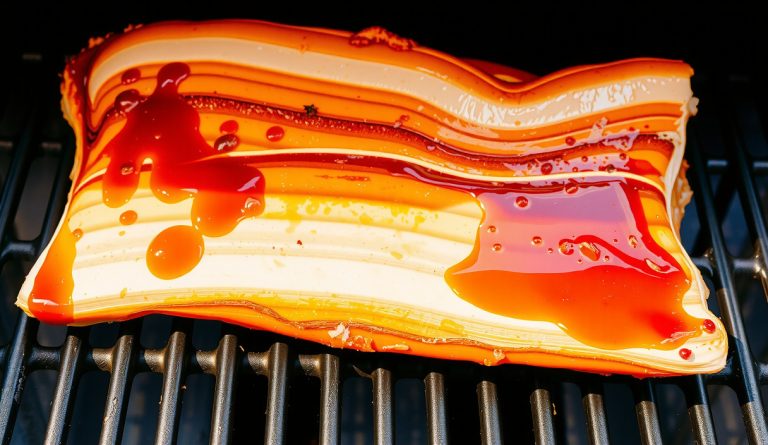
- Optional glaze: While the belly rests, combine soy sauce, honey, and rice vinegar in the hot pan. Stir over medium heat for 60 seconds until the mixture thickens to a syrupy consistency. Brush over the rested belly just before slicing for a lacquered finish.2 tbsp soy sauce, 1 tbsp honey, 1 tsp rice vinegar
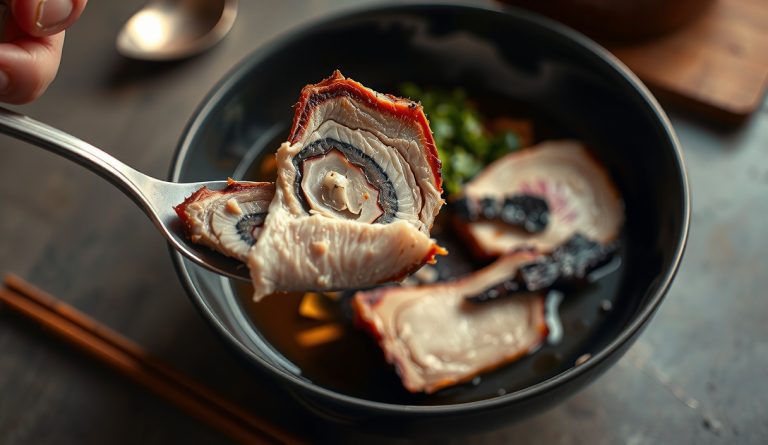
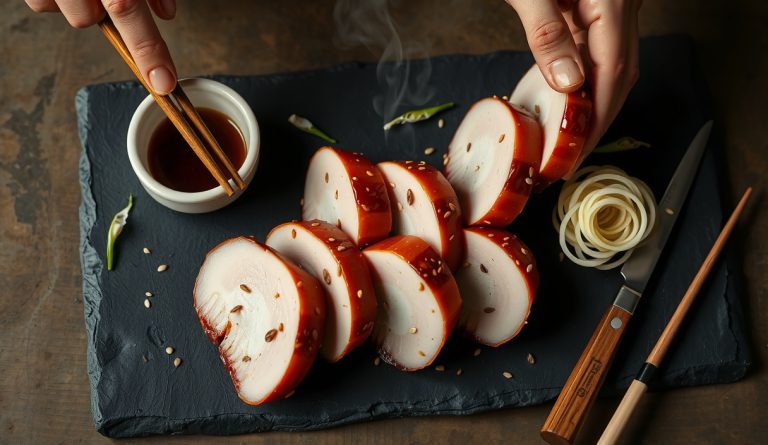
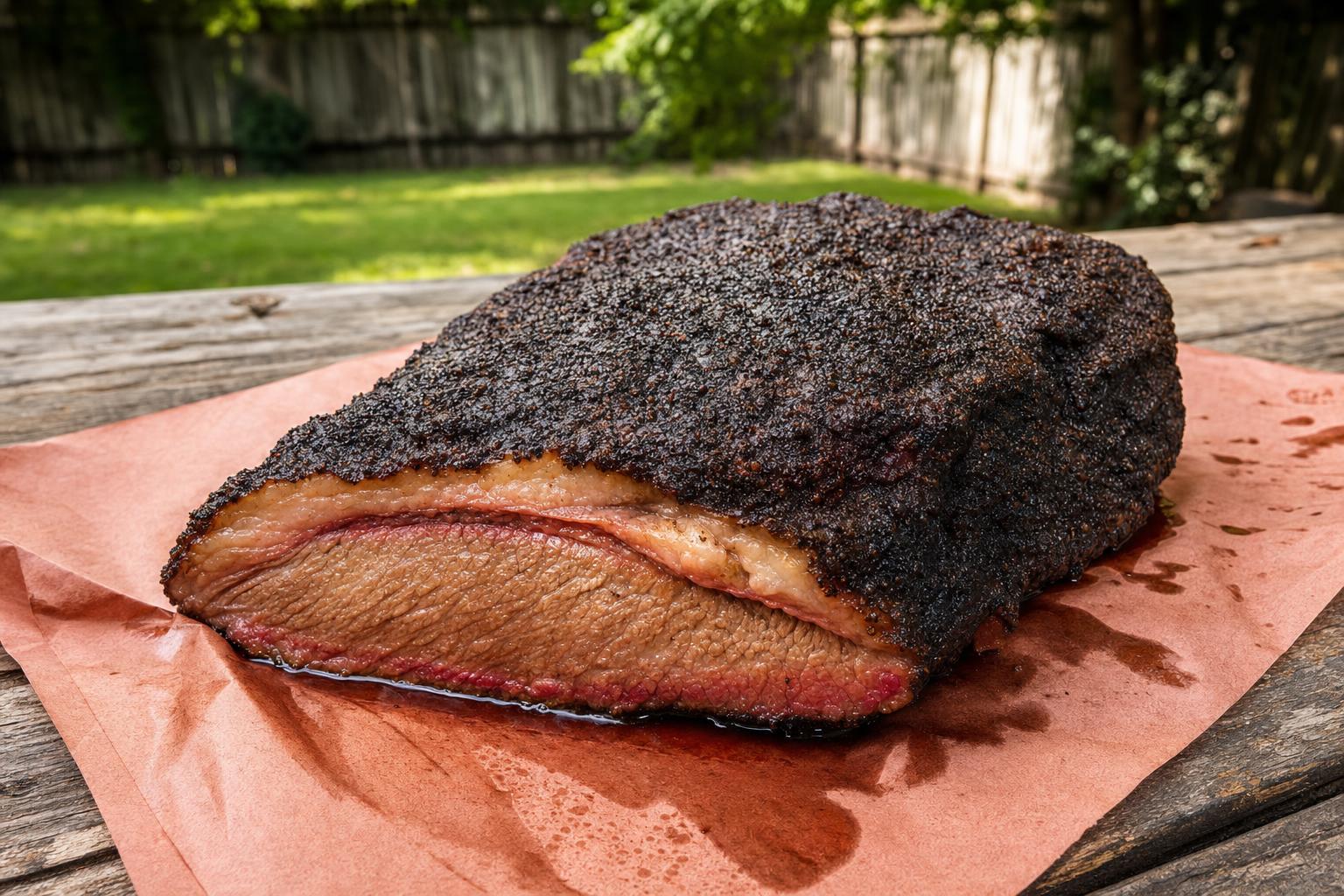
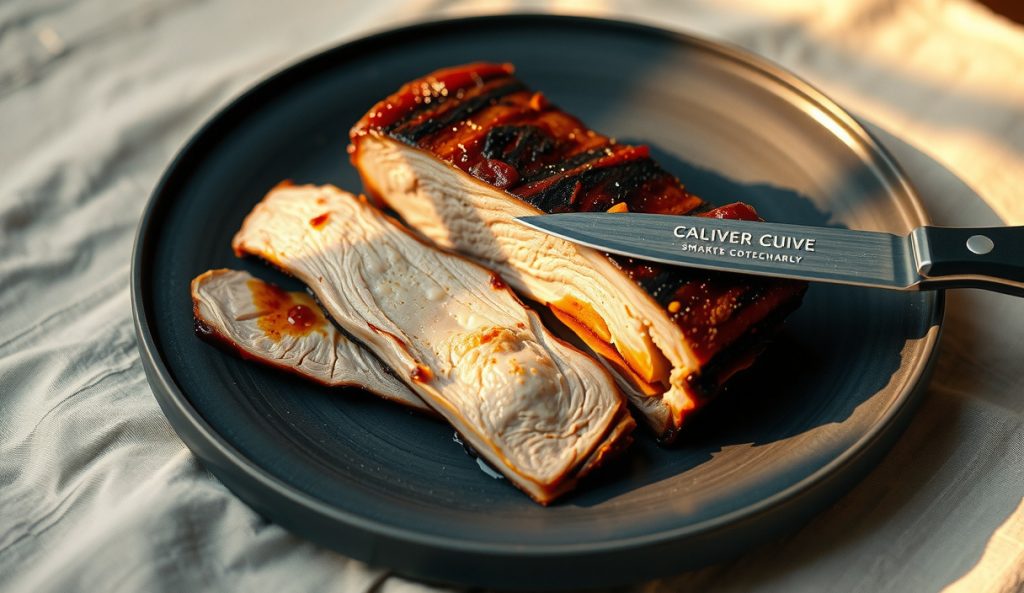
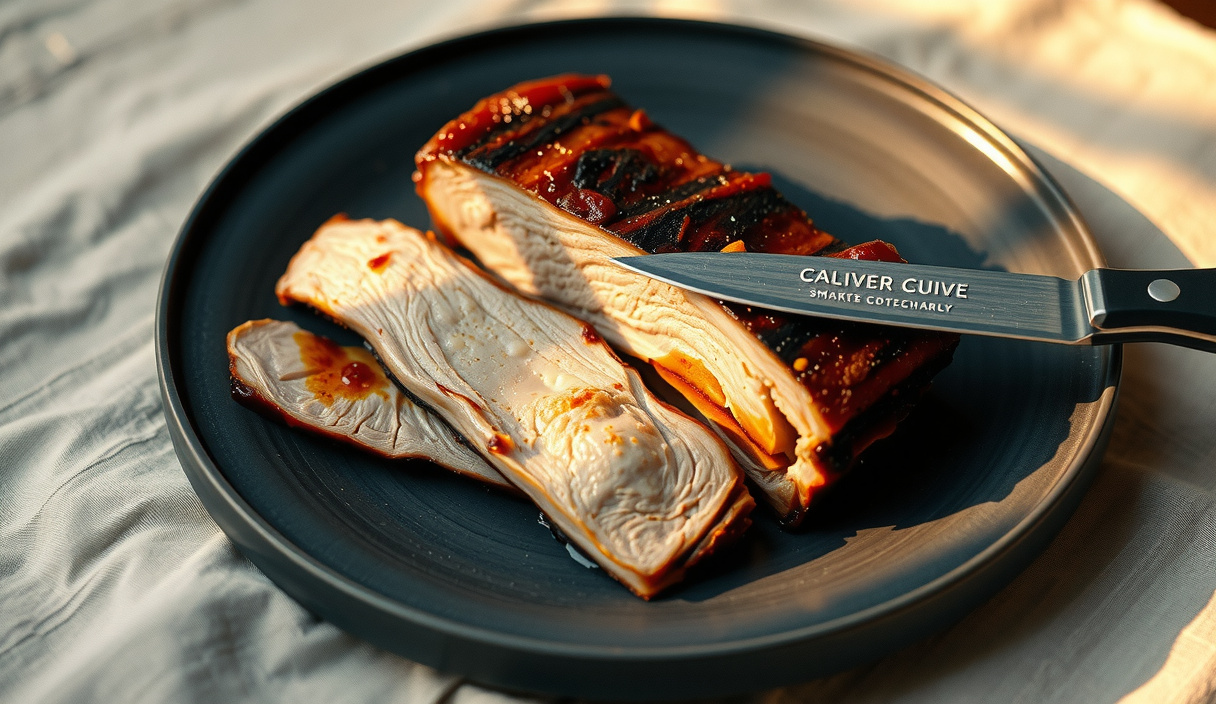
- Slice the belly against the grain into portions 0.5 to 0.75 inches thick using a long, sharp slicing knife. Each slice should reveal distinct alternating layers of translucent, trembling gelatin-set fat and deeply mahogany muscle. Serve immediately — pork belly at its peak is hot, with the fat still silky and the crust still cracking under the knife.
Notes
Nutrition
The first time I pulled a pork belly from a 48-hour sous vide bath and sliced into it, the knife met almost no resistance. The fat was translucent and trembling. The muscle fibers had given up the fight. I had cooked pork belly a hundred times before — braised, roasted, smoked low and slow — and none of those methods delivered this. The problem with every traditional approach is that collagen conversion, fat rendering, and smoke penetration must all happen simultaneously, competing for the same thermal window. This method decouples them entirely, running each transformation on its own terms.
What you get at the end is a slab that has fully converted its connective tissue into molten gelatin at 158°F over 48 hours, taken on four hours of cold apple wood smoke at 90°F without a degree of additional cooking, and then been seared hard to create the lacquered, crackling exterior that makes pork belly worth eating. It is a three-act structure, and every act matters.
Why does sous vide smoked pork belly work? The science
Sous vide smoked pork belly works because the three-stage method — precision heat bath, cold smoke, and high-heat sear — lets collagen hydrolysis, smoke deposition, and fat rendering each proceed at their own optimal temperature without interfering with one another. No single traditional cooking method can provide all three conditions simultaneously.
Pork belly is a composite tissue. The interlayered muscle bands are composed of myosin and actin filaments surrounded by a dense matrix of collagen-rich connective tissue, and all of it is threaded with fat deposits ranging from intramuscular marbling to the thick subcutaneous fat cap. Each of these components has its own thermal kinetics. Myosin begins denaturing around 104°F to 113°F. Collagen undergoes initial shrinkage between 140°F and 149°F before transitioning — slowly, governed by first-order kinetics — into soluble gelatin above 155°F. Actin, the structural protein that makes overcooked meat dry and fibrous, does not catastrophically collapse until temperatures exceed 160°F. Setting the bath at 158°F is a calculated position: it sits above the minimum threshold for aggressive collagen hydrolysis while staying just below the actin danger zone. At this temperature, 48 hours provides the time integral necessary for near-complete collagen-to-gelatin conversion. The result is not falling-apart soft — it is yielding and gelatinous, with structure that still slices cleanly under a knife.
Fat rendering in pork belly is a separate kinetic problem. At 158°F, subcutaneous pork fat does not fully liquefy — the triglycerides soften and the fat lobules lose their rigid crystalline structure, but a significant fraction of solid fat remains. This is actually desirable. Fully rendered fat collapses the fat cap into a greasy void. Partially rendered fat retains its architecture while becoming silky and translucent, almost custardy in texture. The final high-heat sear in a cast iron pan drives surface temperatures above 300°F, which is where the remaining fat cap renders explosively in the last 90 seconds of cooking, blistering and crisping the exterior while the already-gelatinized interior stays cool and intact.
The cold smoke step runs at approximately 90°F — well below any protein denaturation threshold, below even myosin’s onset temperature of 104°F. No cooking is occurring during this phase. What is happening instead is pure volatile organic compound (VOC) deposition: phenols, guaiacols, syringols, and carbonyls from the smoldering apple wood adsorbing onto the cold, moist surface of the pork belly. The water activity on the surface of the just-chilled belly acts as a capture medium for these smoke compounds. Critically, the Maillard reaction requires temperatures above 250°F and controlled water activity well below the surface of a freshly chilled protein — none of those conditions exist at 90°F. The smoke ring and color development happen during the final sear. This complete decoupling of smoke flavor from heat means the smoke signal is precise and clean, not cooked-through and acrid the way it can become after hours in a hot smoker.
What equipment and ingredients do I need?
Immersion circulator: You need ±0.2°F accuracy. The 158°F target is specific — a circulator that swings 2°F in either direction will produce inconsistent results over 48 hours. Anova, Joule, and Inkbird units in the $100–$180 range all hold adequately.
Vacuum sealer: A chamber sealer is ideal for fatty cuts because the liquid fat will not be pulled into a clamp-style sealer. If you only have a clamp-style unit, freeze the belly for 30 minutes before sealing to solidify the surface fat.
Cold smoker or offset smoker with cold-smoking capability: The target is 85°F to 95°F ambient temperature inside the smoking chamber. You can achieve this with a Smoke Daddy cold smoke generator attached to a covered grill, a dedicated cold smoke cabinet, or an offset smoker with the firebox far from the cooking chamber and only a small smoldering coal bed. A probe thermometer in the smoking chamber is mandatory — if the temperature creeps above 100°F, open a vent or remove the lid briefly.
Apple wood: Apple is mild, slightly sweet, and produces a clean smoke that does not compete with the natural sweetness of pork fat. Cherry is an excellent substitute. Hickory at cold-smoke temperatures can be harsh and overwhelming — use it only if you want assertive smoke and reduce the cold-smoke time to 2.5 hours.
Pork belly: Source a skin-on, bone-free slab from a butcher if possible. Skin-on gives you the option of an aggressive skin-side sear for crackle. Skin-off (which is more common at grocery stores) is fine — the fat cap still performs beautifully. Look for a belly with even fat distribution and a fat cap between 0.75 and 1.25 inches thick.
Dry rub: Keep it simple. The 48-hour bath and cold smoke do more flavor work than any spice rub can. Salt, black pepper, and a small amount of brown sugar for Maillard color during the sear is all the rub needs to accomplish.
Sous Vide Smoked Pork Belly — 48-Hour
Equipment
- 1 Immersion circulator Must hold ±0.2°F accuracy; 1000W or higher recommended
- 1 Sous vide container or large stock pot Minimum 12-quart capacity; cover with plastic wrap or lid to reduce evaporation over 48 hours
- 1 Vacuum sealer and bags Chamber sealer preferred for fatty cuts; clamp-style works if belly surface is frozen 30 min beforehand
- 1 Cold smoker or offset smoker with cold-smoking capability Target 85–95°F ambient in smoking chamber; Smoke Daddy generator on a covered grill works well
- 1 Apple wood chips or chunks Enough for 4 hours of sustained smolder; soak chips 30 min in water for slower burn
- 2 Probe thermometers One for smoke chamber ambient, one for belly internal temperature
- 1 Large cambro or stock pot for ice bath Must hold the bagged belly submerged in ice water
- 1 Cast iron skillet or carbon steel pan 12-inch minimum; must sustain very high heat without warping
- 1 Grill press or second heavy pan For maintaining fat-cap contact during the sear
- 1 Wire rack set over sheet pan For air-drying belly and resting after sear
Ingredients
Pork Belly
- 3 lbs skin-off pork belly Bone-free slab; fat cap between 0.75 and 1.25 inches thick; skin-on works if you want crackle — score skin in a crosshatch pattern before sealing
Dry Rub
- 1.5 tsp kosher salt Diamond Crystal; if using Morton’s reduce to 1 tsp
- 1 tsp coarsely ground black pepper Fresh-cracked preferred; provides Maillard substrate during the sear
- 1 tsp dark brown sugar Provides reducing sugars for rapid surface browning during the sear without sweetening the meat noticeably
- 0.5 tsp smoked paprika Adds baseline redness and pre-smoke color; optional but improves visual bark development
- 0.25 tsp garlic powder
For Searing
- 1 tbsp neutral high-smoke-point oil Avocado oil or refined sunflower oil; smoke point above 450°F required
Optional Glaze (for service)
- 2 tbsp soy sauce
- 1 tbsp honey
- 1 tsp rice vinegar Adds acid balance to the glaze; optional
Instructions
Day 1: Rub and Seal
- Combine kosher salt, black pepper, dark brown sugar, smoked paprika, and garlic powder in a small bowl. Pat the pork belly completely dry with paper towels — moisture on the surface dilutes the rub and impedes Maillard development during the eventual sear. Apply the rub to all surfaces of the belly, pressing firmly so it adheres. Do not be timid; the rub needs to survive 48 hours in a water bath and still contribute flavor.1 tsp coarsely ground black pepper, 1 tsp dark brown sugar, 0.5 tsp smoked paprika, 0.25 tsp garlic powder
- Vacuum seal the rubbed belly in a single layer. If using a clamp-style sealer, ensure the belly is cold (freeze 30 minutes first) so surface fat does not migrate into the sealing channel. The bag should be sealed completely with zero air pockets — trapped air creates an insulating barrier that prevents accurate temperature transfer from the water to the meat.
- Set your immersion circulator to 158°F (70°C). Allow the bath to come to full temperature before submerging the sealed belly. Clip the bag to the side of the container to keep it fully submerged and away from the circulator intake. Cover the vessel tightly to prevent evaporation — significant water loss over 48 hours can expose the bag. Start the timer: 48 hours.
Day 3: Ice Bath and Pellicle Development
- After 48 hours, remove the bag from the bath. Transfer immediately to an ice-water bath — a large container filled with equal parts ice and cold water. The belly must drop from 158°F to below 40°F within 2 hours. This is not optional; it is the food safety step that prevents clostridium growth in the anaerobic bag. Stir the ice bath periodically and add more ice if needed. A 3-pound belly typically chills to below 40°F internal temperature in 45 to 60 minutes.
- Once chilled, remove the belly from the bag. Reserve any accumulated bag liquid — it is pure pork gelatin and collagen, intensely savory, and can be reduced and used as a sauce base. Pat the belly completely dry on all surfaces with paper towels. For optimal smoke adhesion, place the belly uncovered on a wire rack over a sheet pan and refrigerate uncovered for 1 to 2 hours. This air-drying step forms the pellicle — a dry, tacky, slightly tacky protein surface that accepts smoke cleanly without generating bitter creosote. Do not skip this if you have the time.
Cold Smoking (4 Hours at 85–95°F)
- Prepare your cold-smoking setup and stabilize the ambient temperature inside the smoking chamber between 85°F and 95°F (29–35°C). Place a probe thermometer in the chamber ambient and a second probe in the thickest part of the belly. Begin smoldering your apple wood chips — you want a slow, sustained smolder producing thin blue-white smoke, not thick white billowing smoke. Thick white smoke indicates incomplete combustion and will produce bitter, harsh deposits on the meat surface.
- Place the belly on the smoking grate with at least 2 inches of clearance on all sides. Cold-smoke for 4 hours, maintaining the chamber between 85°F and 95°F throughout. The belly’s internal temperature should not rise more than 5°F above its starting temperature. If the chamber temperature spikes above 100°F, open vents, reduce fuel, or place a tray of ice in the chamber as a thermal buffer. After 4 hours, remove the belly. It will be deeply colored — mahogany to amber — and the surface will feel dry and tacky with smoke deposits.
- Refrigerate the smoked belly uncovered on a rack for at least 30 minutes before searing. This firms the exterior slightly and ensures the cold interior will not carry over from sear heat into an overcooked state. The belly can be held refrigerated at this stage for up to 24 hours before the final sear.
Sear and Serve
- Heat your cast iron skillet over high heat for a full 3 to 4 minutes until the pan is smoking. Add 1 tablespoon of neutral oil and swirl to coat. The oil should immediately begin to shimmer and just begin to smoke.1 tbsp neutral high-smoke-point oil
- Place the belly fat-cap side down into the hot pan. Press firmly with a grill press or a second heavy pan immediately — the fat cap will try to arch away from the hot surface in the first 30 seconds. Apply steady downward pressure for the first 60 to 90 seconds. You will hear violent sizzling and see smoke — this is correct. The fat cap needs to be in contact with the pan to render and blister. Sear fat-cap side for 2 to 3 minutes until deeply golden and beginning to crackle. The surface Maillard reaction is converting the brown sugar, amino acids from the rub, and smoke-deposited carbonyls into hundreds of aromatic compounds simultaneously.1 tbsp neutral high-smoke-point oil
- Flip and sear the meat side for 1 to 2 minutes, then the short sides for 30 seconds each. The total sear should not exceed 6 to 7 minutes — the interior is already cooked and gelatinized at 158°F; the sear is purely about surface transformation and temperature contrast. Remove from the pan and rest on a wire rack for 5 minutes uncovered.
- Optional glaze: While the belly rests, combine soy sauce, honey, and rice vinegar in the hot pan. Stir over medium heat for 60 seconds until the mixture thickens to a syrupy consistency. Brush over the rested belly just before slicing for a lacquered finish.2 tbsp soy sauce, 1 tbsp honey, 1 tsp rice vinegar
- Slice the belly against the grain into portions 0.5 to 0.75 inches thick using a long, sharp slicing knife. Each slice should reveal distinct alternating layers of translucent, trembling gelatin-set fat and deeply mahogany muscle. Serve immediately — pork belly at its peak is hot, with the fat still silky and the crust still cracking under the knife.
Notes
Nutrition
How do I nail this recipe every time?
- Do not skip the ice bath after the sous vide. You need to drop the belly from 158°F to below 40°F within two hours before cold smoking. Skipping this step and going directly to the smoker means the belly enters the cold-smoke chamber still warm, risking food safety and causing the surface fat to remain liquid, which dramatically reduces smoke compound adhesion. An ice-water bath for 45 to 60 minutes in a cambro or large pot works perfectly.
- Dry the surface completely before cold smoking. After the ice bath, pat every surface bone dry with paper towels. Wet surfaces absorb smoke, but they also produce bitter, acrid creosote. A dry, tacky surface — what pitmasters call the pellicle — accepts smoke selectively and produces a cleaner flavor profile. If you have time, air-dry the belly uncovered on a rack in the refrigerator for 2 hours after the ice bath.
- Monitor smoke chamber temperature obsessively. If ambient temperature in the smoker exceeds 100°F during the cold-smoke phase, you are beginning to cook the belly and negate the entire point of the technique. Keep a probe in the chamber and a second probe in the center of the belly. The belly’s internal temperature should not rise more than 5°F above its starting temperature during the 4-hour cold-smoke window.
- Sear fat-cap side down first and hold it there. The fat cap needs sustained contact with a screaming-hot cast iron surface to render and blister. Press the belly down with a second heavy pan or a grill press for the first 60 seconds to ensure full surface contact. Do not rush this — a pale, soft fat cap is the most common failure mode of this recipe.
- Rest the belly before slicing. After the sear, a 5-minute rest allows the gelatin matrix to recompose and the surface temperature to equalize. Slicing immediately causes the interior to weep and the slices to tear. Five minutes on a cutting board uncovered (not tented — steam will soften the crust) is sufficient.
- Slice against the grain with a sharp, thin-bladed knife. The muscle fibers in pork belly run in multiple directions through the interlayered structure. Use a long slicing knife and orient your cuts perpendicular to the longest visible muscle striations. Thick slices of 0.5 to 0.75 inches showcase both the fat and muscle layers; thin slices under 0.25 inches will compress and lose structural integrity.
What variations can I make on this recipe?
Lower and longer for maximum gelatin: Drop the sous vide temperature to 150°F and extend the bath to 60 hours. At this lower temperature, actin is entirely safe and collagen conversion proceeds more slowly but more completely. The texture becomes even more yielding — closer to what you might find in a high-end ramen shop’s chashu. This version is excellent for braising liquid applications where you want the slices to dissolve slowly into the sauce.
Glazed and hot-smoked finish: Instead of cold smoking, finish the belly in a hot smoker at 250°F for 2 to 3 hours after the sous vide bath and ice chill. Brush with a honey-soy glaze in the final 30 minutes. This produces a more traditional barbecue result with an actual smoke ring (the ring requires temperatures high enough to fix nitric oxide in the myoglobin), a rendered fat cap, and a lacquered exterior. The sous vide collagen conversion still provides superior moisture compared to a fully traditional smoke-only approach.
Asian-style chashu adaptation: Before vacuum sealing, massage the belly with soy sauce, mirin, sake, ginger, and scallion. Sous vide at 158°F for 48 hours as written. Skip the cold-smoke step. After the ice bath, slice the belly and sear in a neutral oil with a small amount of the bag liquid reduced to a glaze. This produces an intensely savory, deeply umami-forward chashu that will elevate any ramen or bao application.
Scaling up for events: This recipe scales linearly. Two or three slabs can run in the same bath simultaneously as long as each is individually sealed in its own bag and the circulator has sufficient flow to circulate around all of them. For batches over 8 pounds total, a larger vessel (12-quart cambro or a large stock pot) and a higher-wattage circulator (1000W or above) are recommended to maintain temperature during the initial warm-up period. The cold-smoke step can also accommodate multiple slabs simultaneously — simply lay them on separate grates in the smoking chamber with at least 2 inches of clearance between each slab for smoke circulation.
Frequently asked questions
Is 158°F for 48 hours safe for pork? Yes. At 158°F, a 6D pasteurization (6-log10 reduction of Salmonella) is achieved in well under 1 minute of sustained temperature, so 48 hours produces a thoroughly pasteurized product. The primary safety concern with extended sous vide is clostridium botulinum and clostridium perfringens under anaerobic (vacuum-sealed) conditions — which is exactly why chilling the pork belly to below 40°F within 2 hours after the bath via ice water is non-negotiable. Cold-smoking at 90°F does not re-pasteurize the product, which means the cold chain must be maintained rigorously from the moment the bag is opened until service.
Can I do the sous vide step in advance and hold the belly for a few days? Yes, with strict protocol. After the 48-hour bath, chill the still-sealed bag in an ice bath to below 40°F, then transfer the sealed bag directly to the refrigerator without opening it. In this sealed, pasteurized, refrigerated state the belly will hold safely for up to 5 days. When ready to proceed, remove the belly from the bag, pat dry, proceed to the cold-smoke step, and sear to serve. You can also freeze the sealed bag post-bath for up to 3 months; thaw under refrigeration for 24 hours before opening.
My cold smoker is producing temperature spikes above 100°F. What do I do? Reduce the size of your fuel load significantly — you want a smolder, not a burn. If you are using a tube smoker or pellet cold-smoke generator, switch to wood chips rather than pellets, as chips smolder at lower temperatures. Place a tray of ice in the smoking chamber to act as a thermal buffer. If you are using an offset smoker, move the charcoal bed even further from the cooking chamber and keep all vents at maximum open position. As a last resort, run the cold-smoke in two 2-hour sessions with a 30-minute rest between sessions — during which you refrigerate the belly — to prevent the belly from warming above 50°F internal temperature.