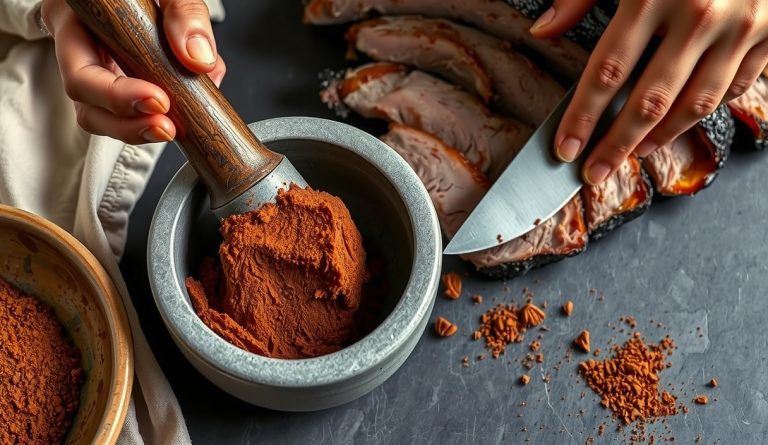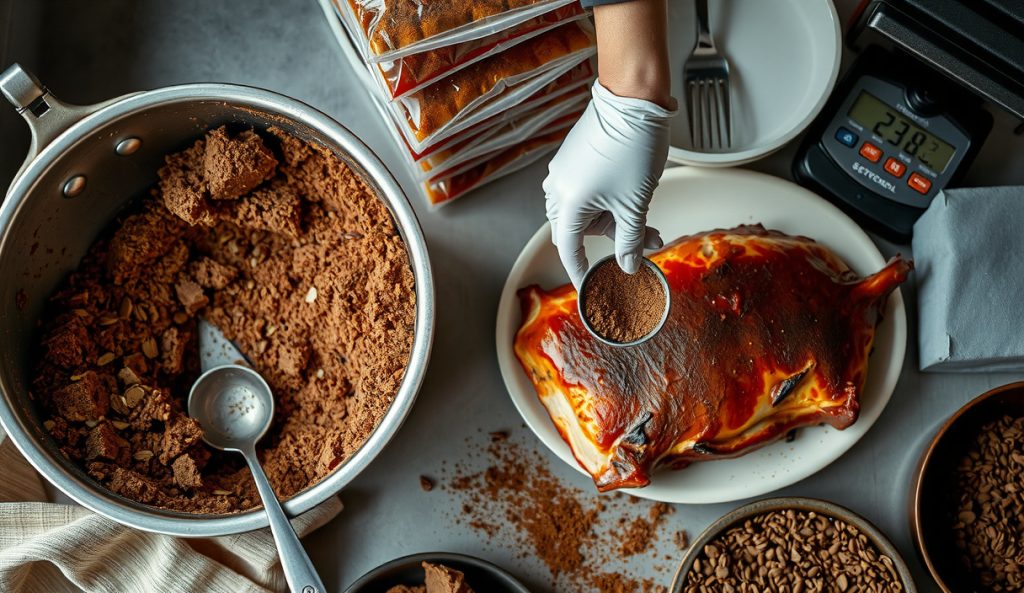
Catering a competition, supplying a restaurant prep kitchen, or staging a large event often requires rub quantities that dwarf the standard home batch. The Coffee-Cocoa Brisket Rub formula scales without modification — no ratio adjustments, no corrective additions — up to a hard ceiling of 2 kg of finished dry rub per mixed batch. Above that ceiling, the physical properties of the ingredients begin to work against uniformity and aromatic quality in ways that matter before you commit to a large pre-mix.
What changes when you scale above 2 kg per batch?
Above 2 kg per batch, particle-size stratification becomes a practical problem. Espresso grounds — particularly those ground to a commercial medium-fine — are significantly lighter and more irregularly shaped than the dense salt and sugar crystals in the blend. In transit, vibration causes differential settling: the heavier salt and sugar migrate to the bottom of the container while the coffee fraction floats toward the top. A rub applied from the top of a stratified container will be coffee-heavy; rub drawn from the bottom will be salt-heavy and missing the aromatic fraction almost entirely.
The fix is straightforward: mix the Coffee-Cocoa Brisket Rub in discrete batches not exceeding 2 kg each, and combine those batches in the storage container only at the point of use — not days in advance. Keeping individual batches at or under the 2 kg ceiling is the single most effective way to guarantee even distribution across a large prep run.
Shelf life is the second variable that changes at scale. The volatile aromatic fraction of dark-roasted espresso — primarily alkylpyrazines responsible for the fresh-roast character — degrades meaningfully within 6 weeks of grinding. This degradation is not a safety issue: the Maillard browning function of the coffee fraction remains chemically intact past that window. The crust will brown at the same rate, form the same texture, and deliver the same bark structure. But the fresh-roast aromatic pop that differentiates this rub from a generic coffee rub in the first two seconds of smell will have dissipated. For competitions, mix no more than 4–5 weeks before the event and store in sealed, airtight containers away from heat and light.
What stays the same at large batch sizes?
All ingredient ratios are identical to the canonical formula at any batch size up to the 2 kg ceiling. Application rate per kilogram of meat surface, resting time after application, and cook protocol are all unchanged. This page is a mixing and storage workflow note — not a reformulation of the Coffee-Cocoa Brisket Rub recipe.
Who actually needs this guidance?
This guidance matters most for competition teams running multiple briskets across a single event, catering operations preparing rub days or weeks in advance, and any context where a single mixed batch needs to travel or sit before use. If you are cooking a single brisket at home and mixing immediately before application, none of these constraints apply — use the canonical formula and skip this page.
All ingredient ratios and application instructions come from the original Coffee-Cocoa Brisket Rub — scale from those figures by weight.