Coffee-Cocoa Brisket Rub
Equipment
- 1 Kitchen scale Required — volume measurements produce unreliable salt percentages in this formula
- 1 Mixing bowl Medium, wide enough to whisk without spilling
- 1 Whisk or fork For thorough incorporation of fine and coarse particles
- 1 Airtight jar or container For storage; keeps for up to 6 weeks before volatile aromatics diminish
- 1 Offset smoker or kettle grill Post oak or 60/40 post oak–pecan recommended; target 250–265°F
- 1 Instant-read thermometer For monitoring internal temp through the stall; wrap at 165–170°F
Ingredients
Dry Rub
- 70 g fine-ground espresso 25% of blend by weight; freshly ground dark roast preferred, no flavored varieties
- 42 g Dutch-process cocoa powder 15% of blend; must be alkalized (pH 6.8–7.5); do not substitute natural cocoa
- 78 g Diamond Crystal kosher salt 28% of blend; reduce by 25% if using Morton kosher salt
- 42 g dark brown sugar 15% of blend; packed; provides free fructose-glucose for early-stage Maillard browning
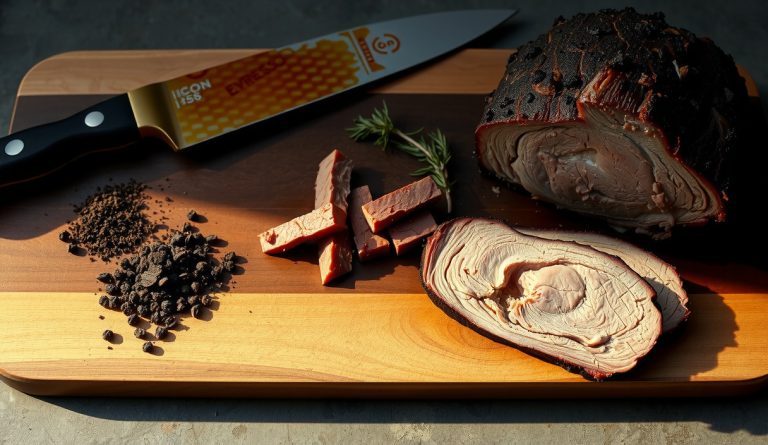
- 28 g coarse-ground black pepper 10% of blend; 16-mesh grind preferred for bark texture
- 20 g smoked paprika 7% of blend; adds carotenoid pigment and methyl pyrazine aromatics
- 14 g ancho chile powder 5% of blend; dried poblano at 1,000–2,000 SHU; do not substitute cayenne

Instructions
Mix the Rub
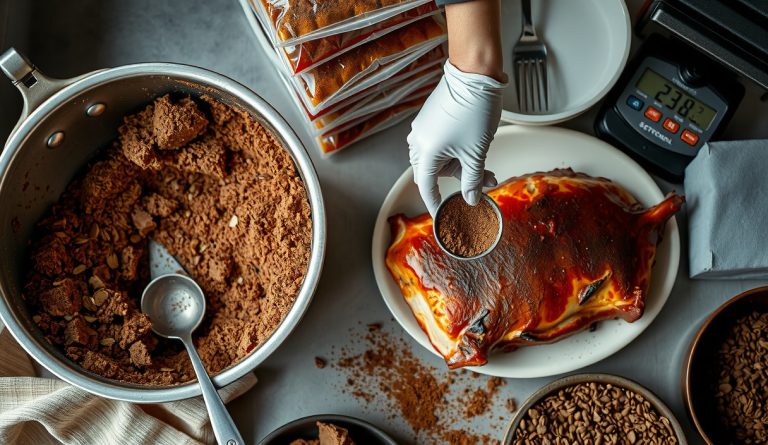
- Weigh each ingredient separately on a kitchen scale. Do not measure by volume — density mismatches between fine espresso and flake salt will throw the salt percentage off by up to 30% if you use tablespoons.42 g Dutch-process cocoa powder, 78 g Diamond Crystal kosher salt, 42 g dark brown sugar, 28 g coarse-ground black pepper, 20 g smoked paprika, 14 g ancho chile powder
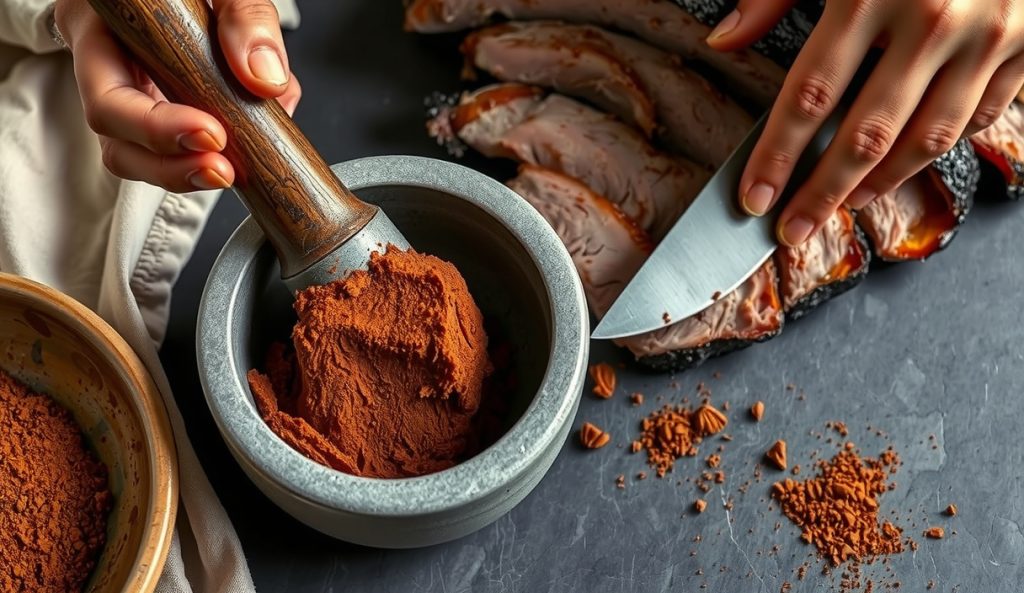
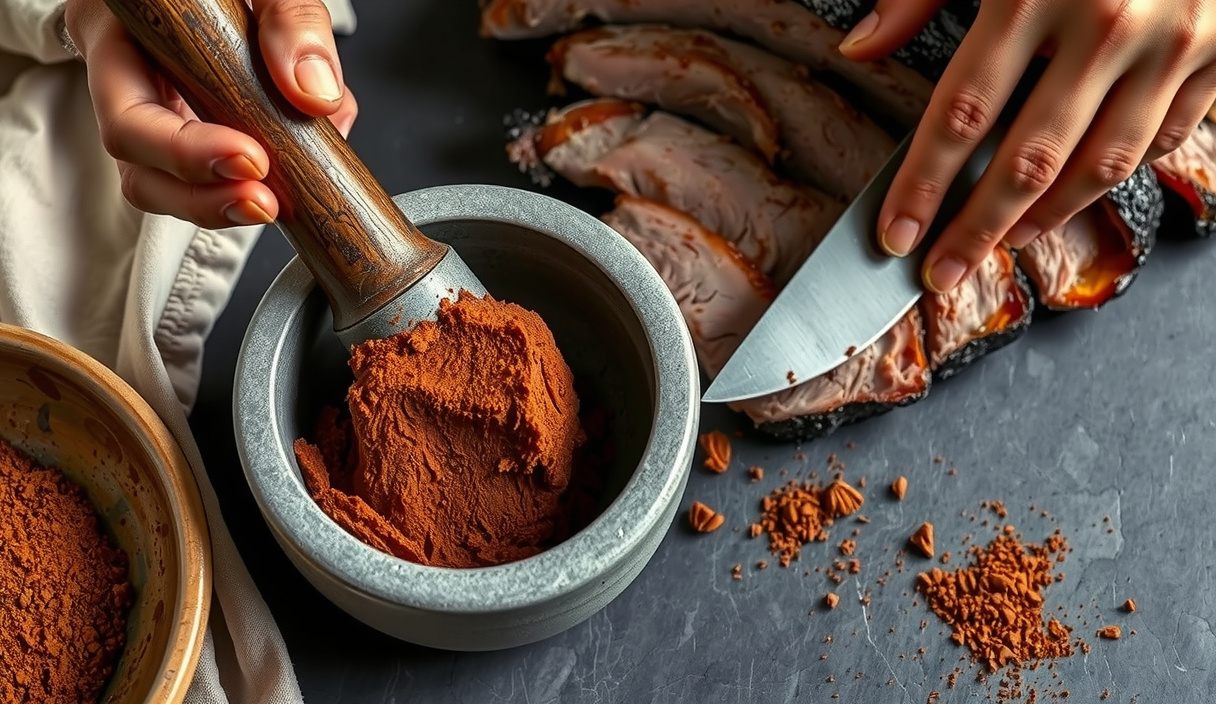
- Combine all ingredients in a medium mixing bowl. Whisk thoroughly for 90 seconds, lifting from the bottom, until the brown sugar has broken up into uniform fine particles and the blend shows no streaks of lighter or darker color. The finished rub should be a uniform dark brown-black with visible coarse pepper flakes.42 g Dutch-process cocoa powder, 78 g Diamond Crystal kosher salt, 42 g dark brown sugar, 28 g coarse-ground black pepper, 20 g smoked paprika, 14 g ancho chile powder
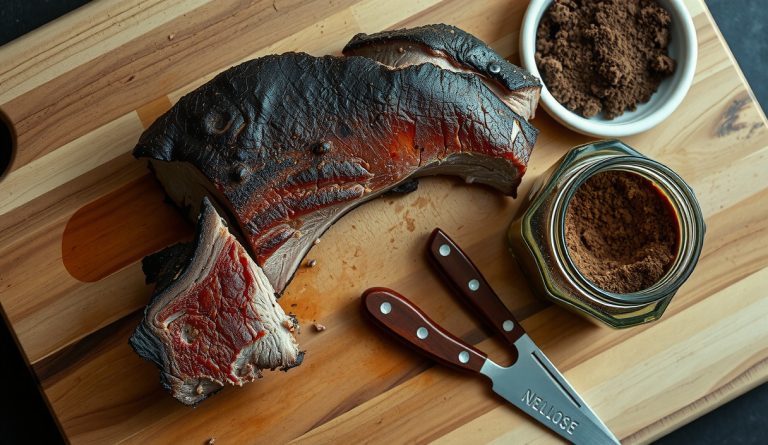
- Transfer to an airtight jar. The rub is ready to use immediately and will keep for up to 6 weeks at room temperature, away from heat and direct light. After 6 weeks the espresso fraction loses most of its volatile pyrazine contribution; the browning function persists but the aromatic depth diminishes.
Apply to Brisket
- Pat the brisket surface completely dry with paper towels. Moisture on the surface will prevent the first layer of rub from adhering and will delay bark formation. If the brisket came from a wet-aged cryovac, dry it uncovered in the refrigerator for 4–8 hours first.
- First pass: Apply a light, even coating of rub to all surfaces — fat cap, flat, and point. This layer gives the second pass something to adhere to. Apply 100–120g of rub total across a 12–16 lb brisket.42 g Dutch-process cocoa powder, 78 g Diamond Crystal kosher salt, 42 g dark brown sugar, 28 g coarse-ground black pepper, 20 g smoked paprika, 14 g ancho chile powder
- Second pass: Apply a more generous coat, pressing firmly with the flat of your hand rather than rubbing. Rubbing strips the first layer. Focus extra coverage on the flat where surface area is greatest and bark tends to set thinner.42 g Dutch-process cocoa powder, 78 g Diamond Crystal kosher salt, 42 g dark brown sugar, 28 g coarse-ground black pepper, 20 g smoked paprika, 14 g ancho chile powder
- Rest the rubbed brisket uncovered at room temperature for 60 minutes before placing in the smoker. During this rest, salt draws surface moisture osmotically, dropping surface water activity from approximately 0.98 toward the 0.70–0.80 range. This is the critical step that primes the surface for Maillard bark formation. Skipping this step means the first hour of smoke is spent steaming rather than browning.78 g Diamond Crystal kosher salt
Smoke
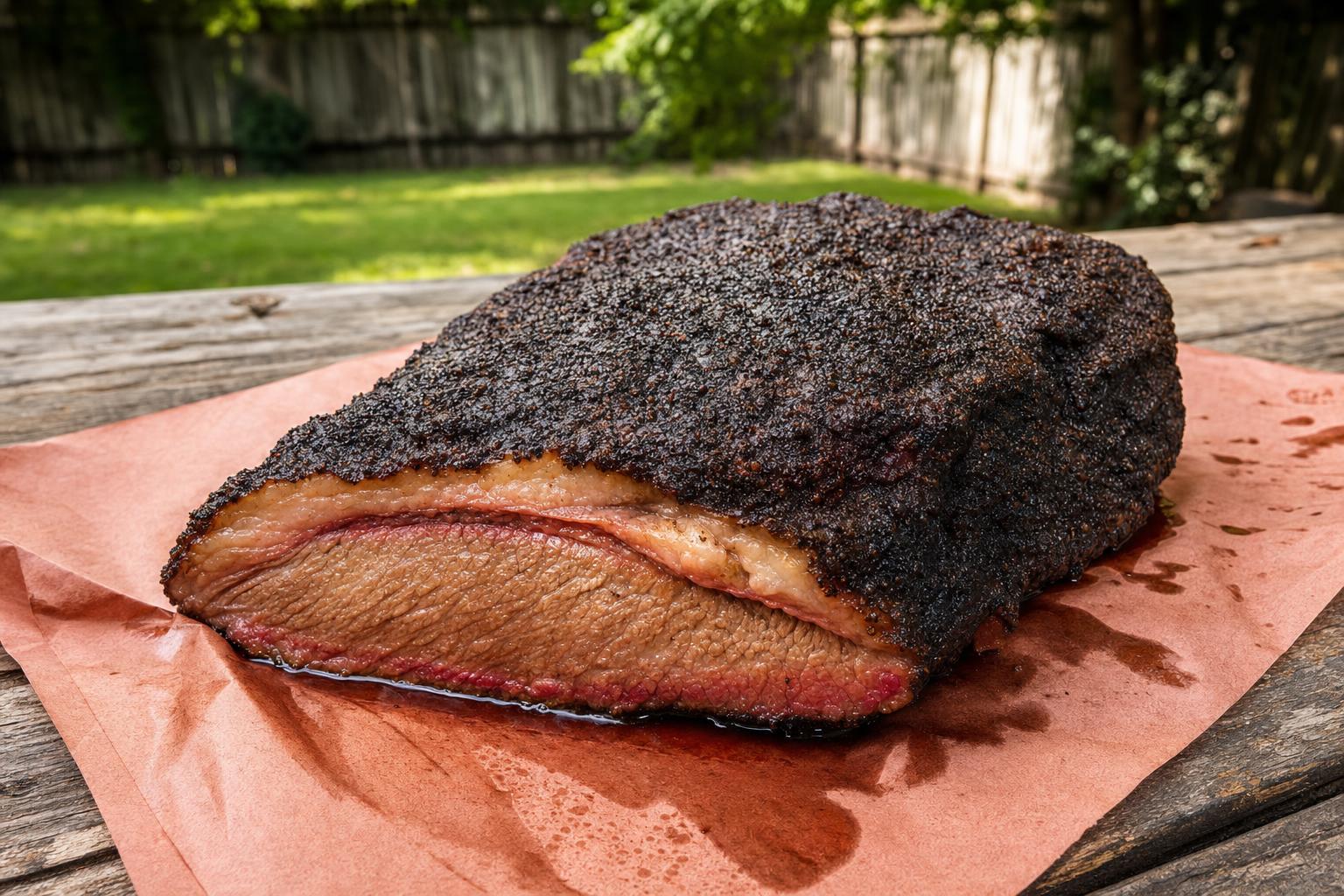
- Place the brisket fat-cap-up in a smoker running at 250–265°F with post oak or a post oak–pecan blend. Do not exceed 275°F — above this threshold the brown sugar fraction pyrolyzes past melanoidin development into acrid char before the bark can fully set.
- Do not spritz for the first 4 hours. Any added moisture resets surface water activity and suppresses the Maillard reaction just as the pyrazine-phenol crust is building. The bark will look alarmingly dark by hour 3 — this is the cocoa and espresso browning ahead of the meat proteins. This is correct.
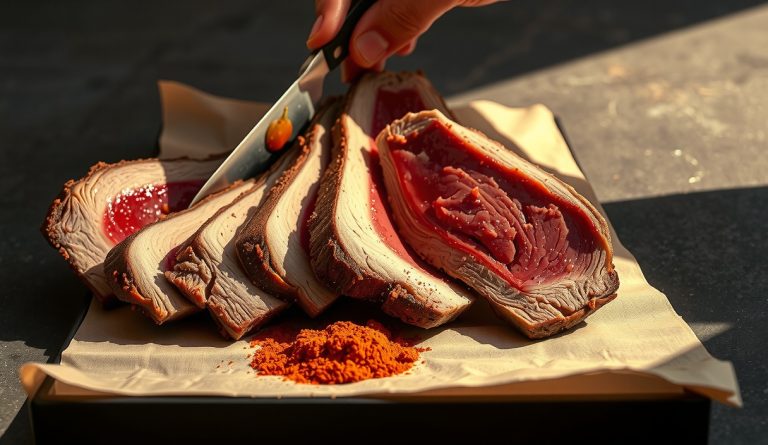
- Monitor internal temperature. The stall will occur at 160–170°F internal as evaporative cooling matches heat input. Do not wrap until the stall has broken or you reach 165–170°F. Wrap in unwaxed butcher paper (or foil for a softer bark) and continue cooking to 200–205°F internal. Rest wrapped for a minimum of 60 minutes — 90 minutes preferred — before slicing against the grain.
Notes
Nutrition
I have ruined plenty of briskets chasing a bark that looked the part but tasted one-dimensional — heavy smoke, a wall of salt, then nothing. The breakthrough came the day I stopped thinking about rubs as seasoning and started thinking about them as Maillard fuel. Ground espresso and Dutch-process cocoa are not gimmicks. They are dense matrices of amino acids, reducing sugars, and volatile precursors that react with the surface of a brisket in ways that black pepper and paprika simply cannot replicate on their own. This coffee-cocoa brisket rub is the result of working backward from the bark I wanted to the chemistry that creates it.
Why does a coffee-cocoa rub work on brisket? The science
The Maillard reaction drives bark formation on brisket, and it requires a surface water activity (aw) between 0.5 and 0.7 alongside temperatures well above 140°F. A cold brisket pulled straight from the refrigerator sits near 0.98 aw — far too wet for browning. The coffee-cocoa rub corrects that problem before the brisket ever touches the smoker.
Salt — held at roughly 28% of the dry blend by weight — draws moisture out of the brisket surface via osmotic pressure during the mandatory 1-hour pre-smoke rest, dropping aw to a browning-ready level. Ground espresso contributes free amino acids, particularly proline and alanine, plus residual reducing sugars carried over from the roasting process. Dutch-process cocoa adds its own Strecker-degradation precursors and a population of N-heterocyclic compounds that react under sustained heat to generate alkylpyrazines — specifically 2-ethyl-3,5-dimethylpyrazine and 2-methylpyrazine — the roasted, nutty, dark-chocolate aromatics you smell when a proper bark is developing. These pyrazines co-elute with the guaiacol and syringol phenols arriving from wood smoke, producing an aromatic synergy neither source achieves alone.
Ancho chile delivers capsaicinoids at sub-threshold concentrations — not enough heat for most palates to register as burn, but sufficient to activate TRPV1 channels in a way that amplifies perceived warmth and extends the finish. Smoked paprika contributes carotenoid pigments that deepen the bark’s mahogany color while adding methyl pyrazines and isovaleraldehyde to the aromatic stack. Brown sugar is functional, not decorative: the molasses fraction contains free fructose and glucose that enter the Maillard cascade around 250°F surface temperature — lower than sucrose alone — accelerating crust formation before the evaporative stall locks the brisket’s surface in a browning-suppression plateau. That stall occurs at roughly 160–170°F internal. Cook the brisket fat-side-up and resist any spritz until hour four; the fat cap acts as a self-basting lipid reservoir, and every early spritz pushes aw back into the browning-suppression zone.
Dutch-process cocoa is non-negotiable in this formula. Natural cocoa sits at pH 5.2–5.5; Dutch-process is alkalized to pH 6.8–7.5. That higher pH shifts the Maillard equilibrium toward faster condensation, deeper color, and a broader melanoidin spectrum. Natural cocoa at identical concentrations produces a lighter, more acidic bark with less roasted depth. The 15% cocoa and 25% espresso by weight in this formula are not arbitrary — drop espresso below 20% and the pyrazine contribution falls below the sensory threshold for the dark-roast character that separates this bark from every paprika-forward rub on the competition circuit.
What equipment and ingredients do I need?
Ground espresso: Use a fine espresso grind, not drip. Coarser grinds create a gritty texture that does not integrate into the bark. Pre-ground supermarket espresso works; freshly ground from a dark-roast bean is perceptibly better. Avoid flavored coffees — vanilla and hazelnut compounds volatilize at smoke temperatures and turn acrid.
Dutch-process cocoa: Look for “Dutched” or “alkalized” on the label. Valrhona, Droste, or Cacao Barry Extra Brute all perform well. Standard Hershey’s natural cocoa will work in a pinch, but the bark will be lighter and sharper in flavor.
Kosher salt: Diamond Crystal is the salt calibrated into this formula. If using Morton kosher salt, reduce the salt by 25% by weight — Morton is denser per unit volume, and the formula will read oversalted if you substitute by volume.
Ancho chile powder: Ancho (dried poblano) registers at 1,000–2,000 SHU and contributes brick-red pigment plus a dried-fruit depth that cayenne cannot replicate. Do not substitute cayenne at equal quantities — the capsaicin concentration in cayenne is approximately ten times higher.
Smoker setup: This coffee-cocoa rub performs best over post oak or a 60/40 post oak–pecan blend. Fruit woods such as apple or cherry produce a lighter phenol profile without the aromatic mass needed to balance the heavy pyrazine contribution from the coffee and cocoa. Target a smoker temperature of 250–265°F. Above 275°F, surface temperatures risk carbonizing the sugar fraction before melanoidin development is complete.
Coffee-Cocoa Brisket Rub
Equipment
- 1 Kitchen scale Required — volume measurements produce unreliable salt percentages in this formula
- 1 Mixing bowl Medium, wide enough to whisk without spilling
- 1 Whisk or fork For thorough incorporation of fine and coarse particles
- 1 Airtight jar or container For storage; keeps for up to 6 weeks before volatile aromatics diminish
- 1 Offset smoker or kettle grill Post oak or 60/40 post oak–pecan recommended; target 250–265°F
- 1 Instant-read thermometer For monitoring internal temp through the stall; wrap at 165–170°F
Ingredients
Dry Rub
- 70 g fine-ground espresso 25% of blend by weight; freshly ground dark roast preferred, no flavored varieties
- 42 g Dutch-process cocoa powder 15% of blend; must be alkalized (pH 6.8–7.5); do not substitute natural cocoa
- 78 g Diamond Crystal kosher salt 28% of blend; reduce by 25% if using Morton kosher salt
- 42 g dark brown sugar 15% of blend; packed; provides free fructose-glucose for early-stage Maillard browning
- 28 g coarse-ground black pepper 10% of blend; 16-mesh grind preferred for bark texture
- 20 g smoked paprika 7% of blend; adds carotenoid pigment and methyl pyrazine aromatics
- 14 g ancho chile powder 5% of blend; dried poblano at 1,000–2,000 SHU; do not substitute cayenne
Instructions
Mix the Rub
- Weigh each ingredient separately on a kitchen scale. Do not measure by volume — density mismatches between fine espresso and flake salt will throw the salt percentage off by up to 30% if you use tablespoons.42 g Dutch-process cocoa powder, 78 g Diamond Crystal kosher salt, 42 g dark brown sugar, 28 g coarse-ground black pepper, 20 g smoked paprika, 14 g ancho chile powder
- Combine all ingredients in a medium mixing bowl. Whisk thoroughly for 90 seconds, lifting from the bottom, until the brown sugar has broken up into uniform fine particles and the blend shows no streaks of lighter or darker color. The finished rub should be a uniform dark brown-black with visible coarse pepper flakes.42 g Dutch-process cocoa powder, 78 g Diamond Crystal kosher salt, 42 g dark brown sugar, 28 g coarse-ground black pepper, 20 g smoked paprika, 14 g ancho chile powder
- Transfer to an airtight jar. The rub is ready to use immediately and will keep for up to 6 weeks at room temperature, away from heat and direct light. After 6 weeks the espresso fraction loses most of its volatile pyrazine contribution; the browning function persists but the aromatic depth diminishes.
Apply to Brisket
- Pat the brisket surface completely dry with paper towels. Moisture on the surface will prevent the first layer of rub from adhering and will delay bark formation. If the brisket came from a wet-aged cryovac, dry it uncovered in the refrigerator for 4–8 hours first.
- First pass: Apply a light, even coating of rub to all surfaces — fat cap, flat, and point. This layer gives the second pass something to adhere to. Apply 100–120g of rub total across a 12–16 lb brisket.42 g Dutch-process cocoa powder, 78 g Diamond Crystal kosher salt, 42 g dark brown sugar, 28 g coarse-ground black pepper, 20 g smoked paprika, 14 g ancho chile powder
- Second pass: Apply a more generous coat, pressing firmly with the flat of your hand rather than rubbing. Rubbing strips the first layer. Focus extra coverage on the flat where surface area is greatest and bark tends to set thinner.42 g Dutch-process cocoa powder, 78 g Diamond Crystal kosher salt, 42 g dark brown sugar, 28 g coarse-ground black pepper, 20 g smoked paprika, 14 g ancho chile powder
- Rest the rubbed brisket uncovered at room temperature for 60 minutes before placing in the smoker. During this rest, salt draws surface moisture osmotically, dropping surface water activity from approximately 0.98 toward the 0.70–0.80 range. This is the critical step that primes the surface for Maillard bark formation. Skipping this step means the first hour of smoke is spent steaming rather than browning.78 g Diamond Crystal kosher salt
Smoke
- Place the brisket fat-cap-up in a smoker running at 250–265°F with post oak or a post oak–pecan blend. Do not exceed 275°F — above this threshold the brown sugar fraction pyrolyzes past melanoidin development into acrid char before the bark can fully set.
- Do not spritz for the first 4 hours. Any added moisture resets surface water activity and suppresses the Maillard reaction just as the pyrazine-phenol crust is building. The bark will look alarmingly dark by hour 3 — this is the cocoa and espresso browning ahead of the meat proteins. This is correct.
- Monitor internal temperature. The stall will occur at 160–170°F internal as evaporative cooling matches heat input. Do not wrap until the stall has broken or you reach 165–170°F. Wrap in unwaxed butcher paper (or foil for a softer bark) and continue cooking to 200–205°F internal. Rest wrapped for a minimum of 60 minutes — 90 minutes preferred — before slicing against the grain.
Notes
Nutrition
How do I nail this rub every time?
- Rest the rubbed brisket uncovered for at least 1 hour before smoking. The salt needs time to draw surface moisture out and partially reabsorb — this is the pellicle-equivalent step for bark development. Under 30 minutes, the bark will steam rather than sear during the first hour in the smoker.
- Do not spritz before the 4-hour mark. Early moisture application resets surface aw and suppresses the Maillard cascade just as it is building momentum. If the bark looks dark at hour 3, that is the Dutch-process cocoa and espresso browning ahead of the meat — trust the process.
- Watch for the sugar scorch line. At smoker temperatures above 275°F, the brown sugar fraction can pyrolyze past melanoidin development into acrid char. If the bark is jet-black rather than dark mahogany at the 6-hour mark, drop the smoker temperature 15–20°F and keep the fat cap up.
- Wrap at 165–170°F internal, not by the clock. Wrapping before the stall breaks traps steam and softens the bark. Wrapping too late extends the cook without benefit. A properly set bark going into the wrap will re-firm during the rest period.
- Scale this recipe by weight, not volume. The density mismatch between fine espresso grind and flake salt is substantial — a tablespoon of espresso weighs roughly 5g while a tablespoon of Diamond Crystal kosher salt weighs roughly 7g. Scaling by volume will throw the salt percentage off significantly.
- Apply the rub in two passes on a cold brisket. The first pass is light — just enough to give the second pass something to adhere to. Press, do not rub, the second application so the first layer is not dislodged.
What variations can I try with this rub?
Competition-style heat addition: Add 1 teaspoon of chipotle powder and reduce the ancho by half. Chipotle contributes a smoked-pepper phenol load that amplifies wood smoke character and pushes heat to a level most judges perceive as lingering warmth rather than burn. Keep the brown sugar constant — reducing it to chase a cleaner flavor profile sacrifices the fructose-glucose browning acceleration that makes this rub generate bark quickly.
No-sugar bark for ketogenic compatibility: Replace the brown sugar with an equal weight of fine-ground allulose. Allulose is a C-3 epimer of fructose and participates in the Maillard cascade beginning around 230°F surface temperature — actually more aggressive than brown sugar at standard smoker temperatures. Reduce the smoker setpoint to 245°F and monitor the bark closely after hour 3. Because the bark will look darker earlier with allulose, use internal temperature rather than bark color to decide on the wrap.
Texas minimalist variant: Pull the cocoa, ancho, and smoked paprika entirely. Increase espresso to 35% of the blend, hold salt at 28%, raise coarse-ground black pepper to 25%, and fill the remaining 12% with fine garlic powder. This is a coffee-forward take on the classic Central Texas salt-and-pepper profile — still Maillard-engineered but without the color depth and dried-fruit sweetness of the full formula. The pyrazine contribution from the espresso still synergizes with post oak phenols; the cocoa-sourced furanone layer is simply absent.
Scaling for competition quantity: This formula scales linearly by weight with no modification needed for batches up to 2 kg of dry rub. Above 2 kg, the fine espresso grind tends to settle and stratify from the heavier salt and sugar particles in transit. Mix in separate batches and store in sealed containers away from heat. Rub older than 6 weeks will have lost most of its volatile aromatic contribution from the espresso fraction — the Maillard browning function remains intact, but the fresh-roast pyrazine pop diminishes noticeably.
Frequently asked questions about coffee-cocoa brisket rub
Can I use this rub on cuts other than brisket? This rub works exceptionally well on beef short ribs and chuck roast — any cut with sufficient fat and collagen to survive a long smoke. The sugar fraction can scorch on lean, fast-cooking cuts like flank or skirt steak. On those cuts, reduce or eliminate the brown sugar and apply the rub no more than 30 minutes before cooking.
Will the brisket taste like coffee or chocolate? No — and this surprises most people. At the concentrations in this formula, after 10–14 hours at smoke temperature, the espresso and cocoa have undergone enough Maillard transformation that neither registers as a discrete ingredient. What you taste is roasted depth, a savory-sweet bark with caramel undertones, and a finish that lingers longer than a conventional pepper rub delivers. If someone identifies coffee or chocolate flavor in a blind taste test, the rub was almost certainly applied too thick or the cook temperature ran too high.
My bark looks very dark at hour 3 — is it burning? Almost certainly not at 250–265°F. Dutch-process cocoa and espresso are already deeply pigmented materials; the bark will look intimidatingly dark long before it is fully set. Press a gloved finger firmly into the surface — if it feels tacky and springs back slightly, bark is building correctly. If it feels crispy and brittle, the smoker may be running hot. A bark that has genuinely burned will smell acrid and bitter at close range; a properly developing bark smells of roasted chocolate, coffee, and wood smoke together.