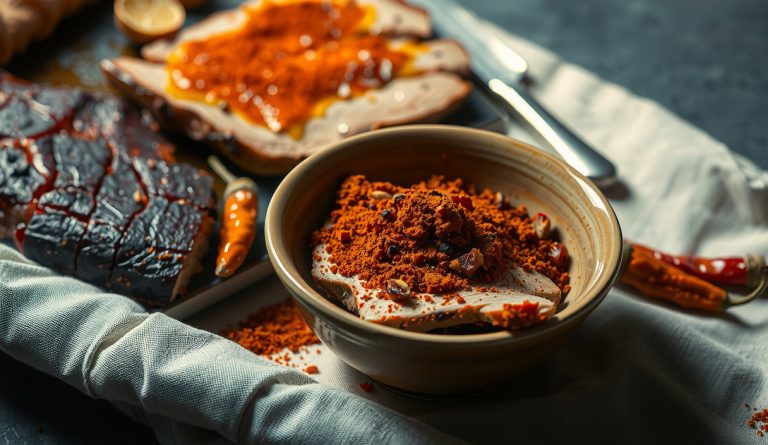
Low-Sodium BBQ Rub — Smoked Paprika-Forward

Equipment
- 1 Spice grinder or clean coffee grinder For grinding dried mushrooms to a fine, flour-like powder — 150–200 micron target particle size
- 1 Fine mesh strainer Optional — screens out coarse mushroom flecks that can scorch at high heat
- 1 Digital kitchen scale Strongly recommended for precision on the KCl-to-NaCl ratio; small measurement errors shift the formula into the metallic-bitter zone
- 1 Airtight glass jar or sealed spice shaker 8 oz / 250 mL capacity; light and oxygen degrade volatile aromatics — keep sealed and dark
- 1 Mixing bowl Medium size, for combining all components
Ingredients
Salt System
- 1.5 tsp fine sea salt (sodium chloride, NaCl) Approximately 2,340 mg sodium total in the full batch — spreads to about 87 mg per 2-tsp serving; use fine-grain for even dispersion
- 0.75 tsp potassium chloride (KCl salt substitute) Nu-Salt, Morton Salt Substitute, or NoSalt brand; this sets KCl at approximately 30% of total chloride equivalents — do not exceed 1 tsp or bitterness crosses detection threshold
Umami Masking Layer
- 2 tsp dried porcini or shiitake mushroom powder Grind whole dried mushrooms in a spice grinder until flour-fine; porcini delivers higher free glutamate density; pass through a fine mesh strainer to remove coarse fragments
Aromatic Spice Base
- 4 tbsp smoked paprika Spanish pimentón de la Vera bittersweet (agridulce) grade strongly preferred — cold-smoked over oak, delivering dense Maillard melanoidins; do not substitute Hungarian paprika
- 1.5 tbsp ground cumin Freshly ground from whole seeds is ideal; contributes pyrazines for nutty, earthy depth
- 1.5 tbsp freshly ground black pepper Medium-coarse grind (approx. 1.0–1.5 mm); provides piperine for trigeminal TRPV1 activation, extending perceived flavor intensity; grind fresh for maximum volatile retention
- 1 tbsp garlic powder Not garlic salt — pure dried garlic; adds allium sulfur compounds and Amadori-product precursors for Maillard reactivity on the meat surface
- 1 tbsp onion powder Pure dried onion; reinforces allium aromatic base; synergizes with garlic’s sulfur volatiles
- 1 tsp ground coriander Adds citrus-floral linalool top notes that brighten the dense spice base
- 1 tsp dry mustard powder Provides mild isothiocyanate-driven pungency and acts as a natural emulsifier on the meat surface pellicle, helping the rub adhere
- 0.5 tsp cayenne pepper Optional but recommended; low-dose capsaicin adds background heat that further activates TRPV1 receptors, amplifying overall flavor intensity without perceivable spiciness at this level
Bark Development
- 1 tbsp dark brown sugar Provides reducing sugars for Maillard cascade onset and caramelization above 230°F; moisture from molasses content helps the rub bind to the pellicle — reduce to 1.5 tsp for hot-and-fast cooks above 325°F to prevent over-charring

Instructions
Prepare Mushroom Powder
- Place dried porcini or shiitake mushrooms in a clean spice grinder. Grind in 10-second pulses until the mushrooms reach a fine, flour-like consistency. Pass through a fine mesh strainer into your mixing bowl, discarding any coarse fragments. Target particle size is 150–200 microns — visible flecks will scorch on the grill before contributing flavor.2 tsp dried porcini or shiitake mushroom powder
Combine the Salt System
- Add the fine sea salt and potassium chloride to the mushroom powder in the mixing bowl. Whisk together thoroughly. This NaCl-to-KCl ratio (approximately 70:30 by chloride equivalents) is the critical control point of this formula. Too much KCl yields metallic bitterness; too little undermines the sodium reduction. Mix these three components first so the KCl is fully dispersed before the spices go in.0.75 tsp potassium chloride (KCl salt substitute), 2 tsp dried porcini or shiitake mushroom powder
Add Aromatic Spices
- Add the smoked paprika, ground cumin, freshly ground black pepper, garlic powder, onion powder, ground coriander, dry mustard powder, and cayenne (if using) to the bowl. Grind black pepper fresh immediately before adding — pre-ground loses up to 60% of its volatile aromatics within two weeks of opening.4 tbsp smoked paprika, 1.5 tbsp ground cumin, 1.5 tbsp freshly ground black pepper, 1 tbsp garlic powder, 1 tbsp onion powder, 1 tsp ground coriander, 1 tsp dry mustard powder, 0.5 tsp cayenne pepper
Add Brown Sugar and Finish
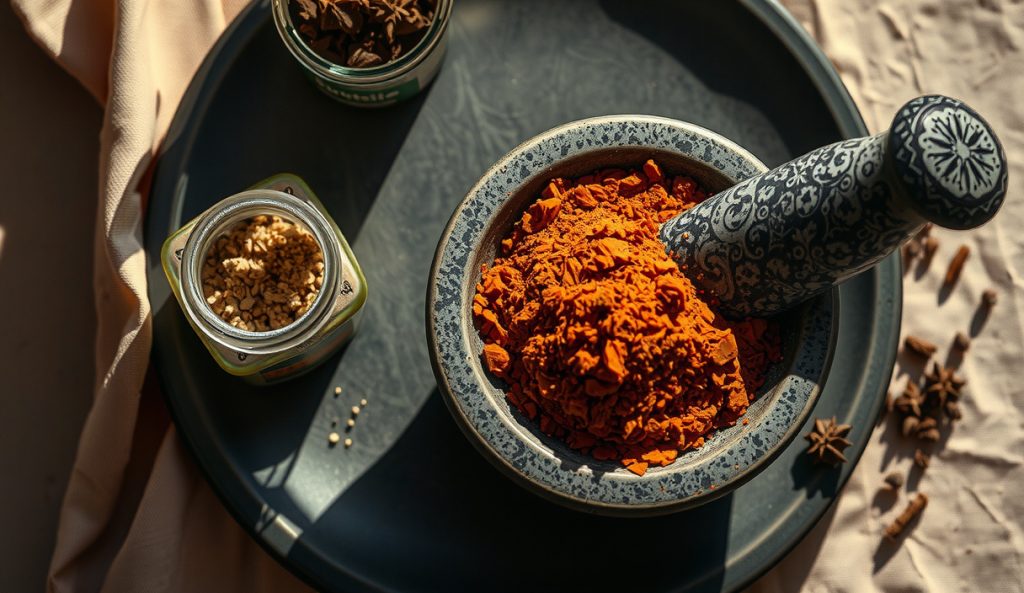
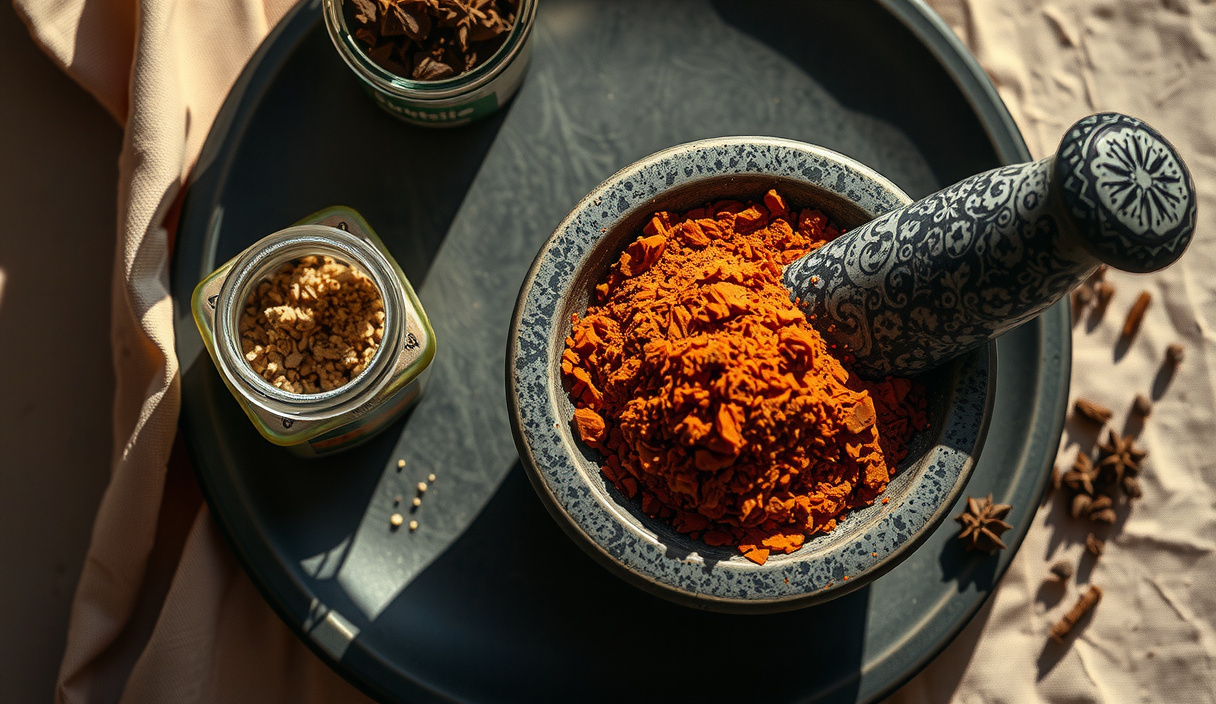
- Add the dark brown sugar. Using a fork or small whisk, work through any clumps from the brown sugar — it tends to compact. Mix all components together for 60–90 seconds until the color is uniform and no unmixed pockets of white salt or dark sugar remain. The finished rub should appear deep brick-red throughout.1 tbsp dark brown sugar
Store and Apply
- Transfer the rub to an airtight glass jar or sealed shaker. Store in a cool, dark pantry — maximum shelf life is approximately 90 days before volatile aromatic degradation (primarily paprika and cumin) begins to noticeably flatten the profile. Label with the date.
- To apply: Pat the protein completely dry with paper towels. Apply 2 teaspoons per pound of meat and press firmly so the rub adheres. Rest uncovered on a rack in the refrigerator for 30–60 minutes before cooking to allow the pellicle to form and the rub to bond to the surface. Do not taste the rub dry off the spoon to assess saltiness — dry spice concentrations always taste flat until heat and moisture activate the full flavor cascade.
Notes
Nutrition
Every great pit master knows a rub is not just seasoning — it is architecture. Salt is the mortar that holds the flavor scaffold together, binding aroma compounds to the protein surface, drawing moisture from the interior to create a tacky pellicle that smoke can grip. Strip the sodium, and the whole structure seems to collapse: flavors flatten, the crust loses definition, and everything tastes like it is behind glass. But that perception — and it is purely a perception — can be re-engineered at the molecular level. This low-sodium BBQ rub does exactly that.
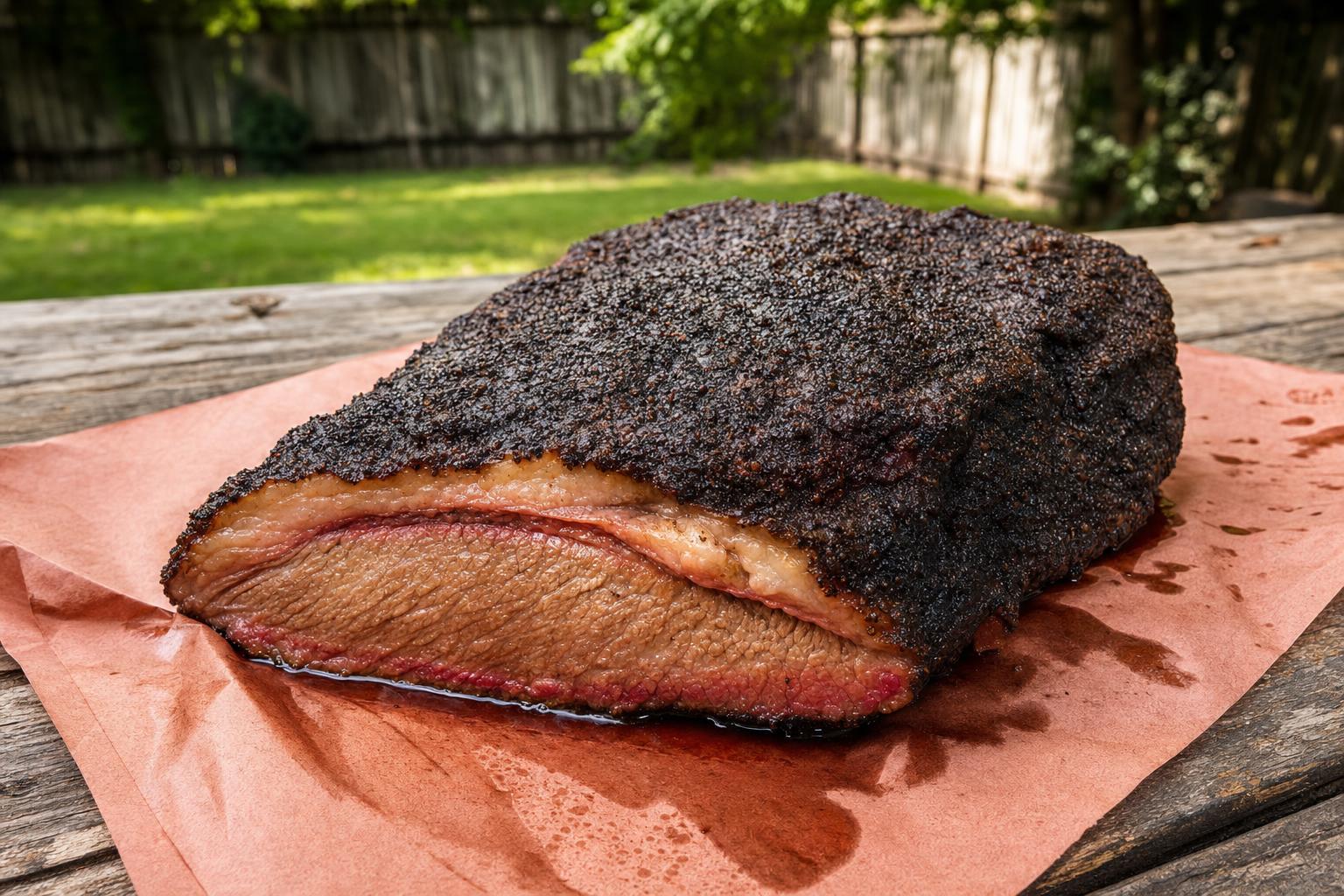
This formula was built to serve guests managing hypertension without telling them anything different was on the brisket. They asked for the recipe before the meal was over. The sodium budget runs under 90 mg per two-teaspoon serving versus the 400-plus mg of a standard rub — roughly a 75% reduction — while the perceived saltiness, savory depth, and aromatic punch register at full throttle. The mechanism is not magic. It is food physics.
Why does a low-sodium BBQ rub actually work? The science
The backbone of low-sodium rub reformulation is potassium chloride (KCl), and most home attempts fail for one simple reason: KCl at a 1:1 NaCl substitution ratio tastes metallic and bitter. The fix is partial substitution — approximately 30% of the chloride ions come from KCl, 70% from a reduced-dose NaCl — combined with an aggressive masking strategy at the sensory layer. KCl engages the same ion channels on taste receptor cells as NaCl does (ENaC — epithelial sodium channels), partially satisfying the saltiness signal without the full sodium load.
The bitter off-note of potassium is not a chemical flaw you work around; it is a psychophysical sensitivity threshold you work below. Keep KCl under roughly 35% of total chloride equivalents and the bitterness remains sub-threshold for most palates. This single ratio — 30% KCl, 70% NaCl — is the structural decision that makes or breaks a low-sodium rub.
The deeper mechanism operates at the glutamate layer. Dried porcini or shiitake mushroom powder carries free L-glutamic acid concentrations in the range of 1,500–3,000 mg per 100 g — comparable to Parmesan. Glutamate binds the T1R1/T1R3 heterodimer umami receptor, but its secondary function is the critical one here: it dramatically heightens the perceived intensity of adjacent tastes, including saltiness. This is cross-modal sensory enhancement. A 0.5–1.0% w/w dose of mushroom powder in a dry rub matrix introduces enough free glutamate to shift the salt perception curve upward — meaning the brain registers more salt signal from less actual sodium chloride.
At the physiological level, glutamate also activates NMDA-type receptors distributed along the pharyngeal epithelium, extending the temporal persistence of savoriness and creating what trained sensory panelists call kokumi — the sensation of depth, thickness, and continuity that normally only fat and salt can produce. The Maillard reaction completes the third pillar. Smoked paprika carries pre-formed Maillard melanoidins from the drying process — complex aminocarbonyl polymers that deliver roasted, bitter-sweet aromatic complexity. When the rub contacts a 250–300°F smoker surface or a searing grate at 450°F and above, those precursors cascade further. Cumin contributes pyrazines (nutty, earthy), black pepper delivers piperine (which activates TRPV1 receptors for mild heat that amplifies overall flavor intensity via trigeminal chemesthesis), and the trace sugars in smoked paprika accelerate crust formation at the muscle surface, driving bark development. The combined effect is a flavor system so dense and multidimensional that the sodium deficit vanishes in the noise.
What equipment and ingredients do I need?
Potassium chloride (KCl): Sold as Nu-Salt, Morton Salt Substitute, or NoSalt at most grocery stores. Do not exceed 30% of total chloride equivalents. At higher ratios, the bitter aftertaste crosses the detection threshold on most palates, especially in a dry rub where there is no fat phase to buffer it.
Mushroom powder: Dried porcini delivers the highest free glutamate density. Dried shiitake runs second and adds a faint woodsy note that complements smoke beautifully. Buy whole dried mushrooms and grind them in a spice grinder to 150–200 micron particle size — fine enough to integrate into the rub without visible flecks. Pre-ground versions work but oxidize quickly; store any opened container airtight and use within 30 days.
Smoked paprika: Spanish pimentón de la Vera (Denominación de Origen) is the benchmark — cold-smoked over oak for up to two weeks, yielding a water activity (aw) low enough for shelf stability and a volatile aromatic profile orders of magnitude richer than domestic alternatives. Bittersweet (agridulce) is the most versatile grade. Avoid Hungarian paprika here — it is not smoked.
Black pepper: Freshly ground to a medium-coarse setting (1.0–1.5 mm particle) maximizes piperine and terpene (limonene, sabinene) surface area. Pre-ground pepper loses 40–60% of its volatiles within two weeks of grinding.
Spice grinder and jar: A clean coffee grinder is sufficient for the mushroom powder step. A mason jar or sealed shaker bottle stores the finished rub. Light and oxygen are the enemies — keep the container dark and sealed at all times.
Low-Sodium BBQ Rub — Smoked Paprika-Forward
Equipment
- 1 Spice grinder or clean coffee grinder For grinding dried mushrooms to a fine, flour-like powder — 150–200 micron target particle size
- 1 Fine mesh strainer Optional — screens out coarse mushroom flecks that can scorch at high heat
- 1 Digital kitchen scale Strongly recommended for precision on the KCl-to-NaCl ratio; small measurement errors shift the formula into the metallic-bitter zone
- 1 Airtight glass jar or sealed spice shaker 8 oz / 250 mL capacity; light and oxygen degrade volatile aromatics — keep sealed and dark
- 1 Mixing bowl Medium size, for combining all components
Ingredients
Salt System
- 1.5 tsp fine sea salt (sodium chloride, NaCl) Approximately 2,340 mg sodium total in the full batch — spreads to about 87 mg per 2-tsp serving; use fine-grain for even dispersion
- 0.75 tsp potassium chloride (KCl salt substitute) Nu-Salt, Morton Salt Substitute, or NoSalt brand; this sets KCl at approximately 30% of total chloride equivalents — do not exceed 1 tsp or bitterness crosses detection threshold
Umami Masking Layer
- 2 tsp dried porcini or shiitake mushroom powder Grind whole dried mushrooms in a spice grinder until flour-fine; porcini delivers higher free glutamate density; pass through a fine mesh strainer to remove coarse fragments
Aromatic Spice Base
- 4 tbsp smoked paprika Spanish pimentón de la Vera bittersweet (agridulce) grade strongly preferred — cold-smoked over oak, delivering dense Maillard melanoidins; do not substitute Hungarian paprika
- 1.5 tbsp ground cumin Freshly ground from whole seeds is ideal; contributes pyrazines for nutty, earthy depth
- 1.5 tbsp freshly ground black pepper Medium-coarse grind (approx. 1.0–1.5 mm); provides piperine for trigeminal TRPV1 activation, extending perceived flavor intensity; grind fresh for maximum volatile retention
- 1 tbsp garlic powder Not garlic salt — pure dried garlic; adds allium sulfur compounds and Amadori-product precursors for Maillard reactivity on the meat surface
- 1 tbsp onion powder Pure dried onion; reinforces allium aromatic base; synergizes with garlic’s sulfur volatiles
- 1 tsp ground coriander Adds citrus-floral linalool top notes that brighten the dense spice base
- 1 tsp dry mustard powder Provides mild isothiocyanate-driven pungency and acts as a natural emulsifier on the meat surface pellicle, helping the rub adhere
- 0.5 tsp cayenne pepper Optional but recommended; low-dose capsaicin adds background heat that further activates TRPV1 receptors, amplifying overall flavor intensity without perceivable spiciness at this level
Bark Development
- 1 tbsp dark brown sugar Provides reducing sugars for Maillard cascade onset and caramelization above 230°F; moisture from molasses content helps the rub bind to the pellicle — reduce to 1.5 tsp for hot-and-fast cooks above 325°F to prevent over-charring
Instructions
Prepare Mushroom Powder
- Place dried porcini or shiitake mushrooms in a clean spice grinder. Grind in 10-second pulses until the mushrooms reach a fine, flour-like consistency. Pass through a fine mesh strainer into your mixing bowl, discarding any coarse fragments. Target particle size is 150–200 microns — visible flecks will scorch on the grill before contributing flavor.2 tsp dried porcini or shiitake mushroom powder
Combine the Salt System
- Add the fine sea salt and potassium chloride to the mushroom powder in the mixing bowl. Whisk together thoroughly. This NaCl-to-KCl ratio (approximately 70:30 by chloride equivalents) is the critical control point of this formula. Too much KCl yields metallic bitterness; too little undermines the sodium reduction. Mix these three components first so the KCl is fully dispersed before the spices go in.0.75 tsp potassium chloride (KCl salt substitute), 2 tsp dried porcini or shiitake mushroom powder
Add Aromatic Spices
- Add the smoked paprika, ground cumin, freshly ground black pepper, garlic powder, onion powder, ground coriander, dry mustard powder, and cayenne (if using) to the bowl. Grind black pepper fresh immediately before adding — pre-ground loses up to 60% of its volatile aromatics within two weeks of opening.4 tbsp smoked paprika, 1.5 tbsp ground cumin, 1.5 tbsp freshly ground black pepper, 1 tbsp garlic powder, 1 tbsp onion powder, 1 tsp ground coriander, 1 tsp dry mustard powder, 0.5 tsp cayenne pepper
Add Brown Sugar and Finish
- Add the dark brown sugar. Using a fork or small whisk, work through any clumps from the brown sugar — it tends to compact. Mix all components together for 60–90 seconds until the color is uniform and no unmixed pockets of white salt or dark sugar remain. The finished rub should appear deep brick-red throughout.1 tbsp dark brown sugar
Store and Apply
- Transfer the rub to an airtight glass jar or sealed shaker. Store in a cool, dark pantry — maximum shelf life is approximately 90 days before volatile aromatic degradation (primarily paprika and cumin) begins to noticeably flatten the profile. Label with the date.
- To apply: Pat the protein completely dry with paper towels. Apply 2 teaspoons per pound of meat and press firmly so the rub adheres. Rest uncovered on a rack in the refrigerator for 30–60 minutes before cooking to allow the pellicle to form and the rub to bond to the surface. Do not taste the rub dry off the spoon to assess saltiness — dry spice concentrations always taste flat until heat and moisture activate the full flavor cascade.
Notes
Nutrition
How do I nail it every time? Tips for success
- Do not taste the rub dry off the spoon to judge saltiness. Dry rubs are extremely concentrated and will always taste under-seasoned until they are on protein and heat has been applied. Apply 2 teaspoons per pound of meat and trust the formula.
- Apply the rub to a dry surface for maximum bark development. Pat the meat completely dry with paper towels before rubbing. Surface moisture activates the KCl and mushroom powder immediately, pulling soluble compounds into the surface liquid before the pellicle can form. Dry application followed by a 30–60 minute uncovered rest in the fridge drives better crust development.
- The KCl bitter window is temperature-sensitive. KCl bitterness is more perceptible at lower serving temperatures. If cold-smoking fish or serving at room temperature, reduce KCl to 20% of the chloride budget and compensate with an additional 0.5% mushroom powder.
- Watch the bark at high heat. The sugars in smoked paprika caramelize rapidly above 325°F. For hot-and-fast cooks above 300°F, reduce the smoked paprika by 20% or tent with foil after bark sets to prevent char crossing into acrid territory.
- Mushroom powder particle size matters. If the powder is too coarse (visible flakes), it will burn on high-heat surfaces before the spice chemistry can contribute. Aim for a fine, flour-like consistency — screen through a mesh strainer if the grinder leaves chunks.
- Scale this rub in batch. The ratio math is dialed in for 0.5 cup batches or larger. Smaller batches introduce measurement error that shifts the KCl percentage, either into the metallic-bitter zone or below the effective masking threshold.
How can I adapt this rub for different proteins and cook styles?
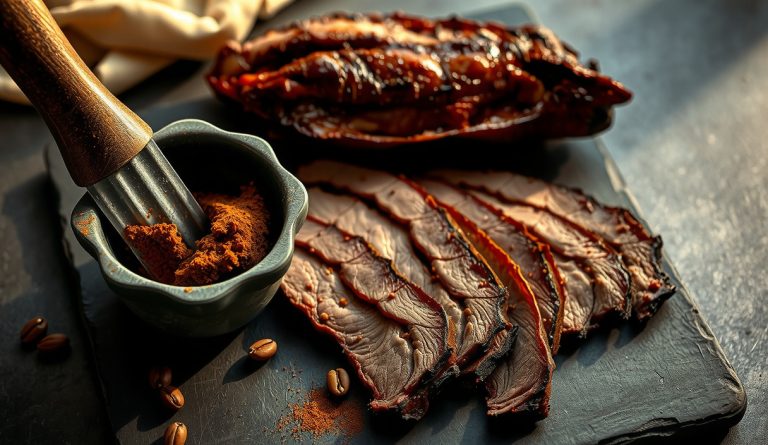
Coffee-forward variant: Replace 1 tablespoon of the smoked paprika with finely ground medium-roast coffee (espresso grind). The added caffeoylquinic acids and pyrazines stack with cumin’s existing pyrazine profile, deepening the earthy-roasted character. This variant is particularly excellent on beef brisket and pork shoulder. The mushroom powder dose stays constant — the glutamate masking strategy is unchanged.
Chipotle heat variant: Add 1.5 teaspoons of chipotle powder and reduce black pepper by 1 teaspoon. Chipotle provides both capsaicin-driven TRPV1 activation and additional smoke-derived Maillard compounds. The net effect is a hotter, more complex bark with a longer trigeminal finish. Keep total heat compounds (capsaicin plus piperine) balanced — too much TRPV1 activation desensitizes the palate to other flavors.
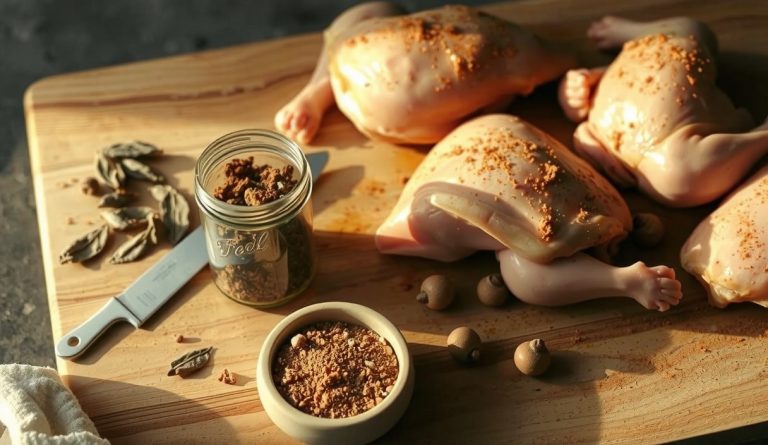
Poultry-specific build: Cut the black pepper to 1 teaspoon, add 1 teaspoon each of dried thyme and dried sage, and increase the mushroom powder to 3 teaspoons. The additional glutamate compensates for the lower fat content of chicken and turkey, which would otherwise leave the flavor profile feeling thin. The herb terpenes (thymol, carvacrol) add a resinous aromatic note that pairs with smoke better than pepper does at poultry internal temperatures of 160–165°F.
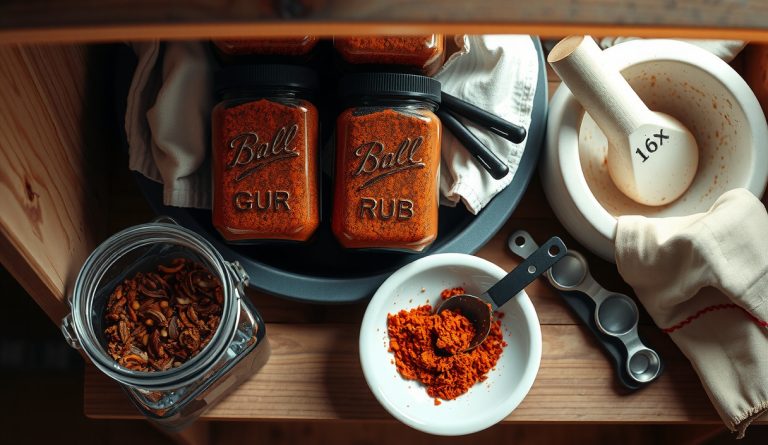
Scaling for a competition cook: This rub scales linearly to any batch size. For a full competition prep covering 8–10 briskets and 12 pork butts, multiply by 16x and store in airtight 1-quart containers. Shelf life at room temperature in a dark pantry runs approximately 90 days before volatile aromatic degradation begins to noticeably flatten the flavor profile — plan batch timing accordingly.
Frequently asked questions
Can I use a commercial low-sodium salt blend instead of measuring NaCl and KCl separately? Yes, with caution. Commercial low-sodium salt blends vary widely in their NaCl-to-KCl ratios, typically ranging from 50/50 to 75/25 KCl-heavy. Check the label. If the blend is more than 40% KCl, the rub will cross the bitterness threshold — reduce the total salt component by 20% and increase mushroom powder by 0.5 teaspoon to compensate perceptually.
Will this low-sodium BBQ rub work as an everyday seasoning salt, not just for BBQ? Absolutely. The formula is balanced for high-heat environments but performs well at any temperature. Use it on roasted vegetables, scrambled eggs, or as a finishing rub on seared fish. The mushroom glutamate is particularly effective in lower-fat cooking contexts where there is no lipid phase to carry flavor — it compensates by extending savory persistence through the umami receptor pathway.
How long does the mushroom powder stay effective once the rub is blended and stored? Free glutamate in dried mushroom powder is chemically stable at low water activity (aw below 0.3, which a sealed rub jar should maintain). What degrades first are the volatile aromatic compounds in the smoked paprika, cumin, and pepper — not the glutamate. The umami-masking performance of this rub remains intact long after the aromatics begin to fade, which is why the 90-day shelf life recommendation is aroma-driven rather than glutamate-driven.