Alabama White BBQ Sauce

Equipment
- 1 Medium mixing bowl At least 1.5 qt capacity to prevent splashing during whisking
- 1 Balloon whisk Low-shear tool is ideal; do not use a high-speed blender which can destabilize the mayo emulsion
- 1 set Measuring cups and spoons
- 1 Glass jar with lid 16 oz or larger for storage; glass prevents off-flavor absorption
- 1 Mortar and pestle or zip-lock bag and heavy pan For cracking whole black peppercorns to approximately 16-mesh — coarser than pre-ground
Ingredients
- 1 cup full-fat mayonnaise Hellmann’s, Best Foods, or Duke’s recommended; reduced-fat will produce a thinner, less stable emulsion
- 3 tablespoons apple cider vinegar Unfiltered, 5% acidity preferred; add gradually to preserve the emulsion
- 1 tablespoon prepared horseradish Drained of excess liquid; not horseradish sauce or cream
- 1 tablespoon fresh lemon juice From approximately half a lemon; adds citric acid brightness distinct from acetic acid
- 1 teaspoon coarsely cracked black pepper Crack whole peppercorns fresh for maximum piperine punch; pre-ground is a poor substitute
- 1 teaspoon granulated white sugar
- 1 teaspoon kosher salt
- 1 teaspoon Dijon mustard Optional but recommended; adds amphiphilic mustard proteins that reinforce emulsion stability and add complexity
- ½ teaspoon garlic powder
- ¼ teaspoon cayenne pepper Optional; adds TRPV1 capsaicin heat to complement the TRPA1 horseradish heat

Instructions
- Measure the mayonnaise into a medium mixing bowl. Whisk briefly to loosen and ensure it is at a uniform, smooth consistency before adding any liquids.1 cup full-fat mayonnaise
- If using Dijon mustard, whisk it into the mayonnaise first until fully incorporated. The mustard proteins will integrate seamlessly with the existing emulsion scaffold at this stage.1 teaspoon Dijon mustard
- Add the apple cider vinegar in a slow, steady drizzle — not all at once. Whisk continuously as you add it over approximately 30 seconds. This gradual acidification prevents localized emulsion collapse. The sauce will thin slightly and become glossier as the acidity distributes through the continuous phase.3 tablespoons apple cider vinegar
- Add the fresh lemon juice and whisk to combine.1 tablespoon fresh lemon juice
- Add the prepared horseradish, cracked black pepper, sugar, salt, garlic powder, and cayenne (if using). Whisk until all ingredients are evenly distributed and the sauce is smooth and homogeneous. Taste and adjust: more horseradish for heat, more vinegar for tang, more sugar to soften sharpness.1 tablespoon prepared horseradish, 1 teaspoon coarsely cracked black pepper, 1 teaspoon granulated white sugar, 1 teaspoon kosher salt, 1/2 teaspoon garlic powder, 1/4 teaspoon cayenne pepper
- Transfer the sauce to a glass jar or airtight container. Rest at room temperature for a minimum of 30 minutes before serving, or refrigerate for at least 1 hour — overnight is ideal. This resting phase allows the AITC from the horseradish to partially migrate into the oil phase and the flavors to integrate fully. Do not skip this step.
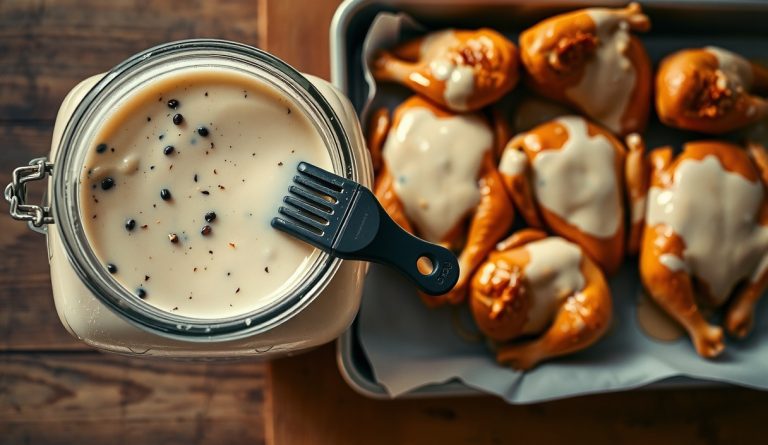
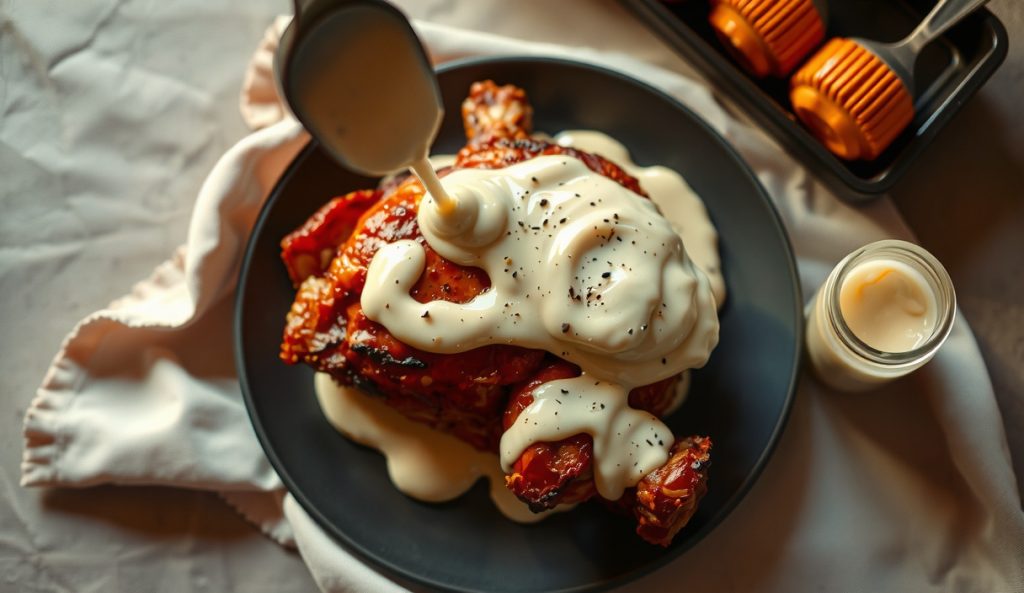
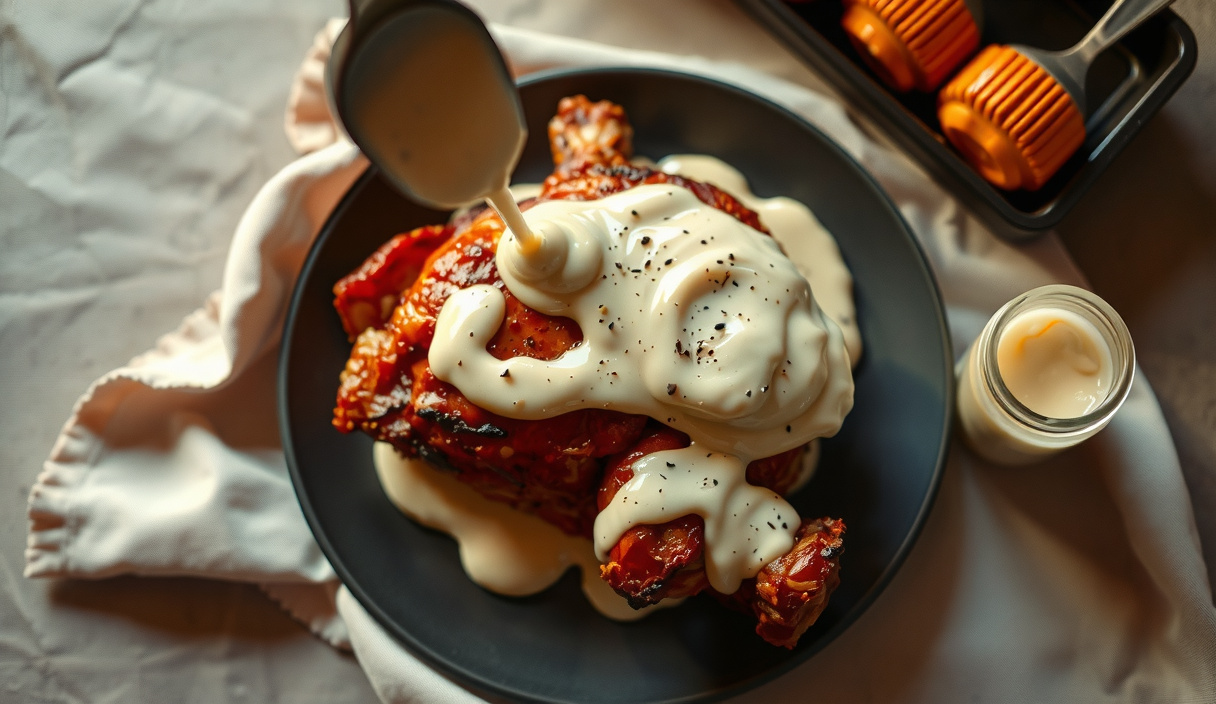
- To use as a smoked chicken finishing sauce (classic Big Bob Gibson application): Remove smoked chicken from the heat. Brush or mop Alabama White Sauce generously over the entire surface, or dunk the bird directly into a container of sauce. The hot skin will immediately begin to set the sauce into a glossy, lacquered glaze. Serve additional sauce on the side for dipping. The sauce can also be brushed on during the last 5 minutes of smoking at 300°F or below — any hotter and the emulsion proteins begin to denature.
Notes
Nutrition
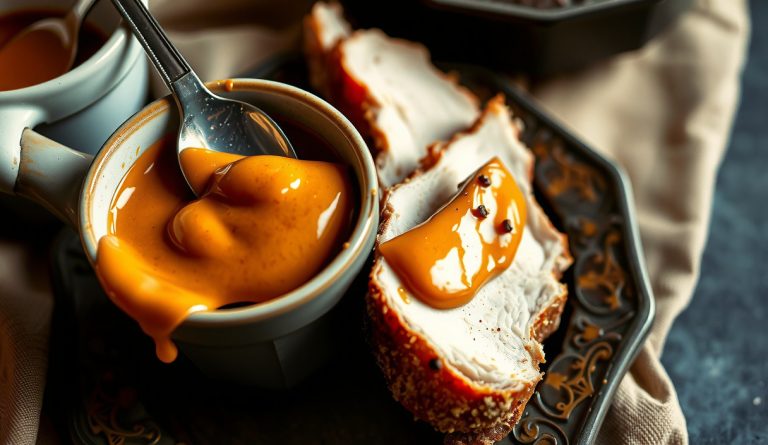
Decatur, Alabama, 1925. Big Bob Gibson digs a pit in his backyard, smokes whole chickens over hickory, and dunks every single bird into a 30-gallon barrel of white sauce before it ever hits the table. The result is jarring to anyone raised on red BBQ: a creamy, peppery, aggressively tangy glaze that clings to the skin and cuts straight through the fat of the smoke. One bite and you stop asking questions.
Alabama White Sauce is not a quirky regional footnote. It is one of the most technically elegant finishing sauces in American barbecue — a stable oil-in-water emulsion that delivers fat-soluble flavor in every smear while its acidity actively brightens the entire smoked surface. American Meathead builds it correctly, from the emulsion physics up.
Why does Alabama White Sauce work? The science
Alabama White Sauce is an acid-stable oil-in-water (O/W) emulsion — it will not break or oil off during normal preparation because the lecithin-coated oil droplets in the mayonnaise base maintain steric and electrostatic repulsion across the full pH range of the finished sauce.
Commercial mayonnaise — the scaffold of Alabama White Sauce — already contains roughly 70–80% dispersed oil phase stabilized by egg-yolk lecithin (primarily phosphatidylcholine). That lecithin sits at the oil-water interface and reduces interfacial tension from around 30 mN/m down to approximately 3–5 mN/m. Adding apple cider vinegar (acetic acid, pH ~3.0–3.3) lowers the continuous aqueous phase toward the isoelectric point of some egg proteins, but the emulsion holds because the lecithin-coated droplets maintain their repulsion at that pH range. Incorporate the vinegar incrementally and avoid high shear — that is all the emulsion asks of you.
Horseradish delivers heat via allyl isothiocyanate (AITC), a volatile thiocyanate that activates the TRPA1 trigeminal ion channel — the same receptor triggered by wasabi and mustard. Unlike capsaicin (TRPV1), AITC dissipates rapidly in heat and in the presence of oxygen, which is why freshly grated horseradish punches harder than prepared. Prepared horseradish is acidified to approximately pH 3.5 on purpose: the acetic acid deactivates the enzyme myrosinase, halting the glucosinolate-to-AITC conversion and locking in heat at a fixed level. The pH synergy between the vinegar and the prepared horseradish makes Alabama White Sauce flavor reproducible batch to batch. Coarsely cracked black pepper adds a separate wave of trigeminal activation — piperine via TRPV1 — staggering the heat perception temporally so the sauce delivers a long, evolving finish rather than a single spike.
Water activity (aw) in Alabama White Sauce sits near 0.92–0.94 due to the combined osmotic load of salt, sugar, and acetic acid — a level that suppresses spoilage organism growth and gives the refrigerated sauce a shelf life of 10–14 days without preservatives. The acidity also governs Maillard browning when the sauce is applied as a finishing glaze: below pH 4.0, the amino-carbonyl condensation rate slows dramatically, meaning the sauce caramelizes gently on contact with a hot smoked surface rather than burning. Apply Alabama White Sauce off the heat or in the last 5 minutes of a 300°F cook for a lacquered, glossy finish without charring.
What equipment and ingredients do I need?
- Mayonnaise: Use a full-fat commercial mayo (Hellmann’s/Best Foods or Duke’s). These are formulated to a consistent oil-phase volume fraction of ~75%, giving you a predictable emulsion scaffold. Reduced-fat mayo has a different aqueous phase composition and may not hold as well when acidified. Homemade mayo works beautifully if your droplet size is uniform — use an immersion blender for tightest emulsification.
- Apple cider vinegar: Unfiltered, 5% acidity is ideal. The residual polyphenols from the mother add complexity. White distilled vinegar is sharper and thinner — it will work but produces a less nuanced result.
- Prepared horseradish: Not horseradish sauce (which contains cream and thickeners). Drain off excess liquid before measuring to maintain emulsion consistency. The AITC level varies significantly by brand and age of the jar; taste and adjust.
- Lemon juice: Fresh only. Adds citric acid (contributing brightness at a different flavor frequency than acetic acid) plus limonene terpenes that amplify the pepper aromatics.
- Whisk vs. blender: A balloon whisk at low shear is all you need — the mayo is already emulsified. Do not use a high-speed blender, which can over-shear and destabilize the existing droplet architecture of the mayonnaise.
- Sugar: A small amount of granulated sugar is traditional and contributes to the colligative suppression of water activity. It also provides a minor reducing-sugar pool that softens the sharpness of the vinegar on the palate.
Alabama White BBQ Sauce
Equipment
- 1 Medium mixing bowl At least 1.5 qt capacity to prevent splashing during whisking
- 1 Balloon whisk Low-shear tool is ideal; do not use a high-speed blender which can destabilize the mayo emulsion
- 1 set Measuring cups and spoons
- 1 Glass jar with lid 16 oz or larger for storage; glass prevents off-flavor absorption
- 1 Mortar and pestle or zip-lock bag and heavy pan For cracking whole black peppercorns to approximately 16-mesh — coarser than pre-ground
Ingredients
- 1 cup full-fat mayonnaise Hellmann’s, Best Foods, or Duke’s recommended; reduced-fat will produce a thinner, less stable emulsion
- 3 tablespoons apple cider vinegar Unfiltered, 5% acidity preferred; add gradually to preserve the emulsion
- 1 tablespoon prepared horseradish Drained of excess liquid; not horseradish sauce or cream
- 1 tablespoon fresh lemon juice From approximately half a lemon; adds citric acid brightness distinct from acetic acid
- 1 teaspoon coarsely cracked black pepper Crack whole peppercorns fresh for maximum piperine punch; pre-ground is a poor substitute
- 1 teaspoon granulated white sugar
- 1 teaspoon kosher salt
- 1 teaspoon Dijon mustard Optional but recommended; adds amphiphilic mustard proteins that reinforce emulsion stability and add complexity
- ½ teaspoon garlic powder
- ¼ teaspoon cayenne pepper Optional; adds TRPV1 capsaicin heat to complement the TRPA1 horseradish heat
Instructions
- Measure the mayonnaise into a medium mixing bowl. Whisk briefly to loosen and ensure it is at a uniform, smooth consistency before adding any liquids.1 cup full-fat mayonnaise
- If using Dijon mustard, whisk it into the mayonnaise first until fully incorporated. The mustard proteins will integrate seamlessly with the existing emulsion scaffold at this stage.1 teaspoon Dijon mustard
- Add the apple cider vinegar in a slow, steady drizzle — not all at once. Whisk continuously as you add it over approximately 30 seconds. This gradual acidification prevents localized emulsion collapse. The sauce will thin slightly and become glossier as the acidity distributes through the continuous phase.3 tablespoons apple cider vinegar
- Add the fresh lemon juice and whisk to combine.1 tablespoon fresh lemon juice
- Add the prepared horseradish, cracked black pepper, sugar, salt, garlic powder, and cayenne (if using). Whisk until all ingredients are evenly distributed and the sauce is smooth and homogeneous. Taste and adjust: more horseradish for heat, more vinegar for tang, more sugar to soften sharpness.1 tablespoon prepared horseradish, 1 teaspoon coarsely cracked black pepper, 1 teaspoon granulated white sugar, 1 teaspoon kosher salt, 1/2 teaspoon garlic powder, 1/4 teaspoon cayenne pepper
- Transfer the sauce to a glass jar or airtight container. Rest at room temperature for a minimum of 30 minutes before serving, or refrigerate for at least 1 hour — overnight is ideal. This resting phase allows the AITC from the horseradish to partially migrate into the oil phase and the flavors to integrate fully. Do not skip this step.
- To use as a smoked chicken finishing sauce (classic Big Bob Gibson application): Remove smoked chicken from the heat. Brush or mop Alabama White Sauce generously over the entire surface, or dunk the bird directly into a container of sauce. The hot skin will immediately begin to set the sauce into a glossy, lacquered glaze. Serve additional sauce on the side for dipping. The sauce can also be brushed on during the last 5 minutes of smoking at 300°F or below — any hotter and the emulsion proteins begin to denature.
Notes
Nutrition
How do I nail Alabama White Sauce every time?
- Whisk in the vinegar gradually. Adding all the acid at once can locally collapse the emulsion at the point of contact. Drizzle it in over 30 seconds while whisking steadily — you are gently acidifying the continuous phase without overwhelming the lecithin film at the droplet interfaces.
- Rest is non-negotiable. Thirty minutes at room temperature allows the horseradish AITC volatiles to partially redistribute through the oil phase, softening the raw edge. One hour refrigerated is even better; overnight produces the most coherent flavor. Do not skip this step.
- Apply at the finish, not the start. The emulsion will break and the lecithin will coagulate if held above 160°F for more than a few minutes. Mop or brush Alabama White Sauce onto smoked chicken after pulling off the heat, or within the last 5 minutes of cooking at 300°F or below.
- Watch your horseradish jar date. Prepared horseradish loses pungency rapidly after opening as AITC oxidizes. A jar older than 6 weeks open in the fridge will require double the quantity — taste first and adjust.
- Pepper grind matters. Coarsely cracked black pepper (approximately 16-mesh) gives you visible specks and a staggered piperine release during chewing. Pre-ground fine pepper produces a hot, one-dimensional hit and looks gray. Use a mortar and pestle or crack peppercorns in a zip-lock bag with a heavy pan.
- Emulsion rescue: If the sauce looks greasy or separated after mixing (rare with commercial mayo), whisk a fresh teaspoon of mayo in a clean bowl and slowly incorporate the broken sauce into it — the fresh emulsifier re-anchors the dispersed droplets.
What variations can I make to Alabama White Sauce?
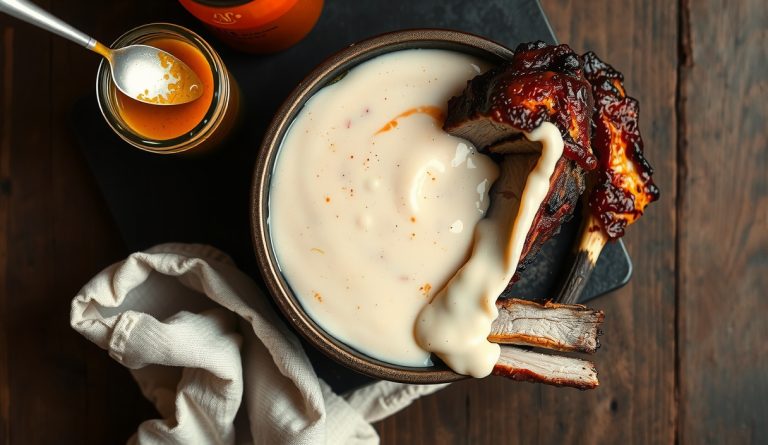
Spicier heat profile: Add 1–2 teaspoons of cayenne pepper or a tablespoon of your favorite Louisiana-style hot sauce to layer TRPV1 capsaicin activation on top of the horseradish TRPA1 hit. The double-receptor strategy creates a more complex, longer-lasting burn that works especially well with fatty pork ribs or duck. Do not substitute fresh horseradish root without adjusting — raw grated root is significantly more pungent, so start at half the quantity and scale up.
Dairy-forward Alabama White: Swap 2 tablespoons of mayo for 2 tablespoons of full-fat sour cream to add lactic acidity and casein micelle body, producing a slightly thicker, tangier sauce with a clean dairy finish. This version holds on turkey and fish particularly well. The additional water in sour cream will thin the sauce fractionally — compensate with a pinch more cracked pepper and a touch less vinegar.
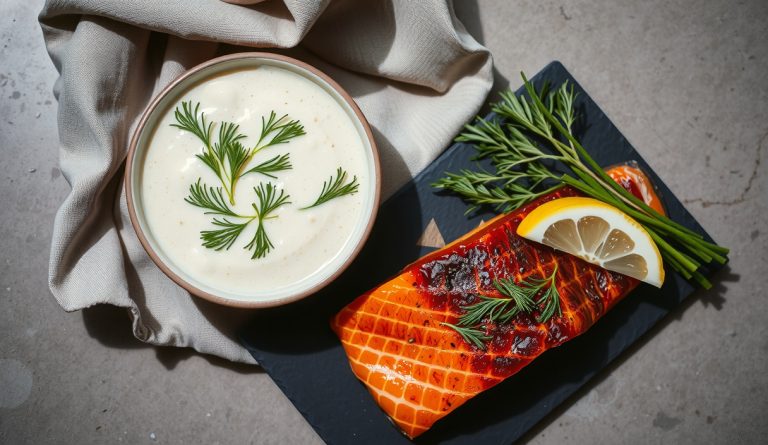
Herb-forward variation: Fold in 2 tablespoons of finely chopped fresh dill or tarragon after combining all other ingredients. Dill’s terpene profile (carvone, limonene) pairs naturally with the acetic acid base and transforms the sauce into an excellent accompaniment for smoked salmon or trout. The chlorophyll from the herbs will begin to degrade in the acidic environment after about 24 hours, so make this variation day-of for maximum color and freshness.
Scaling for a whole BBQ spread: This recipe scales linearly. For a whole smoked chicken (3–4 lbs), a single batch (approximately 1.5 cups) is sufficient for dunking and tableside dipping. For 10 whole chickens at a large tailgate or competition, multiply by 10 and mix in a 2-gallon cambro. The emulsion physics do not change at scale, but rest time remains essential regardless of batch size — make Alabama White Sauce the night before and refrigerate.
Frequently asked questions about Alabama White Sauce
Can I use Alabama White Sauce as a marinade rather than a finishing sauce? Yes, but the results differ from the classic application. The acidity will begin to denature the outermost proteins of the chicken — similar to a ceviche effect — after about two hours, which can produce a slightly mushy surface texture before smoking. The Big Bob Gibson tradition is a post-smoke dunk or finish: the emulsion coats the hot, rendered skin and sets into a glossy glaze. For marinating, cut the vinegar by half and limit exposure to 4–6 hours maximum in the refrigerator.
Why does my Alabama White Sauce look thin and runny? The most common cause is measuring the apple cider vinegar by volume without accounting for the specific gravity difference from water, producing an over-acidified, over-hydrated sauce. The second common cause is using reduced-fat mayonnaise, which contains a higher water fraction and produces a thinner, less stable emulsion scaffold. Fix a thin sauce by stirring in an additional 2–3 tablespoons of full-fat mayo until the desired consistency returns.
How long does Alabama White Sauce keep in the refrigerator? A properly made batch stored in a sealed glass jar at 38–40°F will remain safe and flavorful for 10–14 days. The emulsion remains stable throughout that window because the combined aw depression from salt, sugar, and acetic acid inhibits spoilage organism growth. The horseradish pungency will fade slightly after day 7 as residual AITC continues to oxidize — taste on day 7 and add a small squeeze of fresh prepared horseradish if needed.