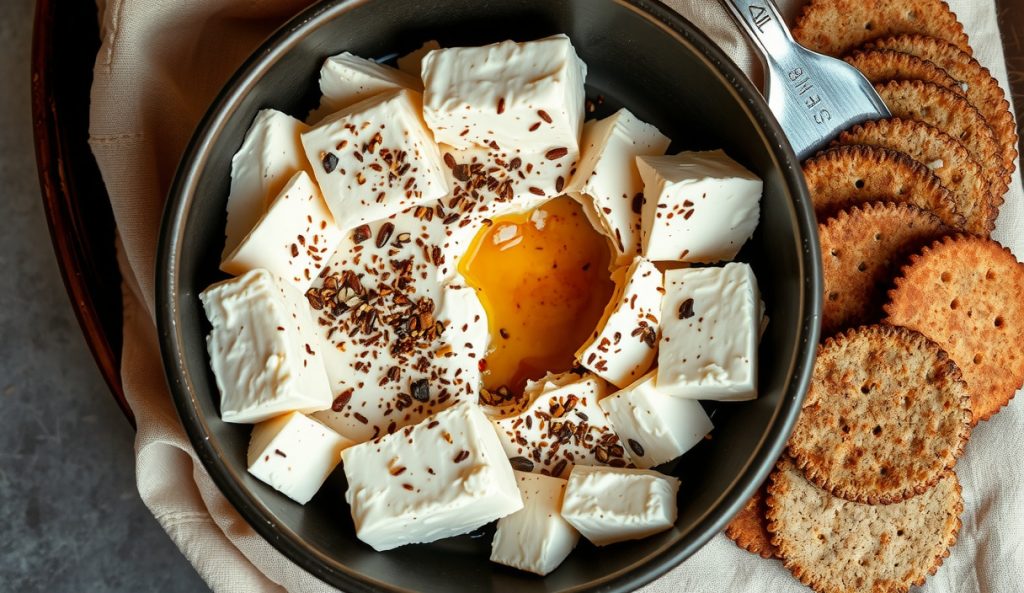
High-Protein Smoked Cottage Cheese with Everything Bagel Seasoning

Equipment
- 1 Smoker or grill with cold-smoke capability Pellet grill with smoke tube, offset with smoldering wood, or dedicated cold-smoke generator — must hold 85–95°F ambient without exceeding 105°F at the cheese surface
- 1 Shallow 9-inch cast iron skillet or quarter-sheet pan Maximizes smoke contact surface area; keep cheese depth under 1.5 inches
- 1 Instant-read or leave-in probe thermometer Insert into the center of the cheese mass — monitor protein matrix temp, not ambient air
- 1 Fine-mesh strainer For draining excess whey before seasoning
- 1 handful Applewood, cherrywood, or alder chips or pellets Avoid hickory and mesquite — too aggressive at cold-smoke temperatures
Ingredients
- 2 cups full-fat 4% cottage cheese Small-curd preferred for maximum surface area; pulled straight from refrigerator at 38–40°F
- 1.5 tablespoons everything bagel seasoning See ingredient notes for ratio; taste commercial blends before applying — they vary in salt load
- 1 tablespoon extra virgin olive oil Optional — drizzled over the surface before seasoning to help the seasoning adhere and add additional lipophilic surface area for smoke absorption
- 0.25 teaspoon flaky sea salt Optional finishing salt — add after smoking if the seasoning blend is low in salt
For Serving (Optional)
- 1 tablespoon fresh dill Chopped; brightens the phenolic depth
- 1 teaspoon hot honey Drizzled immediately before serving for sweet-heat contrast
- crackers, cucumber rounds, or crostini For dipping and spreading

Instructions
Prepare
- Set up your smoker or cold-smoke apparatus and bring it to a stable 85–95°F ambient temperature. Load applewood, cherrywood, or alder and get a clean, thin smoke established before the cheese goes in. Cold smoke requires patient setup — do not rush to place the cheese until your temperature and smoke output are stable and the initial acrid burst from fresh chips has cleared.
- Drain excess whey from the full-fat 4% cottage cheese: pour it into a fine-mesh strainer set over a bowl and let it rest for 10 minutes. This removes standing liquid so the seasoning makes direct contact with curd surfaces and smoke absorption concentrates in the curd matrix rather than the watery continuous phase.2 cups full-fat 4% cottage cheese
- Transfer the drained cottage cheese to your shallow cast iron skillet or quarter-sheet pan, spreading it into an even layer no deeper than 1.5 inches. If using, drizzle the extra virgin olive oil over the surface in a thin, even coat — this adds lipophilic surface area for phenol absorption and helps the seasoning adhere.2 cups full-fat 4% cottage cheese, 1 tablespoon extra virgin olive oil
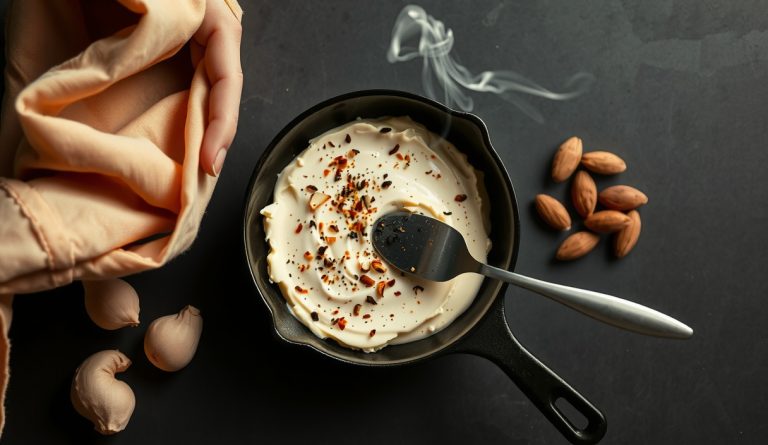
- Distribute the everything bagel seasoning evenly over the entire surface of the cottage cheese. Press it lightly into the top layer of curds — you want the salt crystals in contact with the curd surface so they begin drawing a thin brine film via osmosis before the cheese enters the smoker. This brine layer accelerates water-soluble smoke compound absorption in the first 20 minutes of exposure.1.5 tablespoons everything bagel seasoning
- Insert your probe thermometer tip into the center of the cheese mass. Target cheese surface and interior temperature of 38–50°F when you begin smoking. The colder the starting temperature, the wider your safety margin before you approach protein-denaturing territory above 130°F.
Cold Smoke
- Place the pan in the smoker. Close the lid or cover. Maintain ambient chamber temperature at 85–95°F throughout the process — do not exceed 105°F ambient or 65°F at the cheese surface. On warm days or with an energetic cold-smoke generator, mist the exterior sides of the pan with cold water every 20 minutes to suppress surface heating.
- Smoke for 60 minutes without opening the lid or stirring the cheese. The surface seasoning cap and top curd layer form a phenolic-rich zone that diffuses inward through the curd network. Disturbing this layer resets the concentration gradient. If your smoke output looks thin after 30 minutes, add a small fresh handful of wood chips — but do not produce heavy, billowing smoke, which risks creosote deposition on the cold, wet curd surface.
Rest and Serve
- Remove the pan from the smoker. Let the smoked cottage cheese rest uncovered at room temperature for 10 minutes. This allows the lighter volatile phenols and carbonyl compounds on the surface to partially off-gas, while the remaining bound phenolics equilibrate through the curd interior. Eating immediately produces an acrid top note; resting integrates the smoke into a cohesive, rounded flavor.
- Taste and adjust: add the optional flaky sea salt if the everything bagel blend ran light on salt. Finish with fresh dill and/or a drizzle of hot honey if using.0.25 teaspoon flaky sea salt, 1 tablespoon fresh dill, 1 teaspoon hot honey
- Serve directly from the pan or transfer to a serving bowl. Accompany with crackers, cucumber rounds, or crostini. Leftovers keep in an airtight container refrigerated for up to 5 days — the smoke flavor deepens and integrates noticeably over the first 24 hours of rest.crackers, cucumber rounds, or crostini
Notes
Nutrition
The first time I set a shallow pan of cottage cheese on my cold-smoke rack, my pitmaster instincts screamed at me. No fire. No sear. No Maillard crust forming in real time. Just pale curds sitting in a whisper of applewood smoke at 90°F, doing absolutely nothing visible. Forty-five minutes later I pulled that pan, hit it with everything bagel seasoning, and scooped a spoonful. The smoke had threaded itself into every crevice of every curd — clean, fragrant, and deep without a single degree of heat damage. That is the promise of cold smoke, and cottage cheese is one of the most rewarding canvases it has.
This is not a novelty recipe. Smoked cottage cheese with everything bagel seasoning is a genuinely high-protein appetizer or spread — 28 grams of complete protein per cup — that takes 65 minutes of near-zero active effort and rewards you with something your guests will spend the rest of the evening trying to reverse-engineer. The everything bagel seasoning is load-bearing here, not decorative. The fat, salt, and aromatic seeds modulate the phenolic intensity so the smoke reads as savory complexity rather than campfire.
Why does smoked cottage cheese work? The science
Cold smoke penetrates cottage cheese efficiently because the curd matrix is a porous, hydrated solid with an enormous specific surface area — and that architecture drives uptake through two distinct mechanisms simultaneously. Cottage cheese is a fresh acid-set curd: the casein micelle network has been partially destabilized by lactic acid, causing the protein strands to aggregate into the loose, irregular curds visible in the container.
When cold smoke — carrying phenols, carbonyls, organic acids, and guaiacol — flows over those curds at sub-100°F ambient temperatures, the aqueous whey phase trapped inside each curd acts as a polar solvent, dissolving water-soluble smoke compounds (primarily organic acids and carbonyl aldehydes) directly into the gel interior. Simultaneously, the exposed fat globules in full-fat 4% cottage cheese serve as hydrophobic reservoirs for the lipophilic phenolic fraction: guaiacol, syringol, and their methoxy derivatives — the molecules responsible for the characteristic smoked-wood aroma. Fat carries flavor before it releases it, and that thermodynamic sequestration works in your favor: the smoke phenols bind into the lipid phase and release slowly on the palate rather than evaporating in a single sharp hit.
Temperature control is the only real variable to manage. At 90°F the protein network is stable — whey proteins (beta-lactoglobulin, alpha-lactalbumin) begin to denature meaningfully above 140°F, so keeping the chamber under 105°F preserves the gel architecture, the creamy texture, and the moisture content. Exceeding 130°F for any sustained period starts cooking the cheese: whey expresses, curds tighten, and the delicate spread texture firms into something closer to scrambled egg. A calibrated probe thermometer placed in the cheese surface — not just measuring the ambient chamber — is non-negotiable if you care about reproducibility.
The everything bagel seasoning applied before smoking does additional work: the salt draws a thin film of brine to the curd surface via osmosis, and that brine layer acts as a secondary polar absorption medium for water-soluble smoke compounds during the first 20 minutes of exposure — effectively pre-wetting the surface and accelerating phenol uptake without any heat input.
From a protein standpoint, full-fat 4% cottage cheese delivers approximately 25–28 grams of protein per cup, composed of roughly 80% casein and 20% whey. Casein is a slow-digesting micellar protein with a leucine content of approximately 9% by amino acid mass — adequate to trigger mTORC1-mediated muscle protein synthesis when consumed at a serving threshold approaching 25–30 grams total protein. The cold-smoke process does not hydrolyze or denature the casein at these temperatures, so the full anabolic profile is preserved. This is a legitimate high-protein appetizer, not a gimmick dressed in smoke.
What equipment and ingredients do I need?
- Smoker with cold-smoke capability: You need to hold 85–95°F ambient without exceeding 105°F at the cheese surface. A pellet grill with its smoke tube accessory, an offset with the firebox cracked and wood chips smoldering rather than burning, or a dedicated cold-smoke generator attached to any lidded grill all work. A hot-grill setup that cannot drop below 200°F will cook the cheese — do not attempt it without a cold-smoke accessory.
- Shallow rimmed pan: A 9-inch cast iron skillet or a quarter-sheet stainless pan gives maximum surface area for smoke contact. Keep depth under 1.5 inches so the smoke reaches the lower curd layers. Avoid aluminum if using acidic smoke environments for extended periods.
- Wood selection: Applewood, cherrywood, or alder. These produce dense phenolic output at low combustion temperatures. Hickory and mesquite are too aggressive at 90°F — their heavier tar fraction deposits unevenly on cold, wet surfaces and can produce a bitter, resinous coat rather than clean smoke flavor.
- Full-fat 4% cottage cheese: The fat content is non-negotiable for flavor absorption. Low-fat and fat-free varieties have dramatically reduced lipophilic phenol uptake — expect a flat, slightly acidic result with minimal smoke character. Large-curd or small-curd both work; small-curd provides more total surface area and slightly more pronounced smoke absorption.
- Everything bagel seasoning: Make your own or use a commercial blend. The ratio matters: by weight, approximately 30% white sesame, 20% black sesame, 20% poppy seed, 15% dried minced garlic, 10% dried minced onion, 5% coarse sea salt. Pre-blended versions often run heavy on salt — taste before applying and adjust.
- Probe thermometer: Insert the probe tip into the center of the cheese mass, not into the air above it. You are managing the protein matrix temperature, not the ambient air temperature.
High-Protein Smoked Cottage Cheese with Everything Bagel Seasoning
Equipment
- 1 Smoker or grill with cold-smoke capability Pellet grill with smoke tube, offset with smoldering wood, or dedicated cold-smoke generator — must hold 85–95°F ambient without exceeding 105°F at the cheese surface
- 1 Shallow 9-inch cast iron skillet or quarter-sheet pan Maximizes smoke contact surface area; keep cheese depth under 1.5 inches
- 1 Instant-read or leave-in probe thermometer Insert into the center of the cheese mass — monitor protein matrix temp, not ambient air
- 1 Fine-mesh strainer For draining excess whey before seasoning
- 1 handful Applewood, cherrywood, or alder chips or pellets Avoid hickory and mesquite — too aggressive at cold-smoke temperatures
Ingredients
- 2 cups full-fat 4% cottage cheese Small-curd preferred for maximum surface area; pulled straight from refrigerator at 38–40°F
- 1.5 tablespoons everything bagel seasoning See ingredient notes for ratio; taste commercial blends before applying — they vary in salt load
- 1 tablespoon extra virgin olive oil Optional — drizzled over the surface before seasoning to help the seasoning adhere and add additional lipophilic surface area for smoke absorption
- 0.25 teaspoon flaky sea salt Optional finishing salt — add after smoking if the seasoning blend is low in salt
For Serving (Optional)
- 1 tablespoon fresh dill Chopped; brightens the phenolic depth
- 1 teaspoon hot honey Drizzled immediately before serving for sweet-heat contrast
- crackers, cucumber rounds, or crostini For dipping and spreading
Instructions
Prepare
- Set up your smoker or cold-smoke apparatus and bring it to a stable 85–95°F ambient temperature. Load applewood, cherrywood, or alder and get a clean, thin smoke established before the cheese goes in. Cold smoke requires patient setup — do not rush to place the cheese until your temperature and smoke output are stable and the initial acrid burst from fresh chips has cleared.
- Drain excess whey from the full-fat 4% cottage cheese: pour it into a fine-mesh strainer set over a bowl and let it rest for 10 minutes. This removes standing liquid so the seasoning makes direct contact with curd surfaces and smoke absorption concentrates in the curd matrix rather than the watery continuous phase.2 cups full-fat 4% cottage cheese
- Transfer the drained cottage cheese to your shallow cast iron skillet or quarter-sheet pan, spreading it into an even layer no deeper than 1.5 inches. If using, drizzle the extra virgin olive oil over the surface in a thin, even coat — this adds lipophilic surface area for phenol absorption and helps the seasoning adhere.2 cups full-fat 4% cottage cheese, 1 tablespoon extra virgin olive oil
- Distribute the everything bagel seasoning evenly over the entire surface of the cottage cheese. Press it lightly into the top layer of curds — you want the salt crystals in contact with the curd surface so they begin drawing a thin brine film via osmosis before the cheese enters the smoker. This brine layer accelerates water-soluble smoke compound absorption in the first 20 minutes of exposure.1.5 tablespoons everything bagel seasoning
- Insert your probe thermometer tip into the center of the cheese mass. Target cheese surface and interior temperature of 38–50°F when you begin smoking. The colder the starting temperature, the wider your safety margin before you approach protein-denaturing territory above 130°F.
Cold Smoke
- Place the pan in the smoker. Close the lid or cover. Maintain ambient chamber temperature at 85–95°F throughout the process — do not exceed 105°F ambient or 65°F at the cheese surface. On warm days or with an energetic cold-smoke generator, mist the exterior sides of the pan with cold water every 20 minutes to suppress surface heating.
- Smoke for 60 minutes without opening the lid or stirring the cheese. The surface seasoning cap and top curd layer form a phenolic-rich zone that diffuses inward through the curd network. Disturbing this layer resets the concentration gradient. If your smoke output looks thin after 30 minutes, add a small fresh handful of wood chips — but do not produce heavy, billowing smoke, which risks creosote deposition on the cold, wet curd surface.
Rest and Serve
- Remove the pan from the smoker. Let the smoked cottage cheese rest uncovered at room temperature for 10 minutes. This allows the lighter volatile phenols and carbonyl compounds on the surface to partially off-gas, while the remaining bound phenolics equilibrate through the curd interior. Eating immediately produces an acrid top note; resting integrates the smoke into a cohesive, rounded flavor.
- Taste and adjust: add the optional flaky sea salt if the everything bagel blend ran light on salt. Finish with fresh dill and/or a drizzle of hot honey if using.0.25 teaspoon flaky sea salt, 1 tablespoon fresh dill, 1 teaspoon hot honey
- Serve directly from the pan or transfer to a serving bowl. Accompany with crackers, cucumber rounds, or crostini. Leftovers keep in an airtight container refrigerated for up to 5 days — the smoke flavor deepens and integrates noticeably over the first 24 hours of rest.crackers, cucumber rounds, or crostini
Notes
Nutrition
How do I nail smoked cottage cheese every time?
- Pre-chill the cheese to 38–40°F before smoking. A cold surface creates a temperature gradient that slows the rise of the cheese interior during smoke exposure, buying a wider safety margin before approaching protein-denaturing territory. Pull the cottage cheese straight from the refrigerator into the pan — do not let it temper to room temperature first.
- Drain excess whey before seasoning. Tip the opened container and let it rest inverted in a fine-mesh strainer over a bowl for 10 minutes. Removing standing whey gives the seasoning direct contact with the curd surface rather than floating in liquid, and concentrates smoke absorption into the curd mass rather than the watery continuous phase.
- Do not stir during smoking. The surface crust of seasoning and the top layer of curds form a phenolic-rich cap that continues to migrate inward via diffusion. Breaking the surface resets the concentration gradient and interrupts the absorption process.
- Monitor the cheese surface temperature, not just ambient. If your smoker runs hot — common on warm days or with a new cold-smoke generator — mist the exterior of the pan with cold water every 20 minutes to suppress surface heating. Target a cheese surface temperature of 45–55°F after 30 minutes of exposure.
- Rest 10 minutes uncovered after pulling. The volatile lighter phenols and carbonyl compounds on the surface need time to partially off-gas before the remaining bound phenolics equilibrate through the curd. Eating immediately produces an acrid top note; resting lets the flavor integrate.
- Failure mode — bitter, medicinal smoke flavor: Almost always caused by wet wood chips producing creosote-heavy smoke, or by temperature creeping above 100°F causing the casein surface to partially cook and form a protein film that traps harsh volatiles. Use dry, low-resin wood and keep your temperature probe in the cheese, not just the chamber.
What are the best variations on smoked cottage cheese?
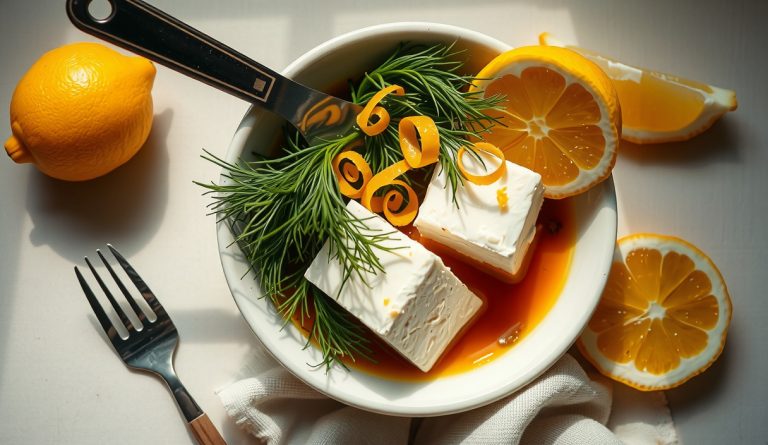
Herb and lemon zest finish: After smoking and resting, fold in 1 tablespoon of fresh dill and the zest of half a lemon before serving. The citrus top note lifts the phenolic depth and shifts the flavor profile from bagel-shop to Mediterranean. Serve with cucumber rounds and radishes for a high-protein crudite spread that reads elegant rather than athletic.
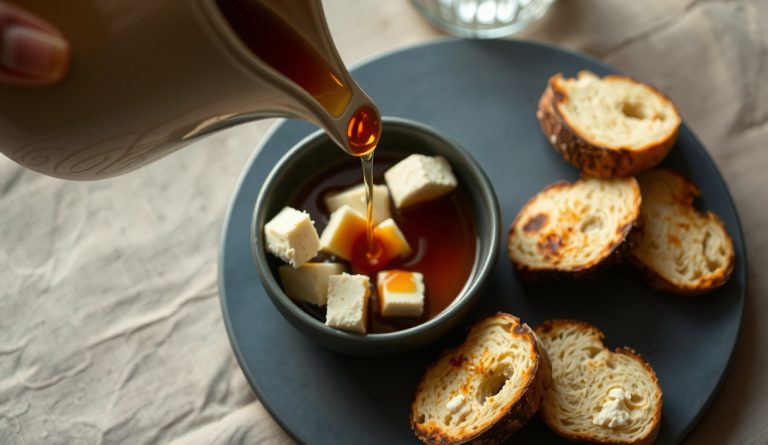
Hot-honey drizzle: Drizzle 1 teaspoon of hot honey over the finished smoked cottage cheese immediately before serving. The reducing sugars in honey interact with residual carbonyl smoke compounds on the surface, amplifying caramel and sweetness notes that create a sweet-heat-smoke trifecta. This version works particularly well as a crostini topping or spooned alongside grilled stone fruit.
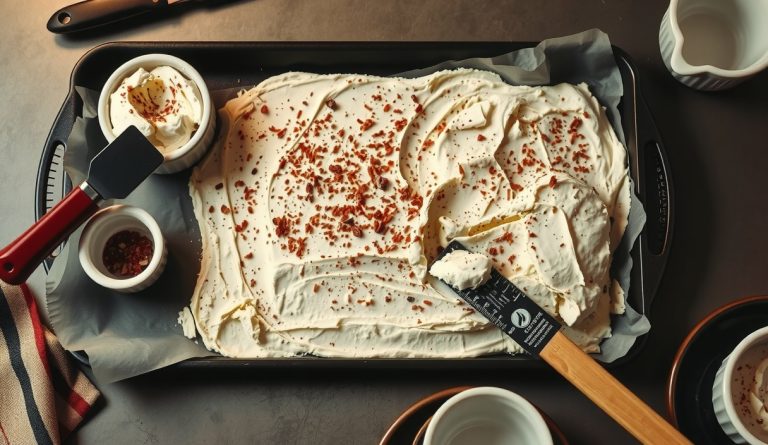
Scaling for a crowd: The recipe scales linearly. Use a full half-sheet pan and two cups of cottage cheese for 8–10 servings. Increase smoke time by 10–15 minutes to account for the greater thermal mass. Smoke absorption is a surface phenomenon, so do not stack the cottage cheese more than 1.5 inches deep regardless of pan size — the bottom layers will not receive adequate phenol exposure.
Dairy-free note: This specific technique is built around the casein matrix and milkfat of full-fat dairy cottage cheese. Commercial cashew-based or almond-based cultured cottage-style products can be cold-smoked using the same method, but their fat and protein compositions differ significantly — expect lighter, less integrated smoke absorption and a shorter optimal smoke window of 35–40 minutes before off-notes develop.
Frequently asked questions about smoked cottage cheese
Can I use a smoke gun or countertop cold smoker instead of a grill? Yes, with a modification. Place the seasoned cottage cheese in a large bowl, fill the bowl with smoke from a smoke gun or Smoking Gun device, cover tightly with plastic wrap, and let it sit for 10 minutes. Repeat 4 to 5 times for a total of 50 minutes of intermittent smoke exposure. The smoke concentration per cycle is lower than a continuous cold-smoke setup, so the final phenolic uptake will be somewhat lighter — pleasant but noticeably more subtle than the full cold-smoke method.
How long does smoked cottage cheese keep? Store smoked cottage cheese in an airtight container in the refrigerator for up to 5 days. The smoke phenols have mild antimicrobial properties — primarily their activity against gram-positive bacteria — which modestly extends the effective shelf life relative to unsmoked cottage cheese. The flavor continues to integrate and deepen over the first 24 hours of refrigerated rest, making smoked cottage cheese an ideal make-ahead appetizer.
Does the protein content change during cold smoking? No. At 90°F, the cottage cheese is well below the denaturation thresholds for both casein (which is largely unstructured and heat-stable in the 4% curd format) and the residual whey proteins. The amino acid profile, leucine content, and digestibility coefficient of the protein remain essentially identical to unsmoked full-fat cottage cheese. The cold-smoke process is additive — it contributes phenolic compounds and volatile aromatics without subtracting protein quality.