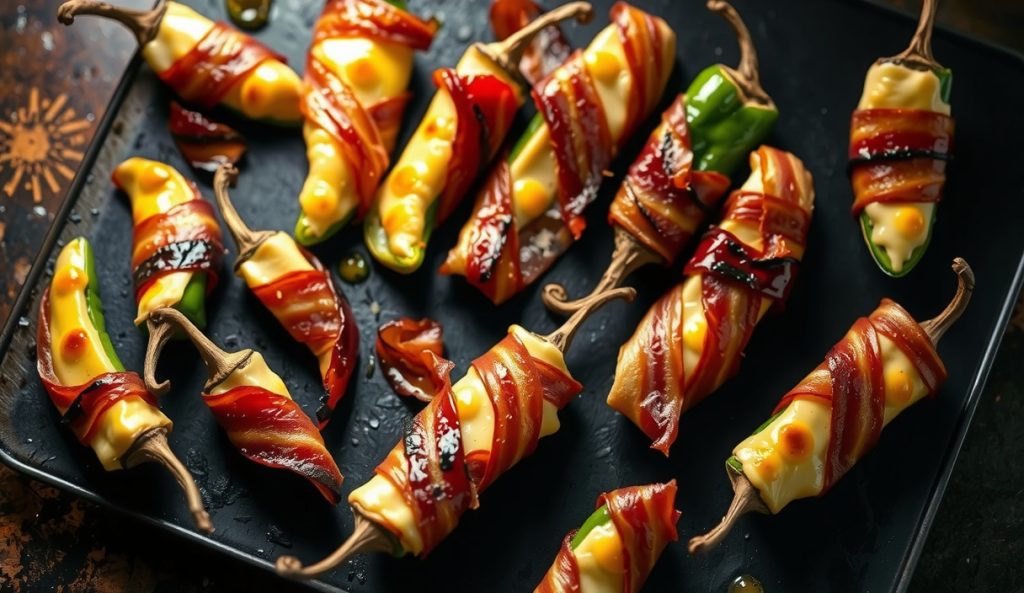
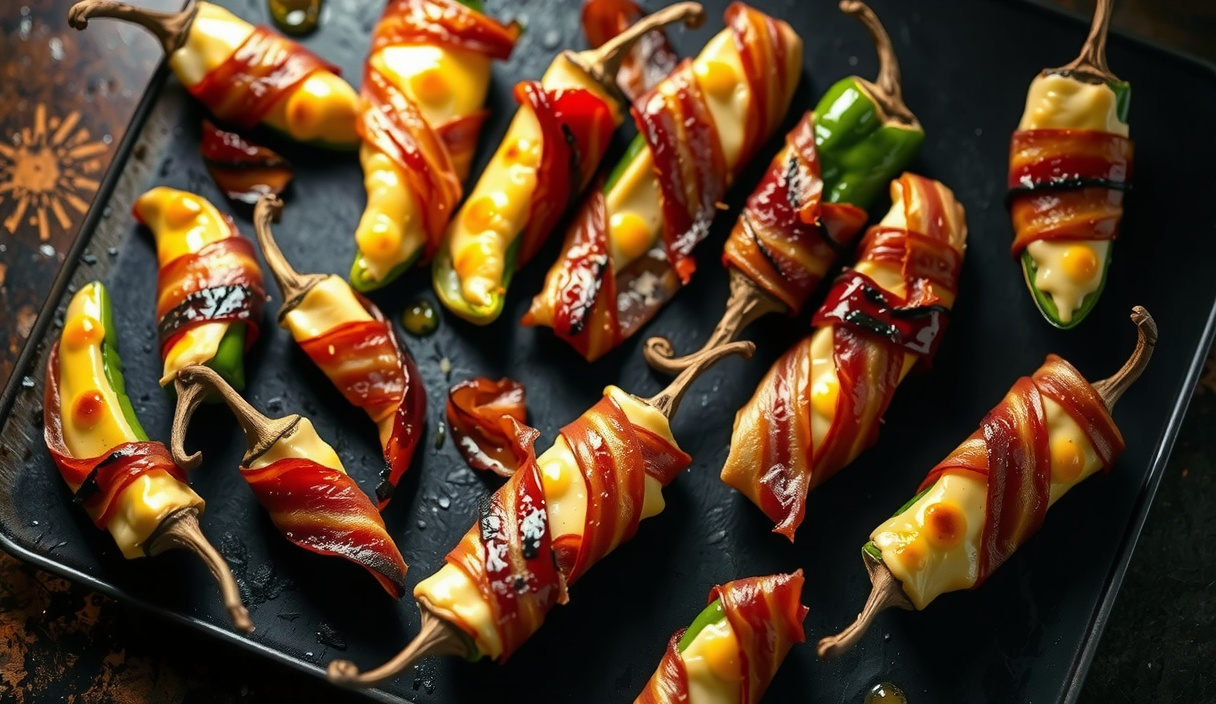
Smoked Bacon-Wrapped Jalapeño Poppers

Equipment
- 1 Smoker, kamado, or covered kettle grill Must hold a stable 275°F with indirect heat and wood smoke
- 2-3 Apple, cherry, or pecan wood chunks or chips Chunks for offset/kamado; chips (soaked 20 min) for kettle setups
- 1 Wire cooling rack set over a half-sheet pan For holding assembled poppers pre-smoke and resting post-smoke
- 1 Instant-read thermometer For pulling at 165-170°F internal filling temperature
- 24 Toothpicks or short bamboo skewers One per popper half to secure the bacon wrap
- 1 pair Nitrile gloves Non-negotiable for jalapeño prep — capsaicin transfers to skin and eyes
- 1 Small spoon or melon baller For removing jalapeño membrane and seeds cleanly
- 1 Piping bag or zip-lock bag with corner snipped Optional but speeds filling considerably for large batches
Ingredients
Peppers
- 12 medium jalapeños (3-4 inches long), uniform in size Halved lengthwise, seeds and membrane removed with a small spoon
Filling
- 8 oz full-fat block cream cheese Brought to room temperature (65-70°F) — cold cream cheese tears the pepper flesh
- 4 oz sharp cheddar, freshly shredded About 1 cup; shred from a block for clean melting — avoid pre-shredded
- 3 tbsp fresh chives, finely minced
- 1 tsp garlic powder
- 1 tsp onion powder
- 0.5 tsp kosher salt
- 0.25 tsp freshly ground black pepper
- 0.5 tsp smoked paprika Optional — amplifies the smoke character in the filling itself
Wrap
- 12 slices standard-cut bacon (not thin-cut, not thick-cut) Halved crosswise — 1 half-slice per popper. Standard cut renders evenly at 275°F within the cook window

Instructions
Fire the Smoker
- Preheat your smoker, kamado, or covered kettle grill to a steady 275°F using indirect heat. Add 2-3 chunks of apple, cherry, or pecan wood (or a handful of soaked chips for a kettle setup). Allow the smoker to stabilize at temperature and produce thin, clean smoke — thick, billowing white smoke is over-combustion and will deposit harsh compounds on the filling. Thin blue or nearly invisible smoke is the target.
Prep the Jalapeños
- Put on nitrile gloves. Halve each jalapeño lengthwise, cutting through the stem end. Use a small spoon or melon baller to scrape out all seeds and as much of the white membrane as possible. The membrane carries the highest capsaicin concentration — remove it thoroughly for crowd-friendly heat, leave a portion for a noticeable kick. Arrange the 24 halves on a wire rack set over a sheet pan.
Make the Filling
- In a medium bowl, combine the room-temperature cream cheese, shredded cheddar, minced chives, garlic powder, onion powder, kosher salt, black pepper, and smoked paprika if using. Mix thoroughly with a spatula or hand mixer until fully homogeneous. The filling should be smooth and spreadable — not stiff, not loose. If it is too stiff, the cream cheese needs more time at room temperature; give it another 10 minutes.4 oz sharp cheddar, freshly shredded, 3 tbsp fresh chives, finely minced, 1 tsp garlic powder, 1 tsp onion powder, 0.5 tsp kosher salt, 0.25 tsp freshly ground black pepper, 0.5 tsp smoked paprika
- Transfer the filling to a piping bag or zip-lock bag with a corner snipped. Pipe or spoon the filling into each jalapeño half, filling it flush with the rim — do not mound above the edge. Overfilling is the primary cause of filling blowout on the smoker.4 oz sharp cheddar, freshly shredded, 3 tbsp fresh chives, finely minced, 1 tsp garlic powder, 1 tsp onion powder, 0.5 tsp kosher salt, 0.25 tsp freshly ground black pepper, 0.5 tsp smoked paprika
Wrap and Chill
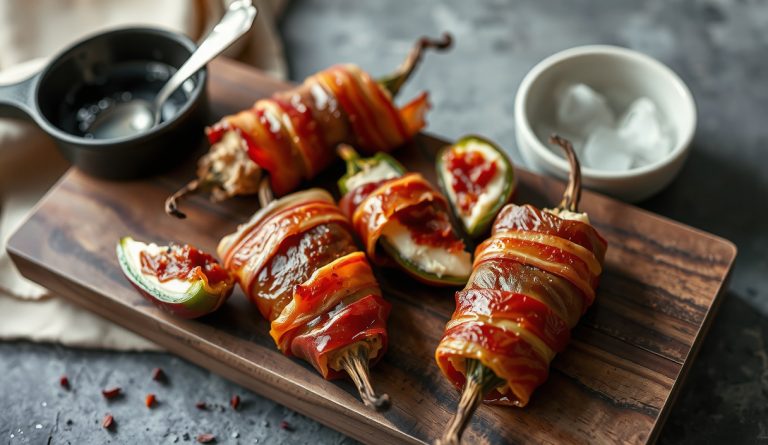
- Cut each bacon slice in half crosswise, giving you 24 half-strips. Wrap one half-strip around each filled jalapeño half, encircling it snugly with the ends overlapping underneath or on the side. Secure the overlapping ends with a toothpick or short skewer angled into the pepper flesh — this prevents the bacon from contracting and unwrapping as fat renders during the cook.12 slices standard-cut bacon (not thin-cut, not thick-cut)
- Place the assembled, wrapped poppers on the wire rack and refrigerate uncovered for 15 minutes. This firms the filling so it holds under the heat of the smoker during the first 20-30 minutes of the cook, before the pepper wall softens and the protein matrix sets.
Smoke
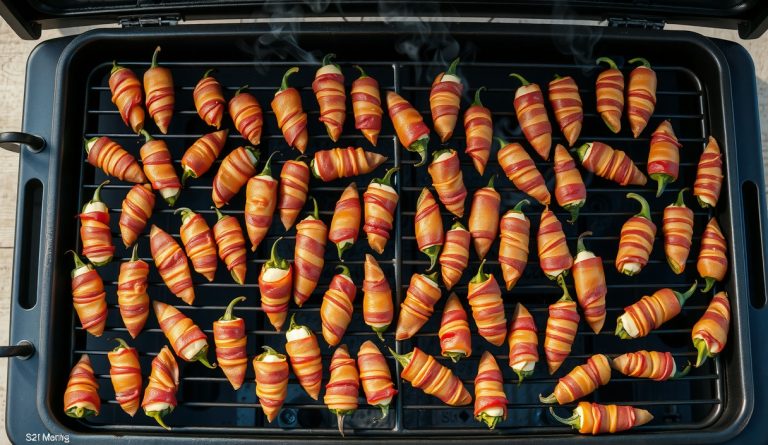
- Arrange the chilled poppers directly on the smoker grate over the indirect zone, filling-side up, leaving at least half an inch of space between each one for smoke circulation. Close the lid and smoke at 275°F for 60-75 minutes, without opening the lid for the first 45 minutes. Resist the urge to check early — thermal cycling from lid-lifts extends your cook time and unevenly renders the bacon.
- At the 60-minute mark, probe the thickest part of the filling with an instant-read thermometer. Target 165-170°F internal. At this range the filling is molten and fully set, the pepper wall is soft and yielding, and the bacon is rendered with a lightly firm exterior. If the filling reads below 160°F, continue for 5-10 additional minutes and re-probe. If bacon is still soft but filling is at temperature, crank the smoker to 300°F for a final 5 minutes or use a brief pass over direct heat.
Rest and Serve
- Transfer the poppers to a clean wire rack or serving platter. Rest for 5 minutes before serving — the filling is molten at pull temperature and will burn the palate immediately off the smoker. The rest allows the fat-protein gel to re-solidify slightly, producing a creamy rather than liquid interior on the first bite. Remove toothpicks immediately before serving, or remind guests they are present. Serve hot.
Notes
Nutrition
There is a moment at every good backyard cookout when someone sets down a tray of these and the crowd stops talking. Smoked bacon-wrapped jalapeño poppers are not complicated, but they reward precision. Get the smoke temperature wrong, rush the cook time, or overload the filling, and you end up with blown-out peppers leaking sad puddles of cheese onto your grates. Get it right and you get something extraordinary: a lacquered bacon shell, a molten, savory filling with just enough chive brightness, and a heat level that has been genuinely tamed by time on the smoker.
This specific formula has been dialed in over years of testing. The variables matter: jalapeño wall thickness, fat-to-protein ratio in the filling, bacon cut weight, and smoke-chamber temperature. All of it feeds into the final result. Here is the exact system used at American Meathead.
Why do smoked jalapeño poppers taste less spicy than oven-baked ones? The science
Sustained low-heat convective smoke at 275°F tames jalapeño heat more effectively than a conventional oven at the same internal temperature — and the physics explain exactly why. Capsaicin, the primary pungent compound in jalapeños, activates the TRPV1 ion channel on trigeminal nerve endings — the same receptor triggered by heat above 109°F. Capsaicin is not technically a flavor molecule in the classic sense; it is a chemesthetic stimulus with a boiling point around 400°F. Under prolonged smoke exposure at 275°F, two distinct mechanisms reduce the perceived heat. First, the pepper wall softens dramatically as pectin in the middle lamella undergoes thermal beta-elimination, causing cell-wall depolymerization that ruptures the oleoresin vesicles and releases their contents into the surrounding matrix — where the fat in the cream cheese captures and buffers the capsaicin by drastically lowering its vapor pressure. Fat is a thermodynamic trap for lipophilic molecules. Second, water-soluble, volatile co-pungent compounds (including dihydrocapsaicin analogs) are leached out as the pepper wall structure collapses and moisture migrates outward. The net result after 60–75 minutes at 275°F is a measurably mellower popper compared with one baked at the same internal temperature in a conventional oven — the sustained low-convective environment allows more time for volatile diffusion before the protein matrix sets.
The filling is a fat-continuous emulsion anchored by cream cheese — essentially a cold-set oil-in-water system that inverts toward a protein-fat gel upon heating. Cream cheese runs approximately 33–35% butterfat with roughly 6% protein. Folding in shredded sharp cheddar adds a casein-fat matrix that contributes both structural integrity and a concentrated Maillard-available lactose source. As filling temperature climbs past 140°F internal, proteins denature progressively and the fat phases begin to coalesce. The chive provides volatile allyl sulfide aromatics that complement the smoke-derived phenolic compounds — particularly guaiacol and syringol — which deposit on the pepper and bacon surfaces from the combustion of wood lignin. Smoke compounds are primarily lipophilic and concentrate in the bacon fat and pepper skin, two high-surface-area lipid zones, which is why even a modest 60-minute smoke window produces a deeply complex result.
Bacon selection matters more than most cooks assume. Thin-cut bacon at 275°F will render and begin to crisp well before the pepper wall has fully softened, risking brittle bacon that shatters on the bite. Standard-cut bacon — approximately 1/16-inch thick, or 12–14 slices per pound — is the target. The myosin in the pork belly begins denaturing above 140°F and fat rendering accelerates past 160°F. At a smoker set to 275°F with a target internal popper temperature of 165–170°F, the bacon spends enough time in the 145–165°F zone to achieve a rendered, pliable-to-slightly-crisp texture without becoming brittle. Toothpick or skewer securing is non-negotiable: as the bacon fat renders out, the strip contracts by up to 15% in length due to protein shrinkage — without mechanical restraint, the wrap loosens and slides off the popper.
What equipment and ingredients do I need?
- Smoker or covered kettle grill: Anything that holds a stable 275°F with indirect heat works. Pellet grills, offset smokers, kamado cookers, and covered kettle grills with a two-zone coal setup all qualify. Avoid anything that spikes above 300°F during the cook — the bacon will crisp before the peppers soften.
- Wood choice: Apple, cherry, or pecan. These fruitwoods and pecan produce a lighter phenolic smoke profile that complements the dairy filling without overwhelming it. Hickory works but is assertive — use it in moderation if at all.
- Jalapeños: Select peppers of consistent medium size, roughly 3–4 inches long. Larger peppers give more filling capacity and easier halving. Avoid very thick-walled grocery store giants — their wall stays too firm at 275°F within the cook window.
- Cream cheese: Full-fat block cream cheese only, brought to room temperature (65–70°F) so it pipes or spoons without tearing the pepper. Cold cream cheese creates an overpressured filling that blows out the pepper halves as it expands on the smoker.
- Cheddar: Shred it yourself from a block. Pre-shredded cheddar is coated with cellulose or starch powder that inhibits clean melting and leaves a slightly gritty filling texture.
- Bacon: Standard-cut (not thick-cut, not thin-cut) bacon, approximately 12–14 slices per pound. One slice per popper half is the target — a full slice wraps a 3–4 inch pepper half cleanly with a small overlap.
- Gloves: Non-negotiable. Capsaicin is oil-soluble and will transfer to eyes and mucous membranes hours after handling. Wear nitrile gloves throughout the prep.
Smoked Bacon-Wrapped Jalapeño Poppers
Equipment
- 1 Smoker, kamado, or covered kettle grill Must hold a stable 275°F with indirect heat and wood smoke
- 2-3 Apple, cherry, or pecan wood chunks or chips Chunks for offset/kamado; chips (soaked 20 min) for kettle setups
- 1 Wire cooling rack set over a half-sheet pan For holding assembled poppers pre-smoke and resting post-smoke
- 1 Instant-read thermometer For pulling at 165-170°F internal filling temperature
- 24 Toothpicks or short bamboo skewers One per popper half to secure the bacon wrap
- 1 pair Nitrile gloves Non-negotiable for jalapeño prep — capsaicin transfers to skin and eyes
- 1 Small spoon or melon baller For removing jalapeño membrane and seeds cleanly
- 1 Piping bag or zip-lock bag with corner snipped Optional but speeds filling considerably for large batches
Ingredients
Peppers
- 12 medium jalapeños (3-4 inches long), uniform in size Halved lengthwise, seeds and membrane removed with a small spoon
Filling
- 8 oz full-fat block cream cheese Brought to room temperature (65-70°F) — cold cream cheese tears the pepper flesh
- 4 oz sharp cheddar, freshly shredded About 1 cup; shred from a block for clean melting — avoid pre-shredded
- 3 tbsp fresh chives, finely minced
- 1 tsp garlic powder
- 1 tsp onion powder
- 0.5 tsp kosher salt
- 0.25 tsp freshly ground black pepper
- 0.5 tsp smoked paprika Optional — amplifies the smoke character in the filling itself
Wrap
- 12 slices standard-cut bacon (not thin-cut, not thick-cut) Halved crosswise — 1 half-slice per popper. Standard cut renders evenly at 275°F within the cook window
Instructions
Fire the Smoker
- Preheat your smoker, kamado, or covered kettle grill to a steady 275°F using indirect heat. Add 2-3 chunks of apple, cherry, or pecan wood (or a handful of soaked chips for a kettle setup). Allow the smoker to stabilize at temperature and produce thin, clean smoke — thick, billowing white smoke is over-combustion and will deposit harsh compounds on the filling. Thin blue or nearly invisible smoke is the target.
Prep the Jalapeños
- Put on nitrile gloves. Halve each jalapeño lengthwise, cutting through the stem end. Use a small spoon or melon baller to scrape out all seeds and as much of the white membrane as possible. The membrane carries the highest capsaicin concentration — remove it thoroughly for crowd-friendly heat, leave a portion for a noticeable kick. Arrange the 24 halves on a wire rack set over a sheet pan.
Make the Filling
- In a medium bowl, combine the room-temperature cream cheese, shredded cheddar, minced chives, garlic powder, onion powder, kosher salt, black pepper, and smoked paprika if using. Mix thoroughly with a spatula or hand mixer until fully homogeneous. The filling should be smooth and spreadable — not stiff, not loose. If it is too stiff, the cream cheese needs more time at room temperature; give it another 10 minutes.4 oz sharp cheddar, freshly shredded, 3 tbsp fresh chives, finely minced, 1 tsp garlic powder, 1 tsp onion powder, 0.5 tsp kosher salt, 0.25 tsp freshly ground black pepper, 0.5 tsp smoked paprika
- Transfer the filling to a piping bag or zip-lock bag with a corner snipped. Pipe or spoon the filling into each jalapeño half, filling it flush with the rim — do not mound above the edge. Overfilling is the primary cause of filling blowout on the smoker.4 oz sharp cheddar, freshly shredded, 3 tbsp fresh chives, finely minced, 1 tsp garlic powder, 1 tsp onion powder, 0.5 tsp kosher salt, 0.25 tsp freshly ground black pepper, 0.5 tsp smoked paprika
Wrap and Chill
- Cut each bacon slice in half crosswise, giving you 24 half-strips. Wrap one half-strip around each filled jalapeño half, encircling it snugly with the ends overlapping underneath or on the side. Secure the overlapping ends with a toothpick or short skewer angled into the pepper flesh — this prevents the bacon from contracting and unwrapping as fat renders during the cook.12 slices standard-cut bacon (not thin-cut, not thick-cut)
- Place the assembled, wrapped poppers on the wire rack and refrigerate uncovered for 15 minutes. This firms the filling so it holds under the heat of the smoker during the first 20-30 minutes of the cook, before the pepper wall softens and the protein matrix sets.
Smoke
- Arrange the chilled poppers directly on the smoker grate over the indirect zone, filling-side up, leaving at least half an inch of space between each one for smoke circulation. Close the lid and smoke at 275°F for 60-75 minutes, without opening the lid for the first 45 minutes. Resist the urge to check early — thermal cycling from lid-lifts extends your cook time and unevenly renders the bacon.
- At the 60-minute mark, probe the thickest part of the filling with an instant-read thermometer. Target 165-170°F internal. At this range the filling is molten and fully set, the pepper wall is soft and yielding, and the bacon is rendered with a lightly firm exterior. If the filling reads below 160°F, continue for 5-10 additional minutes and re-probe. If bacon is still soft but filling is at temperature, crank the smoker to 300°F for a final 5 minutes or use a brief pass over direct heat.
Rest and Serve
- Transfer the poppers to a clean wire rack or serving platter. Rest for 5 minutes before serving — the filling is molten at pull temperature and will burn the palate immediately off the smoker. The rest allows the fat-protein gel to re-solidify slightly, producing a creamy rather than liquid interior on the first bite. Remove toothpicks immediately before serving, or remind guests they are present. Serve hot.
Notes
Nutrition
How do I nail smoked jalapeño poppers every time?
- Hollow the membrane thoroughly: The membrane holds the highest capsaicin concentration. A small spoon or melon baller removes it cleanly. If serious heat retention is the goal, leave more membrane. For crowd-friendly poppers, remove it all. Partial membrane removal is the most common source of inconsistent heat across a batch.
- Do not overfill: The filling expands as it heats. Fill each pepper half to just at or slightly below the rim. Overfilled poppers spill filling onto the grates at the first sign of structural relaxation in the pepper wall — around the 30-minute mark.
- Chill the filled peppers before wrapping: 15 minutes in the refrigerator firms the cream cheese filling enough that the bacon wrap does not compress and displace it. Cold filling also holds its shape when the toothpick is inserted.
- Secure at the seam: The toothpick or skewer goes through the overlapping bacon ends and into the pepper flesh. One skewer per half, angled slightly downward into the pepper, prevents both the bacon from unwrapping and the filling from sliding out as the pepper softens.
- Pull at 165°F internal: Use an instant-read thermometer probed into the thickest part of the filling. Under 160°F the filling is still loose and potentially eggy-soft; over 175°F the bacon crisps past ideal, the pepper turns mushy, and some filling will have already purged. The 165–170°F window is the target.
- Rest 5 minutes before serving: The filling is molten at pull time. A brief 5-minute rest allows the fat-protein gel to re-solidify slightly, delivering a creamy rather than liquid filling on the first bite.
What are the best variations on smoked jalapeño poppers?
Heat escalation: For a significantly hotter popper, leave the membrane intact and add a half-teaspoon of finely minced serrano or a pinch of cayenne to the filling. The fat matrix will buffer some of the added heat, but a measurable increase in TRPV1 stimulation will come through on the palate. Conversely, for a truly mild popper, soak the halved jalapeños in ice water for 30 minutes before filling — osmotic leaching pulls a meaningful fraction of water-soluble pungent compounds out of the flesh.
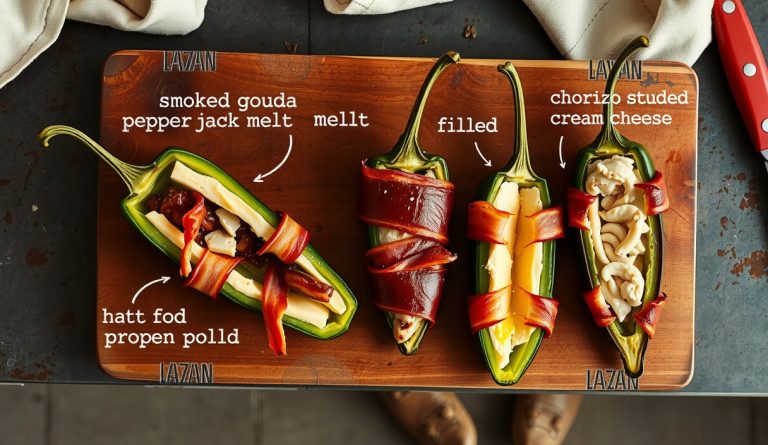
Filling variations: Smoked gouda or pepper jack substituted 1:1 for the cheddar adds a different melt profile. Smoked gouda brings a denser, stringier pull; pepper jack adds another heat dimension. For a southwestern profile, fold two tablespoons of finely diced pickled jalapeño, a teaspoon of cumin, and a tablespoon of crumbled cotija into the base filling. A tablespoon of crumbled cooked chorizo or a tablespoon of real crab meat folded in before piping produces a more substantial, protein-dense appetizer.
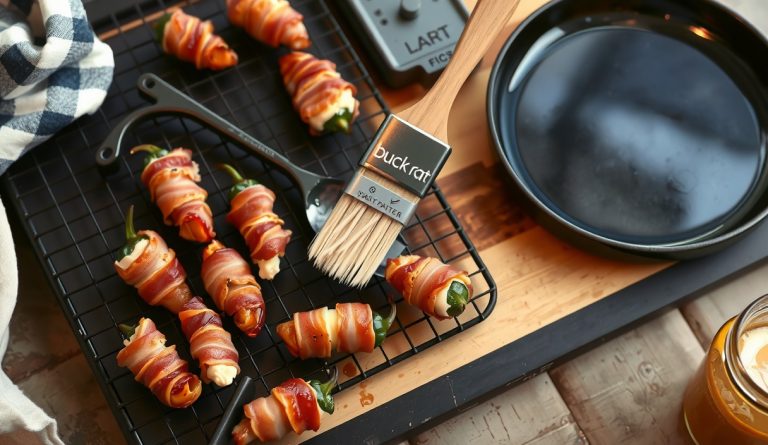
Dietary adaptations: Turkey bacon wraps work functionally but render differently — the lower fat content produces a drier, chewier exterior and requires monitoring, as the bacon does not self-baste the way pork belly fat does. Pull temperature remains 165°F internal. For a pork-free version, thick-cut turkey bacon plus a brush of rendered duck fat on the exterior at the 40-minute mark compensates for the missing fat-basting effect.
Scaling: This recipe scales linearly. For a crowd of 20, double the batch and arrange on two grill grates. At 275°F with good airflow, cook time extends by 5–10 minutes maximum due to the increased thermal mass. Do not crowd the grate — leave at least a half-inch gap between each popper for smoke circulation and even heat exposure on all sides.
Frequently asked questions about smoked jalapeño poppers
Can smoked jalapeño poppers be prepped the night before? Yes, and the poppers are actually better for overnight refrigeration. Assemble through the bacon-wrapping stage, secure with toothpicks, and refrigerate uncovered on a wire rack overnight. The surface moisture dries slightly, which accelerates smoke adhesion and bacon rendering the following day. Pull the poppers from the refrigerator 20 minutes before placing them on the smoker to take the chill off the filling.
Why did the filling blow out of the peppers during smoking? Three likely causes account for blown-out filling: the filling was too warm when the peppers went on the smoker and expanded rapidly as heat rose; the peppers were overfilled past the rim; or the smoker temperature spiked above 300°F early in the cook. The most reliable fix is the combination of refrigerating the filled, wrapped peppers for 15–20 minutes before smoking and keeping smoker temperature disciplined at 270–280°F throughout the cook.
Do smoked jalapeño poppers need direct heat to crisp the bacon? Not necessarily, though direct finishing is an option. At 275°F in a well-managed smoker, standard-cut bacon reaches a rendered, slightly firm texture by the 65–75 minute mark without direct heat. For aggressively crispy bacon, transfer the poppers to a grate directly over coals or a high burner for 2–3 minutes at the end of the cook. Watch carefully — the filling is already molten at this point and direct high heat can purge it quickly.