Vegan Cornbread — Aquafaba Leaven

Equipment
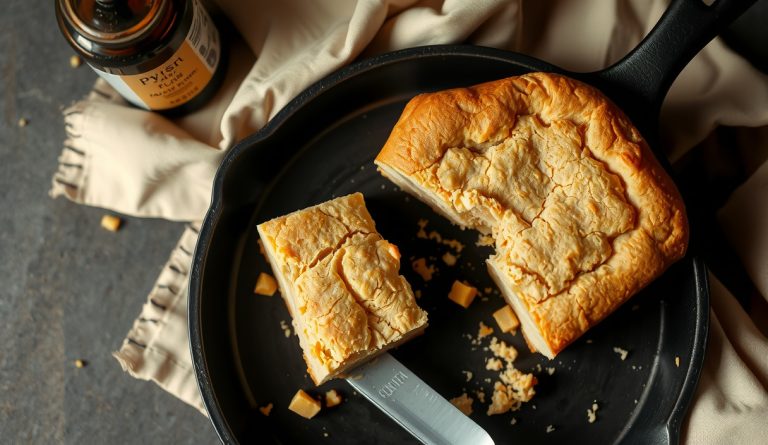
- 1 10-inch cast-iron skillet Preheat inside the oven for the full 10-minute skillet preheat period for a crackling bottom crust.
- 1 Stand mixer or hand mixer with whisk attachment Must be completely free of fat residue. Wipe bowl and whisk with vinegar-dampened paper towel before use.
- 2 Two large mixing bowls
- 1 Instant-read thermometer Target 195°F internal for complete starch gelatinization.
- 1 Silicone spatula Wide, flexible head needed for efficient fold technique.
Ingredients
Oat-Milk Buttermilk Analog
- 1 cup full-fat barista-style oat milk Room temperature. Soy or cashew milk may substitute.
- 1 tbsp apple cider vinegar Raw, unfiltered preferred. Stir into oat milk and let sit 5 minutes until slightly curdled.
Dry Mix
- 1 cup medium-grind yellow cornmeal Stone-ground adds flavor; allow 10-minute hydration before folding foam if using coarse grind.
- ¾ cup all-purpose flour Spoon and level; do not pack.
- 1 tsp baking powder Verify freshness — drop a pinch in hot water; it should fizz vigorously.
- ½ tsp baking soda Reacts with the acid in the buttermilk analog.
- ¾ tsp fine sea salt
Wet Mix
- 3 tbsp refined coconut oil Melted and cooled to room temperature. Must not be warm — hot fat collapses the foam.
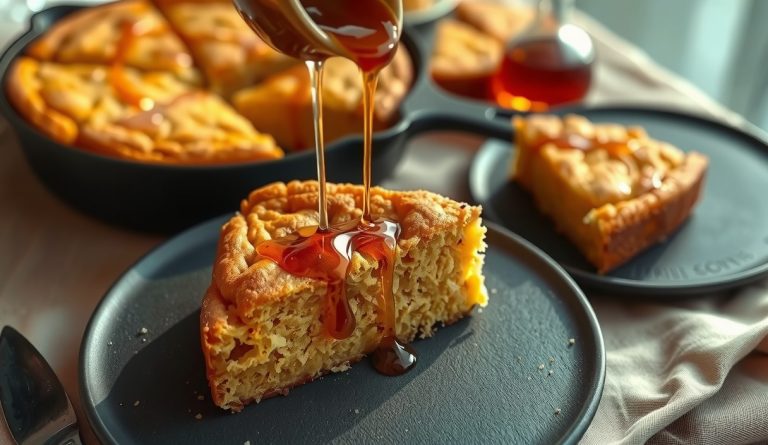
- 2 tbsp pure maple syrup Grade A dark for stronger flavor. Adjust to taste.
Aquafaba Foam
- ½ cup aquafaba Drained liquid from a can of unsalted chickpeas. Refrigerate at least 30 minutes before whipping. If thin, reduce to two-thirds volume and cool completely.
- ⅛ tsp cream of tartar Strongly recommended. Lowers pH, tightens protein film, dramatically stabilizes foam peaks.
Skillet
- 1 tbsp refined coconut oil or neutral vegetable oil Added to the hot skillet just before pouring batter.

Instructions
Setup
- Position a rack in the center of the oven and place the 10-inch cast-iron skillet on it. Preheat oven to 400°F with the skillet inside for at least 10 minutes. A properly preheated skillet produces an audible sizzle when the batter hits and drives immediate bottom-crust formation.
- Wipe your stand mixer bowl and whisk attachment with a paper towel dampened with white vinegar. Any trace of fat will prevent aquafaba foam from forming. Set aside.1/8 tsp cream of tartar
Make the Oat-Milk Buttermilk Analog
- Combine the oat milk and apple cider vinegar in a small bowl or liquid measuring cup. Stir briefly and let stand for 5 minutes at room temperature. The mixture will thicken slightly and may appear lightly curdled — this is the target state, indicating the pH has dropped to approximately 4.0–4.5 and the oat proteins have partially aggregated.1 tbsp apple cider vinegar
Mix Dry and Wet Ingredients
- In a large mixing bowl, whisk together the cornmeal, all-purpose flour, baking powder, baking soda, and salt until evenly combined.1 cup medium-grind yellow cornmeal, 3/4 cup all-purpose flour, 1 tsp baking powder, 1/2 tsp baking soda, 3/4 tsp fine sea salt
- Add the cooled melted coconut oil and maple syrup to the buttermilk analog and whisk to combine. Pour the wet mixture into the dry ingredients and stir with a spatula until just combined — a few streaks of dry flour are fine. Do not overmix. The batter will be thick. Set aside.3 tbsp refined coconut oil, 2 tbsp pure maple syrup, 1 tbsp apple cider vinegar
Whip the Aquafaba Foam
- Add the cold aquafaba and cream of tartar to the clean, fat-free mixer bowl. Whip on high speed for 3–5 minutes until stiff, glossy peaks form — the foam should hold its shape when the whisk is lifted and the bowl can be inverted without it sliding. Do not walk away; overwhipped aquafaba turns dry and grainy, losing its elastic film structure.1/8 tsp cream of tartar, 1 tbsp refined coconut oil or neutral vegetable oil
Fold and Bake
- Work quickly from here. Add one-third of the whipped aquafaba foam to the cornmeal batter and fold gently with a wide silicone spatula — arc from the bottom of the bowl up and over — just until incorporated. This first addition lightens the batter, making the second fold easier.1/8 tsp cream of tartar
- Add the remaining two-thirds of the foam in a single addition. Fold with 10–12 gentle arc strokes until no large white streaks remain. Some very faint streaking is acceptable — do not overfold. The batter should look aerated and slightly domed.1/8 tsp cream of tartar
- Remove the hot skillet from the oven using heavy oven mitts. Add the tablespoon of coconut oil to the skillet and swirl to coat the bottom and lower sides — it will smoke lightly. Immediately pour the batter into the skillet; it should sizzle audibly on contact. Use the spatula to spread it to the edges in one or two strokes — do not fuss with it.
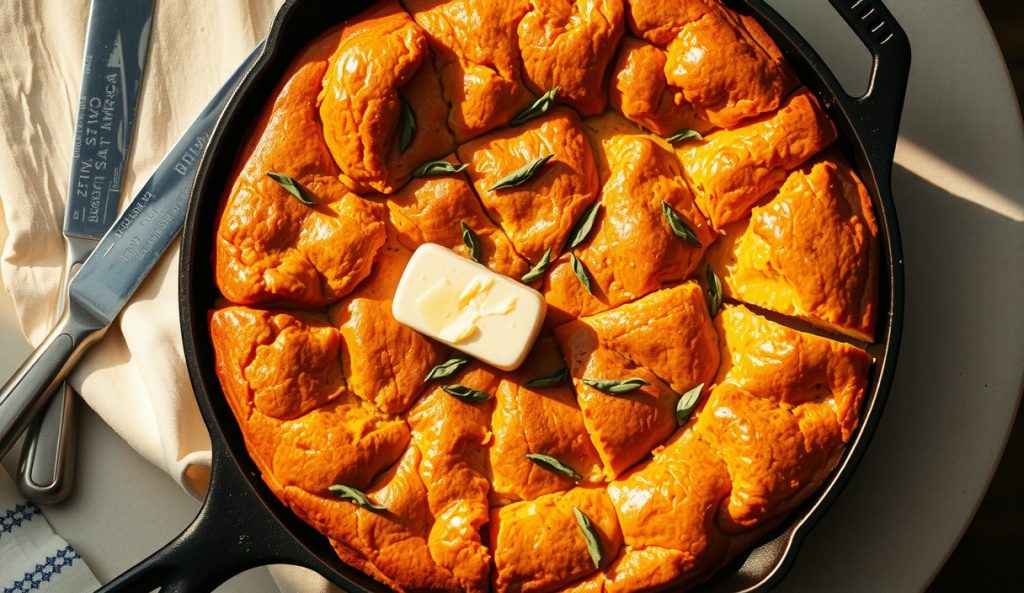
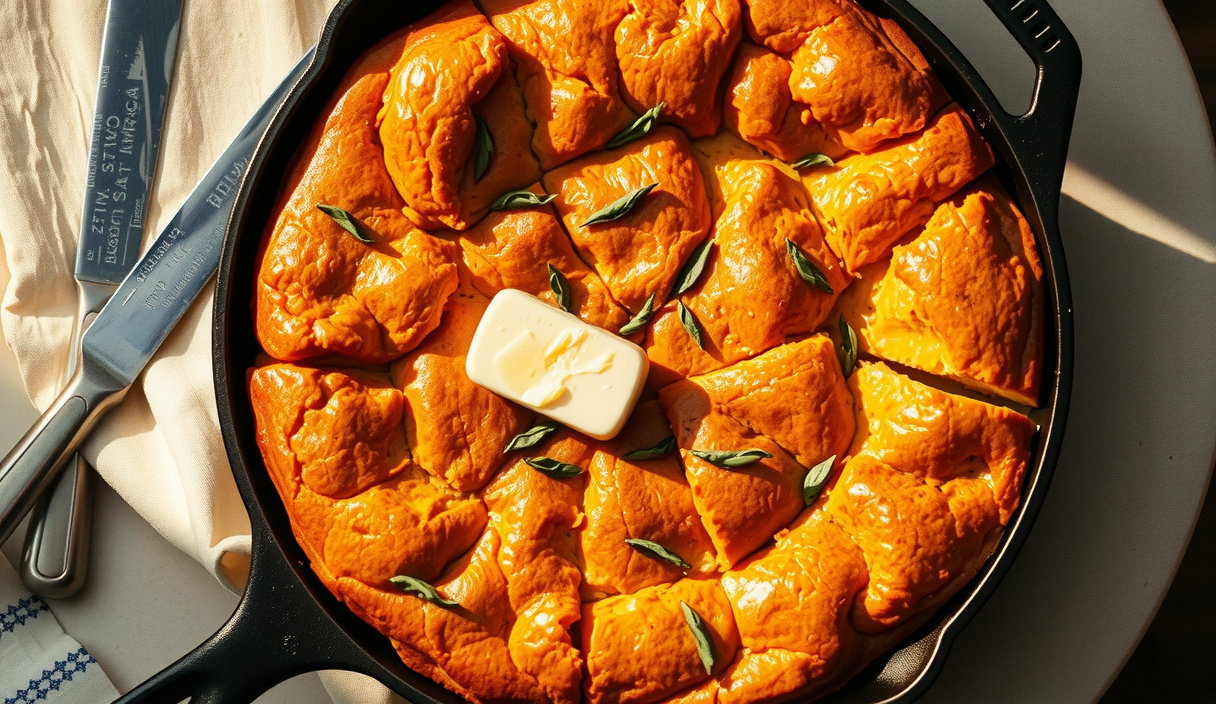
- Return the skillet to the center rack and bake at 400°F for 18–22 minutes. The cornbread is done when the top is deep golden brown, the edges have pulled slightly from the sides, and an instant-read thermometer inserted into the center reads 195°F. Do not rely on the toothpick test alone — the internal temperature confirms starch gelatinization is complete and rules out a gummy crumb.
- Allow the cornbread to cool in the skillet for 5 minutes before slicing into wedges. Serve warm. Leftovers keep wrapped at room temperature for up to 2 days; reheat in a dry skillet over medium-low heat for 2 minutes per side to revive the crust.
Notes
Nutrition
Testing a lot of cornbread reveals a hard truth: every transcendent version leans on two things no plant-based cook is supposed to have — the emulsifying power of egg yolk and the aeration of whipped egg white. The yolk builds the continuous fat phase; the white delivers a network of denatured proteins that hold CO₂ bubbles in suspension long enough for the crumb to set. Remove both, and the result is a dense, greasy puck that no amount of maple syrup can save.
This vegan cornbread solves the problem at the molecular level. Aquafaba — the viscous cooking water drained from a can of chickpeas — contains roughly 3–5% low-molecular-weight proteins, saponins, and complex polysaccharides. Those saponins reduce interfacial tension dramatically, and the proteins are small enough to migrate to the air-water interface fast. Whipped to stiff peaks, aquafaba generates a metastable foam that, when folded into an oat-milk buttermilk batter and baked immediately, expands inside the oven before the starch-protein matrix sets. The result is a cornbread with genuine lift, a slightly custardy interior, and a crackling top crust.
Why does aquafaba cornbread work? The science
Aquafaba cornbread achieves its lift through three simultaneous leavening mechanisms that overlap during the first minutes of baking. First, the aquafaba foam contributes physical gas directly — air bubbles nucleated during whipping and stabilized by interfacial protein-saponin films. Second, baking soda reacts with the acetic acid produced when apple cider vinegar denatures oat-milk proteins, generating CO₂ on contact. Third, water vapor expands as the internal temperature climbs, further inflating the batter before the starch-protein network locks into place at roughly 185°F–195°F, when residual cornmeal starch granules complete gelatinization and the continuous matrix sets rigid.
The aquafaba foam is inherently fragile compared to egg albumen. Unlike egg white, which undergoes thermo-irreversible coagulation to permanently anchor air cells, aquafaba foam relies on a kinetically trapped polysaccharide-protein gel. Any fat contamination — even a film of oil on the bowl or whisk — collapses the interfacial tension differential and prevents foam formation entirely. This is why the wet fat phase (melted coconut oil) is kept completely separate until the final fold. The service window between foam formation and oven entry must be under five minutes.
The oat-milk buttermilk analog works because oat milk contains modest concentrations of beta-glucans and hydrolyzed starches that thicken slightly when acidified. Apple cider vinegar drops the pH to approximately 4.0–4.5 in the cup, causing partial aggregation of the oat proteins and generating tartrate esters from residual apple-derived compounds. This pH drop is essential: baking soda (sodium bicarbonate) requires an acid to generate CO₂ at baking temperatures, and without it the crumb turns soapy and alkaline. Maillard browning on the surface is driven by the reducing sugars in cornmeal reacting with free amino acids, beginning around 280°F surface temperature — cornmeal’s high monosaccharide load means browning initiates faster than in a wheat-dominant batter, so watch the edges after the 18-minute mark.
What equipment and ingredients do I need?
- Cast-iron skillet (10-inch): The thermal mass of a preheated cast-iron skillet drives rapid bottom crust formation before the crumb sets — this gives vegan cornbread that characteristic crunch. A standard 8-inch square pan works but delivers a less dramatic crust.
- Stand mixer or hand mixer: Aquafaba foam requires sustained high-speed agitation of 3–5 minutes to reach stiff peaks. A whisk by hand is possible but strenuous; the resulting foam will be less stable and less voluminous.
- Aquafaba source: Use the liquid from a can of unsalted or low-sodium chickpeas. Viscosity varies by brand; thicker liquid foams better. If the liquid runs freely when you tilt the can, reduce it in a small saucepan over low heat until it coats the back of a spoon, then cool completely before whipping.
- Oat milk: Use full-fat, barista-style oat milk. Thin oat milks with fewer solids will not thicken appreciably when acidified, yielding a more watery batter. Soy or cashew milk are compatible substitutes by phase-state.
- Cornmeal grind: Medium-grind cornmeal delivers the best texture. Fine-grind produces a more cake-like crumb; stone-ground coarse-grind is beautiful but will be grainy unless the batter hydrates for 10 minutes before the foam is folded in.
- Refined coconut oil: Use refined, not virgin. Virgin coconut oil introduces a detectable coconut flavor that competes with the corn. The fat must be fully melted and cooled to room temperature before adding — hot fat will deflate the batter instantly.
Vegan Cornbread — Aquafaba Leaven
Equipment
- 1 10-inch cast-iron skillet Preheat inside the oven for the full 10-minute skillet preheat period for a crackling bottom crust.
- 1 Stand mixer or hand mixer with whisk attachment Must be completely free of fat residue. Wipe bowl and whisk with vinegar-dampened paper towel before use.
- 2 Two large mixing bowls
- 1 Instant-read thermometer Target 195°F internal for complete starch gelatinization.
- 1 Silicone spatula Wide, flexible head needed for efficient fold technique.
Ingredients
Oat-Milk Buttermilk Analog
- 1 cup full-fat barista-style oat milk Room temperature. Soy or cashew milk may substitute.
- 1 tbsp apple cider vinegar Raw, unfiltered preferred. Stir into oat milk and let sit 5 minutes until slightly curdled.
Dry Mix
- 1 cup medium-grind yellow cornmeal Stone-ground adds flavor; allow 10-minute hydration before folding foam if using coarse grind.
- ¾ cup all-purpose flour Spoon and level; do not pack.
- 1 tsp baking powder Verify freshness — drop a pinch in hot water; it should fizz vigorously.
- ½ tsp baking soda Reacts with the acid in the buttermilk analog.
- ¾ tsp fine sea salt
Wet Mix
- 3 tbsp refined coconut oil Melted and cooled to room temperature. Must not be warm — hot fat collapses the foam.
- 2 tbsp pure maple syrup Grade A dark for stronger flavor. Adjust to taste.
Aquafaba Foam
- ½ cup aquafaba Drained liquid from a can of unsalted chickpeas. Refrigerate at least 30 minutes before whipping. If thin, reduce to two-thirds volume and cool completely.
- ⅛ tsp cream of tartar Strongly recommended. Lowers pH, tightens protein film, dramatically stabilizes foam peaks.
Skillet
- 1 tbsp refined coconut oil or neutral vegetable oil Added to the hot skillet just before pouring batter.
Instructions
Setup
- Position a rack in the center of the oven and place the 10-inch cast-iron skillet on it. Preheat oven to 400°F with the skillet inside for at least 10 minutes. A properly preheated skillet produces an audible sizzle when the batter hits and drives immediate bottom-crust formation.
- Wipe your stand mixer bowl and whisk attachment with a paper towel dampened with white vinegar. Any trace of fat will prevent aquafaba foam from forming. Set aside.1/8 tsp cream of tartar
Make the Oat-Milk Buttermilk Analog
- Combine the oat milk and apple cider vinegar in a small bowl or liquid measuring cup. Stir briefly and let stand for 5 minutes at room temperature. The mixture will thicken slightly and may appear lightly curdled — this is the target state, indicating the pH has dropped to approximately 4.0–4.5 and the oat proteins have partially aggregated.1 tbsp apple cider vinegar
Mix Dry and Wet Ingredients
- In a large mixing bowl, whisk together the cornmeal, all-purpose flour, baking powder, baking soda, and salt until evenly combined.1 cup medium-grind yellow cornmeal, 3/4 cup all-purpose flour, 1 tsp baking powder, 1/2 tsp baking soda, 3/4 tsp fine sea salt
- Add the cooled melted coconut oil and maple syrup to the buttermilk analog and whisk to combine. Pour the wet mixture into the dry ingredients and stir with a spatula until just combined — a few streaks of dry flour are fine. Do not overmix. The batter will be thick. Set aside.3 tbsp refined coconut oil, 2 tbsp pure maple syrup, 1 tbsp apple cider vinegar
Whip the Aquafaba Foam
- Add the cold aquafaba and cream of tartar to the clean, fat-free mixer bowl. Whip on high speed for 3–5 minutes until stiff, glossy peaks form — the foam should hold its shape when the whisk is lifted and the bowl can be inverted without it sliding. Do not walk away; overwhipped aquafaba turns dry and grainy, losing its elastic film structure.1/8 tsp cream of tartar, 1 tbsp refined coconut oil or neutral vegetable oil
Fold and Bake
- Work quickly from here. Add one-third of the whipped aquafaba foam to the cornmeal batter and fold gently with a wide silicone spatula — arc from the bottom of the bowl up and over — just until incorporated. This first addition lightens the batter, making the second fold easier.1/8 tsp cream of tartar
- Add the remaining two-thirds of the foam in a single addition. Fold with 10–12 gentle arc strokes until no large white streaks remain. Some very faint streaking is acceptable — do not overfold. The batter should look aerated and slightly domed.1/8 tsp cream of tartar
- Remove the hot skillet from the oven using heavy oven mitts. Add the tablespoon of coconut oil to the skillet and swirl to coat the bottom and lower sides — it will smoke lightly. Immediately pour the batter into the skillet; it should sizzle audibly on contact. Use the spatula to spread it to the edges in one or two strokes — do not fuss with it.
- Return the skillet to the center rack and bake at 400°F for 18–22 minutes. The cornbread is done when the top is deep golden brown, the edges have pulled slightly from the sides, and an instant-read thermometer inserted into the center reads 195°F. Do not rely on the toothpick test alone — the internal temperature confirms starch gelatinization is complete and rules out a gummy crumb.
- Allow the cornbread to cool in the skillet for 5 minutes before slicing into wedges. Serve warm. Leftovers keep wrapped at room temperature for up to 2 days; reheat in a dry skillet over medium-low heat for 2 minutes per side to revive the crust.
Notes
Nutrition
How do I nail this vegan cornbread every time?
- Fat-free equipment is non-negotiable. Wipe the bowl and whisk with a paper towel dampened with white vinegar before whipping. A single fat droplet will destroy the aquafaba foam before it starts.
- Cold aquafaba foams faster and holds longer. Refrigerate the drained chickpea liquid for at least 30 minutes before whipping. Cold continuous phases slow Ostwald ripening, keeping the bubble size distribution tight.
- Reduce before whipping if the aquafaba is thin. If the liquid runs freely when you tilt the can, simmer it down to two-thirds volume and cool completely. Concentration raises the protein-saponin density and dramatically improves peak stability.
- Preheat the skillet inside the oven. A cold cast-iron skillet produces a pale, steamed bottom. Preheat the skillet for the full 10 minutes of oven preheating, add oil, swirl, and pour batter immediately.
- Fold, do not stir. Fold the whipped aquafaba into the batter in two additions using a silicone spatula with wide, arc-shaped strokes from the bottom of the bowl. Overmixing shears the air cells and collapses the foam network before gelatinization can lock it in place.
- Bake immediately. The aquafaba foam begins draining from the moment it is folded in. Every minute between fold and oven costs measurable lift. Have the skillet preheated, the oven at temperature, and a clear path to the oven before folding begins.
What variations can I make to this cornbread?
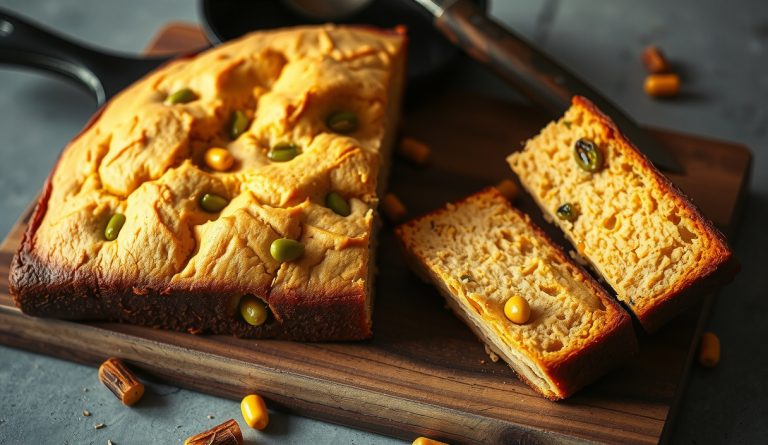
Jalapeño and roasted corn: Fold in 1 cup of charred fresh or thawed frozen corn kernels and 2 tablespoons of finely diced pickled jalapeño with the dry-wet mixture before adding the foam. The sugar in charred corn kernels contributes extra Maillard substrate at the surface; reduce oven temperature by 10°F to account for the accelerated browning. This variation works best in a wood-fired offset smoker: set the damper for indirect 375°F and smoke with a single small chunk of apple or cherry wood for the first 15 minutes. Smoke uptake is moderate because the surface sets quickly.
Sweet Southern style: Increase the maple syrup to 4 tablespoons and substitute half the all-purpose flour with a second quarter-cup of fine-grind cornmeal. The additional monosaccharides accelerate surface browning — drop the oven to 375°F and tent with foil after the first 15 minutes if the top is browning faster than the interior sets. This sweeter version is lower in savory depth; compensate with a pinch of smoked paprika in the dry mix.
Gluten-free: Replace the all-purpose flour with a 1:1 gluten-free baking flour blend that includes xanthan gum. Because xanthan provides pseudoplastic viscosity that substitutes for gluten’s strain-hardening behavior, the batter will be noticeably thicker — this is desirable, as it holds the aquafaba bubbles in suspension longer. Add 2 teaspoons of psyllium husk powder to the dry mix to further improve crumb cohesion and slow staling.
Whole-grain: Substitute half the all-purpose flour with whole-wheat pastry flour. The additional dietary fiber raises the water demand of the batter; increase oat milk by 2 tablespoons. Whole-wheat pastry flour has a lower protein content than bread flour, so the added bran does not significantly toughen the crumb, but the result will be denser and earthier with a slightly shorter service window before staling accelerates.
Frequently asked questions about vegan aquafaba cornbread
Why did the cornbread come out dense and gummy? The two most common culprits are a collapsed aquafaba foam and underbaking. If the foam was deflated before it entered the oven — due to fat contamination, overmixing, or a delayed bake — the crumb lacks the gas cell architecture needed to set light. Gumminess specifically points to under-gelatinized starch: pull the skillet when an internal probe reads 195°F minimum, not just when the surface looks done.
Can the batter be made ahead of time? No. The aquafaba foam is a kinetically trapped metastable structure with no thermo-irreversible cross-linking to hold it permanently. Within 10–15 minutes of folding, the foam drains significantly and leavening potential drops. The dry ingredients and the wet ingredients can be mixed separately up to one hour ahead and refrigerated individually, then the aquafaba should be whipped and the batter assembled immediately before baking.
Why won’t the aquafaba reach stiff peaks? Three possibilities: fat contamination in the bowl or on the whisk (the most common cause), aquafaba that was too warm or too dilute (chill it and reduce it by simmering to two-thirds volume), or the omission of cream of tartar. Cream of tartar lowers the pH slightly, which tightens the protein network and significantly improves foam stability. Cream of tartar is listed as optional in the recipe but is strongly recommended for reliability.