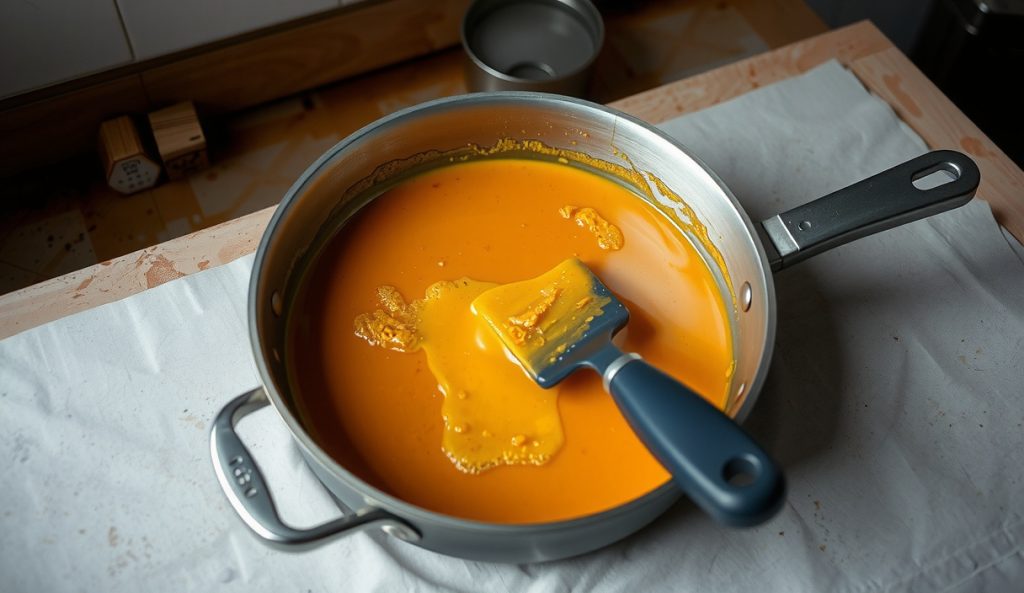
Carolina Mustard BBQ Sauce scales linearly by mass, which makes large-batch production straightforward for competition cooks, catering events, or any service requiring multiple gallons. The ingredient math is simple — the physics of reduction is not. At 4x scale and above, vessel geometry becomes the primary variable determining whether the sauce finishes on schedule or stalls indefinitely in a too-deep pot. Getting vessel selection right is the difference between a sauce ready for service and one still simmering two hours past deadline.
What changes when you scale Carolina Mustard BBQ Sauce up?
Reduction is a surface evaporation phenomenon: water vapor exits through the liquid’s top surface, not through the walls or bottom of the pot. The rate of evaporation is directly proportional to exposed surface area, not to total volume. When you double a Carolina Mustard BBQ Sauce recipe in the same saucepan, the liquid depth doubles but the surface area stays constant — the evaporation rate is unchanged while the total water to be driven off doubles, making reduction time approximately twice as long.
At 4x scale in a standard deep saucepan, this surface-area effect compounds severely. The solution is a wide, shallow rondeau or brazier — a vessel with a significantly larger diameter-to-depth ratio than a saucepan. A 14-inch rondeau loaded to 3 inches of depth exposes far more surface area than a 10-inch saucepan loaded to 6 inches, even if both hold the same volume. Maintain the same heat level and the same visual doneness cues as in the original single-batch process: the sauce thickens, deepens in color, and coats a spoon.
No timing adjustments to flavor development are needed at larger scale. The Maillard and caramelization reactions — onset around 140–150 °C for sugars — proceed identically once reduction brings the sauce to its target concentration, regardless of batch size.
What stays the same at any batch size?
All ingredient ratios, spice proportions, and target flavor balance in Carolina Mustard BBQ Sauce are identical to the canonical single batch at every scale. The visual doneness cues — color deepening, spoon-coat consistency, and volume reduction — are the same benchmarks regardless of how many gallons are in the vessel. Quality control by taste and texture, not by clock, is the rule at any scale.
When is scaling up in one vessel the better choice?
Any time volume demand exceeds two or three single batches, scaling up in one wide vessel is more efficient and more consistent than running multiple parallel batches on limited burners. Competition cooks especially benefit from producing a single unified batch: the flavor profile stays perfectly consistent across the entire service quantity rather than varying batch to batch with minor temperature and timing differences.
Use the full ingredient list, ratios, and method from the original Carolina Mustard BBQ Sauce — multiply all quantities by mass and switch to the appropriate vessel.