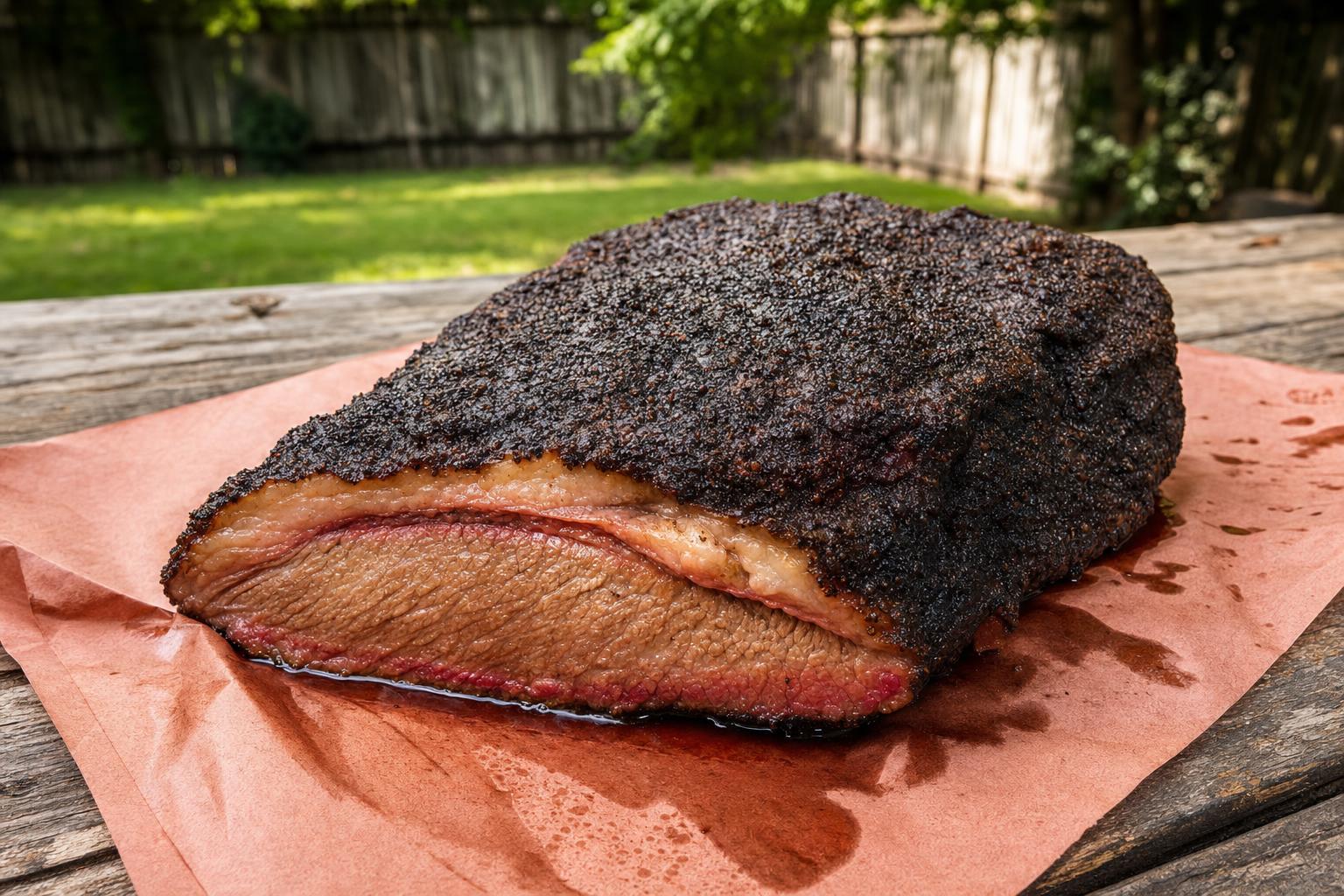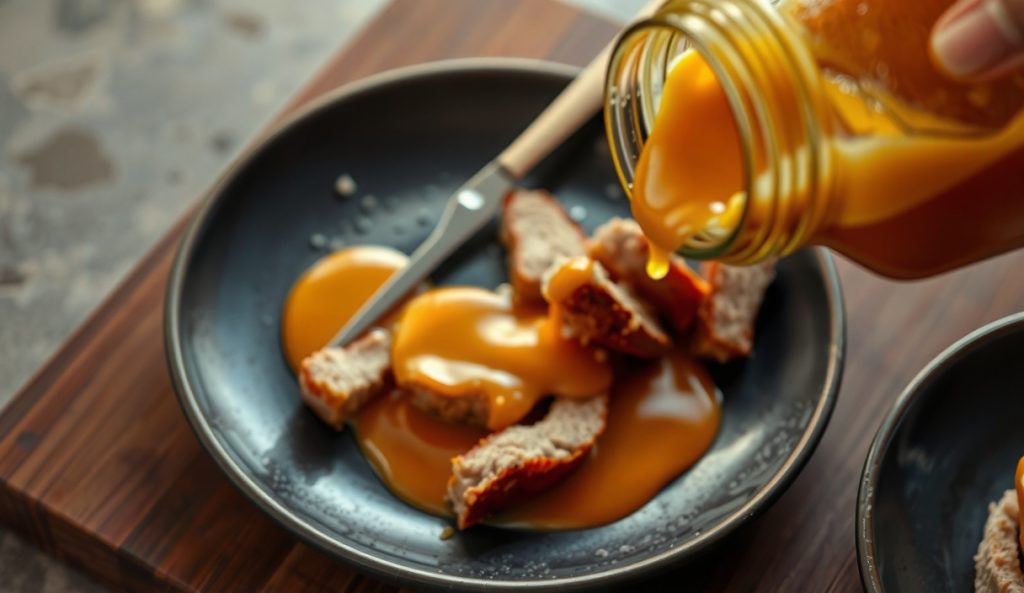
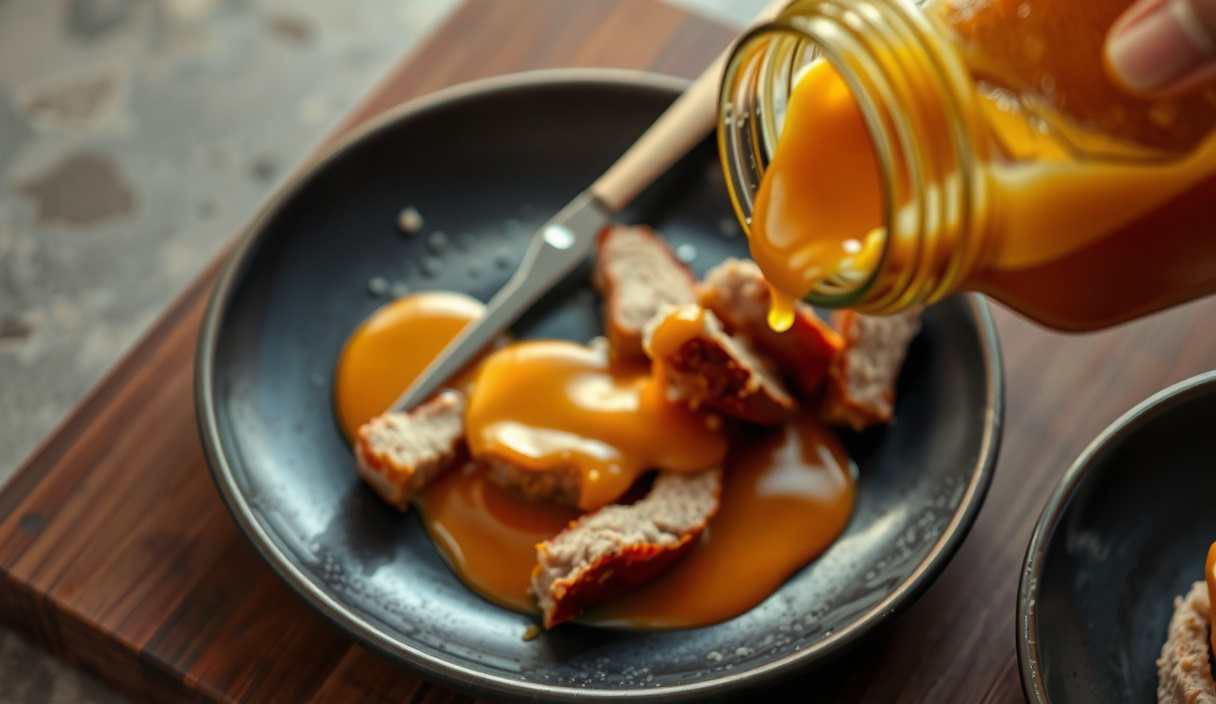
Carolina Mustard BBQ Sauce (South Carolina Gold)

Equipment
- 1 Heavy-bottomed saucepan (2-quart) Stainless-steel or enameled cast iron preferred to prevent scorching from sugar concentration.
- 1 Silicone spatula or wooden spoon For continuous stirring during the final reduction phase.
- 1 Instant-read thermometer Optional but useful; target 200–205°F during active reduction.
- 1 Glass jar with lid (16 oz) For storage; glass is non-reactive with the low-pH sauce.
Ingredients
Sauce Base
- 1 tablespoon unsalted butter Used to bloom the dry spices; provides fat for dissolving fat-soluble capsaicinoids.
- 1 cup prepared yellow mustard Standard American yellow mustard (e.g., French’s). Do not substitute Dijon — the emulsion profile and flavor register differ substantially.
- 0.5 cup apple cider vinegar Raw, unfiltered preferred for ester complexity. Distilled white vinegar produces a sharper, cleaner result.
- 0.25 cup light brown sugar, packed Dark brown sugar is acceptable for a deeper molasses note; watch for increased bitterness at high reduction.
- 2 tablespoons Worcestershire sauce Lee & Perrins is the benchmark. Scale to taste if using a generic brand with lower anchovy/tamarind concentration.
- 1 tablespoon honey Adds floral complexity and helps round the acidic edge. Can be omitted for a sharper sauce.
- 1 tablespoon ketchup A small tomato note anchors the sauce without pushing it toward a ketchup-based Southern style.
Spice Blend
- 0.5 teaspoon cayenne pepper For a hotter sauce, increase to 1 teaspoon; for mild, reduce to 1/4 teaspoon.
- 0.5 teaspoon dry mustard powder Amplifies the glucosinolate heat of the prepared mustard base with additional allyl isothiocyanate precursors.
- 0.5 teaspoon garlic powder
- 0.25 teaspoon onion powder
- 0.25 teaspoon freshly ground black pepper
- 0.25 teaspoon kosher salt Added at the end of cooking to avoid ionic disruption of the mustard emulsion during the reduction phase.

Instructions
Build the Sauce
- Melt the butter in a heavy-bottomed 2-quart saucepan over medium heat. Once it foams and subsides, add the cayenne, dry mustard powder, garlic powder, onion powder, and black pepper. Stir constantly and cook for 60 seconds, until the spices are fragrant and the butter is lightly golden. This fat-bloom step dissolves fat-soluble capsaicinoids and sulfurous volatile compounds for even heat distribution throughout the final sauce.0.5 teaspoon dry mustard powder, 0.5 teaspoon garlic powder, 0.25 teaspoon onion powder, 0.25 teaspoon freshly ground black pepper, 0.25 teaspoon kosher salt
- Add the yellow mustard, apple cider vinegar, brown sugar, Worcestershire sauce, honey, and ketchup to the saucepan. Whisk vigorously to fully incorporate the spice-fat bloom into the liquid base. The sauce will look slightly grainy at this stage — that is normal and will resolve as it heats.1 cup prepared yellow mustard, 0.5 cup apple cider vinegar, 0.25 cup light brown sugar, packed, 2 tablespoons Worcestershire sauce, 1 tablespoon honey, 1 tablespoon ketchup
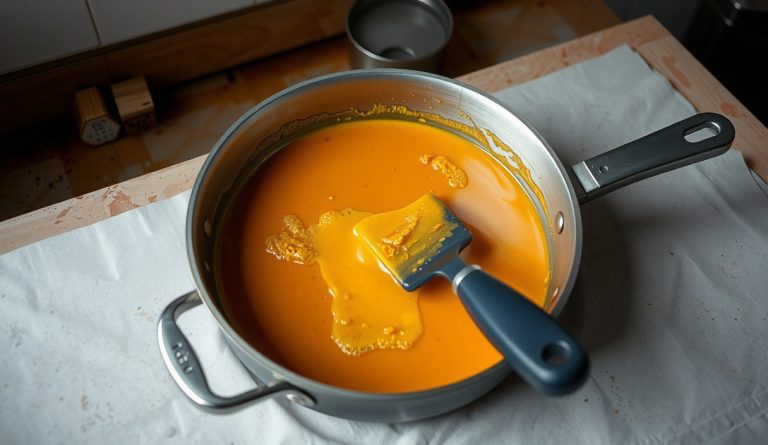
- Increase heat to medium-high and bring the sauce to a low boil, whisking occasionally. Once bubbling, reduce heat to medium and maintain a vigorous simmer. Cook uncovered for 12 to 15 minutes, stirring every 2 to 3 minutes, until the sauce has reduced by roughly one-quarter and coats the back of a spoon with visible resistance. Target sauce temperature: 200–205°F. Watch closely in the final 3 minutes — sugar concentration increases rapidly and scorching risk spikes.
- Remove the saucepan from heat. Stir in the kosher salt. Allow the sauce to rest, uncovered, for 5 minutes before tasting. Flavors will sharpen and concentrate as the sauce cools. Adjust salt and, if desired, a few extra drops of apple cider vinegar for brightness. The sauce is ready to use immediately or transfer to a sealed glass jar for refrigerated storage.0.5 cup apple cider vinegar
Notes
Nutrition
There is a specific county-fair moment burned into my palate: a pulled pork sandwich dressed in a yellow-gold sauce that was simultaneously sharp, sweet, tangy, and faintly smoky. No tomato. No ketchup base. Just the assertive, nasal-clearing heat of yellow mustard cut with cider vinegar and enough brown sugar to keep everything in tension. That is South Carolina gold-style barbecue sauce, and it is as close to a pure flavor argument as American BBQ gets.
Most cooks treat Carolina mustard BBQ sauce like a condiment afterthought. At American Meathead, we treat it like a colloidal-chemistry problem with a smoke-and-char payoff. This recipe is built to be tight, fast, and replicable — 18 minutes on the stove, one saucepan, and a sauce that holds its body, its gloss, and its flavor across a wide range of service temperatures.
Why does Carolina mustard BBQ sauce work? The science
Carolina mustard BBQ sauce achieves its characteristic gloss, body, and heat because yellow prepared mustard is already a stable oil-in-water emulsion, held together by mucilage proteins and polysaccharides extracted from the seed coat during milling. These structural molecules do double duty: they give the sauce viscosity and they keep the fat droplets suspended without any synthetic emulsifier.
The key molecular actors are glucosinolate hydrolysis products — specifically allyl isothiocyanate and related thiocyanate derivatives — which form during enzymatic breakdown of sinigrin and sinalbin when the seed is crushed in the presence of water. These amphiphilic molecules reduce interfacial tension at the oil-water boundary and produce the sauce’s characteristic nasal pungency. That pungency is a trigeminal TRPA1 ion channel stimulus, not the TRPV1 capsaicin response you get from chili. This is why mustard heat blooms fast and fades fast compared to chili heat. The mucilaginous seed proteins carry a slight negative surface charge at the culinary pH range of this sauce — roughly pH 3.5 to 4.2 — which maintains droplet repulsion and long-term emulsion stability.
Apple cider vinegar drives the pH of South Carolina gold sauce firmly below 4.0, accomplishing three things at once: it suppresses microbial activity through combined acid and water-activity effects; it brightens the fruit and fermentation esters in the vinegar itself; and it keeps the mustard proteins above their isoelectric point, sustaining electrostatic repulsion between dispersed droplets. Brown sugar contributes sucrose and a small fraction of reducing monosaccharides from invert-sugar formation at cooking temperatures, which accelerates Maillard browning on the meat surface when the sauce is applied as a glaze in the final minutes of a cook. The molasses fraction in brown sugar also supplies trace minerals and furanone-type aroma compounds — that characteristic low caramel note — without the sharp bitterness of dark molasses alone.
Worcestershire sauce adds a complex umami layer: glutamate-rich tamarind and anchovies, present at trace concentrations after fermentation, synergistically activate T1R1/T1R3 umami receptors alongside sulfurous garlic and allium notes. Cayenne delivers a dose-controlled TRPV1 capsaicin stimulus that, unlike the fast-bloom mustard heat, builds slowly and lingers. Using both in the same sauce creates a temporal heat architecture: the mustard hits immediately and recedes, the cayenne arrives slightly later and holds. Reduction concentrates all these flavor compounds while driving off volatile acetic acid molecules from the surface, mellowing the raw vinegar aggression and allowing the savory and sweet registers to come forward.
What equipment and ingredients do I need? Notes before you start
- Yellow mustard, not Dijon: Dijon uses white wine and brown mustard seeds; its glucosinolate and mucilage profile differs from yellow prepared mustard. Yellow prepared mustard gives you the correct emulsion viscosity and the classic South Carolina flavor register. French’s or a comparable store-brand works perfectly.
- Apple cider vinegar: Raw, unfiltered ACV delivers a slightly more complex ester profile and a touch more body from the mother. Distilled white vinegar produces a sharper, cleaner-tasting sauce that is less nuanced but still correct.
- Brown sugar: Light brown sugar gives a delicate molasses undertone. Dark brown sugar deepens the caramel note but can tip toward bitterness at high reduction. Either works — adjust by taste in the final two minutes of cooking.
- Worcestershire sauce: Lee and Perrins is the benchmark. Generic Worcestershire sauces vary widely in tamarind and anchovy concentration, so taste yours before using and scale accordingly. For a fish-free version, use a vegan Worcestershire or increase tamari by half.
- Heavy-bottomed saucepan: Mustard-based sauces scorch easily because mucilage and sugars form a concentrated layer on the pan floor. A stainless-steel or enameled cast iron saucepan with consistent heat distribution prevents hot spots and uneven reduction.
- Instant-read thermometer (optional but useful): Target a sauce temperature of 200–205°F during the active reduction phase. This ensures starch gelatinization of residual particulate matter from the brown sugar and achieves the right viscosity without burning.
Carolina Mustard BBQ Sauce (South Carolina Gold)
Equipment
- 1 Heavy-bottomed saucepan (2-quart) Stainless-steel or enameled cast iron preferred to prevent scorching from sugar concentration.
- 1 Silicone spatula or wooden spoon For continuous stirring during the final reduction phase.
- 1 Instant-read thermometer Optional but useful; target 200–205°F during active reduction.
- 1 Glass jar with lid (16 oz) For storage; glass is non-reactive with the low-pH sauce.
Ingredients
Sauce Base
- 1 tablespoon unsalted butter Used to bloom the dry spices; provides fat for dissolving fat-soluble capsaicinoids.
- 1 cup prepared yellow mustard Standard American yellow mustard (e.g., French’s). Do not substitute Dijon — the emulsion profile and flavor register differ substantially.
- 0.5 cup apple cider vinegar Raw, unfiltered preferred for ester complexity. Distilled white vinegar produces a sharper, cleaner result.
- 0.25 cup light brown sugar, packed Dark brown sugar is acceptable for a deeper molasses note; watch for increased bitterness at high reduction.
- 2 tablespoons Worcestershire sauce Lee & Perrins is the benchmark. Scale to taste if using a generic brand with lower anchovy/tamarind concentration.
- 1 tablespoon honey Adds floral complexity and helps round the acidic edge. Can be omitted for a sharper sauce.
- 1 tablespoon ketchup A small tomato note anchors the sauce without pushing it toward a ketchup-based Southern style.
Spice Blend
- 0.5 teaspoon cayenne pepper For a hotter sauce, increase to 1 teaspoon; for mild, reduce to 1/4 teaspoon.
- 0.5 teaspoon dry mustard powder Amplifies the glucosinolate heat of the prepared mustard base with additional allyl isothiocyanate precursors.
- 0.5 teaspoon garlic powder
- 0.25 teaspoon onion powder
- 0.25 teaspoon freshly ground black pepper
- 0.25 teaspoon kosher salt Added at the end of cooking to avoid ionic disruption of the mustard emulsion during the reduction phase.
Instructions
Build the Sauce
- Melt the butter in a heavy-bottomed 2-quart saucepan over medium heat. Once it foams and subsides, add the cayenne, dry mustard powder, garlic powder, onion powder, and black pepper. Stir constantly and cook for 60 seconds, until the spices are fragrant and the butter is lightly golden. This fat-bloom step dissolves fat-soluble capsaicinoids and sulfurous volatile compounds for even heat distribution throughout the final sauce.0.5 teaspoon dry mustard powder, 0.5 teaspoon garlic powder, 0.25 teaspoon onion powder, 0.25 teaspoon freshly ground black pepper, 0.25 teaspoon kosher salt
- Add the yellow mustard, apple cider vinegar, brown sugar, Worcestershire sauce, honey, and ketchup to the saucepan. Whisk vigorously to fully incorporate the spice-fat bloom into the liquid base. The sauce will look slightly grainy at this stage — that is normal and will resolve as it heats.1 cup prepared yellow mustard, 0.5 cup apple cider vinegar, 0.25 cup light brown sugar, packed, 2 tablespoons Worcestershire sauce, 1 tablespoon honey, 1 tablespoon ketchup
- Increase heat to medium-high and bring the sauce to a low boil, whisking occasionally. Once bubbling, reduce heat to medium and maintain a vigorous simmer. Cook uncovered for 12 to 15 minutes, stirring every 2 to 3 minutes, until the sauce has reduced by roughly one-quarter and coats the back of a spoon with visible resistance. Target sauce temperature: 200–205°F. Watch closely in the final 3 minutes — sugar concentration increases rapidly and scorching risk spikes.
- Remove the saucepan from heat. Stir in the kosher salt. Allow the sauce to rest, uncovered, for 5 minutes before tasting. Flavors will sharpen and concentrate as the sauce cools. Adjust salt and, if desired, a few extra drops of apple cider vinegar for brightness. The sauce is ready to use immediately or transfer to a sealed glass jar for refrigerated storage.0.5 cup apple cider vinegar
Notes
Nutrition
How do I nail it every time? Tips for a perfect South Carolina gold sauce
- Don’t skip the bloom: Cooking the dry spices — cayenne, black pepper, dry mustard — in butter for 60 seconds before adding the liquids is not optional. Fat-soluble capsaicinoids and sulfur-bearing volatile compounds in dry mustard seed need lipid contact to fully dissolve and distribute. A raw-spice dump into a vinegar base leaves the heat uneven and harsh.
- Watch the reduction carefully after minute 10: Sugar concentration increases rapidly in the final third of the reduction. The sauce can go from glossy to scorched in under 90 seconds if heat is not reduced. Pull to medium-low and stir continuously once the sauce coats the back of a spoon with visible resistance.
- Taste calibration happens off-heat: Flavors compress and sharpen as the sauce cools. A sauce that tastes perfectly balanced at 200°F will often read sharper and sweeter at 70°F. Adjust salt and vinegar after a 5-minute rest, not while the sauce is at full boil.
- Mustard emulsion can break under high ionic load: Salting aggressively before the sauce sets allows sodium ions to shield the electrostatic repulsion between mustard protein-coated droplets and cause visible oil separation. Add salt at the end of cooking in increments.
- Glaze vs. table sauce requires different viscosity: For a glaze applied in the last 10–15 minutes of a pork shoulder cook, reduce the South Carolina gold sauce an additional 3–4 minutes until it sheets cleanly off a spoon. For a table sauce, stop earlier at a looser, pourable consistency.
- pH matters for shelf life: This sauce sits comfortably below pH 4.0 due to the ACV content, which suppresses most pathogen growth. Refrigerate in a sealed glass jar. Shelf life is 3–4 weeks refrigerated; flavor actually improves after 48 hours as the components integrate and the mustard heat mellows slightly.
How can I change it up? Variations on South Carolina gold
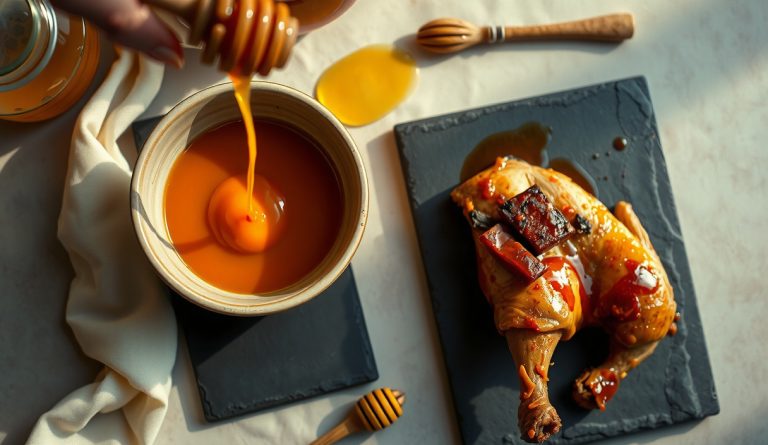
Honey-Gold variant: Replace up to half the brown sugar with raw wildflower honey, added off-heat after reduction completes. Honey contains fructose and glucose at roughly equal ratios, plus trace glucose oxidase activity that produces hydrogen peroxide on the sauce surface, adding subtle antimicrobial protection. Honey also introduces floral monoterpene aromatics that push the sauce toward a sweeter, more complex finish — excellent with smoked chicken thighs or grilled pork tenderloin.
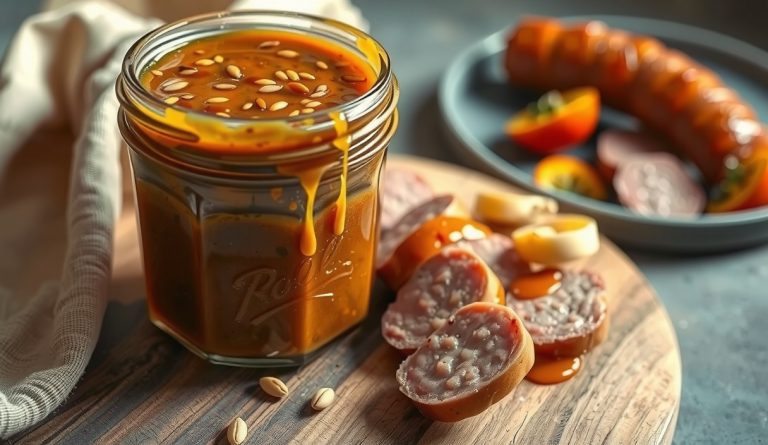
Whole-grain mustard version: Substitute one-third of the yellow prepared mustard with coarse-ground whole-grain mustard. The intact seed particles provide textural contrast and a burst of fresh glucosinolate heat on the palate that differs from the background emulsion heat of the prepared base. This version pairs particularly well with sausages, brats, and grilled kielbasa, where the coarser texture reads as intentional and rustic.
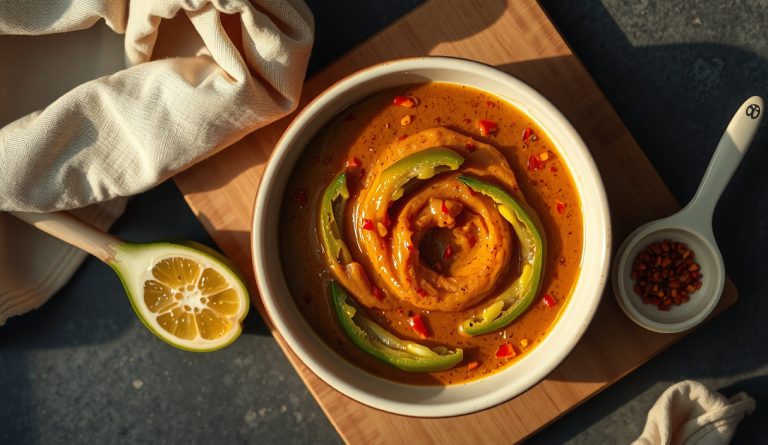
Spicier, Western Piedmont profile: Double the cayenne to 1 teaspoon and add a tablespoon of sambal oelek or a finely minced fresh serrano. The fresh pepper adds green-herbal pyrazine notes and a sharper, more immediate TRPV1 stimulus than dried cayenne alone. Rest the sauce 24 hours before serving — capsaicin migrates more evenly through the emulsion during refrigerated hold, and heat distribution becomes more uniform.
Scaling for competition or catering: This recipe scales linearly by mass. When scaling up 4x or more, use a wide, shallow rondeau rather than a deep saucepan to maintain surface-area-to-volume ratio and achieve the same reduction time. Reduction is a surface evaporation phenomenon; doubling the pot depth without increasing surface area doubles the reduction time, not the flavor concentration rate.
Frequently asked questions about Carolina mustard BBQ sauce
Why does my Carolina mustard sauce taste too sharp or vinegary? Under-reduction is the most likely cause: not enough acetic acid drove off during the cooking phase, or the vinegar was added late in the process. Acetic acid is highly volatile and evaporates readily during a rolling reduction at 200–205°F. If the sauce is already made, simmer it an additional 3–5 minutes uncovered. If adjusting a finished, cooled sauce, add brown sugar in 1/2-teaspoon increments — sugar suppresses sour perception at low concentrations without materially changing the flavor profile.
Can I use this sauce during a long smoke, or only at the end? Apply Carolina mustard BBQ sauce only in the final 15–20 minutes of a smoke or high-heat cook. The brown sugar content — roughly 20–25% of the sauce by weight — means the sauce will scorch and carbonize if exposed to direct radiant heat or convective smoker temperatures above 275°F for extended periods. The Maillard products formed in those final minutes produce exactly the thin, caramelized lacquer with complex browning aromatics you want. Applied earlier, you get carbon.
Is the emulsion stable enough for bottling and refrigerated storage? Yes. Under refrigeration, South Carolina gold sauce maintains emulsion integrity for 3–4 weeks. The combined effects of low pH (below 4.0), high sugar content raising osmotic pressure and suppressing water activity, and the natural mucilaginous polysaccharides in the mustard base create a thermodynamically favorable environment for droplet stability. If slight oil separation appears after extended storage, a 30-second shake or stir at room temperature will fully re-incorporate the dispersed phase — the emulsifier complex has not been destroyed, merely settled.