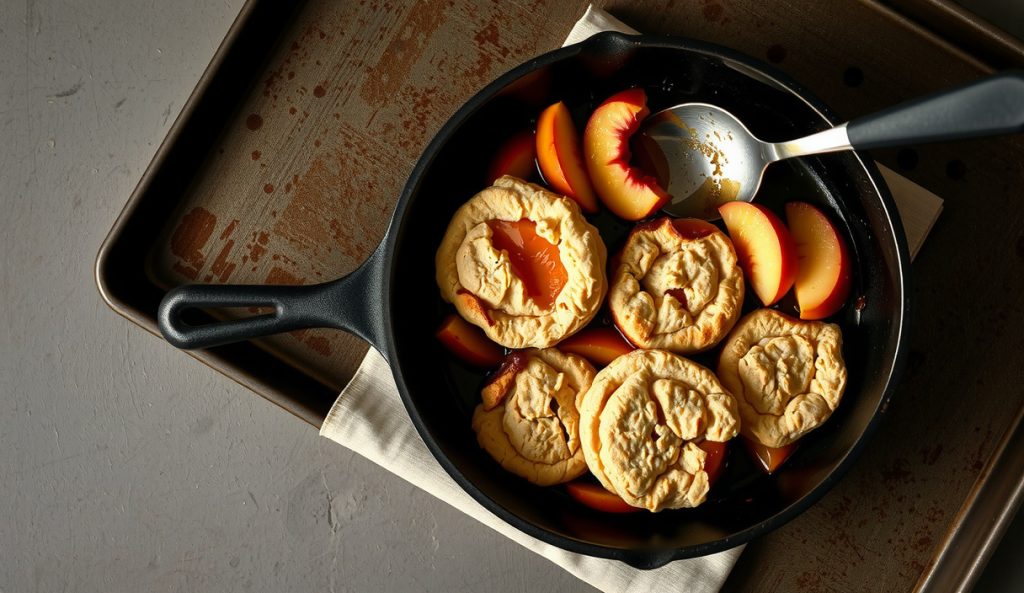
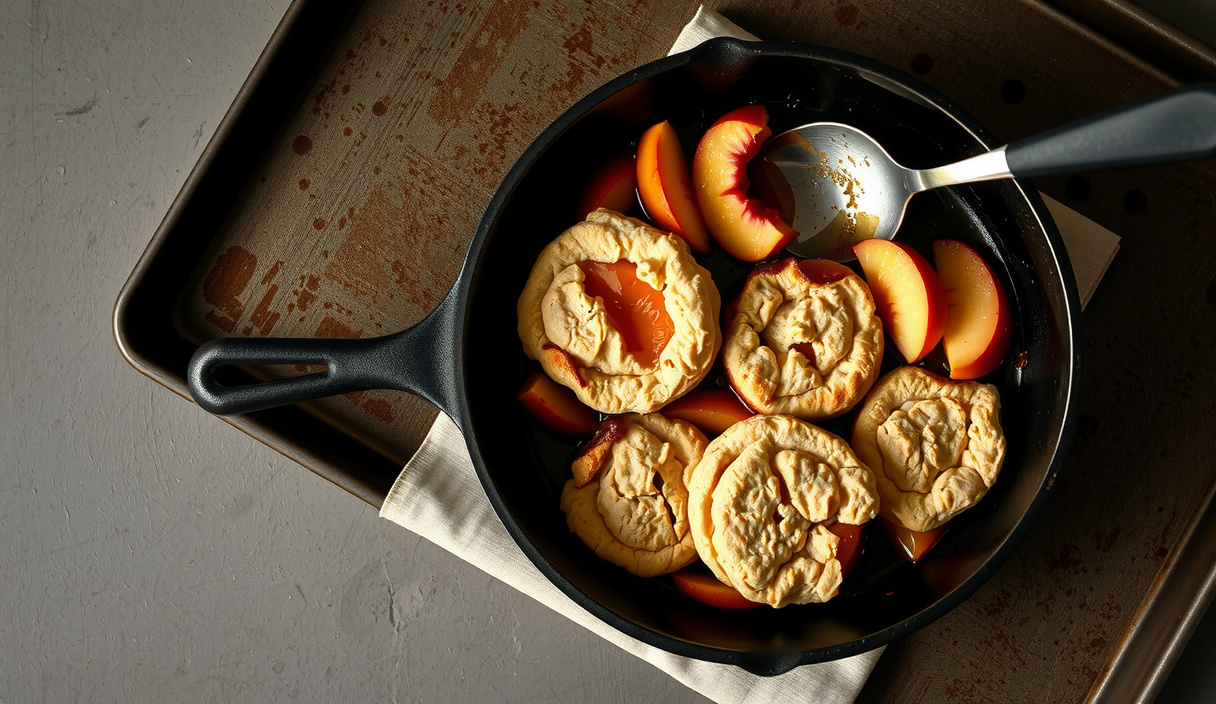
Smoked Peach Cobbler in a Cast Iron Skillet
Equipment
- 1 12-inch cast iron skillet Pre-seasoned. Thermal mass is essential for even bottom heat and preventing a scorched filling.
- 1 Smoker or charcoal grill with a lid Must hold a stable 350°F. Apple, cherry, or peach wood chunks recommended.
- 1 Instant-read thermometer Required to confirm biscuit doneness — target 200–205°F at the center of the thickest biscuit piece.
- 2 Large mixing bowl One for the filling, one for the biscuit dough.
- 1 Pastry cutter or fork For cutting cold butter into the flour mixture.
Ingredients
Peach Filling
- 3 lbs fresh ripe freestone peaches Peeled, pitted, and sliced 1/2-inch thick. About 6 to 7 medium peaches. Frozen (thawed and drained) works off-season.
- ½ cup dark brown sugar Packed. Dark brown preferred for deeper molasses-Maillard flavor; light brown works.
- 2 tablespoons granulated sugar
- 2 tablespoons cornstarch Primary thickening agent for the filling gel.
- 1 teaspoon ground cinnamon
- ¼ teaspoon ground nutmeg Freshly grated preferred.
- 1 tablespoon fresh lemon juice Brightens the filling and prevents enzymatic browning of cut peaches.
- 1 teaspoon pure vanilla extract
Biscuit Topping
- 1 ½ cups all-purpose flour
- ¼ cup granulated sugar
- 1 ½ teaspoons baking powder
- ¼ teaspoon baking soda
- ½ teaspoon kosher salt
- 6 tablespoons unsalted butter Cold, cut into 1/2-inch cubes. Keep refrigerated until the moment of use.
- ¾ cup cold whole buttermilk The acidity reacts with baking soda for additional lift and contributes lactic acid tang.
Finish
- 2 tablespoons unsalted butter Melted, for brushing the skillet and optionally brushing the biscuit top before the last 5 minutes.
- 2 tablespoons turbinado sugar For sprinkling over the biscuit top. Creates a crackling, caramelized crust.

Instructions
Prep and Fire Setup
- Fire up your smoker and bring it to a stable 350°F. Add 2 to 3 chunks of apple, cherry, or peach wood (each about the size of a fist) to the firebox or coals. Allow the smoker to run for 20 to 25 minutes until the temperature is locked in and you are producing a thin, blue-white smoke rather than thick white billowing smoke. Thick white smoke carries harsh, acrolein-heavy combustion products that will make the cobbler taste bitter.
- While the smoker stabilizes, peel, pit, and slice the peaches into 1/2-inch thick wedges. Place them in a large bowl. Add the dark brown sugar, granulated sugar, cornstarch, cinnamon, nutmeg, lemon juice, and vanilla extract. Toss thoroughly until every peach slice is coated and the cornstarch is fully dissolved into the released juice. Let the mixture sit for 5 minutes — the peaches will macerate and release additional liquid that will become the base of the filling gel.1/2 cup dark brown sugar, 2 tablespoons granulated sugar, 2 tablespoons cornstarch, 1 teaspoon ground cinnamon, 1/4 teaspoon ground nutmeg, 1 tablespoon fresh lemon juice, 1 teaspoon pure vanilla extract
Make the Biscuit Topping
- In a separate large bowl, whisk together the all-purpose flour, granulated sugar, baking powder, baking soda, and kosher salt until evenly combined.1 1/2 cups all-purpose flour, 1/4 cup granulated sugar, 1 1/2 teaspoons baking powder, 1/4 teaspoon baking soda, 1/2 teaspoon kosher salt
- Add the cold butter cubes to the flour mixture. Using a pastry cutter or your fingertips (work quickly to avoid warming the fat), cut the butter into the flour until the mixture resembles coarse, irregular crumbs with some pea-sized butter pieces remaining. Those larger chunks are exactly what you want — they will create steam pockets and laminate layers in the finished biscuit top.6 tablespoons unsalted butter
- Pour the cold buttermilk into the flour-butter mixture. Stir with a fork until the dough just comes together — it will look shaggy and sticky. Do not overwork it. Overworking develops gluten and produces a tough, bready topping rather than a tender, flaky biscuit crust. Stop stirring the moment there are no large streaks of dry flour remaining.3/4 cup cold whole buttermilk
Assemble and Smoke
- Brush the inside of the 12-inch cast iron skillet generously with the melted butter, coating the bottom and sides completely. Pour the peach filling into the skillet and spread it into an even layer.2 tablespoons unsalted butter
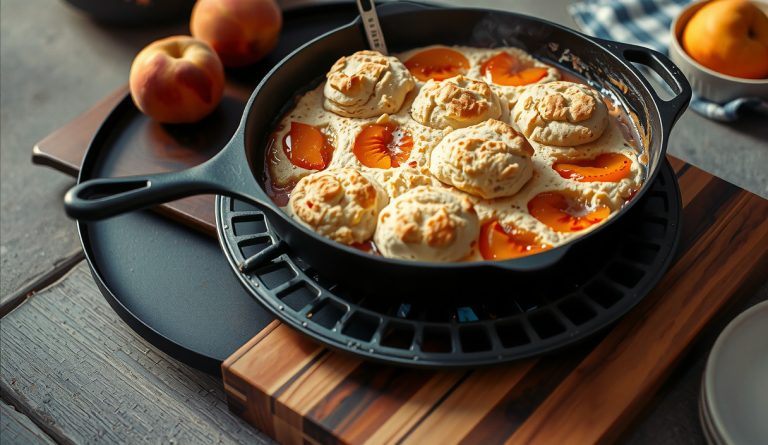
- Drop the biscuit dough over the peach filling in rough, irregular spoonfuls — aim for pieces about 2 to 3 inches across and roughly 1 inch tall. Do not smooth the dough into a single flat sheet. Leave gaps between the pieces; the filling will bubble up through the gaps as it cooks, which is correct and beautiful. Sprinkle the turbinado sugar evenly over the biscuit pieces.2 tablespoons turbinado sugar
- Place the cast iron skillet directly on the smoker grate. Close the lid. Cook at 350°F for 40 to 45 minutes, resisting the urge to open the lid more than once during cooking. Check at the 40-minute mark: the biscuit top should be deep golden-brown, the filling should be visibly bubbling at the edges, and an instant-read thermometer inserted into the center of the thickest biscuit piece should read 200°F to 205°F. If the top is darkening too quickly before the interior is done, tent loosely with foil for the final 10 minutes.
- Optional: In the last 5 minutes of cooking, brush the biscuit tops lightly with any remaining melted butter and close the lid. This adds a final layer of fat for the smoke phenolics to bind to and deepens the crust color.2 tablespoons unsalted butter
Rest and Serve
- Remove the skillet from the smoker and place it on a heat-safe surface. Rest for at least 15 minutes before serving. The cornstarch gel continues to firm as the filling temperature drops below 160°F. Serving too hot produces a runny, sauce-like filling. After 15 minutes, the filling will be thick, glossy, and scoopable. Serve directly from the skillet with vanilla ice cream or lightly sweetened whipped cream.
Notes
Nutrition
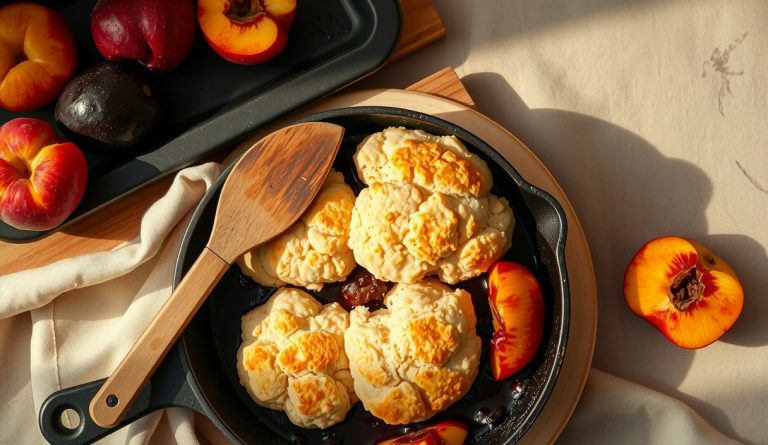
There is a specific kind of magic that happens when fruit cobbler meets live fire. We have been making peach cobbler in cast iron for years — deep dish, sweet, buttery biscuit crust floating on a molten stone fruit filling. Then we started finishing it on the smoker, and every other version became obsolete. The combination of caramelized peach sugars, browning biscuit dough, and a slow wash of hardwood smoke produces an aroma compound profile you simply cannot replicate in an oven. We call it the campfire peach signature, and once you smell it, you understand immediately.
This is not a recipe that requires a competition-grade rig or a PhD in fire management. You need a smoker capable of holding 350°F, a 12-inch cast iron skillet, ripe peaches, and about 45 minutes. The skillet goes in cold, heats through on the grate, and the whole assembly behaves like a stone oven with smoke draught. The result is a cobbler with a bottom crust that stays crisp rather than soggy, a filling that sets into a glossy, jammy gel, and a biscuit top that develops a crackling, dark-golden exterior with a fluffy, steam-lifted interior.
Why does smoked peach cobbler work? The science
Smoked peach cobbler works because three simultaneous reactions — Maillard browning, caramelization, and smoke-fat adsorption — each reinforce the others in a cast iron environment at 350°F. The filling runs on two of those pathways at once. The Maillard cascade — non-enzymatic condensation between free amino groups on peach proteins and the carbonyl groups of fructose and glucose — requires a water activity below 0.7 and surface temperatures above roughly 280°F to generate meaningful melanoidin pigments and the ketone-aldehyde aroma volatiles responsible for the characteristic cooked stone fruit note. Because the cobbler cooks at 350°F rather than a screaming 500°F broiler, the browning proceeds gradually, producing depth without bitterness. The brown sugar layer accelerates the process by supplying additional free reducing sugars — fructose liberated from the partial inversion of sucrose — that lower the Maillard activation threshold and contribute caramel-range volatiles like diacetyl and furaneol.
The biscuit crust operates on the classical high-fat laminated dough model. Cold butter, cut into the flour, creates discrete lipid lenses between hydrated gluten sheets. In oven heat, the water in the butter flash-vaporizes into steam — the primary leavening mechanism working alongside the baking powder — and the laminate puffs and separates into the flaky layers characteristic of a proper cobbler top. The cast iron skillet is critical here: its thermal mass means the skillet heats slowly and evenly, preventing a scorched bottom while ensuring the full 45-minute window gives the biscuit top enough time to set completely through its center without burning the peach layer beneath.
The smoke layer is the differentiating variable. Wood combustion at these temperatures generates guaiacol, syringol, and a family of furanic aldehydes. These lipophilic volatile organic compounds partition preferentially into the fat phase of the biscuit crust — specifically, they adsorb onto the butter-lipid surfaces as the crust cooks, which explains why the smoke flavor in this cobbler is richer and more sustained than you would detect in a smoked lean protein. The fat acts as a long-chain aroma reservoir, slowly releasing those campfire-vanilla-caramel VOCs retronasally during each bite. A fruitwood like apple or peach wood at mild combustion produces lighter phenolics that complement rather than overpower the stone fruit; hickory or mesquite will push smoke flavor forward aggressively and should be used in small quantities if at all.
What equipment and ingredients do you need?
- Cast iron skillet, 12-inch: The thermal mass is non-negotiable. A thin sheet pan will scorch the bottom before the biscuit top sets. Pre-seasoned cast iron also contributes a thin polymerized oil layer that acts as a natural release agent and adds a faint metallic-mineral umami note to the filling.
- Peaches: Use freestone peaches at peak ripeness — the sugars are highest at Brix 12–16 and the pectin in the flesh has begun softening, meaning the filling will gel without added starch at the quantities used here. Underripe peaches will stay firm and tart; overripe peaches will collapse into mush. A slight give when pressed at the shoulder is the target. Frozen peaches (thawed and drained) work in the off-season but lose roughly 20% of their moisture on thaw, so reduce the cornstarch slightly.
- Brown sugar: Dark brown sugar carries more molasses — roughly 6.5% w/w versus 3.5% in light brown — which means more free amino acids and more pronounced caramel flavor in the Maillard cascade. Either grade works; dark brown sugar deepens the filling color and flavor.
- Cold butter: Butter must be genuinely cold — straight from the refrigerator, cut into small cubes, ideally chilled again for 10 minutes after cutting. If the fat softens before baking, it fuses into the flour matrix rather than creating discrete laminate pockets, and the flaky, puffed biscuit structure is lost entirely.
- Cornstarch: Acts as the primary thickening agent for the filling. Starch granules swell and burst above 185°F, releasing amylose chains that cross-link the free peach juice into a clear, glossy gel. Use exactly the amount specified — too little and the filling will be watery; too much and it will set rubbery.
- Wood choice: Apple, cherry, or peach wood are the ideal complement. Aim for a thin blue smoke rather than thick white billowing smoke; thick white smoke carries incomplete combustion products — acrolein and creosote — that produce harsh, acrid notes in baked goods.
Smoked Peach Cobbler in a Cast Iron Skillet
Equipment
- 1 12-inch cast iron skillet Pre-seasoned. Thermal mass is essential for even bottom heat and preventing a scorched filling.
- 1 Smoker or charcoal grill with a lid Must hold a stable 350°F. Apple, cherry, or peach wood chunks recommended.
- 1 Instant-read thermometer Required to confirm biscuit doneness — target 200–205°F at the center of the thickest biscuit piece.
- 2 Large mixing bowl One for the filling, one for the biscuit dough.
- 1 Pastry cutter or fork For cutting cold butter into the flour mixture.
Ingredients
Peach Filling
- 3 lbs fresh ripe freestone peaches Peeled, pitted, and sliced 1/2-inch thick. About 6 to 7 medium peaches. Frozen (thawed and drained) works off-season.
- ½ cup dark brown sugar Packed. Dark brown preferred for deeper molasses-Maillard flavor; light brown works.
- 2 tablespoons granulated sugar
- 2 tablespoons cornstarch Primary thickening agent for the filling gel.
- 1 teaspoon ground cinnamon
- ¼ teaspoon ground nutmeg Freshly grated preferred.
- 1 tablespoon fresh lemon juice Brightens the filling and prevents enzymatic browning of cut peaches.
- 1 teaspoon pure vanilla extract
Biscuit Topping
- 1 ½ cups all-purpose flour
- ¼ cup granulated sugar
- 1 ½ teaspoons baking powder
- ¼ teaspoon baking soda
- ½ teaspoon kosher salt
- 6 tablespoons unsalted butter Cold, cut into 1/2-inch cubes. Keep refrigerated until the moment of use.
- ¾ cup cold whole buttermilk The acidity reacts with baking soda for additional lift and contributes lactic acid tang.
Finish
- 2 tablespoons unsalted butter Melted, for brushing the skillet and optionally brushing the biscuit top before the last 5 minutes.
- 2 tablespoons turbinado sugar For sprinkling over the biscuit top. Creates a crackling, caramelized crust.
Instructions
Prep and Fire Setup
- Fire up your smoker and bring it to a stable 350°F. Add 2 to 3 chunks of apple, cherry, or peach wood (each about the size of a fist) to the firebox or coals. Allow the smoker to run for 20 to 25 minutes until the temperature is locked in and you are producing a thin, blue-white smoke rather than thick white billowing smoke. Thick white smoke carries harsh, acrolein-heavy combustion products that will make the cobbler taste bitter.
- While the smoker stabilizes, peel, pit, and slice the peaches into 1/2-inch thick wedges. Place them in a large bowl. Add the dark brown sugar, granulated sugar, cornstarch, cinnamon, nutmeg, lemon juice, and vanilla extract. Toss thoroughly until every peach slice is coated and the cornstarch is fully dissolved into the released juice. Let the mixture sit for 5 minutes — the peaches will macerate and release additional liquid that will become the base of the filling gel.1/2 cup dark brown sugar, 2 tablespoons granulated sugar, 2 tablespoons cornstarch, 1 teaspoon ground cinnamon, 1/4 teaspoon ground nutmeg, 1 tablespoon fresh lemon juice, 1 teaspoon pure vanilla extract
Make the Biscuit Topping
- In a separate large bowl, whisk together the all-purpose flour, granulated sugar, baking powder, baking soda, and kosher salt until evenly combined.1 1/2 cups all-purpose flour, 1/4 cup granulated sugar, 1 1/2 teaspoons baking powder, 1/4 teaspoon baking soda, 1/2 teaspoon kosher salt
- Add the cold butter cubes to the flour mixture. Using a pastry cutter or your fingertips (work quickly to avoid warming the fat), cut the butter into the flour until the mixture resembles coarse, irregular crumbs with some pea-sized butter pieces remaining. Those larger chunks are exactly what you want — they will create steam pockets and laminate layers in the finished biscuit top.6 tablespoons unsalted butter
- Pour the cold buttermilk into the flour-butter mixture. Stir with a fork until the dough just comes together — it will look shaggy and sticky. Do not overwork it. Overworking develops gluten and produces a tough, bready topping rather than a tender, flaky biscuit crust. Stop stirring the moment there are no large streaks of dry flour remaining.3/4 cup cold whole buttermilk
Assemble and Smoke
- Brush the inside of the 12-inch cast iron skillet generously with the melted butter, coating the bottom and sides completely. Pour the peach filling into the skillet and spread it into an even layer.2 tablespoons unsalted butter
- Drop the biscuit dough over the peach filling in rough, irregular spoonfuls — aim for pieces about 2 to 3 inches across and roughly 1 inch tall. Do not smooth the dough into a single flat sheet. Leave gaps between the pieces; the filling will bubble up through the gaps as it cooks, which is correct and beautiful. Sprinkle the turbinado sugar evenly over the biscuit pieces.2 tablespoons turbinado sugar
- Place the cast iron skillet directly on the smoker grate. Close the lid. Cook at 350°F for 40 to 45 minutes, resisting the urge to open the lid more than once during cooking. Check at the 40-minute mark: the biscuit top should be deep golden-brown, the filling should be visibly bubbling at the edges, and an instant-read thermometer inserted into the center of the thickest biscuit piece should read 200°F to 205°F. If the top is darkening too quickly before the interior is done, tent loosely with foil for the final 10 minutes.
- Optional: In the last 5 minutes of cooking, brush the biscuit tops lightly with any remaining melted butter and close the lid. This adds a final layer of fat for the smoke phenolics to bind to and deepens the crust color.2 tablespoons unsalted butter
Rest and Serve
- Remove the skillet from the smoker and place it on a heat-safe surface. Rest for at least 15 minutes before serving. The cornstarch gel continues to firm as the filling temperature drops below 160°F. Serving too hot produces a runny, sauce-like filling. After 15 minutes, the filling will be thick, glossy, and scoopable. Serve directly from the skillet with vanilla ice cream or lightly sweetened whipped cream.
Notes
Nutrition
How do you nail smoked peach cobbler every time?
- Stabilize your temperature before the skillet goes on. Fluctuating smoker temps between 300°F and 400°F will cause the biscuit top to set unevenly — crisp on the outside, raw in the center. Give the smoker 20 to 25 minutes at 350°F with stable thin smoke before placing the skillet.
- Do not stir the filling once it hits the skillet. The peach-sugar slurry needs to remain undisturbed so the cornstarch can form a continuous gel network as it heats. Stirring breaks the network and produces a runny, separated filling.
- Drop the biscuit dough in rough pieces, not a smooth spread. The irregular, jagged surface area of roughly dropped biscuit pieces maximizes the crust-to-crumb ratio and creates more Maillard browning per square inch. A smooth, even spread produces a bread-like dome instead of a proper cobbler top.
- Check internal biscuit temperature, not color alone. The smoker environment produces surface darkening faster than a conventional oven because of phenolic smoke deposition. The biscuit top should read 200°F to 205°F on an instant-read thermometer at the thickest point before pulling. Color alone is not a reliable indicator in this cooking environment.
- Rest for at least 15 minutes before serving. The filling continues to thicken as it cools below 160°F. Cutting into the cobbler hot will produce a runny sauce; resting allows the starch gel to fully set into the scoopable, jammy consistency you want.
- If the top is dark but the center is raw, tent loosely with foil for the last 10 minutes. The foil blocks radiant smoke deposition and slows surface browning while interior heat continues to cook the biscuit through.
What variations can you make with this smoked cobbler recipe?
Bourbon-peach version: Add 2 tablespoons of bourbon directly to the peach filling and stir to combine before topping with the biscuit dough. Bourbon contributes ethyl esters and fusel alcohols that co-volatilize with the smoke phenolics during cooking, amplifying the caramel-vanilla aroma register significantly. The alcohol flashes off almost entirely in 45 minutes at 350°F, leaving behind flavor without proof.
Spiced nectarine or plum swap: Nectarines or Italian prune plums substitute 1:1 for peaches by weight. Plums run more acidic — pH 3.2–3.6 versus peach at pH 3.7–4.1 — which accelerates the Maillard reaction slightly and requires an extra teaspoon of sugar to balance. Plum cobbler on apple wood smoke is exceptional and deeply underrated in the BBQ dessert conversation.
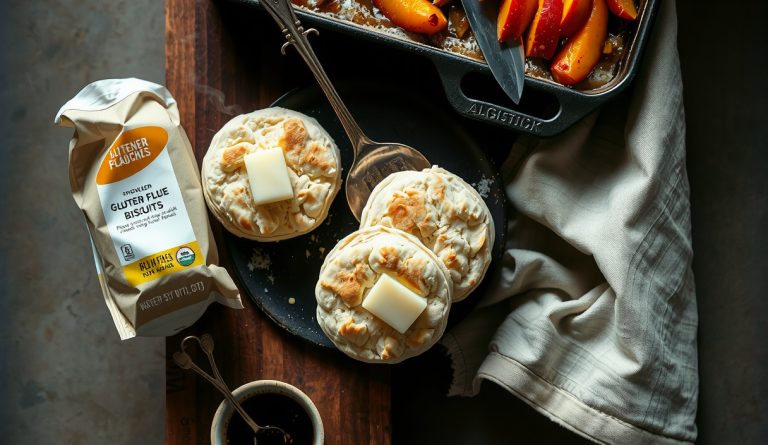
Gluten-free adaptation: Replace the all-purpose flour in the biscuit topping with a 1:1 gluten-free flour blend (rice flour base with xanthan gum included). The biscuit top will be slightly denser and less flaky because there is no gluten network to provide extensibility, but the cobbler will still brown correctly and cook through cleanly. Add an extra tablespoon of cold butter to compensate for the reduced fat-trapping capacity of the gluten-free flour matrix.
Scaling for a crowd: This recipe scales directly to a 15-inch cast iron skillet by multiplying every ingredient by 1.5. The cook time extends by roughly 10 to 15 minutes due to the greater thermal mass of the larger skillet and deeper filling depth. Check the internal biscuit temperature rather than relying on timing alone. For very large quantities, two 12-inch skillets run simultaneously will give more even results than one oversized vessel.
Frequently asked questions about smoked peach cobbler
Can I use canned peaches? Yes, with adjustments. Drain canned peaches thoroughly and reduce the cornstarch from 2 tablespoons to 1 tablespoon, because canned peaches are already cooked and their cell walls have collapsed, meaning they release less liquid than fresh. Use peaches packed in juice rather than syrup, and reduce the granulated sugar by 2 tablespoons to account for the residual sweetness from the canning liquid.
What if my smoker runs hot and I cannot hold 350°F? If your cooker runs 375°F to 400°F, reduce the cook time to 30 to 35 minutes and check the biscuit internal temperature at the 30-minute mark. The filling will still gel and the biscuit will still cook through, but there is less margin before the top over-browns. A foil tent in the last 10 minutes is the best tool at higher temperatures.
Why does the biscuit top look done on the outside but feel doughy in the center? This is the most common failure mode and it has two causes: the dough pieces were too thick when dropped onto the filling (keep them roughly 1 inch tall), or the smoker temperature dropped below 325°F during the cook. Smoke-heavy environments cause earlier surface color development because phenolic compounds absorb radiant heat differently than plain dough, so the visual indicator outpaces actual internal doneness. Always confirm with a thermometer reading of 200°F to 205°F at the center of the thickest biscuit piece.