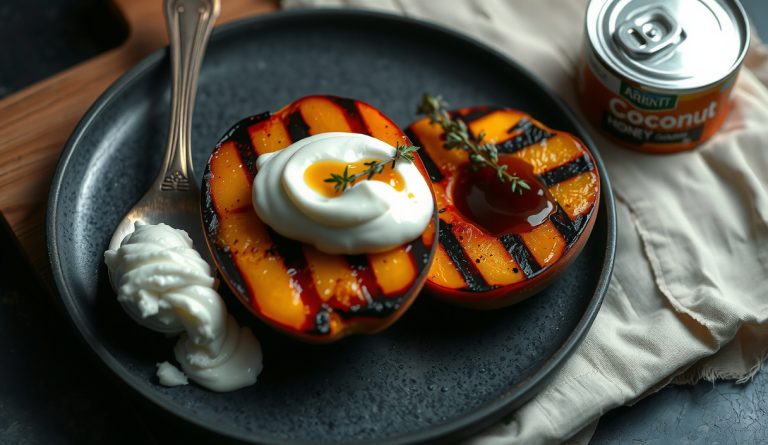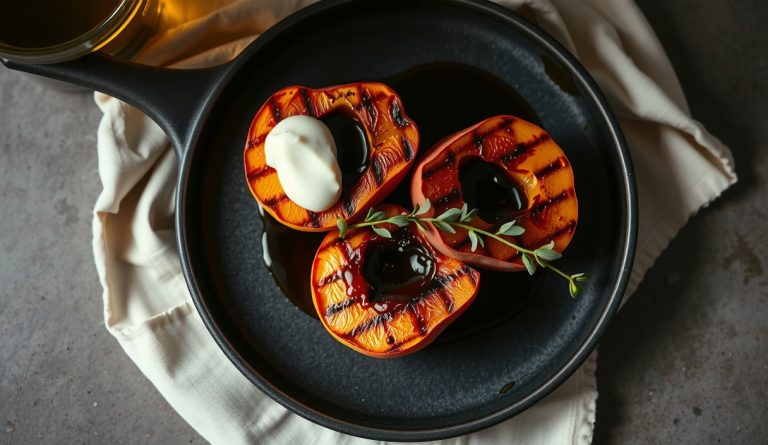
Grilled Peaches with Honey-Yogurt and Fresh Thyme

Equipment
- 1 Gas or charcoal grill Must reach 450–500°F (232–260°C) at the grate surface. Preheat with lid closed for at least 10 minutes.
- 1 Laser thermometer Optional but strongly recommended — confirms grate surface temperature rather than relying on ambient dial readings.
- 1 Thin wide spatula Slides fully under the flat caramelized face for clean removal without tearing the flesh.
- 1 Pastry brush For applying neutral oil to the cut face of each peach half before grilling.
- 1 Sharp chef’s knife For halving and pitting the peaches cleanly along the crease.
Ingredients
Grilled Peaches
- 4 ripe freestone peaches Fully ripe — they should yield slightly when pressed at the shoulder. Freestone varieties release from the pit cleanly. Do not use underripe fruit.
- 1 tablespoon neutral oil Grapeseed or avocado oil. Applied to the cut face, not the grate, to prevent sticking and promote even heat conduction.
- 1 pinch flaky sea salt Maldon or similar. Applied at plating, not during cooking. Heightens sweetness perception and amplifies the caramel char aroma.
Honey-Yogurt
- 1 cup full-fat Greek yogurt Minimum 5% milkfat. The fat phase carries the volatile aroma compounds from the honey and thyme. Low-fat versions will taste watery against the caramelized fruit.
- 3 tablespoons raw honey Varietal raw honey preferred — tupelo, orange blossom, or wildflower. Raw honey retains volatile terpene and phenolic compounds destroyed by commercial heat-filtration.
- 1 teaspoon fresh thyme leaves Stripped from stems just before serving to preserve linalool and thymol concentration. Do not substitute dried thyme — oxidation during drying destroys the key volatile compounds.

Instructions
Preheat and Prep
- Preheat your grill to high with the lid closed for 10 minutes. Confirm the grate surface temperature reaches 450–500°F (232–260°C) using a laser thermometer or by holding your hand 3 inches above the grate — you should only be able to hold it there for 1 second. A cool grate stews the peaches instead of searing them.
- Halve the peaches along their natural crease and twist to separate. Remove the pit with a spoon or your thumb. Pat the cut faces dry with a paper towel — removing surface moisture speeds the evaporative phase and gets you to Maillard browning faster. Brush the cut face of each half lightly with neutral oil.1 tablespoon neutral oil
- While the grill heats, stir together the Greek yogurt and 2 tablespoons of the honey in a small bowl until smooth. Keep it in the refrigerator until plating — cold yogurt against warm caramelized peach is a deliberate temperature contrast, not an oversight.1 cup full-fat Greek yogurt, 3 tablespoons raw honey
Grill the Peaches
- Place the peach halves cut-side down on the hot grate. Do not move them once placed — uninterrupted contact is required for the Maillard crust to form. Set a timer for 3 minutes.
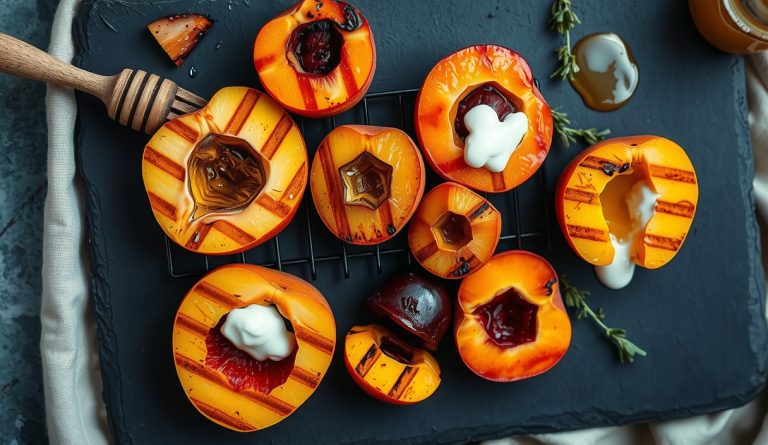
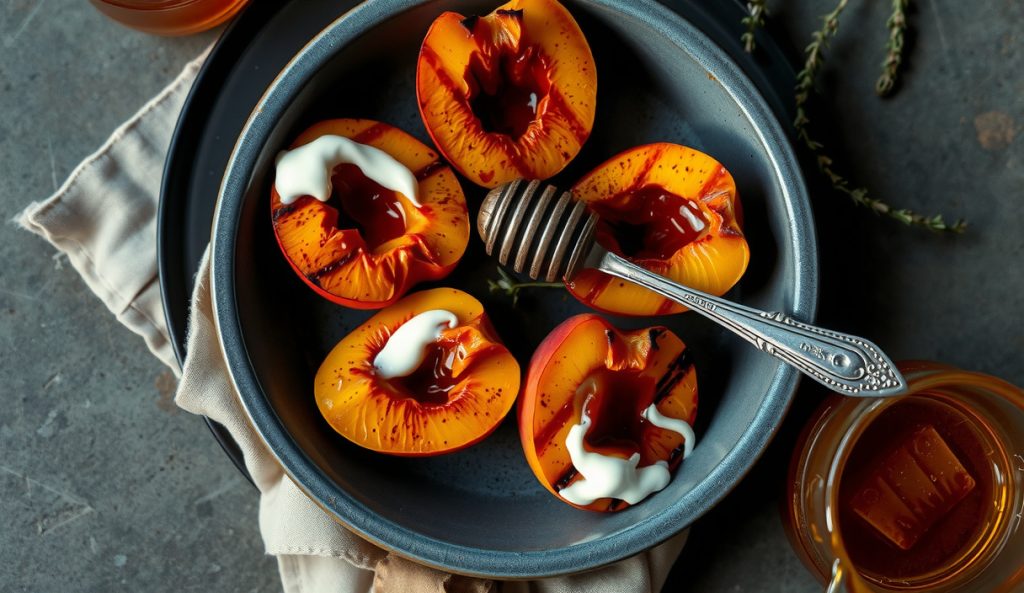
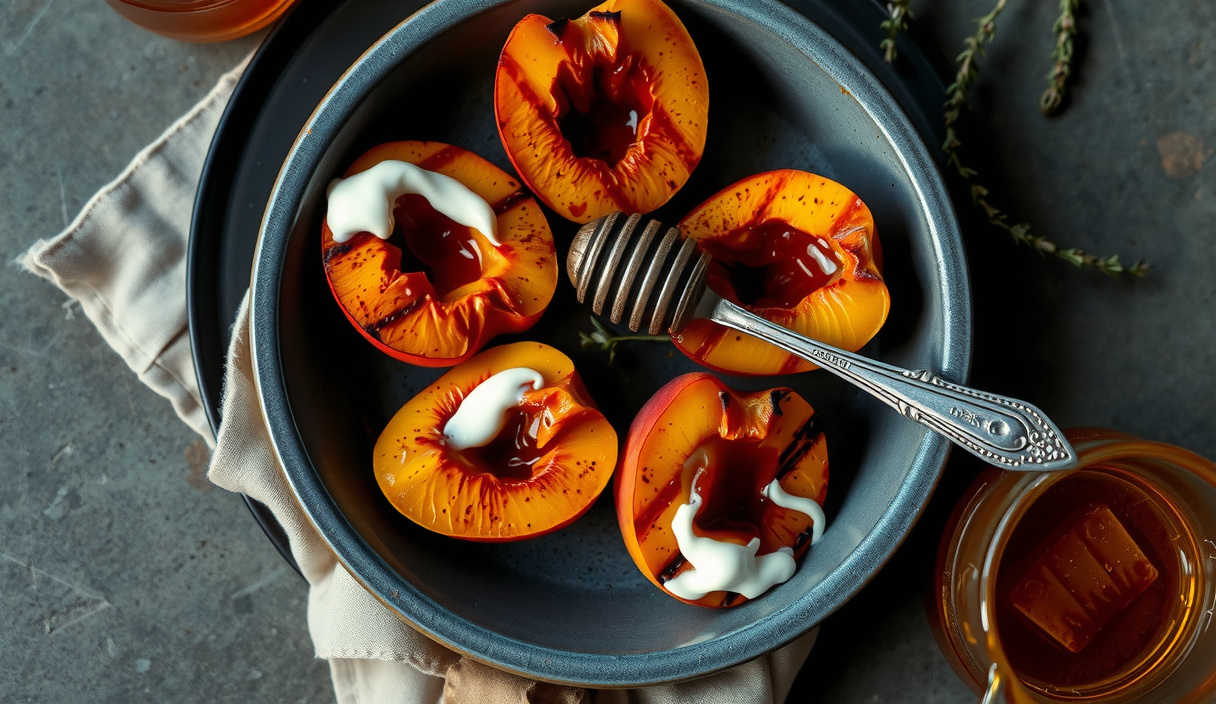
- After 3 minutes, slide a thin wide spatula fully under the flat face and lift gently. The cut surface should show deep amber to caramel-brown grill marks and a slightly glossy, caramelized texture. If the peaches resist, give them another 30 seconds — they are still releasing from the grate. Do not grill past 4 minutes total or the pectin structure collapses and the halves turn to mush.
- Transfer the grilled peach halves to a plate or sheet pan, cut-side up. They can rest for 1 to 2 minutes before plating — the interior will continue to warm through gently.
Plate and Finish
- Spoon a generous dollop of the cold honey-yogurt into the cavity of each grilled peach half, letting it spread slightly over the caramelized face. Cold yogurt goes on first — it creates the landing surface for the honey drizzle and slows heat transfer from the warm fruit to the cream layer.1 cup full-fat Greek yogurt, 3 tablespoons raw honey
- Drizzle the remaining tablespoon of raw honey directly over the yogurt. Strip the fresh thyme leaves from their stems and scatter over the top. Finish with a very small pinch of flaky sea salt placed on the yogurt layer, not the peach.3 tablespoons raw honey, 1 teaspoon fresh thyme leaves, 1 pinch flaky sea salt
- Serve immediately. The temperature contrast between the warm caramelized peach and the cold acidic yogurt is at its maximum right now — it diminishes as the yogurt comes to room temperature.
Notes
Nutrition
There is a two-minute window on a hot grill where a peach half crosses from raw fruit into something that tastes like it has been simmered in a copper pot for an hour. The cut face goes from pale gold to deep amber, the flesh softens just enough to yield under a spoon, and the perfume — a volatile wave of lactones, benzaldehyde, and caramelized sugar — punches straight through the smoke. That window is the entire recipe. Everything else — the yogurt, the honey, the thyme — is just framing.
This recipe came together by accident at a July cookout with a half-empty grill and a flat of freestone peaches going soft in the heat. Grilled peaches with honey-yogurt and fresh thyme is the dessert to make when the goal is to impress without lighting the oven: four ingredients, one technique, twelve minutes from halving the fruit to plating.
Why do grilled peaches work? The science
Grilled peaches caramelize so dramatically because ripe stone fruit is a near-perfect Maillard substrate: the cut face carries free reducing sugars at 6 to 10 percent by fresh weight, plus free amino acids released during ripening, and both are immediately available for browning chemistry the instant that face contacts a 450–500°F (232–260°C) grate.
Surface water flash-evaporates within the first 30 to 45 seconds of grill contact. Once that aqueous film is gone, the boundary-layer temperature spikes and the Maillard cascade ignites: Schiff base condensation between the carbonyl groups of the reducing sugars and the nucleophilic amino groups of the fruit’s free amino acids initiates at around 280°F (138°C) and accelerates exponentially above 300°F (149°C). The result is the same volatile Strecker degradation products that drive caramel, roasted grain, and brown-butter aroma — dozens of furyl compounds, pyrazines, and ketones — generated in under three minutes.
Simultaneously, the heat softens the peach’s pectin matrix. Pectin — polygalacturonic acid chains cross-linked by calcium ions — begins thermal beta-elimination and depolymerization above roughly 185°F (85°C). Three minutes of direct grill contact raises the flesh temperature at the surface well beyond that threshold while leaving the interior relatively cool and firm, producing a deliberate textural gradient: yielding caramelized exterior, juicy cool center. Pushing the cook past four minutes collapses the pectin too deeply, and the halves lose structural integrity and turn to mush on the plate.
The yogurt component does more than provide creaminess. Full-fat Greek yogurt sits at pH 4.0 to 4.5 — acidic enough that when it pools against the warm peach, it creates a sharp lactic contrast that amplifies the perceived sweetness of the caramelized fruit via sensory contrast. That acidity also stabilizes the delicate volatile lactone and aldehyde compounds in the peach aroma by slightly suppressing their vapor pressure, slowing their escape and lengthening the aromatic finish on the palate. Raw honey adds a second Maillard payload — its own free glucose and fructose — and the thyme delivers linalool and thymol, terpene compounds that bind TRPM8 cold receptors with a mild cooling aftereffect that plays against the warm grill char.
What equipment and ingredients do I need?
- Peach ripeness is non-negotiable. The fruit must be fully ripe — it should yield slightly when pressed at the shoulder — but not overripe. Underripe peaches lack the free sugar concentration needed for rapid Maillard browning at three minutes; overripe peaches will disintegrate on the grate. Freestone varieties release from the pit cleanly, which matters when keeping a perfect half intact.
- Grill surface temperature, not ambient temperature, is the variable. Target 450–500°F (232–260°C) at the grate. A laser thermometer confirms this in seconds. Gas grills should run on high for at least 10 minutes with the lid closed before cooking; charcoal grills should have a clean bed of glowing coals directly under the grill zone. A cool grill stews instead of searing.
- Full-fat Greek yogurt only. Low-fat or non-fat versions lack the lipid phase needed to carry the fat-soluble aroma compounds in the honey and thyme. Fat-free yogurt will taste watery against the richness of the caramelized peach. Strain your own overnight if the thickest texture is the goal: line a colander with cheesecloth, fill with whole-milk yogurt, and refrigerate for 8 to 12 hours.
- Raw honey over processed. Processed honey is heat-filtered, which destroys much of the minor volatile compound load — the floral terpenes and phenolics that make varietal honeys interesting. Raw honey from a local source carries those intact. Tupelo, orange blossom, or wildflower all work well here.
- Fresh thyme, not dried. Dried thyme has largely lost its linalool through oxidation during drying. Fresh sprigs release linalool and thymol only when bruised or heated, so strip the leaves just before serving.
Grilled Peaches with Honey-Yogurt and Fresh Thyme
Equipment
- 1 Gas or charcoal grill Must reach 450–500°F (232–260°C) at the grate surface. Preheat with lid closed for at least 10 minutes.
- 1 Laser thermometer Optional but strongly recommended — confirms grate surface temperature rather than relying on ambient dial readings.
- 1 Thin wide spatula Slides fully under the flat caramelized face for clean removal without tearing the flesh.
- 1 Pastry brush For applying neutral oil to the cut face of each peach half before grilling.
- 1 Sharp chef’s knife For halving and pitting the peaches cleanly along the crease.
Ingredients
Grilled Peaches
- 4 ripe freestone peaches Fully ripe — they should yield slightly when pressed at the shoulder. Freestone varieties release from the pit cleanly. Do not use underripe fruit.
- 1 tablespoon neutral oil Grapeseed or avocado oil. Applied to the cut face, not the grate, to prevent sticking and promote even heat conduction.
- 1 pinch flaky sea salt Maldon or similar. Applied at plating, not during cooking. Heightens sweetness perception and amplifies the caramel char aroma.
Honey-Yogurt
- 1 cup full-fat Greek yogurt Minimum 5% milkfat. The fat phase carries the volatile aroma compounds from the honey and thyme. Low-fat versions will taste watery against the caramelized fruit.
- 3 tablespoons raw honey Varietal raw honey preferred — tupelo, orange blossom, or wildflower. Raw honey retains volatile terpene and phenolic compounds destroyed by commercial heat-filtration.
- 1 teaspoon fresh thyme leaves Stripped from stems just before serving to preserve linalool and thymol concentration. Do not substitute dried thyme — oxidation during drying destroys the key volatile compounds.
Instructions
Preheat and Prep
- Preheat your grill to high with the lid closed for 10 minutes. Confirm the grate surface temperature reaches 450–500°F (232–260°C) using a laser thermometer or by holding your hand 3 inches above the grate — you should only be able to hold it there for 1 second. A cool grate stews the peaches instead of searing them.
- Halve the peaches along their natural crease and twist to separate. Remove the pit with a spoon or your thumb. Pat the cut faces dry with a paper towel — removing surface moisture speeds the evaporative phase and gets you to Maillard browning faster. Brush the cut face of each half lightly with neutral oil.1 tablespoon neutral oil
- While the grill heats, stir together the Greek yogurt and 2 tablespoons of the honey in a small bowl until smooth. Keep it in the refrigerator until plating — cold yogurt against warm caramelized peach is a deliberate temperature contrast, not an oversight.1 cup full-fat Greek yogurt, 3 tablespoons raw honey
Grill the Peaches
- Place the peach halves cut-side down on the hot grate. Do not move them once placed — uninterrupted contact is required for the Maillard crust to form. Set a timer for 3 minutes.
- After 3 minutes, slide a thin wide spatula fully under the flat face and lift gently. The cut surface should show deep amber to caramel-brown grill marks and a slightly glossy, caramelized texture. If the peaches resist, give them another 30 seconds — they are still releasing from the grate. Do not grill past 4 minutes total or the pectin structure collapses and the halves turn to mush.
- Transfer the grilled peach halves to a plate or sheet pan, cut-side up. They can rest for 1 to 2 minutes before plating — the interior will continue to warm through gently.
Plate and Finish
- Spoon a generous dollop of the cold honey-yogurt into the cavity of each grilled peach half, letting it spread slightly over the caramelized face. Cold yogurt goes on first — it creates the landing surface for the honey drizzle and slows heat transfer from the warm fruit to the cream layer.1 cup full-fat Greek yogurt, 3 tablespoons raw honey
- Drizzle the remaining tablespoon of raw honey directly over the yogurt. Strip the fresh thyme leaves from their stems and scatter over the top. Finish with a very small pinch of flaky sea salt placed on the yogurt layer, not the peach.3 tablespoons raw honey, 1 teaspoon fresh thyme leaves, 1 pinch flaky sea salt
- Serve immediately. The temperature contrast between the warm caramelized peach and the cold acidic yogurt is at its maximum right now — it diminishes as the yogurt comes to room temperature.
Notes
Nutrition
How do I nail grilled peaches every time?
- Do not move the peaches once they are placed. The Maillard crust needs uninterrupted contact time to form. Shifting the peaches releases the cut face from the hot metal, drops the surface temperature, and eliminates the grill marks and char flavor. Set them and walk away for exactly three minutes.
- Oil the peach, not the grate. Brushing a thin coat of neutral oil directly on the cut face before placing helps conduct heat evenly and prevents sticking without causing flare-ups. Oiling a hot grate burns off instantly and does little to prevent adhesion with high-sugar fruit.
- Watch for overripe failure. If the flesh is mushy before grilling, the halves will fall apart when lifted. Use a thin, wide spatula — not tongs — and slide it fully under the flat face before lifting. If the peaches resist at three minutes, they are sticking, not caramelizing; give them another 30 seconds and try again gently.
- Temperature-sequence the components. Serve the yogurt cold, straight from the refrigerator. The contrast between the warm caramelized peach and the cold acidic yogurt is a deliberate sensory engineering decision — the temperature differential amplifies the perception of both the char flavor and the cool lactic tang.
- Honey goes on last. Drizzling honey over the hot peach before the yogurt is added causes it to run off and pool uselessly on the plate. Add yogurt first to create a landing surface, then drizzle the honey so it stays suspended in the cream layer against the warm fruit.
- Salt is not optional. A very small pinch of flaky sea salt on the finished plate — placed on the yogurt, not the peach — dramatically heightens sweetness perception and amplifies the aromatic complexity of the char. This is not decoration.
What variations can I make?
For a dairy-free version, coconut cream whipped to soft peaks and chilled replaces the Greek yogurt with minimal structural loss. The fat content of coconut cream is high enough to carry the aroma compounds, though the flavor contrast becomes richer and less acidic. Add a few drops of apple cider vinegar to the coconut cream before whipping to approximate the lactic tang. The result reads more tropical but holds up well against the grill char.
Nectarines, apricots, and plums all behave mechanically the same as peaches on the grill — same sugar concentration band, same pectin degradation window. Apricots require halving and pitting carefully as they are smaller; reduce the grill time to two minutes to prevent total pectin collapse. Plums caramelize more slowly due to thicker skin but develop an extraordinary tartness when the skin chars slightly. Leave plum skin on and orient the cut face down regardless.
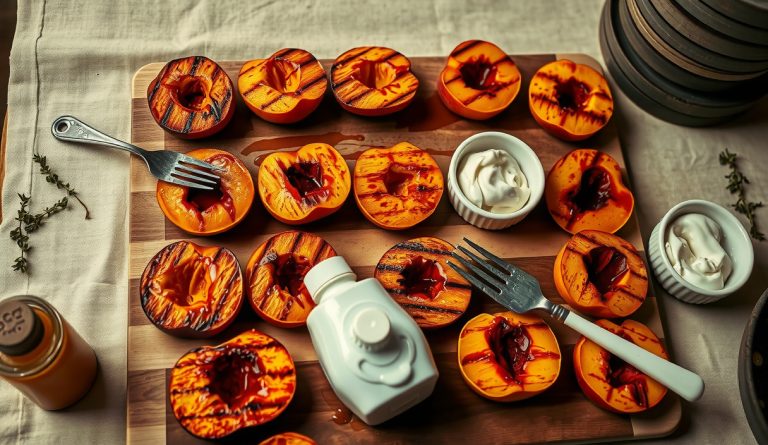
To scale for a crowd, pre-halve and pit all peaches up to two hours ahead, store cut-side-up on a sheet pan in a single layer, and brush with oil just before grilling. Yogurt can be pre-seasoned with honey and a pinch of salt and held refrigerated in a squeeze bottle for easy plating. Thyme sprigs can be stripped and the leaves held at room temperature — do not strip them more than 30 minutes ahead or the volatile compounds begin to dissipate.
For a savory direction, swap the honey for aged balsamic vinegar and replace the thyme with fresh tarragon. The balsamic provides its own reducing-sugar Maillard resonance and the anise notes of tarragon pair surprisingly well with stone fruit char. A few grinds of black pepper amplify the tarragon’s aromatic compounds via piperine-mediated receptor sensitization. This version works well alongside grilled pork or duck.
Frequently asked questions
Can I use a cast-iron grill pan on the stovetop instead of an outdoor grill? Yes, and it works well. Preheat the cast-iron pan over high heat for at least five minutes until it is smoking before adding the peaches. A cast-iron grill pan holds heat density comparable to a charcoal grate and will produce the same Maillard crust. There will be no smoke flavor, but the caramelization chemistry is identical. Open a window — the sugar burning off the peach face generates considerable smoke indoors.
My peaches are not very ripe — can I still make this? Underripe peaches will not caramelize properly in three minutes because their free sugar concentration is too low and their pectin matrix is too rigid to soften in that time window. If the peaches are firm, leave them at room temperature for one to two days until they yield at the shoulder, or slice them and macerate in a tablespoon of sugar and a splash of lemon juice for 30 minutes to hydrate the surface sugars before grilling. The macerated surface will caramelize faster.
How do I prevent the yogurt from going warm and runny before serving? Chill serving plates in the freezer for five minutes before plating. A cold plate slows the temperature transfer from the warm peach to the yogurt layer significantly, buying a longer window before the yogurt thins out. Alternatively, thicker strained yogurt — 20 percent total solids rather than the 15 percent typical of commercial Greek yogurt — is more viscous at room temperature and holds its shape longer against a warm surface.