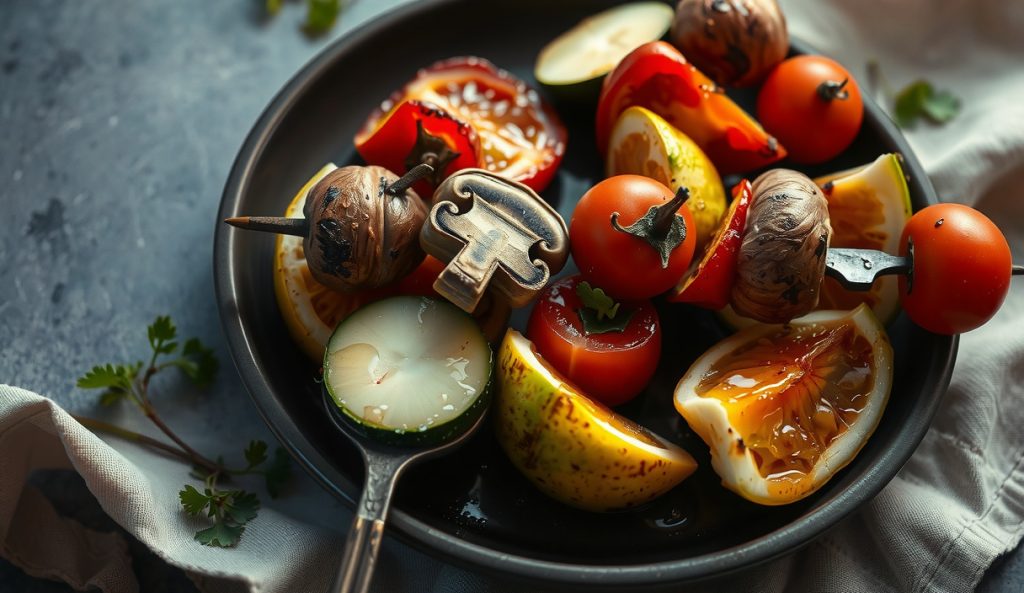
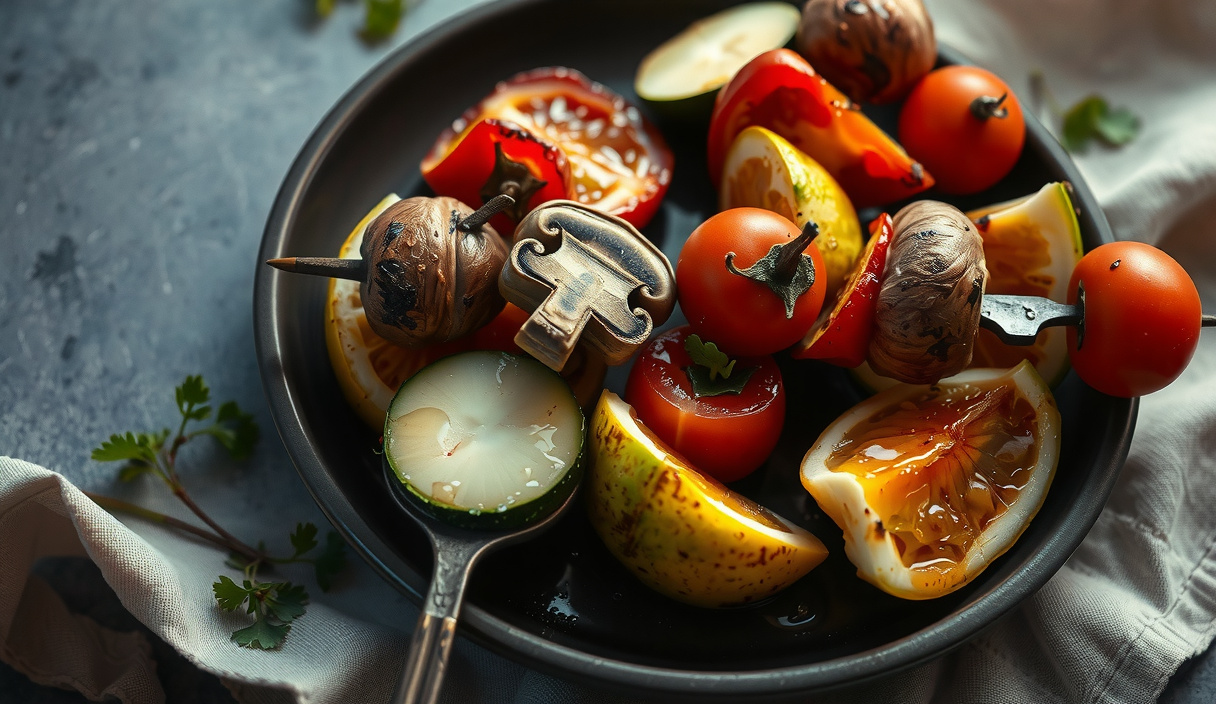
Whole-Food Smoked Veggie Skewers with Lemon-Herb Marinade

Equipment
- 1 Charcoal or pellet grill with lid Set up for two-zone cooking — one indirect side for the smoke phase, one direct-heat side for the sear
- 2 to 3 Cherry or apple wood chunks or chips Chunks for charcoal; chips in a foil pouch for gas. Fruitwood keeps phenolic smoke deposit mild enough not to overwhelm the herbs
- 8 Flat-blade metal skewers Flat blade prevents vegetable rotation during flipping; 12-inch length accommodates a full load
- 1 Instant-read thermometer Optional but useful — target 195 to 205°F internal for onion and zucchini, 185°F for tomatoes
- 1 Large mixing bowl
- 1 Wire rack over rimmed sheet pan For resting skewers post-cook without steaming the crust
Ingredients
Vegetables
- 2 medium zucchini Cut into 3/4-inch rounds — uniform thickness ensures even cooking
- 2 large bell peppers, any color Cut into 1.5-inch squares, ribs and seeds removed
- 1 large red onion Cut through the root into 1-inch wedges, keeping the root intact to hold petals together on the skewer
- 10 oz cremini mushrooms Stems trimmed flush; leave whole — cremini density holds better than button mushrooms on a skewer
- 1 pint cherry tomatoes Thread through the equator to preserve structural integrity and delay skin rupture
Lemon-Herb Marinade
- ¼ cup extra-virgin olive oil
- 3 cloves garlic Crushed with the flat of a knife — not minced; crushing maximizes allicin and organosulfur compound generation
- 2 tablespoons fresh lemon juice From 1 large lemon; reserve the spent lemon for the finishing squeeze
- 1 teaspoon fresh lemon zest
- 1 tablespoon fresh thyme leaves Stripped from stems
- 1 teaspoon fresh rosemary Finely chopped — rosemary is assertive; do not exceed 1 teaspoon or it dominates
- 1 teaspoon kosher salt
- ½ teaspoon freshly cracked black pepper
- ¼ teaspoon red pepper flakes Optional; adds trigeminal heat without sugar or sauces
Finishing
- 1 large lemon Cut into wedges for squeezing at service — use fresh lemon here, not the marinade
- 2 tablespoons fresh flat-leaf parsley Roughly chopped; added at the last moment so the volatile terpenes survive

Instructions
Make the Marinade
- In a large bowl, combine the extra-virgin olive oil, crushed garlic cloves, lemon juice, lemon zest, thyme, rosemary, salt, black pepper, and red pepper flakes if using. Whisk briefly to homogenize the oil and juice into a loose emulsion — it will not hold permanently, but that is fine. The oil phase carries the fat-soluble herb aromatics; the aqueous acid phase carries the citric acid that will begin working on the vegetable cell walls immediately.1/4 cup extra-virgin olive oil, 3 cloves garlic, 2 tablespoons fresh lemon juice, 1 teaspoon fresh lemon zest, 1 tablespoon fresh thyme leaves, 1 teaspoon fresh rosemary, 1 teaspoon kosher salt, 1/2 teaspoon freshly cracked black pepper, 1/4 teaspoon red pepper flakes
Prep and Marinate the Vegetables
- Cut all vegetables as specified: zucchini into 3/4-inch rounds, bell pepper into 1.5-inch squares, red onion into 1-inch wedges through the root end, cremini mushrooms left whole with stems trimmed, cherry tomatoes left whole. Add all vegetables to the marinade bowl and toss thoroughly with your hands so every cut face is coated. Let sit at room temperature for 30 minutes — do not refrigerate during this window.2 large bell peppers, any color, 1 large red onion, 10 oz cremini mushrooms, 1 pint cherry tomatoes
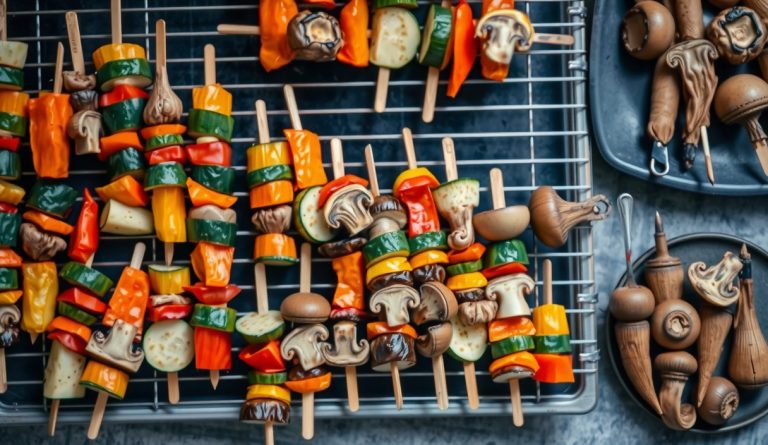
- Thread the vegetables onto flat metal skewers in alternating order: zucchini, bell pepper, mushroom, onion wedge, cherry tomato, repeat. Leave a 1/4-inch gap between each piece — this is not aesthetic preference, it is airflow management. Reserve the leftover marinade in the bowl.2 large bell peppers, any color, 1 large red onion, 10 oz cremini mushrooms, 1 pint cherry tomatoes
Set Up the Grill for Two-Zone Cooking
- Prepare your grill for two-zone indirect cooking. For charcoal: bank coals to one side and place 2 to 3 cherry or apple wood chunks directly on the lit coals. For gas: light one or two burners on one side only and place wood chips in a foil pouch with a few holes punched in it, set over the lit burner. Close the lid and stabilize the grill temperature at 350°F — use the dome thermometer or a probe clipped to the grate level on the indirect side. Allow the wood to begin generating smoke before loading the skewers.
Smoke Phase — Indirect, 350°F, 20 Minutes
- Place loaded skewers on the indirect side of the grill — away from direct flame or coals. Close the lid. Cook undisturbed for 20 minutes. During this phase, convective heat and smoke compounds are penetrating the vegetable tissue simultaneously. The internal temperature of the zucchini and onion will climb to around 160 to 175°F, the pectin structure will soften via thermal beta-elimination, and guaiacol and syringol from the wood smoke will deposit on the moist vegetable surface. Do not open the lid repeatedly — every lid-lift drops grate temperature and disrupts the smoke envelope.
Sear Phase — Direct High Heat, 2 to 3 Minutes Per Side
- Transfer skewers to the direct-heat side of the grill. If using charcoal, the coals should still be at high heat — 450 to 500°F surface temperature. If using gas, crank the lit burners to high and allow 2 minutes to recover temperature. Sear skewers with the lid open for 2 to 3 minutes per side, turning once. You are looking for visible dark grill marks and slight char on the edges of the zucchini and onion. The cherry tomatoes will blister and their skins will tighten — this is correct. If they begin to split aggressively before the other vegetables are seared, slide them off the skewer with tongs and hold them on the indirect side.
- Total active grill time across both sides of the sear should be 4 to 6 minutes. The finished zucchini should feel tender when pressed with a finger through the skewer hole and show a dark crust on the grate-contact face. The onion wedges should be translucent at the core with charred edges. Internal temperature targets: zucchini and onion 195 to 205°F; cherry tomatoes 185°F.
Rest and Finish
- Transfer finished skewers to a wire rack over a sheet pan — not directly onto a flat plate, which would trap steam under the vegetables and soften the crust you just built. Rest for 3 minutes. Scatter freshly chopped flat-leaf parsley over the skewers. Squeeze fresh lemon wedges generously over everything immediately before serving — use fresh lemon here, not anything from the marinade bowl. The fresh squeeze delivers volatile limonene that survived no heat treatment and provides significantly brighter citrus aromatics than any pre-cooked acid.1 large lemon, 2 tablespoons fresh flat-leaf parsley
Notes
Nutrition
There is a moment on the grill when a mushroom stops being a mushroom and becomes something else entirely — dark, collapsed inward, its cell walls finally surrendering their moisture and concentrating every ounce of earthy glutamate into a jewel-sized bite. That transformation does not require a sauce from a bottle or a spoonful of refined sugar. It requires fire, time, and a marinade made from things that grew in the ground. That is what this recipe is about.
Whole-food BBQ is not a restriction. It is a discipline in letting the Maillard reaction, smoke chemistry, and natural plant sugars do the heavy lifting. These skewers run a two-stage cook: a low-and-slow smoke phase at 350°F to drive flavor deep into the vegetable tissue, followed by a direct-heat sear that scorches the exterior and builds the crust. The result is a plate that looks like it came out of a wood-fired kitchen and tastes like it took all day — but from thread to table, you are looking at under an hour.
Why do smoked veggie skewers work? The science behind the two-stage cook
Smoked veggie skewers work because a two-stage cook — indirect heat first, direct sear second — solves the fundamental moisture problem that makes vegetables difficult to grill well. Vegetables are predominantly water: zucchini runs roughly 94% moisture by mass, bell peppers around 92%, and cremini mushrooms close to 90%. That water fraction is simultaneously your biggest asset and your biggest enemy on the grill.
Managed correctly, water creates steam inside the cell matrix during the smoke phase, softening the pectin-rich middle lamella via thermal beta-elimination and building internal tenderness without collapse. Mismanaged — hit with full direct heat immediately — surface evaporation absorbs energy faster than the tissue can brown, anchoring the boundary layer near 212°F and stalling Maillard chemistry entirely. Running the first 20 minutes at 350°F indirect gives the interior time to soften and the surface time to lose enough free moisture that the subsequent sear can rocket past 300°F and into the amino-carbonyl browning cascade within seconds of contact with the hot grate.
The lemon-garlic marinade is doing structural work, not just flavor work. Olive oil, at roughly 13% saturated and 73% monounsaturated fat, coats the vegetable surface and acts as a lipid carrier for the fat-soluble volatile terpenes in the fresh herbs — linalool from the thyme, limonene from the lemon zest, and the organosulfur compounds released when garlic is crushed. Because these lipophilic molecules partition strongly into the oil phase, they resist early volatilization during the smoke period and are released in a sustained, layered way as the oil heats and is absorbed by the plant tissue.
Acid from the lemon juice depresses the local pH to roughly 4.0–4.5 at the vegetable surface, which activates pectin methylesterase activity in the cell walls at temperatures below 85°F during the marinating window, creating a slightly firmer baseline that helps the skewers hold shape under two-stage thermal stress.
Cherry tomatoes deserve special attention in the thread order. Their skin is a pressure vessel. As internal temperature climbs past 180°F, the water inside superheats and the skin must either rupture on the grate or later in your tongs — and you want the former. Threading cherry tomatoes through the equator rather than pole-to-pole keeps the skewer clear of the seed chambers, preserves structural integrity longer, and lets you pull them at exactly the moment the skin blisters without losing the juice. The red onion wedges, built from multiple cell layers with very high fructose content, caramelize aggressively under direct heat — their Maillard onset is accelerated because monosaccharides in plant tissue bypass the sucrose hydrolysis step and hit the amino-carbonyl reaction pathway faster than a sugar-heavy sauce ever could.
What equipment and ingredients do I need to get right?
Skewers: Metal flat-blade skewers prevent vegetable rotation when you flip. If using wood, soak 30 minutes minimum — not for fire safety (the research on this is mixed) but because the wet wood surface delays charring and gives you a more controlled sear window. Double-skewer chunky pieces like mushrooms to hold them square to the grate.
Wood choice: Cherry or apple wood works best with the vegetable profile in this recipe. Hickory and mesquite generate phenolic smoke compounds (guaiacol, syringol) that are assertive enough to overwhelm the delicate herb marinade. Fruitwoods sit at roughly 2–4 ppm phenolics per gram of smoke deposited, which is right where you want it for a 20-minute exposure window at 350°F.
Cremini vs. portobello: Creminis are young portobellos — same species, smaller form factor, firmer flesh. Creminis hold on a skewer where a portobello cap would disintegrate. If you substitute button mushrooms, expect roughly 20% less glutamate concentration and a blander baseline flavor that the marinade will need to compensate for.
Olive oil: Use extra-virgin for marinating — the polyphenols matter here as flavor compounds, not just smoke-point considerations. The smoke point of EVOO (around 375°F) is above your indirect cooking temp, and the direct sear is measured in seconds, not minutes.
Garlic: Crush, do not mince. Crushing ruptures the cells and triggers the alliinase enzyme cascade that generates allicin and downstream organosulfur compounds. These have a much more complex aromatic profile than the sharp, volatile thiosulfinates that evaporate quickly from minced garlic cooked at high heat.
Whole-Food Smoked Veggie Skewers with Lemon-Herb Marinade
Equipment
- 1 Charcoal or pellet grill with lid Set up for two-zone cooking — one indirect side for the smoke phase, one direct-heat side for the sear
- 2 to 3 Cherry or apple wood chunks or chips Chunks for charcoal; chips in a foil pouch for gas. Fruitwood keeps phenolic smoke deposit mild enough not to overwhelm the herbs
- 8 Flat-blade metal skewers Flat blade prevents vegetable rotation during flipping; 12-inch length accommodates a full load
- 1 Instant-read thermometer Optional but useful — target 195 to 205°F internal for onion and zucchini, 185°F for tomatoes
- 1 Large mixing bowl
- 1 Wire rack over rimmed sheet pan For resting skewers post-cook without steaming the crust
Ingredients
Vegetables
- 2 medium zucchini Cut into 3/4-inch rounds — uniform thickness ensures even cooking
- 2 large bell peppers, any color Cut into 1.5-inch squares, ribs and seeds removed
- 1 large red onion Cut through the root into 1-inch wedges, keeping the root intact to hold petals together on the skewer
- 10 oz cremini mushrooms Stems trimmed flush; leave whole — cremini density holds better than button mushrooms on a skewer
- 1 pint cherry tomatoes Thread through the equator to preserve structural integrity and delay skin rupture
Lemon-Herb Marinade
- ¼ cup extra-virgin olive oil
- 3 cloves garlic Crushed with the flat of a knife — not minced; crushing maximizes allicin and organosulfur compound generation
- 2 tablespoons fresh lemon juice From 1 large lemon; reserve the spent lemon for the finishing squeeze
- 1 teaspoon fresh lemon zest
- 1 tablespoon fresh thyme leaves Stripped from stems
- 1 teaspoon fresh rosemary Finely chopped — rosemary is assertive; do not exceed 1 teaspoon or it dominates
- 1 teaspoon kosher salt
- ½ teaspoon freshly cracked black pepper
- ¼ teaspoon red pepper flakes Optional; adds trigeminal heat without sugar or sauces
Finishing
- 1 large lemon Cut into wedges for squeezing at service — use fresh lemon here, not the marinade
- 2 tablespoons fresh flat-leaf parsley Roughly chopped; added at the last moment so the volatile terpenes survive
Instructions
Make the Marinade
- In a large bowl, combine the extra-virgin olive oil, crushed garlic cloves, lemon juice, lemon zest, thyme, rosemary, salt, black pepper, and red pepper flakes if using. Whisk briefly to homogenize the oil and juice into a loose emulsion — it will not hold permanently, but that is fine. The oil phase carries the fat-soluble herb aromatics; the aqueous acid phase carries the citric acid that will begin working on the vegetable cell walls immediately.1/4 cup extra-virgin olive oil, 3 cloves garlic, 2 tablespoons fresh lemon juice, 1 teaspoon fresh lemon zest, 1 tablespoon fresh thyme leaves, 1 teaspoon fresh rosemary, 1 teaspoon kosher salt, 1/2 teaspoon freshly cracked black pepper, 1/4 teaspoon red pepper flakes
Prep and Marinate the Vegetables
- Cut all vegetables as specified: zucchini into 3/4-inch rounds, bell pepper into 1.5-inch squares, red onion into 1-inch wedges through the root end, cremini mushrooms left whole with stems trimmed, cherry tomatoes left whole. Add all vegetables to the marinade bowl and toss thoroughly with your hands so every cut face is coated. Let sit at room temperature for 30 minutes — do not refrigerate during this window.2 large bell peppers, any color, 1 large red onion, 10 oz cremini mushrooms, 1 pint cherry tomatoes
- Thread the vegetables onto flat metal skewers in alternating order: zucchini, bell pepper, mushroom, onion wedge, cherry tomato, repeat. Leave a 1/4-inch gap between each piece — this is not aesthetic preference, it is airflow management. Reserve the leftover marinade in the bowl.2 large bell peppers, any color, 1 large red onion, 10 oz cremini mushrooms, 1 pint cherry tomatoes
Set Up the Grill for Two-Zone Cooking
- Prepare your grill for two-zone indirect cooking. For charcoal: bank coals to one side and place 2 to 3 cherry or apple wood chunks directly on the lit coals. For gas: light one or two burners on one side only and place wood chips in a foil pouch with a few holes punched in it, set over the lit burner. Close the lid and stabilize the grill temperature at 350°F — use the dome thermometer or a probe clipped to the grate level on the indirect side. Allow the wood to begin generating smoke before loading the skewers.
Smoke Phase — Indirect, 350°F, 20 Minutes
- Place loaded skewers on the indirect side of the grill — away from direct flame or coals. Close the lid. Cook undisturbed for 20 minutes. During this phase, convective heat and smoke compounds are penetrating the vegetable tissue simultaneously. The internal temperature of the zucchini and onion will climb to around 160 to 175°F, the pectin structure will soften via thermal beta-elimination, and guaiacol and syringol from the wood smoke will deposit on the moist vegetable surface. Do not open the lid repeatedly — every lid-lift drops grate temperature and disrupts the smoke envelope.
Sear Phase — Direct High Heat, 2 to 3 Minutes Per Side
- Transfer skewers to the direct-heat side of the grill. If using charcoal, the coals should still be at high heat — 450 to 500°F surface temperature. If using gas, crank the lit burners to high and allow 2 minutes to recover temperature. Sear skewers with the lid open for 2 to 3 minutes per side, turning once. You are looking for visible dark grill marks and slight char on the edges of the zucchini and onion. The cherry tomatoes will blister and their skins will tighten — this is correct. If they begin to split aggressively before the other vegetables are seared, slide them off the skewer with tongs and hold them on the indirect side.
- Total active grill time across both sides of the sear should be 4 to 6 minutes. The finished zucchini should feel tender when pressed with a finger through the skewer hole and show a dark crust on the grate-contact face. The onion wedges should be translucent at the core with charred edges. Internal temperature targets: zucchini and onion 195 to 205°F; cherry tomatoes 185°F.
Rest and Finish
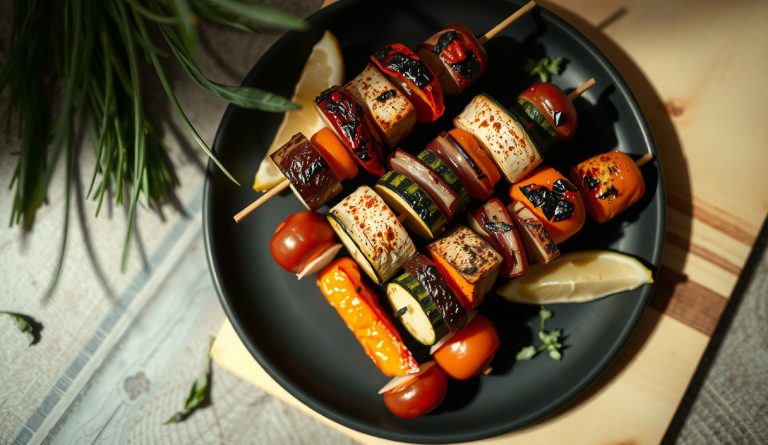
- Transfer finished skewers to a wire rack over a sheet pan — not directly onto a flat plate, which would trap steam under the vegetables and soften the crust you just built. Rest for 3 minutes. Scatter freshly chopped flat-leaf parsley over the skewers. Squeeze fresh lemon wedges generously over everything immediately before serving — use fresh lemon here, not anything from the marinade bowl. The fresh squeeze delivers volatile limonene that survived no heat treatment and provides significantly brighter citrus aromatics than any pre-cooked acid.1 large lemon, 2 tablespoons fresh flat-leaf parsley
Notes
Nutrition
How do I nail these skewers every time?
- Cut uniformly, not identically. Zucchini rounds at 3/4-inch, bell pepper at 1.5-inch squares, onion wedges at 1-inch — each vegetable has a different density and moisture content, so cutting them to different thicknesses to hit the same finished texture simultaneously is the actual skill here. Mushrooms go on whole.
- Do not crowd the skewer. Leave a 1/4-inch gap between pieces. Crowding creates steam pockets that block smoke penetration and prevent browning on the contact faces. The gap lets convective air and smoke reach every surface.
- Marinate at room temperature, not refrigerated. Cold oil viscosity increases significantly below 50°F — the marinade sits on the surface instead of penetrating. 30 minutes at 65–70°F is more effective than 2 hours cold.
- Resist the urge to move during the sear. The Maillard crust requires uninterrupted contact with the hot grate. If the skewer sticks, the crust has not formed and released. Wait 60–90 seconds before attempting the turn.
- Pull cherry tomatoes early if needed. If they are blistering and threatening to burst before the other vegetables are finished, slide them off the skewer with tongs and let them rest on indirect heat. Cherry tomatoes are done at an internal temperature of 185°F; the rest of the skewer is optimally finished around 195–205°F internal for the onion and zucchini.
- Finish with fresh lemon juice, not from the marinade. The raw marinade has been sitting on raw vegetables and should not be used as a finishing sauce unless brought to a full boil. Squeeze fresh lemon directly at service — the volatile limonene compounds in fresh juice are far more aromatic than what survives the cooking process anyway.
What variations can I try with this recipe?
Mediterranean herb swap: Replace the fresh thyme and rosemary with za’atar and dried oregano. Add a tablespoon of pomegranate molasses to the marinade — it is a whole-food sweetener that adds both sugar for faster browning and tartaric acid for brightness. The result skews Levantine and pairs well with labneh or a tahini drizzle if your dietary mode permits.
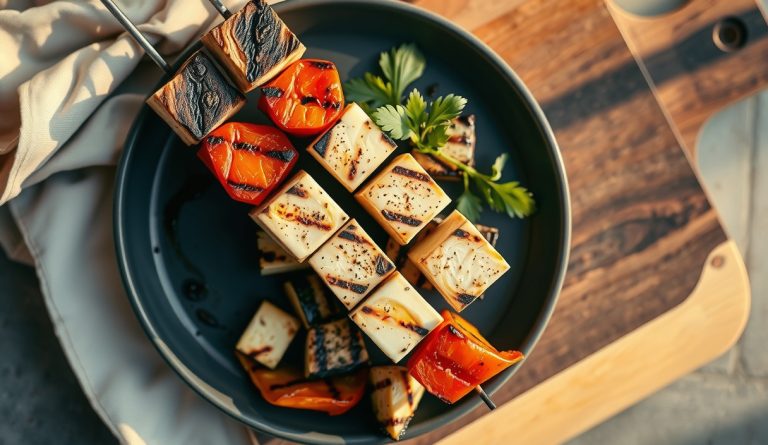
Add firm tofu or halloumi: Cut extra-firm tofu into 1.5-inch cubes, press for 20 minutes, and marinate alongside the vegetables. Tofu picks up smoke flavor well and its protein matrix sets firmly during the sear, giving it a satisfying exterior char. Halloumi holds its shape up to around 400°F before softening and works beautifully in the same lemon-herb marinade — though halloumi moves this recipe outside strict whole-food territory depending on your interpretation.
Scaling for a crowd: This recipe doubles and triples cleanly. The limiting factor is grate space, not marinade chemistry. Give each skewer at least 2 inches of clearance from its neighbors on the grate. If you are running more than 12 skewers simultaneously, rotate the outermost skewers toward the center of the grate at the 10-minute mark of the smoke phase to even out the temperature gradient.
Winter oven adaptation: Lay skewers across a rimmed sheet pan on a wire rack. Roast at 425°F for 20 minutes, then broil on high for 4–5 minutes, rotating the pan 180 degrees at the 2-minute mark. The oven adaptation loses the smoke chemistry entirely — add 1 teaspoon of smoked paprika to the marinade to approximate the phenolic-compound flavor contribution of wood smoke.
Frequently asked questions
Can I prep the skewers the night before? Yes — thread and marinate up to 12 hours ahead, covered in the refrigerator. Pull the skewers out 30 minutes before cooking to temper. Cold vegetables going onto a hot grate create a harsh thermal gradient that causes exterior charring before the interior softens. The marinade will continue to acidify the surface during refrigerated hold, which is fine and actually improves the final texture slightly.
My vegetables always fall apart on the grill. What am I doing wrong? Three likely causes account for most failures: over-marinating in acid (more than 4 hours breaks down the pectin structure too aggressively), cutting pieces too small (anything under 3/4-inch will cook through before a crust forms and will slide off the skewer), or using round skewers (which allow the vegetables to spin freely and tear at the puncture point during flipping). Switch to flat-blade metal skewers and keep your cuts generous.
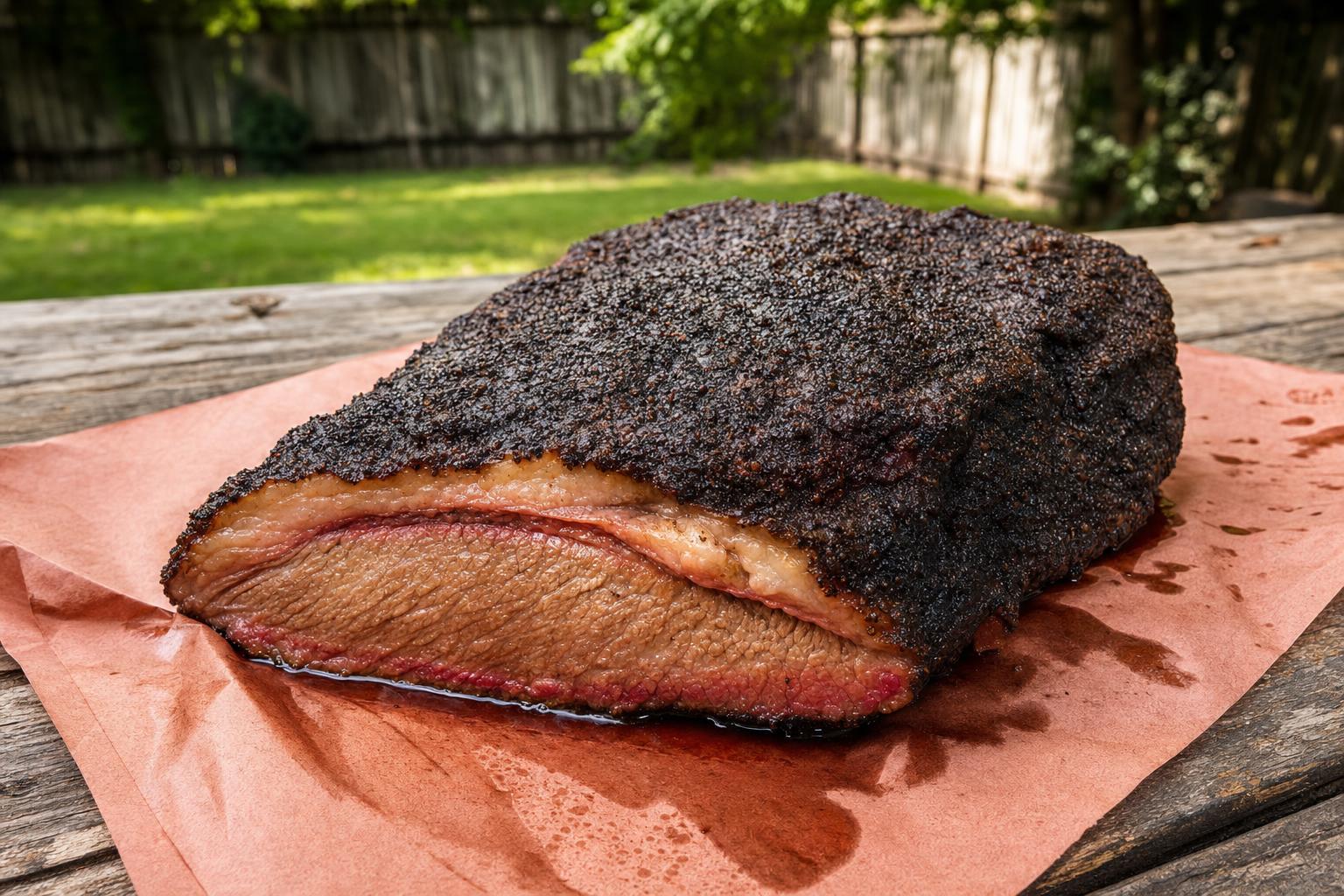
Is 350°F really low enough to call this smoking rather than just grilling? Yes. At 350°F indirect, the vegetables sit in a convective smoke environment for the full 20 minutes — smoke compounds (primarily guaiacol and syringol from the wood lignin) deposit on the cool, moist vegetable surface throughout that window. True smoking is defined by smoke-compound deposition, not temperature. The 225–275°F range used for brisket is required for collagen hydrolysis over long cooks; vegetables do not have collagen. At 350°F, the skewers receive meaningful smoke penetration within a practical vegetable cook window.