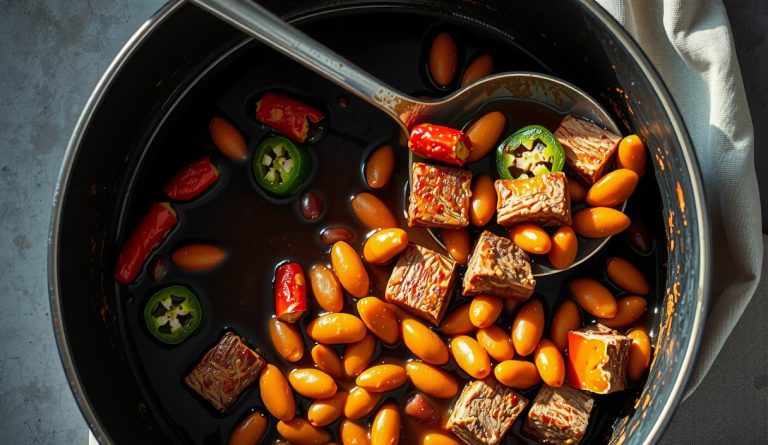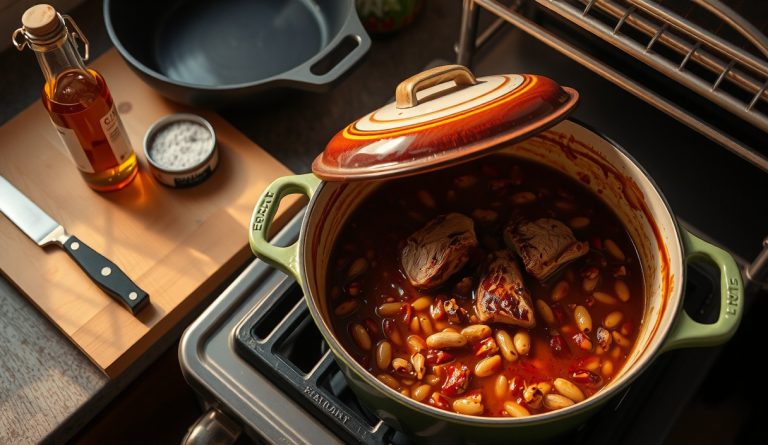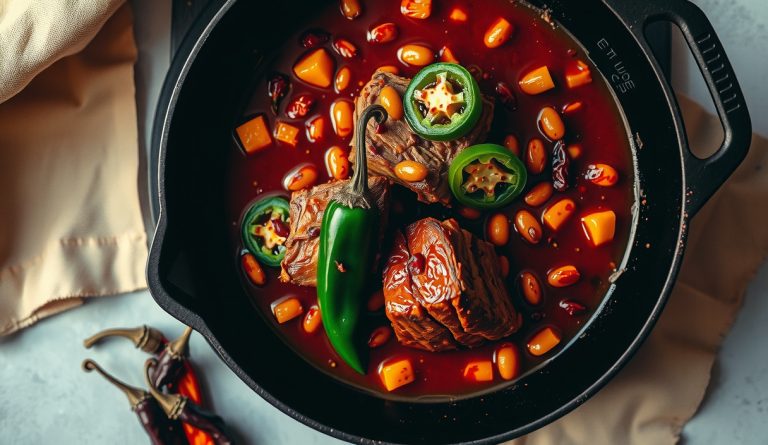
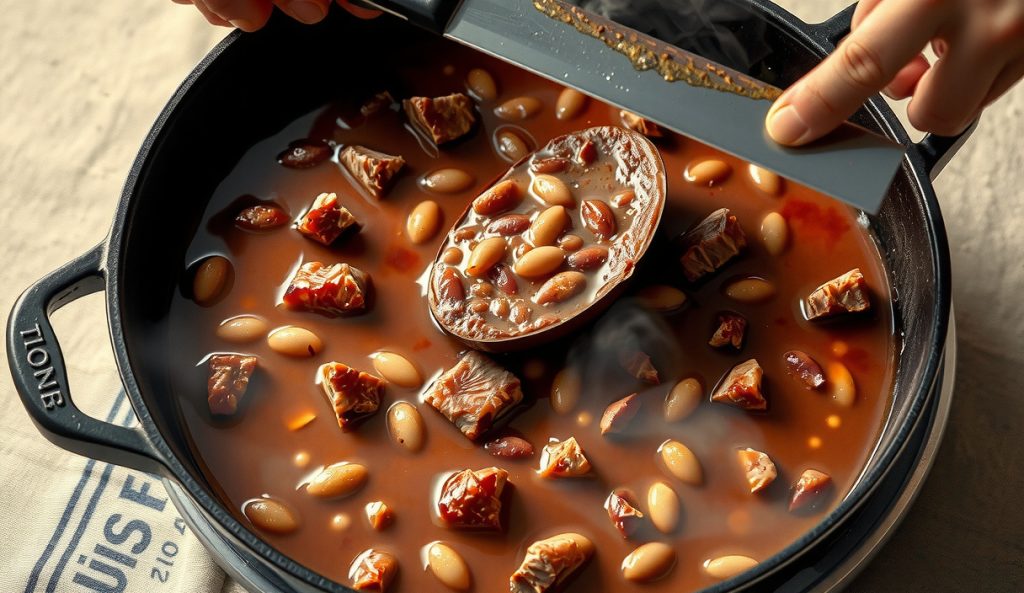
When feeding a competition team, a large cookout, or a catering run, a single batch of pit beans falls short. This variation scales the recipe to a doubled batch in a 10-to-12-quart pot and addresses the one variable that does not scale linearly with volume: smoke absorption. Getting smoke absorption right is the difference between a doubled batch that tastes like true pit beans and one that tastes like braised beans with smoke as an afterthought.
What changes when you double the batch?
All ingredients double proportionally — beans, brisket trimmings, aromatics, braising liquid, and rub quantities. The chemistry of the braise scales with mass, so covered cook time remains unchanged: the beans reach the same collagen-softening and pectin-hydration endpoints regardless of batch size because the internal temperature of the pot tracks the same heating curve.
Smoke absorption, however, is a surface-area phenomenon, not a volume phenomenon. Smoke compounds deposit on the exposed liquid surface and the upper layer of beans during the uncovered phase; they do not penetrate downward through the pot by convection alone. A doubled batch in a tall, narrow vessel has a significantly worse surface-area-to-volume ratio than the single batch, meaning the bottom half of the pot receives proportionally less smoke exposure. A wide, shallow 12-quart brazier or rondeau maximizes exposed surface relative to liquid depth and is the preferred vessel for a doubled pit bean batch. If working with a taller stock pot, extend the uncovered smoke phase by 20 to 30 minutes and stir the pot once at the midpoint to rotate the upper layer into the body and expose fresh material to the smoke environment.
What stays the same at double scale?
The covered braise time, target oven or smoker temperature, and all flavor ratios remain unchanged when doubling pit beans. The fundamental two-phase structure — uncovered smoke absorption followed by covered braise — is identical to the canonical single-batch method.
When is the large-batch scale the better choice?
Use the doubled batch whenever serving more than eight people, cooking for a competition where beans are a required turn-in category or a heavily weighted side, or batch-cooking for freezer storage. The doubled pit bean batch also holds better in a cambro or hotel pan during service — greater thermal mass means a slower temperature drop across the meal.
Use the single-batch ingredient list, trimming specifications, and rub formula from the original Pit Beans — Texas-Style Smoked Pinto Beans with Brisket Trimmings and double everything proportionally.