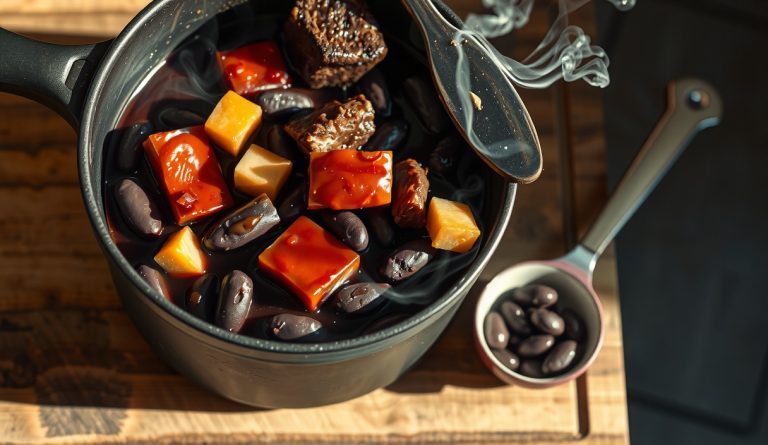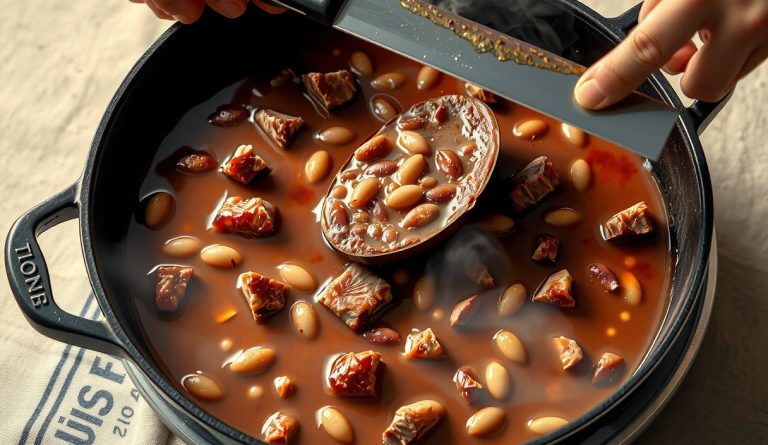
Pit Beans — Texas-Style Smoked Pinto Beans with Brisket Trimmings
Equipment
- 1 5-to-6-quart cast iron Dutch oven or heavy enameled pot Must fit under your smoker rack with the lid off
- 1 Offset smoker, kettle, or kamado cooker Running at 250 to 275°F with post oak, hickory, or a blend
- 1 Instant-read thermometer For verifying liquid temperature above 200°F during the covered braise
- 1 Large mixing bowl For overnight soaking the beans
Ingredients
Beans and Liquid
- 1 lb dried pinto beans Soaked overnight in cold water, drained and rinsed
- 4 cups unsalted beef stock Plus up to 1 additional cup hot stock or water to maintain liquid level
- 2 cups water
- 3 tbsp apple cider vinegar Unfiltered, with the mother preferred
Protein and Fat
- 12 oz brisket trimmings Fatty point-end offcuts with connective tissue intact, cut into 1.5-inch chunks
- 4 strips thick-cut bacon Cut into 1-inch lardons
Aromatics and Seasoning
- 1 medium yellow onion Diced
- 4 cloves garlic Minced
- 2 medium jalapeños Sliced into thin rounds, seeds included for full heat
- 3 tbsp dark brown sugar Packed
- 2 tbsp yellow mustard
- 1 tbsp Worcestershire sauce
- 1 tsp smoked paprika
- 1 tsp black pepper Freshly cracked
- 1 tsp kosher salt Added only in the final 30 minutes of the cook
- 0.5 tsp cayenne pepper Optional, for additional heat

Instructions
Prep
- The night before, place the dried pinto beans in a large bowl and cover with cold water by at least 3 inches. Let soak 8 to 12 hours. Drain and rinse well before using. Do not add salt to the soak water.
- Fire up your smoker and bring it to a stable 250 to 275°F using post oak, hickory, or a clean hardwood blend. You want a steady, thin blue smoke — not thick white billowing smoke, which will deposit harsh, acrid compounds onto the beans.
Build the Pot
- In the Dutch oven over a side burner or stovetop on medium heat, render the bacon lardons until the fat is released and the edges are just beginning to crisp, 4 to 5 minutes. Do not drain the fat — it stays in the pot.4 strips thick-cut bacon
- Add the brisket trimming chunks to the rendered bacon fat and sear on the highest-surface-contact sides for 2 to 3 minutes per side to develop a Maillard crust. They do not need to be cooked through. Remove and set aside briefly.12 oz brisket trimmings
- In the same pot, add the diced onion and sliced jalapeños. Cook over medium heat until the onion is translucent and beginning to soften, 4 to 5 minutes. Add the minced garlic and cook 1 minute more until fragrant.4 cloves garlic, 3 tbsp dark brown sugar, 2 medium jalapeños
- Return the brisket trimmings and bacon to the pot. Add the drained pinto beans, beef stock, water, apple cider vinegar, dark brown sugar, yellow mustard, Worcestershire sauce, smoked paprika, black pepper, and cayenne if using. Stir to combine. Do not add salt yet.4 cups unsalted beef stock, 2 cups water, 3 tbsp apple cider vinegar, 2 tbsp yellow mustard, 1 tbsp Worcestershire sauce, 1 tsp smoked paprika, 1 tsp black pepper, 1 tsp kosher salt
- Bring the pot to a strong simmer on the stovetop over medium-high heat. This gets the liquid temperature up before it goes into the smoker so you do not waste smoke absorption time waiting for the liquid to heat.
Phase 1 — Open Smoke (2 hours)
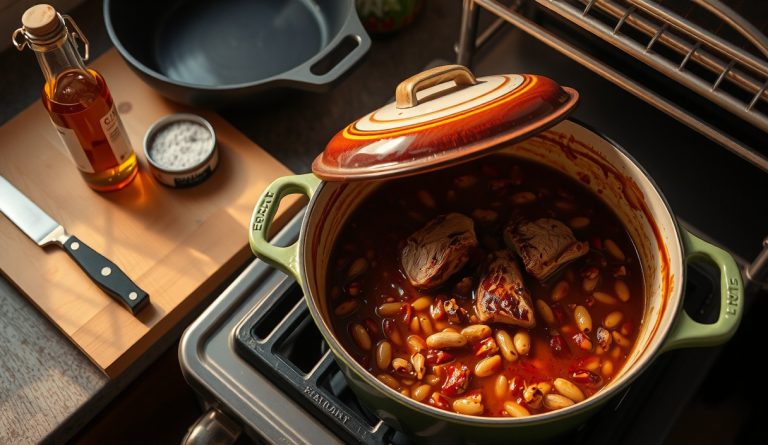
- Transfer the pot, uncovered and lid off, to the smoker rack. Position it directly under any protein you may be cooking simultaneously if possible — drippings from above contribute rendered fat and juice to the bean liquid. Maintain smoker temperature at 250 to 275°F.
- At the 60-minute mark, check the liquid level. The beans must remain submerged by at least 1 inch of liquid. If the level has dropped below that, add hot beef stock or hot water — never cold — in 0.5-cup increments to maintain coverage. Stir once gently, then leave the surface undisturbed.4 cups unsalted beef stock
- Continue the uncovered smoke phase for a full 2 hours total from the moment the pot entered the smoker. Resist stirring during this window to allow maximum phenolic compound deposition on the liquid surface.
Phase 2 — Covered Braise (2 hours)
- After 2 hours of open smoke, check liquid level once more and adjust if needed. Place the lid on the Dutch oven. Continue cooking with the lid on at the same 250 to 275°F smoker temperature for 2 additional hours. The covered environment traps steam, raises the internal liquid temperature above 200°F, and accelerates pectin degradation in the bean cell walls.
- At the 3-hour total mark (1 hour into the covered phase), stir the beans gently from the bottom to prevent any sugar-rich liquid from scorching on the bottom of the pot. Check bean texture by pressing one bean between two fingers — it should yield with some resistance but have no chalky center.
- In the final 30 minutes of the cook, add the kosher salt. Stir to incorporate. Taste and adjust: if you want more brightness, add a teaspoon of additional ACV; for more sweetness, a small pinch of brown sugar; for more heat, a pinch of cayenne.0.5 tsp cayenne pepper, 3 tbsp apple cider vinegar, 2 tbsp yellow mustard
Finish and Serve
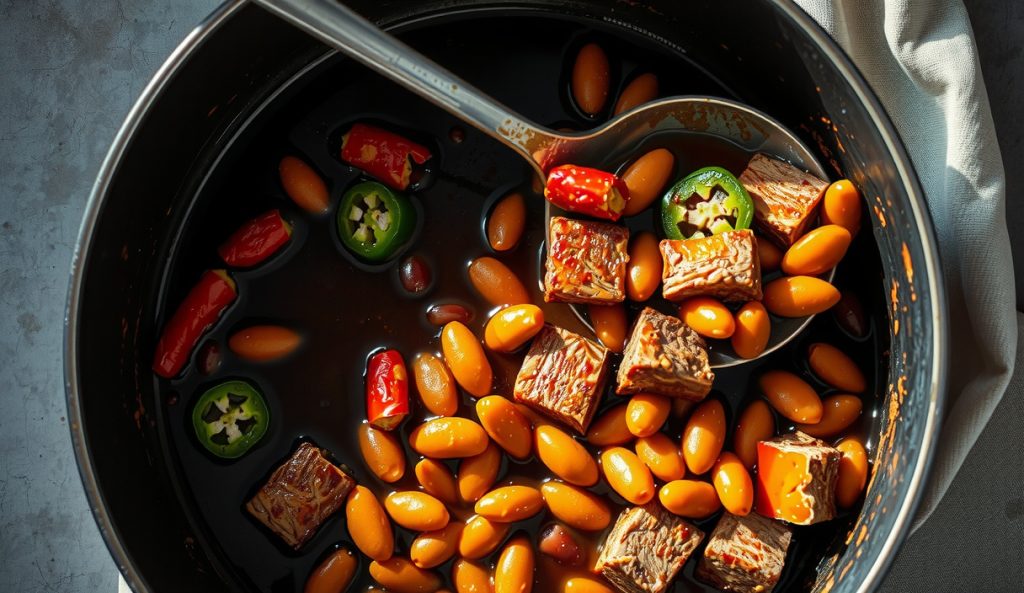
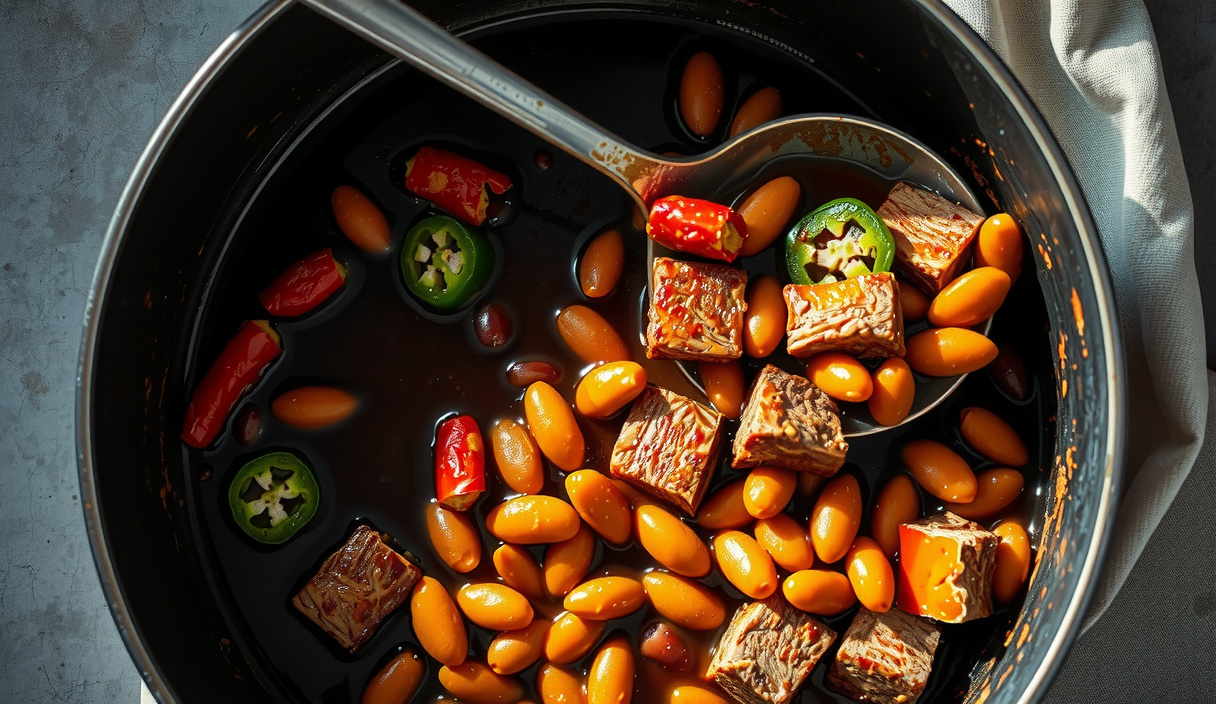
- After 4 total hours on the smoker, the beans are done when: they crush easily between your fingers with no chalky interior, the braising liquid coats the back of a spoon with a glossy, lightly viscous sheen from dissolved gelatin, and the edges of the pot show a dark caramelized ring of reduced sugar and fat. If you want a drier, crustier top, remove the lid for the final 15 minutes.
- Remove the pot from the smoker. Let rest, uncovered, for 10 minutes before serving. The liquid will thicken slightly as it cools and the gelatin concentration rises. Serve directly from the Dutch oven alongside sliced brisket, ribs, or sausage.
Notes
Nutrition
There is a moment at any serious Texas BBQ joint — somewhere between the brisket and the ribs — when a spoonful of the house beans stops you cold. They are not an afterthought. They are dark, smoky, faintly sweet, thick with rendered fat and collagen, and they carry the complexity of everything that burned above them for the past several hours. These are pit beans: a side dish built entirely around proximity to fire.
This recipe locks in that tradition with a two-phase cook that matches pitmaster instinct to food physics. The pot goes in uncovered for the first two hours directly under working smoke, then gets covered to finish the braise. The sequence is not arbitrary — it is the consequence of how smoke volatiles behave in time, how bean pectin responds to sustained heat, and how brisket collagen transforms a humble pot of pintos into something deeply satisfying. Where Flavor Meets the Flame.
Why do pit beans work? The science behind the two-phase cook
Pit beans work because smoke absorption, pectin degradation, and collagen hydrolysis each operate on a distinct thermal timeline — and the two-phase cook sequences them deliberately. Smoke is not a uniform substance; it is a dynamic aerosol of several hundred volatile organic compounds (VOCs), including guaiacol, syringol, 4-methylguaiacol, and a range of carbonyl-bearing phenols. Their deposition onto a food surface follows a sharp early-loading curve: the mass flux of smoke-soluble compounds onto a wet, open surface is highest in the first ninety minutes to two hours of exposure, after which the surface concentration gradient flattens and absorption yields diminish.
Keeping the pit beans pot uncovered during this window maximizes phenolic uptake into the aqueous bean matrix and the fat cap of the brisket trimmings — which, as a lipid phase, acts as a thermodynamic sink for hydrophobic smoke aromatics. After those two hours, covering the pot stops further smoke deposition but shifts the cook into a fully efficient braise where evaporative loss is controlled and the thermal environment stabilizes.
Bean softening is a pectin degradation problem. The middle lamella cementing individual cotyledon cells together is composed largely of calcium-cross-linked polygalacturonic acid chains. Thermal beta-elimination — the dominant degradation pathway at culinary temperatures — proceeds at a meaningful rate above roughly 183°F and accelerates substantially past 200°F internal pot temperature. Sustained exposure above that threshold over one to two hours systematically de-esterifies and cleaves the pectin backbone, breaking intercellular adhesion and producing the yielding, creamy interior the recipe targets.
The apple cider vinegar lowers the pH of the cooking liquid into the 4.5–5.5 range, which slows beta-elimination slightly and preserves a degree of cell wall integrity — meaning the beans hold their shape even as they become tender. Too alkaline (using baking soda), and the beans turn to mush. The vinegar is doing textural engineering, not just flavor work, and it must be added at the start so the pH is established before the beans begin serious softening.
The brisket trimmings are the collagen delivery mechanism. Beef connective tissue — primarily type I collagen — begins hydrolysis into soluble gelatin above about 160°F, with the rate accelerating sharply past 180°F and reaching full conversion over long holds at 205°F. In a covered pot with substantial liquid, this hydrolyzed gelatin concentrates in the cooking broth, raising the viscosity of the braising liquid and contributing the lip-coating, full-bodied mouthfeel that separates a great pot of pit beans from a thin, watery one. Brown sugar provides both sweetness and reactive reducing-sugar chemistry: its fructose and glucose components participate in Maillard condensation with free amino groups from the cooking proteins at the liquid surface, building the dark, roasted top-note depth that characterizes the best pit bean recipes.
What equipment and ingredients do pit beans require?
A 5-to-6-quart cast iron Dutch oven or a heavy enameled pot is strongly preferred for pit beans. Cast iron holds heat evenly and survives the radiant heat environment under a smoker grate without issue. Thin aluminum pans work but create hot spots that scorch the bean-sugar interface on the bottom. The pot needs to fit comfortably under your smoker rack with the lid off during phase one and lid on during phase two — measure before you start your fire.
Pinto beans: start dry. Soaking overnight in cold water reduces cook time and leaches some of the oligosaccharide load, but more importantly it ensures even hydration going into the pot so pectin softening proceeds uniformly. If you short-soak (one hour in boiling water), add 20 to 30 minutes to the covered braise phase. Do not salt the soaking water — sodium ions compete with calcium at the pectin cross-links and can cause premature softening before the beans ever hit the smoker.
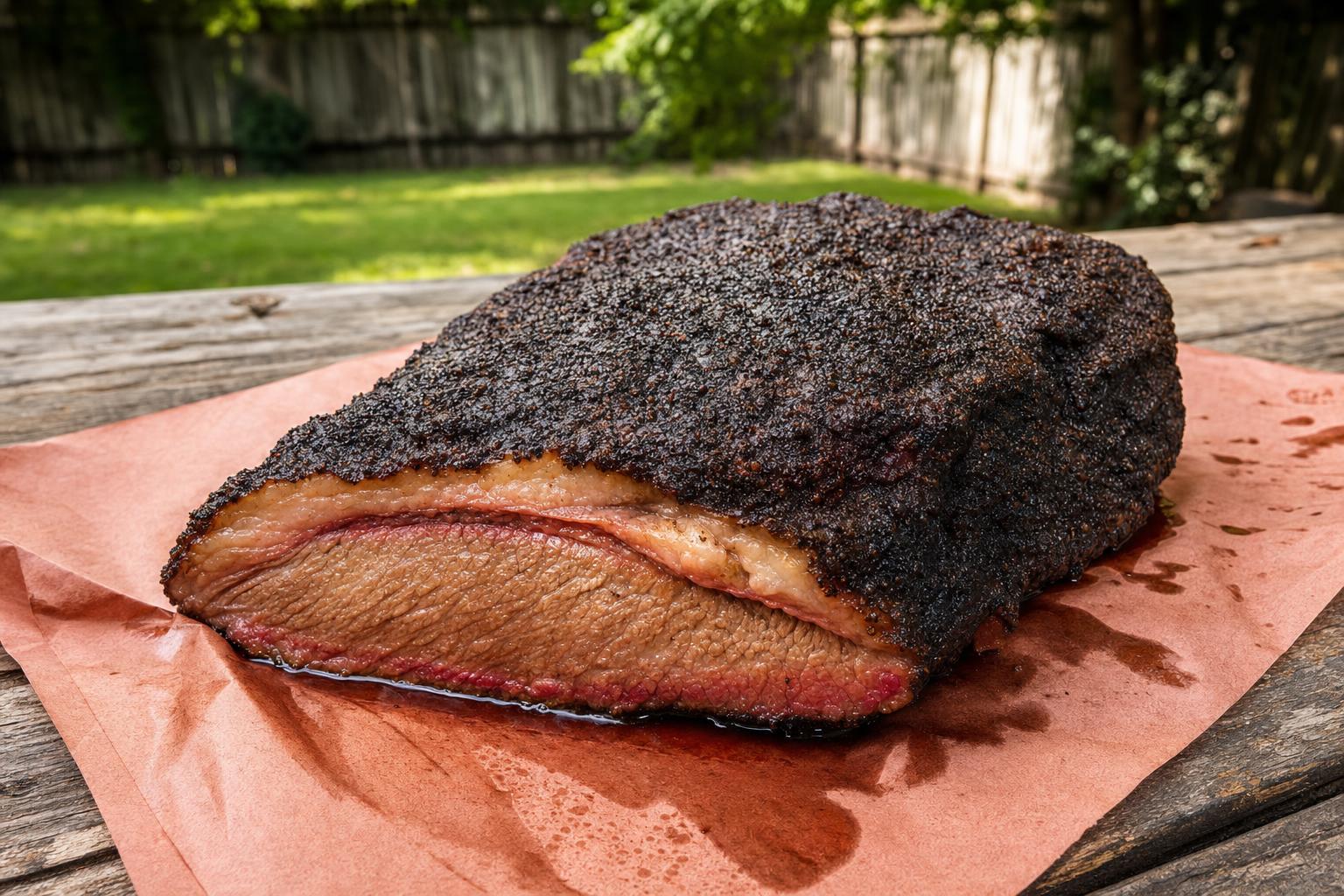
Brisket trimmings are the fatty offcuts from a packer brisket — the point-end cap fat and any heavily marbled chunks cut away during trim. They are not lean, and that is intentional. The intramuscular fat and connective tissue sheaths must render and hydrolyze into the liquid. If you are not trimming your own brisket, ask your butcher for beef suet or fatty chuck trimmings. Bacon is a fine addition as a secondary fat and smoke source but does not replace the collagen contribution of actual beef connective tissue.
Apple cider vinegar: use unfiltered ACV with the mother for a fuller organic acid profile (primarily acetic and malic). The acidity is functional — it buffers the cooking liquid, controls pectin degradation rate, and provides brightness that cuts the fat richness of the trimmings. Add the ACV at the start, not at the end; the pH must be established before the beans begin serious softening.
Wood choice matters for pit beans. Post oak is the Texas standard — it burns clean and produces predominantly guaiacol-class phenolics that integrate well with beef and pork. Mesquite burns hot and fast and produces more aggressive cresol-heavy smoke; use it sparingly or blended with oak. Hickory sits between the two. Avoid lighter-fluid-assisted charcoal or resinous softwoods — they introduce harsh, turpentine-adjacent compounds that will dominate the delicate early smoke absorption in the beans.
Pit Beans — Texas-Style Smoked Pinto Beans with Brisket Trimmings
Equipment
- 1 5-to-6-quart cast iron Dutch oven or heavy enameled pot Must fit under your smoker rack with the lid off
- 1 Offset smoker, kettle, or kamado cooker Running at 250 to 275°F with post oak, hickory, or a blend
- 1 Instant-read thermometer For verifying liquid temperature above 200°F during the covered braise
- 1 Large mixing bowl For overnight soaking the beans
Ingredients
Beans and Liquid
- 1 lb dried pinto beans Soaked overnight in cold water, drained and rinsed
- 4 cups unsalted beef stock Plus up to 1 additional cup hot stock or water to maintain liquid level
- 2 cups water
- 3 tbsp apple cider vinegar Unfiltered, with the mother preferred
Protein and Fat
- 12 oz brisket trimmings Fatty point-end offcuts with connective tissue intact, cut into 1.5-inch chunks
- 4 strips thick-cut bacon Cut into 1-inch lardons
Aromatics and Seasoning
- 1 medium yellow onion Diced
- 4 cloves garlic Minced
- 2 medium jalapeños Sliced into thin rounds, seeds included for full heat
- 3 tbsp dark brown sugar Packed
- 2 tbsp yellow mustard
- 1 tbsp Worcestershire sauce
- 1 tsp smoked paprika
- 1 tsp black pepper Freshly cracked
- 1 tsp kosher salt Added only in the final 30 minutes of the cook
- 0.5 tsp cayenne pepper Optional, for additional heat
Instructions
Prep
- The night before, place the dried pinto beans in a large bowl and cover with cold water by at least 3 inches. Let soak 8 to 12 hours. Drain and rinse well before using. Do not add salt to the soak water.
- Fire up your smoker and bring it to a stable 250 to 275°F using post oak, hickory, or a clean hardwood blend. You want a steady, thin blue smoke — not thick white billowing smoke, which will deposit harsh, acrid compounds onto the beans.
Build the Pot
- In the Dutch oven over a side burner or stovetop on medium heat, render the bacon lardons until the fat is released and the edges are just beginning to crisp, 4 to 5 minutes. Do not drain the fat — it stays in the pot.4 strips thick-cut bacon
- Add the brisket trimming chunks to the rendered bacon fat and sear on the highest-surface-contact sides for 2 to 3 minutes per side to develop a Maillard crust. They do not need to be cooked through. Remove and set aside briefly.12 oz brisket trimmings
- In the same pot, add the diced onion and sliced jalapeños. Cook over medium heat until the onion is translucent and beginning to soften, 4 to 5 minutes. Add the minced garlic and cook 1 minute more until fragrant.4 cloves garlic, 3 tbsp dark brown sugar, 2 medium jalapeños
- Return the brisket trimmings and bacon to the pot. Add the drained pinto beans, beef stock, water, apple cider vinegar, dark brown sugar, yellow mustard, Worcestershire sauce, smoked paprika, black pepper, and cayenne if using. Stir to combine. Do not add salt yet.4 cups unsalted beef stock, 2 cups water, 3 tbsp apple cider vinegar, 2 tbsp yellow mustard, 1 tbsp Worcestershire sauce, 1 tsp smoked paprika, 1 tsp black pepper, 1 tsp kosher salt
- Bring the pot to a strong simmer on the stovetop over medium-high heat. This gets the liquid temperature up before it goes into the smoker so you do not waste smoke absorption time waiting for the liquid to heat.
Phase 1 — Open Smoke (2 hours)
- Transfer the pot, uncovered and lid off, to the smoker rack. Position it directly under any protein you may be cooking simultaneously if possible — drippings from above contribute rendered fat and juice to the bean liquid. Maintain smoker temperature at 250 to 275°F.
- At the 60-minute mark, check the liquid level. The beans must remain submerged by at least 1 inch of liquid. If the level has dropped below that, add hot beef stock or hot water — never cold — in 0.5-cup increments to maintain coverage. Stir once gently, then leave the surface undisturbed.4 cups unsalted beef stock
- Continue the uncovered smoke phase for a full 2 hours total from the moment the pot entered the smoker. Resist stirring during this window to allow maximum phenolic compound deposition on the liquid surface.
Phase 2 — Covered Braise (2 hours)
- After 2 hours of open smoke, check liquid level once more and adjust if needed. Place the lid on the Dutch oven. Continue cooking with the lid on at the same 250 to 275°F smoker temperature for 2 additional hours. The covered environment traps steam, raises the internal liquid temperature above 200°F, and accelerates pectin degradation in the bean cell walls.
- At the 3-hour total mark (1 hour into the covered phase), stir the beans gently from the bottom to prevent any sugar-rich liquid from scorching on the bottom of the pot. Check bean texture by pressing one bean between two fingers — it should yield with some resistance but have no chalky center.
- In the final 30 minutes of the cook, add the kosher salt. Stir to incorporate. Taste and adjust: if you want more brightness, add a teaspoon of additional ACV; for more sweetness, a small pinch of brown sugar; for more heat, a pinch of cayenne.0.5 tsp cayenne pepper, 3 tbsp apple cider vinegar, 2 tbsp yellow mustard
Finish and Serve
- After 4 total hours on the smoker, the beans are done when: they crush easily between your fingers with no chalky interior, the braising liquid coats the back of a spoon with a glossy, lightly viscous sheen from dissolved gelatin, and the edges of the pot show a dark caramelized ring of reduced sugar and fat. If you want a drier, crustier top, remove the lid for the final 15 minutes.
- Remove the pot from the smoker. Let rest, uncovered, for 10 minutes before serving. The liquid will thicken slightly as it cools and the gelatin concentration rises. Serve directly from the Dutch oven alongside sliced brisket, ribs, or sausage.
Notes
Nutrition
How do I nail pit beans every time? Six proven tips
- Do not skip the overnight soak. Dry beans going into a smoker pot have wildly uneven hydration. The outer cells absorb cooking liquid faster than the core, causing the exterior to turn to mush before the center is cooked. An overnight soak in cold water equilibrates the moisture gradient across the entire cotyledon and gives you consistent, evenly soft beans with structural integrity.
- Position the pot directly under the drip zone of a protein cook if possible. Brisket or pork ribs rendering above the bean pot will drip rendered fat and juices directly into the liquid. This is not an accident — it is an intentional flavor-delivery mechanism that pitmaster tradition figured out long before food science confirmed why it worked.
- Resist stirring during the uncovered smoke phase. Agitation disrupts the thin condensation layer of phenolic smoke compounds forming on the surface of the liquid. Let the surface sit undisturbed for maximum smoke deposition. You can stir once at the 60-minute mark to check liquid level, then leave it alone.
- Watch your liquid level carefully. The open pot loses significant moisture to evaporation during phase one. If the beans are peeking above the liquid surface by the 90-minute mark, add hot water or unsalted beef stock — never cold, which stalls the thermal curve. Target liquid level at least one inch above the bean mass at all times.
- The brown sugar goes in at the start, not the end. Adding it early means the reducing sugars participate in Maillard browning reactions at the liquid surface throughout the cook, building layered depth. Adding it at the end gives you raw sweetness with no development. The same timing logic applies to the ACV.
- Taste for salt only in the final 30 minutes. Salt added early inhibits pectin calcium cross-linking and causes premature softening. Adding it late lets you control the final seasoning precisely once the bean texture is already set.
What variations can I make to this pit beans recipe?
If you do not have a smoker running, you can approximate the smoke phase using a stovetop or oven technique: add one to two teaspoons of smoked salt (alder or hickory), a quarter teaspoon of liquid smoke (use sparingly — it is extremely concentrated guaiacol), and proceed with the braise covered the entire time at a maintained 250°F oven temperature. The result will be noticeably less complex than live-smoke pit beans, but the collagen and pectin chemistry will be identical and the beans will still be excellent.
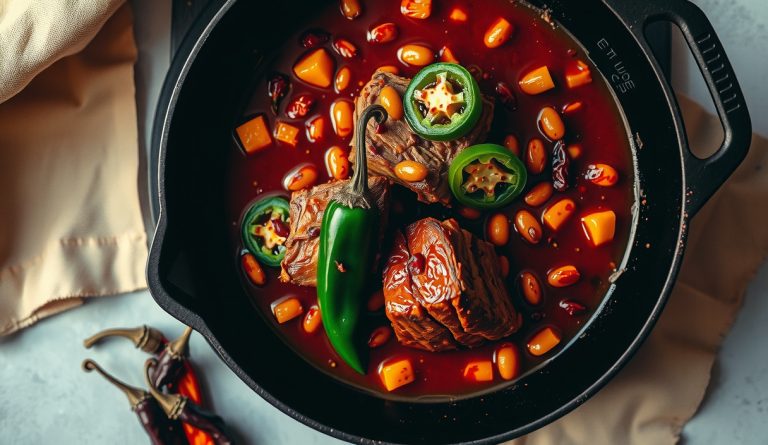
For a spicier profile, double the jalapeños and add one or two dried chiles de árbol to the pot. The capsaicin in fresh jalapeños activates TRPV1 thermoreceptors and provides the characteristic heat-building burn; the dried chiles contribute a distinct lipophilic heat with fruity, toasted aromatics. Remove the dried chiles before serving if you want heat without visual intensity, or leave them in for rustic presentation.
To scale pit beans for a competition or large cookout, this recipe doubles cleanly in a 10-to-12-quart pot. The smoke-absorption phase scales by surface area, not volume — a wider, shallower pot will absorb more smoke per unit time than a tall narrow one. For a doubled batch, consider a wider vessel or extend the uncovered phase by 20 to 30 minutes to compensate for the reduced surface-area-to-volume ratio.
Black beans can substitute for pintos with minimal adjustment. Black beans have a slightly higher anthocyanin content (which gives them their color) and a denser cell wall structure requiring 15 to 20 additional minutes on the covered braise. Their flavor profile is earthier and less sweet than pintos, which pairs particularly well with mesquite smoke and a heavier hand with the chiles.
Frequently asked questions about pit beans
Why are my pit beans still firm after four hours? Hard beans after extended cooking almost always trace back to one of three causes: the beans were old (dried beans older than one year have desiccated cells that resist rehydration), the cooking liquid was too acidic early in the cook (ACV in excess slows pectin degradation significantly), or the pot temperature was below 200°F for most of the cook. Verify your smoker is running at 250 to 275°F, not lower, and make sure the liquid itself is at a sustained simmer. A probe thermometer in the liquid should read 200°F or above during the covered braise phase.
Can I cook pit beans entirely in advance and reheat? Yes — and the beans arguably improve overnight. Cooling and reheating drives further starch retrogradation and allows the collagen-rich braising liquid to set into a thick gel that coats every bean. Reheat covered over low heat with a splash of beef stock or water to restore consistency; the beans will release that gelatin back into the liquid as it warms. Do not reheat uncovered on high heat, which scorches the sugar-rich bottom layer.
How do I know when pit beans are done? Three simultaneous signals confirm doneness: the beans should crush easily between two fingers with no chalky or grainy center, the braising liquid should coat the back of a spoon with a glossy, lightly viscous sheen from dissolved gelatin, and the top surface of the pot should show a dark, slightly caramelized crust around the edges where the sugar-rich liquid has evaporated and re-deposited. If you have the first two signals but not the third, remove the lid for the final 15 minutes over direct smoker heat to develop that crust.