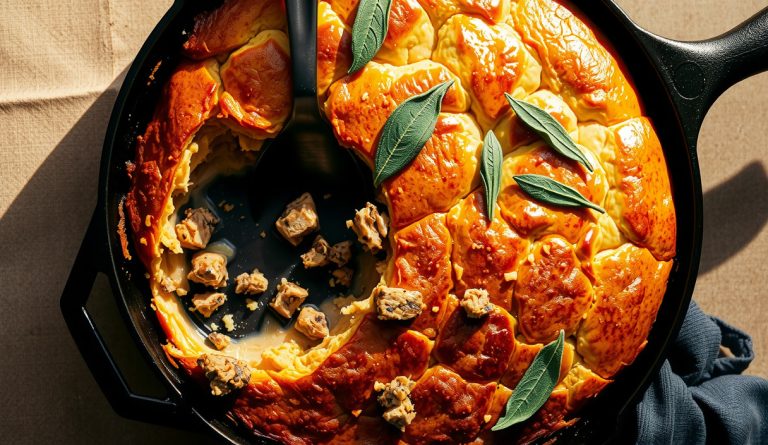
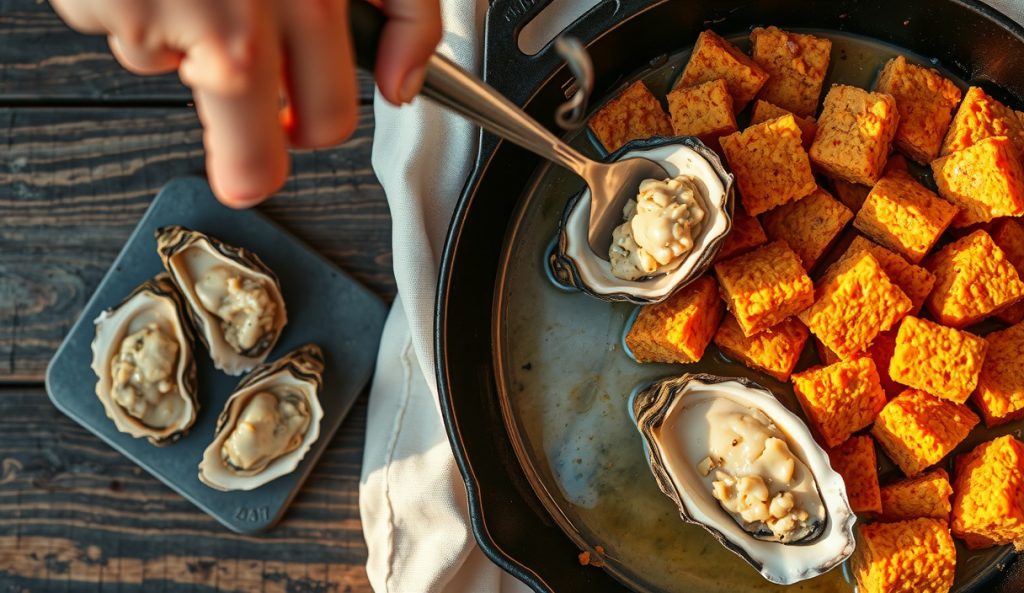
The low-country tradition of oyster dressing predates most of what we now call Southern cooking. Folding raw oysters into a smoked cornbread dressing pulls that coastal heritage directly into the backyard smoker, and the result is a dish that tastes simultaneously ancient and completely alive. This is not a subtle modification — oysters change the aromatic register of the finished dressing in ways that are immediately noticeable and consistently polarizing in the best possible sense.
What changes when you add oysters to smoked cornbread dressing?
Fold 1 cup of drained, roughly chopped raw oysters into the mix with the broth, just before loading the skillet into the smoker. Use oysters packed in their liquor if possible — drain the oysters, but reserve that liquor and add it as part of your total broth volume. Adding the reserved oyster liquor preserves the brine character of the dressing without diluting the overall moisture balance. During the smoke, the oysters release their remaining liquid directly into the cornbread binder, creating small pockets of intensely savory, salt-forward moisture throughout the dressing.
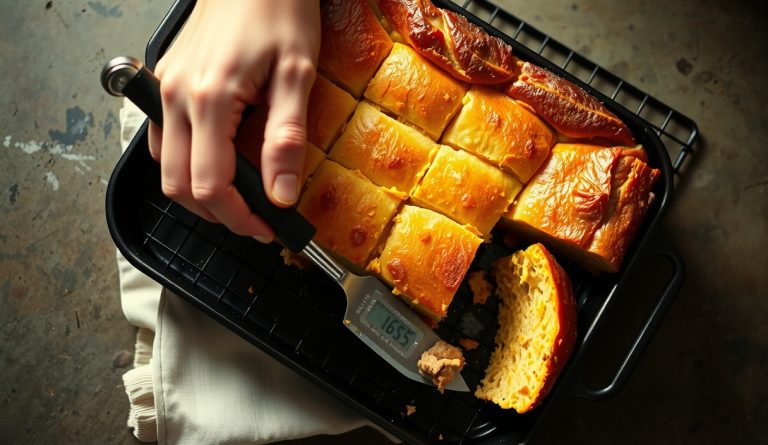
The underlying mechanism is a convergence of two separate umami pathways. Oysters are rich in glutamates and succinic acid, both of which register as deep savory on the palate. When those compounds meet the smoke phenols deposited by hardwood combustion — guaiacol and syringol chief among them — the perceived complexity multiplies beyond what either element delivers alone. Crucially, the oysters cook fully at the same 160°F internal temperature target required by the sausage component, so no timing adjustments are necessary.
What stays the same in the oyster version?
Everything else in the canonical method holds without change. The sausage-and-sage base, the cornbread-to-broth ratio, the 275°F smoker temperature, the 60-to-65-minute smoke window, and the 160°F internal temperature finish all remain identical. The skillet size, the broth type, and the egg binder are unchanged. The oyster version adds one ingredient at one step — the rest of the process is exactly the same as the original.
When is the oyster version the better choice?
The oyster variation outperforms the canonical dressing when you are cooking for a crowd that appreciates layered, ingredient-forward Southern food and expects something more ambitious than a standard holiday side. The oyster version is particularly well-suited to Thanksgiving tables near the coast, to menus that already feature seafood, or to any occasion where the conversation around the table benefits from a dish that requires explanation. It is not the right call for guests who are averse to shellfish or who prefer a clean, straightforward smoke-and-sausage profile.
Use the full method, equipment, and rub measurements from the original Smoked Cornbread Dressing with Sausage and Sage.