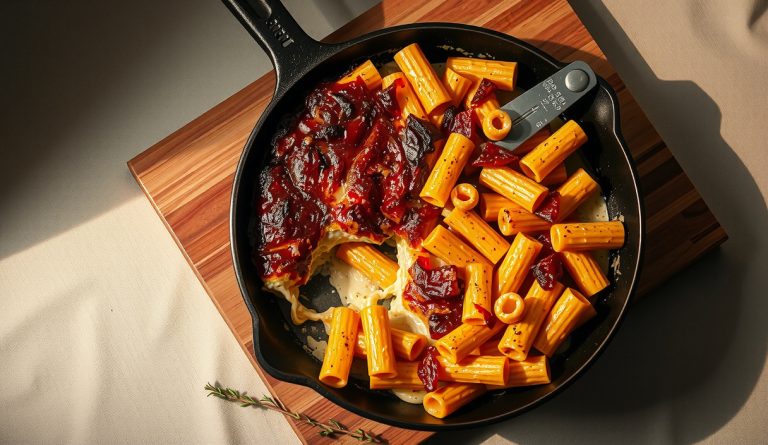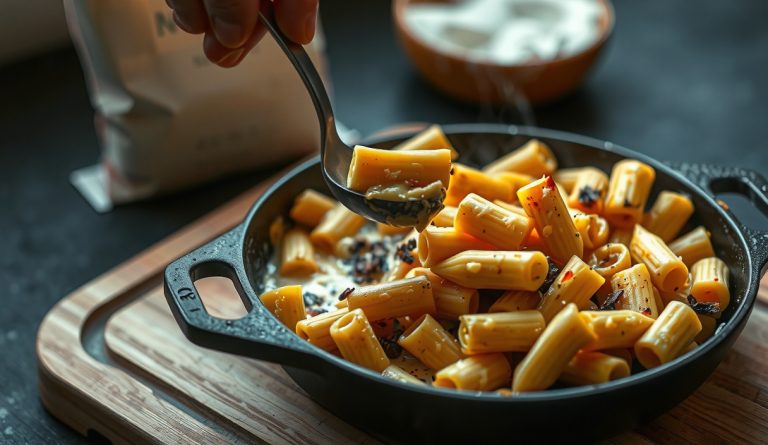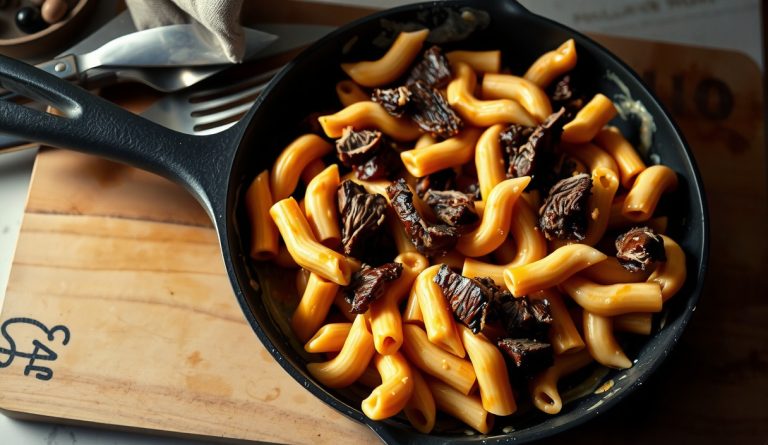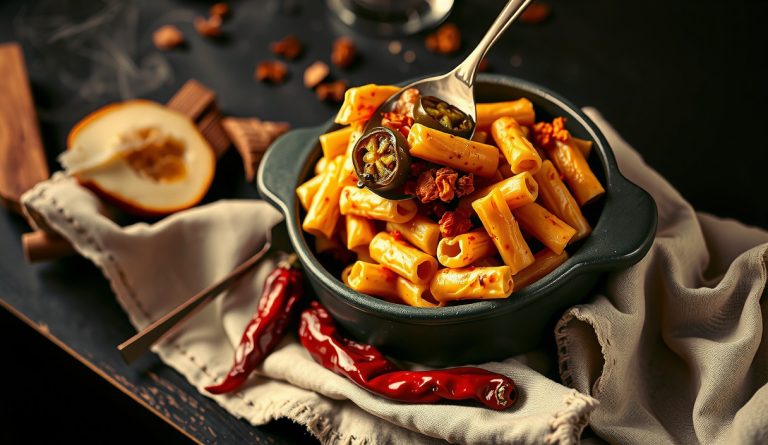
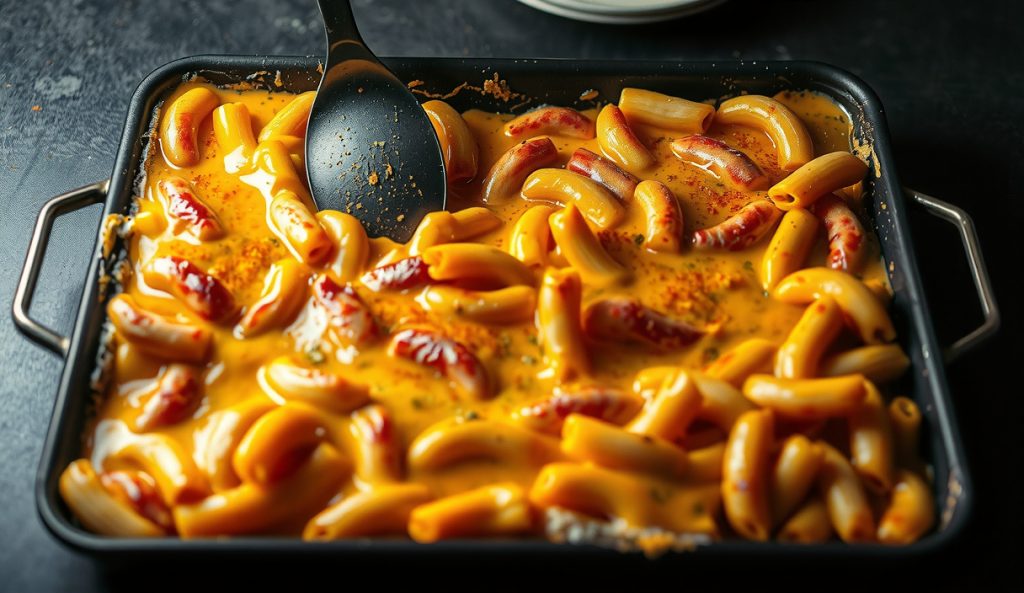
The canonical Smoked Mac & Cheese recipe is sized for a 12-inch cast iron skillet and serves 6–8 as a side. For a backyard cookout, a competition spread, or a catering setup where mac and cheese needs to carry a buffet line, the batch needs to scale. This version triples the canonical output and distributes it across two 12-inch cast iron skillets or one large enameled roasting pan sized for a half-sheet hotel pan insert. The math is linear; the critical variable is time, not temperature.
What changes when you triple the batch?
Triple every ingredient from the canonical recipe — pasta weight, roux components, milk volume, cheese weights, sodium citrate, and dry spices — without alteration to ratios. The béchamel is constructed in the same sequence; a larger Dutch oven or stock pot is required for the sauce build, but the method is identical. Because the scaling is linear, no ratio recalculation is needed: sodium citrate percentage, roux ratio, and cheese proportions all hold at canonical values regardless of batch size.
Extend the smoke time to 75–80 minutes for a tripled batch. The increased thermal mass means the interior of the pan takes significantly longer to reach the temperature at which surface proteins set and the smoke crust develops properly. Do not raise the chamber temperature above 275°F to compensate — at a larger surface area, a higher chamber temperature will over-brown and dry the exposed top layer before the interior has reached equilibrium. The relationship between surface heat flux and interior mass is unfavorable at higher temperatures; 275°F allows heat to diffuse inward at a rate that matches the extended set time without burning the crust. Check the interior temperature with an instant-read thermometer at the 65-minute mark — you are looking for a set, not-liquid center before pulling.
What stays the same when scaling smoked mac and cheese?
The 275°F chamber temperature, the wood type, the pan-uncovered approach, and the three-cheese emulsion logic are all unchanged when scaling to a tripled batch. Scaling does not alter the underlying chemistry — sodium citrate percentage, roux ratio, and cheese proportions hold at canonical values regardless of how large the batch grows.
When is the scaled-up batch the better choice?
This scaled build is the correct approach for any event where the canonical single-skillet batch would require more than two back-to-back smokes to cover demand — a 20-person cookout, a competition side dish category, or a catered event where the smoker needs to be cleared for other proteins. A single large batch is more efficient than running multiple canonical batches consecutively and produces more consistent results because smoke exposure is uniform across the full batch rather than staggered across sequential cooks.
Use the full ingredient list, roux method, and cheese emulsion instructions from the original Smoked Mac & Cheese — Three-Cheese Béchamel.